Quick Verdict: The Sensible Electric SUV
The 2025 VW ID.4 Pro RWD occupies a specific niche in the EV market: a mainstream, rear-wheel-drive electric compact SUV that prioritizes comfort, space, and practical range over performance theatrics. With an EPA-estimated 291 miles of range, a usable 77 kWh battery, and a starting MSRP of $43,995 (before destination), it undercuts many rivals on price while offering competitive interior volume. The 2025 model year brings a significant interior refresh with a redesigned steering wheel, improved infotainment software, and physical controls that address the most common complaints from early ID.4 owners.
But the ID.4 Pro RWD isn't for everyone. Its 201-horsepower single motor delivers leisurely acceleration, DC fast charging tops out at 170 kW (slower than Hyundai/Kia's 800V architecture), and VW's driver-assist tech trails Tesla and GM's hands-free systems. If you need a comfortable daily commuter with strong cargo capacity and competitive range, the ID.4 Pro RWD deserves a close look. If you prioritize fast road-trip charging or spirited driving dynamics, keep shopping.
Range, Battery & Real-World Efficiency
| Specification | 2025 VW ID.4 Pro RWD |
|---|---|
| EPA Estimated Range | 291 miles |
| Battery (Usable) | 77 kWh (NMC chemistry) |
| EPA Efficiency | 104 MPGe combined (32 kWh/100 mi) |
| Drivetrain | Rear-Wheel Drive (single motor) |
| Horsepower | 201 hp |
| 0–60 mph | ~7.7 seconds |
| Battery Warranty | 8 years / 100,000 miles |
The ID.4 Pro RWD uses a lithium-ion NMC (nickel-manganese-cobalt) battery pack manufactured by SK Innovation. Unlike LFP chemistry (found in the Tesla Model 3 RWD and some Ford Mustang Mach-E trims), NMC offers higher energy density but is more sensitive to prolonged storage at 100% state of charge. VW recommends daily charging to 80% for battery longevity, using the built-in charge limiter. The 8-year/100,000-mile battery warranty guarantees at least 70% capacity retention — consistent with industry standards from Hyundai, Kia, and Ford.
Efficiency at 32 kWh per 100 miles is respectable for the segment, though the Hyundai Ioniq 5 RWD achieves 114 MPGe combined (29 kWh/100 mi) thanks to its lighter platform and more efficient power electronics. Over 15,000 annual miles at $0.16/kWh (national average home electricity rate), the ID.4 Pro RWD costs roughly $768 per year to charge at home — compared to approximately $1,800 for a 25 MPG gas SUV at $3.00/gallon.
Charging Speed: Home & DC Fast Charging
| Charging Level | Power | Speed (Approx.) | Notes |
|---|---|---|---|
| Level 1 (120V) | ~1.4 kW | ~4 miles per hour | Emergency/top-up only |
| Level 2 (240V, 48A) | 11.5 kW | ~35 miles per hour | Full charge in ~7 hours |
| DC Fast Charge | 170 kW peak | 10–80% in ~30 min | Tapers significantly above 80% |
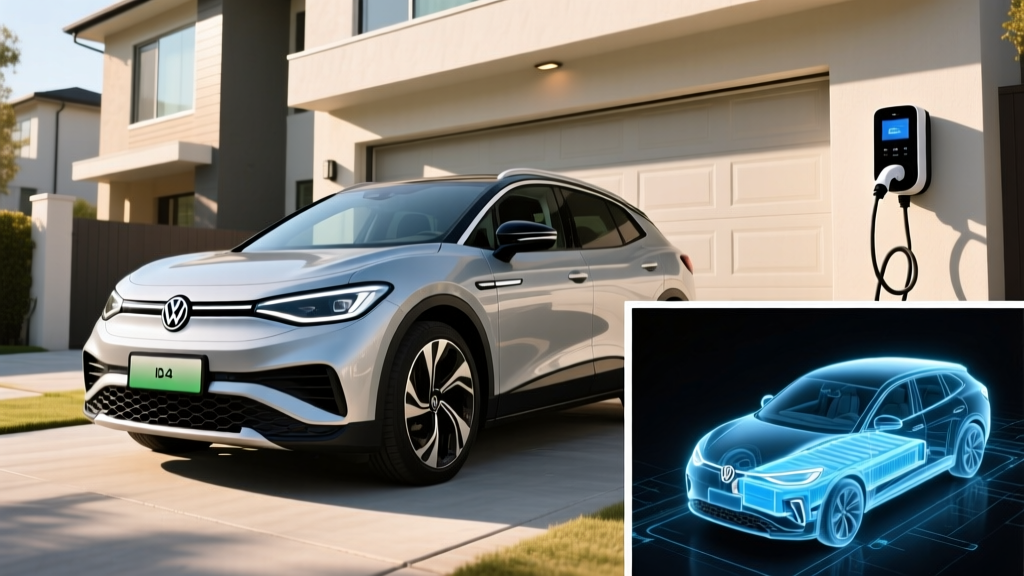
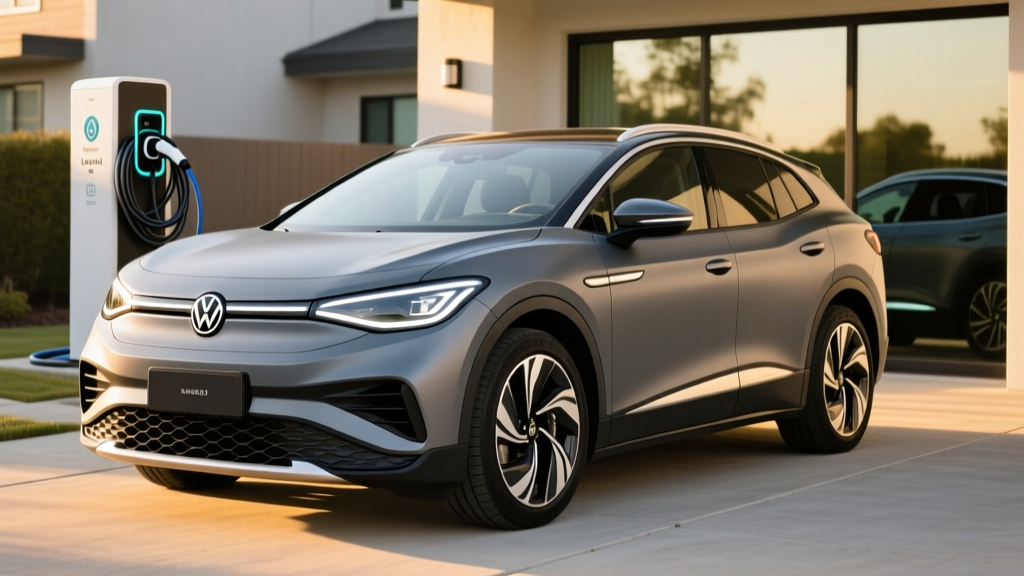
The ID.4 Pro RWD supports up to 170 kW peak DC fast charging via its CCS1 connector (2025 models ship with CCS; VW has announced a NACS adapter for future compatibility with Tesla Superchargers). On a 350 kW Electrify America or similar station, the ID.4 will peak near 170 kW at low state of charge, then taper progressively. The 10–80% charge takes approximately 28–33 minutes under ideal thermal conditions. Preconditioning the battery via the vehicle's navigation-routed charging feature is essential for achieving peak charge rates — arriving at a fast charger without preconditioning can add 5–10 minutes to your session, especially in cold weather.
Compared to the Hyundai Ioniq 5 and Kia EV6 (both capable of 10–80% in ~18 minutes on 800V architecture at 240+ kW), the ID.4's charging speed is a generation behind. For road warriors who frequently drive 300+ mile segments, this 10–15 minute difference per stop adds up. However, for the majority of owners who charge at home overnight and use DC fast charging only a few times per year, 170 kW is perfectly adequate.
Level 2 home charging at 11.5 kW (48 amps on a 60-amp circuit) replenishes the 77 kWh battery from empty in roughly 7 hours. Most owners installing a home Level 2 charger (such as the ChargePoint Home Flex or Emporia Level 2) will budget $500–$1,500 for equipment plus $800–$2,500 for electrician installation, depending on panel proximity and local permit costs. A 200-amp electrical panel is typically required; older homes may need a panel upgrade adding $1,500–$3,000 to the project.
Performance & Driving Dynamics
The single rear-mounted permanent-magnet synchronous motor produces 201 horsepower and 229 lb-ft of torque. VW claims a 0–60 mph time of approximately 7.7 seconds — adequate for highway merging and daily driving, but noticeably slower than the dual-motor AWD ID.4 Pro S (295 hp, ~5.4 seconds) or the Ford Mustang Mach-E Select RWD (266 hp, ~6.1 seconds). The ID.4 Pro RWD is tuned for comfort, not sportiness: the suspension absorbs road imperfections well, steering is light and predictable, and the turning circle of 31.5 feet makes it manageable in tight urban environments.
Regenerative braking in the ID.4 is modest compared to one-pedal-driving champions like the Nissan LEAF or BMW iX. The B (Brake) mode increases regen but doesn't bring the car to a complete stop, requiring you to use the friction brake pedal at low speeds. This is a deliberate VW design choice — some drivers appreciate the natural coasting behavior, while others find it requires more brake-pedal modulation than expected in stop-and-go traffic.
Towing capacity for the RWD ID.4 is rated at 2,200 pounds (with factory tow hitch), sufficient for a small utility trailer or a pair of dirt bikes, but not enough for most campers or boats. The AWD ID.4 Pro S bumps towing to 2,700 pounds. If towing is a priority, the Ford F-150 Lightning or Rivian R1S are in a different class entirely.
Interior, Cargo & Technology
The 2025 ID.4 interior represents a meaningful upgrade over the 2021–2024 models. VW replaced the controversial capacitive-touch steering wheel controls with physical buttons, upgraded the center touchscreen to 12.9 inches with faster response times, and added a volume knob — addressing the three most common owner complaints. The cabin materials are a mix of soft-touch surfaces on the dash and door uppers with harder plastics on lower panels, consistent with the segment.
Passenger space is a genuine strength:
- Front headroom: 40.6 inches
- Front legroom: 41.1 inches
- Rear headroom: 38.4 inches
- Rear legroom: 37.6 inches
- Cargo (rear seats up): 30.3 cubic feet
- Cargo (rear seats folded): 64.2 cubic feet
These dimensions put the ID.4 ahead of the Hyundai Ioniq 5 (27.2 / 59.3 cu ft) and competitive with the Toyota RAV4 Hybrid in cargo volume. The flat floor (no transmission tunnel) and wide rear door openings make it practical for child seats and bulky cargo. There is no front trunk (frunk); VW uses that space for power electronics.
The infotainment system runs VW's ID.Software 4.x, which supports wireless Apple CarPlay and Android Auto, over-the-air updates, and improved voice recognition. The 5.3-inch digital driver display is compact but legible, showing speed, range, and navigation prompts. A head-up display with augmented-reality navigation is available on the Pro S Plus trim but not on the Pro RWD.
Driver assistance comes via VW's IQ.DRIVE suite, which includes adaptive cruise control with stop-and-go, lane-centering assist, automatic emergency braking, blind-spot monitoring, and rear cross-traffic alert. This is an SAE Level 2 system — the driver must keep hands on the wheel and remain fully engaged at all times. It does not offer hands-free driving like GM's Super Cruise or Ford's BlueCruise on mapped highways. The system works competently on well-marked interstates but can struggle with faded lane lines and construction zones.
Pricing, Trims & Federal Tax Credit
| Trim | MSRP (incl. destination) | Est. After §30D Credit* |
|---|---|---|
| ID.4 Standard Range | $40,790 | $33,290 |
| ID.4 Pro RWD | $45,290 | $37,790 |
| ID.4 Pro S RWD | $48,790 | $41,290 |
| ID.4 Pro S Plus AWD | $55,290 | $47,790 |
*Federal tax credit estimates assume full $7,500 eligibility under IRS §30D. Actual credit depends on buyer income, battery sourcing, and MSRP caps. See eligibility checklist below.
The 2025 VW ID.4 Pro RWD carries a base MSRP of $43,995 plus $1,295 destination, totaling $45,290. This positions it below the Ford Mustang Mach-E Select ($42,995 for Standard Range RWD, $48,995 for Extended Range) and the Hyundai Ioniq 5 SEL ($47,750) while undercutting the Tesla Model Y Long Range ($47,990). Popular options on the Pro RWD include the Gradient Package ($1,095 — two-tone roof, 20-inch wheels) and a panoramic sunroof ($1,195).
Under current IRS §30D rules, the ID.4 Pro RWD may qualify for up to $7,500 in federal tax credits, but eligibility is not guaranteed for every buyer. The credit is split into two $3,750 halves:
- MSRP Cap: SUVs must be under $80,000 MSRP — the ID.4 Pro RWD passes easily.
- Buyer Income Cap: Modified AGI must not exceed $150,000 (single), $225,000 (head of household), or $300,000 (joint). Check your prior-year or current-year AGI.
- Battery Component Sourcing (first $3,750): A percentage of battery components must be manufactured or assembled in North America. VW's ID.4 battery (SK Innovation, Georgia) has met this threshold for recent model years, but annual IRS sourcing updates can change eligibility. Always verify on fueleconomy.gov before purchasing.
- Critical Minerals (second $3,750): A percentage of critical minerals must be sourced from the US or a free-trade-agreement country. This is the more volatile requirement — verify current compliance status before relying on the full $7,500.
- Point-of-Sale Transfer: As of 2024, buyers can transfer the credit to the dealer at purchase, reducing the out-of-pocket price immediately rather than waiting for a tax refund. The dealer must be registered with the IRS energy credits portal.
The ID.4 is assembled at VW's Chattanooga, Tennessee plant, which helps with domestic content narratives, but the §30D credit hinges specifically on battery sourcing, not final assembly location. Always confirm eligibility with your tax professional and check the latest IRS guidance before signing a purchase agreement.
Ownership Costs & Warranty
VW backs the ID.4 with a competitive warranty package:
- Bumper-to-bumper: 4 years / 50,000 miles
- Battery & powertrain: 8 years / 100,000 miles (70% capacity retention guarantee)
- Corrosion perforation: 7 years / 100,000 miles
- Roadside assistance: 4 years / 50,000 miles
- Complimentary DC fast charging: 3 years of unlimited sessions at Electrify America (a significant value for road trippers)
Insurance premiums for the ID.4 Pro RWD average 10–20% higher than a comparable gas-powered VW Tiguan, reflecting EV repair cost trends. Expect annual premiums of $1,600–$2,200 depending on your location, driving record, and coverage levels (based on 2025 national averages). Always get a personalized quote before purchasing.
Maintenance costs are minimal: no oil changes, no transmission fluid, no spark plugs. Budget for cabin air filter replacement (~$50 every 20,000 miles), brake fluid checks, and tire rotations. EV-specific tires (optimized for low rolling resistance and noise) tend to cost $200–$350 per corner and may wear faster than all-season tires on gas vehicles due to the ID.4's 4,600+ lb curb weight and instant torque.
Competitor Comparison: ID.4 Pro RWD vs. the Field
| Spec | VW ID.4 Pro RWD | Hyundai Ioniq 5 SEL RWD | Ford Mach-E Select ER RWD |
|---|---|---|---|
| EPA Range | 291 mi | 303 mi | 320 mi |
| Battery | 77 kWh (NMC) | 77.4 kWh (NMC) | 91 kWh (NMC) |
| Peak DC Charge | 170 kW | 233 kW (800V) | 150 kW |
| 10–80% Time | ~30 min | ~18 min | ~41 min |
| 0–60 mph | 7.7 sec | 7.4 sec | 6.1 sec |
| Cargo (seats up) | 30.3 cu ft | 27.2 cu ft | 29.7 cu ft |
| Base MSRP | $45,290 | $47,750 | $48,995 |
| Free DC Charging | 3 yrs (EA) | 2 yrs (EA) | 250 kWh (EA) |
- You want the lowest MSRP in the segment with competitive range
- Cargo space is a priority (30.3 cu ft leads the class)
- You value 3 years of unlimited Electrify America sessions for road trips
- You prefer a comfortable, quiet ride over sporty handling
- Fast DC charging (18-minute 10–80%) is critical for your road-trip habits
- You prefer the retro-modern design language and dual-screen interior
- You want slightly better efficiency (114 MPGe vs. 104 MPGe)
- Performance matters (6.1-second 0–60 in the Extended Range RWD)
- You want maximum EPA range (320 miles with Extended Range battery)
- You prefer BlueCruise hands-free driving on mapped highways (available option)
Pros, Cons & Who Should Buy
Pros
- Competitive 291-mile EPA range at a sub-$46K price point
- Class-leading cargo space (30.3 cu ft) with flat load floor
- 3 years of unlimited Electrify America DC fast charging included
- 2025 interior refresh fixes steering wheel controls and adds volume knob
- Comfortable ride quality and low cabin noise
- Assembled in Chattanooga, TN with strong domestic content
- Heat pump standard for improved cold-weather efficiency
Cons
- 170 kW DC charging is slower than Ioniq 5 / EV6 (233+ kW)
- 201 hp feels modest — highway passing requires planning
- No front trunk (frunk) for additional cargo
- IQ.DRIVE requires hands on wheel — no hands-free highway assist
- Regenerative braking doesn't enable true one-pedal driving
- Software still less polished than Tesla or Rivian interfaces
- Tax credit eligibility depends on evolving battery sourcing rules
Who the ID.4 Pro RWD suits best: Daily commuters with home charging access who need a practical, spacious electric SUV for family duty and occasional road trips. The 291-mile range covers most weekly driving without mid-week charging, the cargo area handles strollers and groceries with room to spare, and the 3-year Electrify America membership reduces road-trip charging costs. If your commute is under 60 miles round-trip and you charge at home, the ID.4 Pro RWD will rarely require a public charging stop.
Who should look elsewhere: Performance-oriented drivers (consider the Mach-E GT or Tesla Model Y Performance), frequent long-distance road trippers who need 18-minute charge stops (Ioniq 5 or EV6), or buyers who want hands-free highway driving (Ford BlueCruise or GM Super Cruise equipped models).
Frequently Asked Questions
What is the real-world range of the 2025 VW ID.4 Pro RWD?
The EPA rates the ID.4 Pro RWD at 291 miles combined. In real-world highway driving at 70–75 mph, expect 245–265 miles. In cold weather (below freezing), range drops to approximately 215–245 miles due to battery chemistry limitations and cabin heating. City driving with regenerative braking can match or slightly exceed the EPA estimate.
How fast does the ID.4 Pro RWD charge?
On a DC fast charger, the ID.4 Pro RWD peaks at 170 kW and charges from 10–80% in approximately 28–33 minutes (with battery preconditioning). At home on a Level 2 charger (11.5 kW / 48 amps), a full charge takes about 7 hours, adding roughly 35 miles of range per hour of charging. Level 1 (120V) charging is suitable only for emergency top-ups at about 4 miles per hour.
Does the 2025 VW ID.4 qualify for the $7,500 federal tax credit?
The ID.4 Pro RWD may qualify for up to $7,500 under IRS §30D, split into two $3,750 components based on battery component sourcing and critical mineral requirements. Eligibility also depends on buyer income (under $150K single / $300K joint) and the SUV MSRP cap (under $80K — the ID.4 passes easily). Battery sourcing rules are updated annually by the IRS, so verify current eligibility on fueleconomy.gov and consult a tax professional before purchasing. The credit can be transferred to the dealer at point of sale to reduce your purchase price immediately.
Is the ID.4 Pro RWD worth buying over the Tesla Model Y or Hyundai Ioniq 5?
It depends on your priorities. The ID.4 Pro RWD offers the lowest starting price in the segment, the most cargo space, and 3 years of free Electrify America charging. The Tesla Model Y Long Range offers more range (320+ mi), access to the Supercharger network, and more advanced software but at a higher price. The Hyundai Ioniq 5 charges significantly faster (18 min vs. 30 min for 10–80%) and has slightly better efficiency. Test-drive all three before deciding — ride comfort, interior ergonomics, and software usability are subjective and matter for daily ownership.
What is the battery warranty on the VW ID.4?
VW covers the ID.4's 77 kWh battery pack for 8 years or 100,000 miles, whichever comes first, guaranteeing at least 70% capacity retention. If the battery degrades below 70% of its original capacity within that period, VW will repair or replace it to restore capacity above the threshold. This warranty is consistent with Hyundai, Kia, Ford, and other mainstream EV manufacturers.
Can I charge the VW ID.4 at Tesla Superchargers?
As of the 2025 model year, the ID.4 ships with a CCS1 charge port and does not natively support Tesla's NACS connector. VW has announced that future models will adopt NACS, and a CCS-to-NACS adapter is expected to be available for existing ID.4 owners to access Tesla's Supercharger network (where Tesla has opened access to non-Tesla vehicles via the Magic Dock or adapter programs). Check VW's official announcements for adapter availability and compatibility before relying on Supercharger access.
How much does it cost to charge the ID.4 at home vs. public chargers?
At the national average residential electricity rate of ~$0.16/kWh, fully charging the 77 kWh battery costs approximately $12.32, yielding about 4.3 cents per mile. Public DC fast charging costs vary widely: Electrify America charges $0.31–$0.48/kWh depending on location and membership plan, meaning a 10–80% charge (~54 kWh) costs $17–$26. The ID.4's included 3-year unlimited Electrify America membership eliminates this cost for road trips during the ownership honeymoon period.