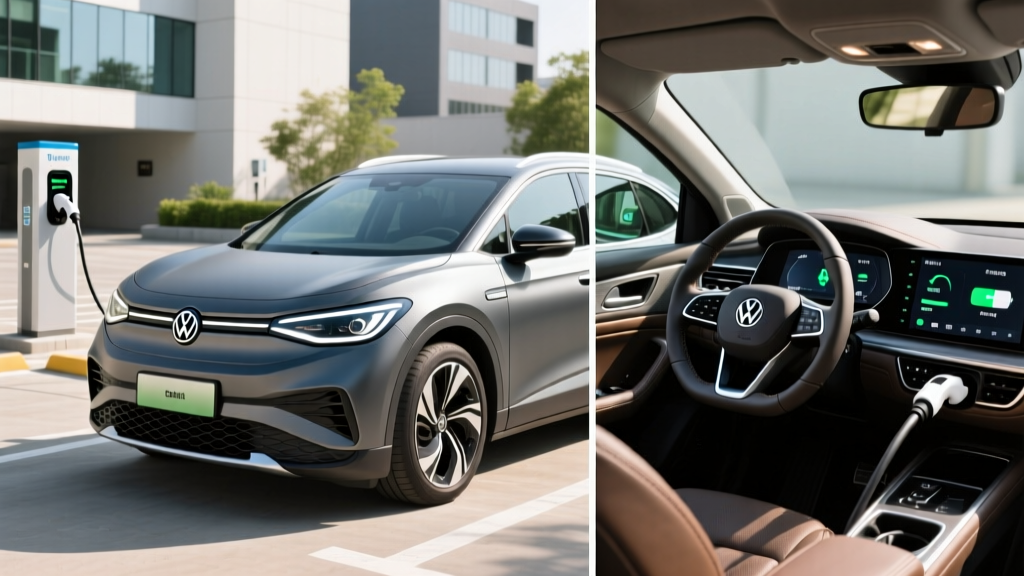
The Volkswagen ID.4 has been one of the most approachable electric SUVs on the market since its US launch, and the 2025 ID.4 Pro continues that tradition with meaningful software updates and refined powertrain tuning. Positioned as a practical two-row electric crossover for families and commuters, the Pro trim sits in the middle of the ID.4 lineup, balancing range and features without the premium of the Pro S or the dual-motor AWD models. This review breaks down exactly what you get for the money — and where the ID.4 Pro falls short against increasingly competitive rivals.
2025 ID.4 Pro: Key Specs at a Glance
| Attribute | Value |
|---|---|
| EPA Range | 291 miles |
| Battery (gross / usable) | 82 kWh gross / ~77 kWh usable (NMC) |
| Drivetrain | Rear-wheel drive (single motor) |
| Horsepower / Torque | 282 hp / 339 lb-ft |
| 0–60 mph | 7.7 seconds |
| DC Fast Charge (peak) | 175 kW |
| 10–80% DC Fast Charge | ~28 minutes |
| Level 2 Home Charge Rate | 11 kW (~37 mi/hr) |
| Combined MPGe | 107 MPGe |
| Efficiency | 31 kWh/100 mi |
| Base MSRP (Pro RWD) | $44,195 (incl. destination) |
| Battery/Powertrain Warranty | 8 years / 100,000 miles |
| Federal Tax Credit (§30D) | Up to $7,500 (eligibility varies) |
Real-World Range: What 291 EPA Miles Actually Means
The EPA rates the 2025 ID.4 Pro at 291 miles on a full charge. That figure comes from the updated APP550 rear-drive motor introduced in the 2024 model year, which improved efficiency over the original ID.4's 275-mile rating. But EPA testing blends city and highway driving under moderate temperatures — conditions that rarely match real-world ownership.
- City/suburban driving (moderate climate): 275–295 miles — regen braking in stop-and-go traffic helps recover energy and can match or exceed the EPA estimate.
- Highway cruising (70–75 mph): 235–260 miles — aerodynamic drag at sustained highway speeds significantly reduces efficiency. Expect ~3.5–3.8 mi/kWh vs the EPA-blended ~3.7 mi/kWh.
- Cold weather (below 32°F): 200–240 miles — battery chemistry slows, cabin heating draws heavily, and range can drop 15–30%. The ID.4's heat pump (standard on Pro) mitigates some of this loss compared to resistive heating.
- Worst case (highway + cold + hills): ~190–210 miles — plan charging stops accordingly on winter road trips.
According to fueleconomy.gov, the ID.4 Pro returns 107 MPGe combined, translating to roughly 31 kWh per 100 miles. That's competitive with the Hyundai Ioniq 5 (114 MPGe combined) but trails the Tesla Model Y Long Range (122 MPGe). The ID.4 prioritizes ride comfort and interior volume over maximum efficiency — a trade-off many families will accept.
Battery, Chemistry, and Long-Term Degradation
The 2025 ID.4 Pro uses an 82 kWh gross (approximately 77 kWh usable) lithium-ion battery pack with NMC (nickel-manganese-cobalt) chemistry. Volkswagen does not offer an LFP (lithium iron phosphate) option in the US-market ID.4. NMC provides higher energy density — essential for fitting 291 miles of range into the ID.4's platform — but is more sensitive to sustained high-state-of-charge storage than LFP.
Degradation expectations: Based on data from early 2021–2022 ID.4 owners tracked on community forums and VW's own warranty commitment, expect roughly 5–8% capacity loss over the first 100,000 miles under normal use. VW warrants the battery to retain at least 70% of its original capacity for 8 years or 100,000 miles, whichever comes first. If degradation exceeds that threshold, VW will repair or replace the pack at no cost.
Longevity tip: For daily driving, set the charge limit to 80% and only charge to 100% before long road trips. NMC chemistry degrades faster when held at full charge for extended periods. The ID.4's infotainment system lets you set a max charge limit — use it.
Charging Speed: DC Fast Charging and Home Level 2
Charging is where the ID.4 Pro is competent but not class-leading. Here's the full breakdown:
| Charging Level | Power / Rate | Time / Miles Added |
|---|---|---|
| Level 1 (120V household) | ~1.4 kW | ~4–5 mi/hr — overnight trickle only |
| Level 2 (240V home, 48A) | 11 kW (max onboard) | ~37 mi/hr — full charge in ~7.5 hours |
| DC Fast Charge (CCS) | 175 kW peak | 10–80% in ~28 min; 80–100% tapers significantly |
DC fast charging reality: The ID.4 Pro peaks at 175 kW, but like all EVs, it doesn't sustain that rate for the full session. The charge curve holds near peak from roughly 5% to 35% state of charge, then tapers progressively. From 10–80%, expect an average rate closer to 110–120 kW, yielding the ~28-minute session time. Above 80%, charging slows dramatically to protect battery health — adding the final 20% can take another 25–30 minutes. On road trips, plan to charge to 80% and move on unless you need the full buffer.
Home charging: The 11 kW onboard charger means a full Level 2 session from empty to full takes roughly 7.5 hours on a 48-amp circuit. Most owners will need a 60-amp dedicated circuit installed. Expect to spend $800–$2,500 on a Level 2 home charger installation depending on panel capacity and wiring distance — factor this into your total purchase budget.
The ID.4 Pro uses the CCS1 connector for DC fast charging and the J1772 connector for Level 2. It does not natively support NACS (Tesla's connector), though VW has indicated future models will adopt NACS. For now, Tesla Supercharger access requires checking network compatibility — Electrify America remains VW's primary charging network partner, and ID.4 buyers receive a complimentary Electrify America charging period (typically 2 years of 800 kWh sessions).
Performance and Driving Dynamics
The APP550 electric motor on the rear axle produces 282 horsepower and 339 lb-ft of torque. The 0–60 mph sprint takes 7.7 seconds — adequate for merging and passing but noticeably behind the Hyundai Ioniq 5 RWD (7.0 sec) and far behind the Tesla Model Y Long Range (5.0 sec with AWD).
Where the ID.4 Pro excels is ride quality. The suspension tuning is distinctly comfort-oriented, absorbing road imperfections with a composure that rivals luxury crossovers. Steering is light and low-effort, ideal for city driving but lacking the feedback enthusiasts want. The turning circle is a tight 31.5 feet — a genuine advantage in urban parking situations.
Towing: The RWD ID.4 Pro is rated for 2,200 pounds with a factory tow hitch (dealer-installed). That's enough for a small utility trailer or a pair of dirt bikes, but not a boat or camper. The AWD Pro S model bumps towing to 2,700 pounds. If towing is a priority, look elsewhere — the Ford F-150 Lightning or Rivian R1S are built for it.
Interior Space, Tech, and Daily Livability
The ID.4 Pro's cabin is where it makes its strongest case as a family vehicle:
- Cargo volume: 30.3 cubic feet behind the second row; 64.2 cu ft with rear seats folded. No front trunk (frunk) — the space under the hood houses electronics and the 12V battery.
- Rear legroom: 37.6 inches — generous for adults on longer trips.
- Front legroom: 41.1 inches.
- Panoramic glass roof: Standard on Pro trim, floods the cabin with light but reduces headroom slightly vs the solid-roof Standard trim.
Infotainment: The 12.9-inch touchscreen runs VW's ID.Software 4.0, a significant improvement over the laggy 3.x software in early ID.4 models. Wireless Apple CarPlay and Android Auto are standard. However, VW's decision to use capacitive-touch slider bars for volume and climate control remains a usability frustration — physical knobs would be far better for in-drive adjustments.
Driver assistance (SAE Level 2): The ID.4 Pro comes with VW's IQ.DRIVE suite, including Travel Assist (adaptive cruise + lane centering), Front Assist (automatic emergency braking), and Lane Assist. This is a Level 2 system — you must keep your hands on the wheel and eyes on the road at all times. It handles highway cruising competently but does not approach the capability of Tesla's Autopilot or GM's Super Cruise on mapped highways. There is no hands-free driving mode on the ID.4.
Pricing, Trim Levels, and Federal Tax Credit
The 2025 ID.4 lineup offers several trims. Here's where the Pro sits:
| Trim | MSRP | Key Features |
|---|---|---|
| Standard | $39,735 | 62 kWh battery, 206 mi range, basic infotainment |
| Pro | $44,195 | 82 kWh battery, 291 mi range, panoramic roof, heat pump |
| Pro S | $48,395 | Pro + premium seats, 360° camera, upgraded audio |
| Pro S Plus (AWD) | $53,795 | Dual-motor AWD, 263 mi range, max towing 2,700 lbs |
Federal tax credit (§30D) eligibility: The ID.4 Pro may qualify for up to $7,500 in federal tax credits, but eligibility depends on several factors that change periodically. As of the current tax year, the IRS §30D rules require:
- MSRP cap: The vehicle must have an MSRP at or below $80,000 for SUVs — the ID.4 Pro at $44,195 clears this easily.
- Buyer income cap: Modified adjusted gross income must not exceed $150,000 (single), $225,000 (head of household), or $300,000 (joint filers).
- Battery sourcing requirements: A percentage of critical minerals and battery components must be sourced from the US or free-trade-agreement countries. These thresholds increase annually. The ID.4 is assembled in Chattanooga, Tennessee, which helps on the final-assembly requirement, but battery cell sourcing is the variable factor.
- Point-of-sale transfer: Eligible buyers can transfer the credit to the dealer at purchase, reducing the out-of-pocket price immediately rather than waiting for a tax refund.
The credit amount splits into two halves — $3,750 for meeting critical-mineral requirements and $3,750 for battery-component requirements. Depending on the model year and production batch, the ID.4 Pro may qualify for the full $7,500, a partial $3,750, or potentially none if sourcing thresholds aren't met for that specific batch. Always verify current eligibility on the IRS website or with a tax professional before purchasing.
How It Compares: ID.4 Pro vs Key Competitors
The compact electric SUV segment is crowded. Here's how the ID.4 Pro stacks up against three direct rivals:
| Metric | VW ID.4 Pro | Hyundai Ioniq 5 SEL | Tesla Model Y LR | Ford Mustang Mach-E Select |
|---|---|---|---|---|
| EPA Range | 291 mi | 303 mi | 320 mi | 250 mi |
| Battery | 82 kWh NMC | 77.4 kWh NMC | ~75 kWh NMC | 70 kWh LFP |
| Peak DC Charge | 175 kW | 240 kW | 250 kW | 150 kW |
| 10–80% Time | ~28 min | ~18 min | ~22 min | ~33 min |
| 0–60 mph | 7.7 sec | 7.0 sec | 5.0 sec (AWD) | 6.3 sec |
| Cargo (rear seats up) | 30.3 cu ft | 27.2 cu ft | 30.2 cu ft | 29.7 cu ft |
| Base MSRP | $44,195 | $46,650 | $46,630 | $42,995 |
| Charging Standard | CCS1 | CCS1/NACS | NACS | CCS1/NACS |
- Comfortable, quiet ride quality that outperforms its price class
- Spacious cabin with generous rear legroom (37.6 in)
- Strong cargo capacity (30.3 cu ft) and flat load floor
- Tight turning circle (31.5 ft) — excellent for city driving
- Heat pump standard on Pro — better cold-weather efficiency
- Tight 8-year / 100,000-mile battery warranty
- US-assembled (Chattanooga, TN) — supports domestic manufacturing
- DC fast charging (175 kW peak) trails Ioniq 5 and Model Y by ~50–75 kW
- Capacitive-touch sliders for volume/climate are frustrating while driving
- 0–60 time (7.7 sec) is the slowest in its class
- No frunk — missed opportunity for additional storage
- CCS-only connector limits Tesla Supercharger access (without adapter/network changes)
- Infotainment, while improved, still lags behind Tesla and Hyundai UX
- Tax credit eligibility uncertain due to battery-sourcing requirements
Who Should Buy the 2025 ID.4 Pro?
- You prioritize ride comfort and cabin quietness over acceleration and charging speed.
- Your daily commute is under 60 miles round-trip and you charge at home overnight.
- You need generous rear-seat space for kids or adult passengers.
- You want a mainstream-brand EV with a large dealer network for service.
- You value US assembly and a strong battery warranty.
- You take frequent road trips and need the fastest DC charging possible — the Ioniq 5 or Model Y charge significantly faster.
- You want AWD for snow or towing capacity above 2,200 lbs — consider the ID.4 AWD Pro S or a different model entirely.
- You want hands-free highway driving — GM's Super Cruise (on the Equinox EV or Blazer EV) or Tesla's Autopilot are more advanced.
- You need maximum range — the Model Y Long Range delivers 320+ EPA miles.
Frequently Asked Questions
What is the real-world range of the 2025 ID.4 Pro?
Expect 235–260 miles on highway road trips at 70–75 mph, 275–295 miles in city/suburban driving, and 200–240 miles in cold weather (below 32°F). The EPA estimate of 291 miles is achievable in moderate conditions with mixed driving, but plan conservatively for long trips.
How fast does the ID.4 Pro charge at home and on the road?
On a Level 2 home charger (240V, 48A), the ID.4 Pro charges at up to 11 kW, adding roughly 37 miles of range per hour and reaching a full charge in about 7.5 hours. On DC fast chargers, it peaks at 175 kW and charges from 10–80% in approximately 28 minutes, though sustained rates average closer to 110–120 kW due to the charge curve taper.
How much does the ID.4 Pro cost after the federal tax credit?
The base MSRP is $44,195. If you qualify for the full $7,500 federal tax credit under §30D and transfer it at point of sale, the effective price drops to approximately $36,695. However, credit eligibility depends on your income, the vehicle's battery sourcing compliance, and current IRS rules — verify before purchasing.
Does the 2025 ID.4 Pro qualify for the federal EV tax credit?
It may qualify for up to $7,500, split between critical-mineral and battery-component requirements. The ID.4 is assembled in the US (Chattanooga, TN), which satisfies final-assembly rules, but battery cell and mineral sourcing determine the actual credit amount. Check the current eligibility list at fueleconomy.gov and consult the IRS §30D guidance for the latest information.
Is the ID.4 Pro worth buying over the Ioniq 5 or Model Y?
The ID.4 Pro wins on ride comfort, interior space, and value if you don't need the fastest charging or the longest range. The Ioniq 5 charges faster (240 kW peak, 18-minute 10–80%) and has a slightly longer range. The Model Y offers more range, faster charging, and access to the Supercharger network. If comfort and daily practicality matter more than road-trip charging speed, the ID.4 Pro is a strong choice.
What is the ID.4 Pro's battery warranty?
Volkswagen covers the high-voltage battery for 8 years or 100,000 miles, guaranteeing it will retain at least 70% of its original capacity. The basic vehicle warranty is 4 years / 50,000 miles.
Can the ID.4 Pro use Tesla Superchargers?
As of the 2025 model year, the ID.4 uses the CCS1 connector and does not natively support NACS (Tesla's connector). Access to Tesla Superchargers depends on Tesla opening specific stations to non-Tesla EVs via their Magic Dock adapter or through future VW NACS adoption. For now, Electrify America is VW's primary DC fast-charging partner in the US.