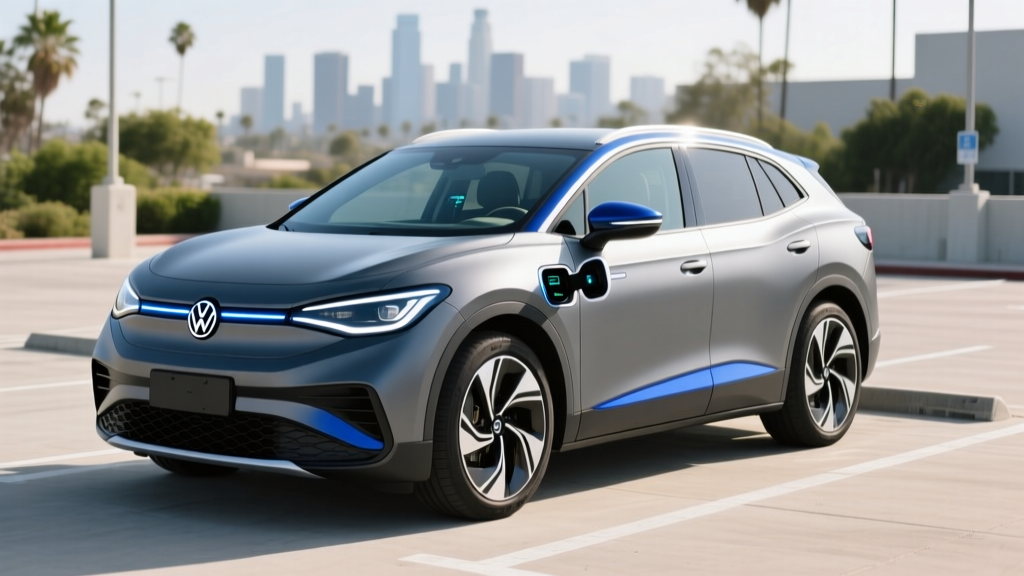
If you're researching a 2025 Volkswagen ID.4 for lease in Costa Mesa, you're likely weighing it against the Tesla Model Y, Hyundai Ioniq 5, and Ford Mustang Mach-E — all popular electric crossovers in Southern California. The ID.4 occupies a distinct niche: it's the mainstream, comfort-oriented EV that prioritizes ride quality and interior space over headline-grabbing acceleration. For Orange County commuters navigating the 405 and 73, the question isn't whether the ID.4 is the fastest or longest-range option — it's whether its combination of pricing, practicality, and DC fast-charging access makes it the smartest lease decision in its segment.
This review covers every spec that matters for a lease decision: EPA range versus what you'll actually see on Pacific Coast Highway, DC fast-charging curves, 2025 pricing by trim, federal tax credit eligibility under current IRS §30D rules, and the ownership realities that brochures don't mention.
2025 VW ID.4: Core Specs at a Glance
| Spec | Standard Range (RWD) | Pro / Pro S (RWD) | AWD Pro / Pro S |
|---|---|---|---|
| EPA Range | 206 mi | 291 mi | 263 mi |
| Battery (Usable) | 62 kWh (NMC) | 82 kWh (NMC) | 82 kWh (NMC) |
| Horsepower | 201 hp | 282 hp | 335 hp |
| 0–60 mph | ~7.7 sec | ~7.0 sec | ~5.4 sec |
| Max DC Fast Charge | 140 kW | 175 kW | 175 kW |
| 10–80% DC Time | ~30 min | ~28 min | ~28 min |
| Level 2 Home Charge | 10.8 kW (~35 mi/hr) | 11.5 kW (~37 mi/hr) | 11.5 kW (~37 mi/hr) |
| MPGe (Combined) | 104 MPGe | 107 MPGe | 98 MPGe |
| Drivetrain | Rear-Wheel Drive | Rear-Wheel Drive | Dual-Motor AWD |
Source: fueleconomy.gov, Volkswagen of America 2025 spec sheets.
Real-World Range: What Costa Mesa Drivers Actually Get
Real-World Expectation: 240–265 miles in mixed SoCal driving; 210–230 miles sustained highway at 70+ mph; 200–220 miles in cold conditions (below 45°F).
Standard Range (62 kWh): EPA 206 miles; expect ~170–185 miles highway.
Southern California's mild climate is one of the best environments for EV efficiency. The ID.4 Pro's 82 kWh NMC (nickel-manganese-cobalt) battery pack delivers strong real-world numbers around Costa Mesa, where most driving is stop-and-go surface streets and moderate-speed freeway cruising. Regenerative braking recovers meaningful energy on the frequent slowdowns along Bristol Street and Harbor Boulevard.
However, EPA testing includes low-speed urban cycles that flatter every EV. On a sustained 70–75 mph run from Costa Mesa to San Diego (roughly 85 miles each way on I-5), expect the Pro RWD to consume energy at approximately 33–36 kWh/100mi, translating to roughly 220–240 miles of practical range before you'd want to stop. That's enough for the round trip with a comfortable buffer, but not enough to detour through Palm Desert without a charge stop.
The 62 kWh Standard Range model is best understood as a dedicated commuter: 206 EPA miles means roughly 170 miles of real highway range. That works fine for daily driving within Orange County, but it limits road-trip flexibility significantly. For lease buyers who occasionally drive to Big Bear or Joshua Tree, the 82 kWh Pro trims are the pragmatic choice.
Charging Speed and Infrastructure Access
Charging speed determines how livable an EV is beyond your daily commute. The ID.4's DC fast-charging performance is competitive but not class-leading — and understanding the charge curve matters more than the peak kW number.
| Charging Level | Power | Speed | Use Case |
|---|---|---|---|
| Level 1 (120V household) | ~1.4 kW | ~4 mi/hr | Emergency / overnight trickle |
| Level 2 (240V home) | 10.8–11.5 kW | ~35–37 mi/hr | Daily home charging (full charge in ~7–8 hrs) |
| DC Fast (Pro/Pro S 82 kWh) | Peak 175 kW | 10–80% in ~28 min | Road trips, Electrify America network |
| DC Fast (Standard Range 62 kWh) | Peak 140 kW | 10–80% in ~30 min | Road trips, shorter sessions |
The 175 kW peak on the 82 kWh models is achieved at low state-of-charge (around 10–20%). Like all modern EVs, the ID.4 tapers charge rate as the battery fills to protect cell longevity. Expect roughly 150–175 kW from 10–40% SoC, stepping down to ~100 kW by 60%, and ~50 kW from 80–90%. This is typical NMC charge-curve behavior, but it means a 10–90% session takes closer to 40 minutes, not 28.
For Costa Mesa residents, this matters practically: the Electrify America station at South Coast Plaza and several ChargePoint DC stations along the 73 corridor can deliver the ID.4's full 175 kW. Volkswagen includes a complimentary Electrify America charging period (typically 3 years or a set kWh allocation) with new ID.4 purchases and leases — confirm the exact terms with your dealer, as promotional details shift by model year.
Home Level 2 charging at 11.5 kW means you'll add roughly 37 miles of range per hour plugged in. A typical overnight session (10 hours on a home wall connector) fully replenishes the 82 kWh battery from near-empty. Installation of a 240V/48A circuit in a Costa Mesa home typically runs $800–$2,000 depending on panel proximity and whether your electrical panel needs an upgrade to 200A service.
2025 Pricing, Lease Economics, and Federal Tax Credits
| Trim | Base MSRP | Est. Monthly Lease (36 mo) | §30D Credit Eligible? |
|---|---|---|---|
| Standard Range | ~$39,735 | $299–$399/mo | Check sourcing rules |
| Pro | ~$44,735 | $349–$459/mo | Check sourcing rules |
| Pro S | ~$48,735 | $399–$509/mo | Check sourcing rules |
| AWD Pro | ~$48,435 | $379–$479/mo | Check sourcing rules |
| AWD Pro S Plus | ~$53,735 | $449–$569/mo | Check sourcing rules |
Lease estimates vary by dealer, money factor, residual, and down payment. Confirm with Costa Mesa-area VW dealers.
The IRS §30D clean vehicle credit offers up to $7,500, but eligibility depends on three moving targets: buyer income caps ($150K single / $300K joint MAGI), vehicle MSRP caps ($80,000 for SUVs — all ID.4 trims qualify), and battery critical-mineral and component sourcing requirements that tighten annually. As of 2025, many EVs that previously qualified have lost partial or full credit eligibility due to foreign entity of concern (FEOC) battery-sourcing restrictions. Volkswagen publishes current credit status on its website, and your Costa Mesa dealer should confirm eligibility at signing.
Lease-specific advantage: Under the "commercial vehicle" loophole in §45W, leasing companies can claim the $7,500 credit and pass savings to lessees as a capitalized-cost reduction — even if the vehicle wouldn't qualify under §30D purchase rules. Many VW dealers structure ID.4 leases to pass this benefit through, but it is not automatic. Ask explicitly whether the lease quote reflects the EV credit applied as a cap-cost reduction.
Interior, Cargo, and Daily Livability
The ID.4's cabin is where it earns its family-crossover credentials. Rear legroom measures 37.6 inches — more than the Tesla Model Y (36.5 in) and competitive with the Hyundai Ioniq 5 (39.4 in). Front legroom is generous at 41.1 inches. The flat floor (no transmission tunnel) makes the rear middle seat genuinely usable for adults on short trips.
Cargo volume behind the rear seats is 30.3 cubic feet, expanding to 64.2 cubic feet with the 60/40 rear seats folded. That's enough for two large suitcases and a stroller without folding seats, or a full Costco run with seats down. The ID.4 does not offer a front trunk (frunk) — the space under the hood houses the HVAC and power electronics, which is a missed opportunity compared to the Mach-E and Ioniq 5.
Infotainment runs on VW's ID. Software 4.0 in 2025 models, a significant improvement over the sluggish early ID.3/ID.4 software. The 12.9-inch touchscreen (Pro S and above) is responsive, supports wireless Apple CarPlay and Android Auto, and includes over-the-air update capability. However, VW's decision to use capacitive-touch sliders for volume and climate (rather than physical knobs) remains a frustration for many drivers — particularly when adjusting temperature on the move.
Driver assistance comes via VW's IQ.DRIVE suite, which includes adaptive cruise control with stop-and-go, lane centering, front assist with autonomous emergency braking, and blind-spot monitoring. This is SAE Level 2 driver assistance — it does not replace an attentive driver. Hands must remain on the wheel, and the system will issue escalating warnings if it detects inattention. It's a competent highway companion on the 405 but does not offer the hands-free capability of GM's Super Cruise or Ford's BlueCruise on mapped highways.
Who Should Lease the ID.4 in Costa Mesa?
- You want a comfortable, quiet ride over sporty handling
- Home Level 2 charging is available (garage or driveway access)
- Your daily driving is under 80 miles round-trip
- You value rear-seat space for children or car seats
- You want Electrify America network access with complimentary charging
- You need 300+ miles of real-world range for frequent long trips
- You want hands-free highway driving (consider Mach-E with BlueCruise)
- Frunk storage matters for your use case
- You want the fastest acceleration in the segment (Model Y Performance: 3.5 sec)
The ID.4 is a strong match for Costa Mesa households with two cars, where the EV handles daily commuting and errands while a second vehicle covers long road trips. It's also well-suited to renters or condo owners who can install a Level 2 charger in their garage — the overnight-charge-every-morning routine makes the 260-mile real-world range feel essentially unlimited for local driving.
For single-car households that regularly drive to San Diego, Las Vegas, or the Eastern Sierra, the ID.4's 28-minute 10–80% charge time is workable but not exceptional. The Hyundai Ioniq 5 (800V architecture, 10–80% in ~18 minutes at a 350 kW charger) and the Tesla Model Y (Supercharger network, ~25 minutes) both offer faster road-trip charging experiences.
Biggest Pros and Cons
- Ride quality and cabin quietness exceed most rivals in the segment
- Generous rear-seat legroom (37.6 in) for families
- Complimentary Electrify America charging period included
- Strong lease value with potential §45W credit pass-through
- Improved ID. Software 4.0 resolves earlier infotainment complaints
- Turning radius of 31.5 ft makes it easy to park at Fashion Island
- No frunk — lost cargo opportunity
- Capacitive-touch sliders for climate/volume frustrate some drivers
- DC fast-charge speed trails Ioniq 5 and Model Y
- Real-world highway range ~220–240 mi falls short of 291 EPA sticker
- IQ.DRIVE is competent but not hands-free like BlueCruise
- Regenerative braking lacks true one-pedal driving mode
Warranty and Long-Term Battery Confidence
Volkswagen backs the ID.4's battery and drive units with an 8-year / 100,000-mile warranty, covering defects and capacity loss below 70% of original capacity. The limited vehicle warranty is 4 years / 50,000 miles, which is standard for the segment but shorter than Hyundai's 5-year / 60,000-mile bumper-to-bumper coverage.
The 82 kWh NMC pack uses LG Energy Solution cells with a proven track record in the MEB platform (shared with the Audi Q4 e-tron). Real-world degradation data from European and North American ID.4 fleets shows approximately 5–8% capacity loss over the first 60,000 miles, which is within normal NMC parameters. For a 36-month lease covering 30,000–45,000 miles, battery degradation is essentially a non-issue — you'll return the vehicle before it becomes relevant.
Frequently Asked Questions
What is the real-world range of the 2025 VW ID.4?
The Pro RWD with the 82 kWh battery has a 291-mile EPA rating. In real-world mixed driving around Costa Mesa, expect 250–265 miles. Sustained highway driving at 70+ mph drops that to roughly 220–240 miles. The Standard Range (62 kWh) model delivers about 170–185 miles on the highway.
How fast does the ID.4 charge at home and on the road?
On a home Level 2 charger (240V, 48A), the ID.4 charges at up to 11.5 kW, adding roughly 37 miles of range per hour — a full charge takes about 7–8 hours. On a DC fast charger, the 82 kWh models peak at 175 kW and reach 10–80% in approximately 28 minutes, though the charge rate tapers significantly above 80%.
Does the 2025 ID.4 qualify for the $7,500 federal tax credit?
Eligibility under IRS §30D depends on battery critical-mineral sourcing, buyer income limits, and MSRP caps. The ID.4's MSRP is well under the $80,000 SUV cap, but sourcing requirements change annually. When leasing, the dealer's financing arm may claim the credit under §45W and pass savings through as a cap-cost reduction — ask your dealer to confirm this is reflected in your quote.
Is the ID.4 worth leasing over a Tesla Model Y or Hyundai Ioniq 5?
It depends on priorities. The ID.4 wins on ride comfort, cabin quietness, and value-priced leasing. The Model Y wins on range, Supercharger network access, and acceleration. The Ioniq 5 wins on DC fast-charge speed and interior design. If comfort and monthly payment matter most, the ID.4 is the strongest pick in this trio.
Can I install a Level 2 charger in my Costa Mesa home?
Most single-family homes with a 200-amp electrical panel can support a 48-amp Level 2 charger on a dedicated 60-amp circuit. Installation costs in Orange County typically range from $800 to $2,000 if the panel is near the garage. Older homes with 100-amp service may need a panel upgrade ($2,000–$4,000) — consult a licensed electrician for an assessment. SCE (Southern California Edison) may offer rebates for EV charger installations; check their current programs.
What happens if the battery degrades during my lease?
Over a typical 36-month lease (30,000–45,000 miles), NMC battery degradation is minimal — usually 3–5%. You won't notice meaningful range loss during the lease term. VW's 8-year/100,000-mile battery warranty covers capacity loss below 70%, but this would primarily concern the second owner, not the lessee.