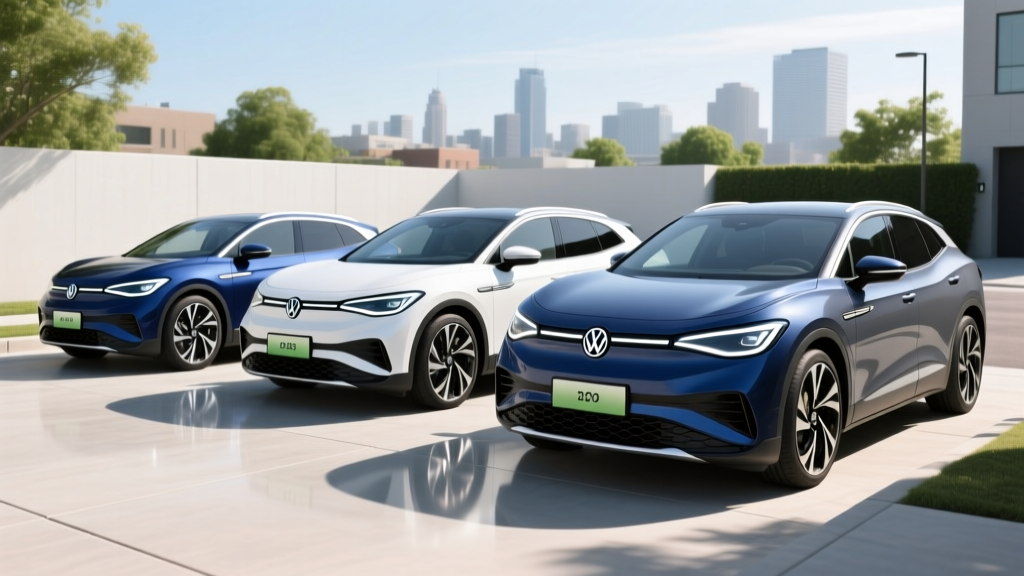
The 2025 Volkswagen ID.4 enters its fifth model year in North America with a clearer trim strategy and continued domestic production at VW's Chattanooga, Tennessee plant. For buyers navigating the 2025 Volkswagen ID.4 trim levels, the lineup now spans from a value-oriented Standard Style to a fully loaded AWD Pro S Plus — each with distinct battery sizes, drivetrains, and feature sets that materially affect range, performance, and price. This guide dissects every trim with exact EPA figures, real-world range expectations, charging data, and current federal tax credit eligibility.
2025 ID.4 Trim Lineup at a Glance
Volkswagen offers the 2025 ID.4 in six primary configurations across two battery packs and two drivetrains. The Standard and Standard Style trims use a smaller 62 kWh battery with rear-wheel drive, while the Pro, Pro S, and Pro S Plus trims step up to an 82 kWh battery available in either RWD or AWD (badged as "AWD" with dual motors). Here's how the full lineup stacks up:
| Trim | Battery (kWh usable) | Drivetrain | EPA Range | HP / lb-ft | 0-60 mph | Base MSRP |
|---|---|---|---|---|---|---|
| Standard | 62 (NMC) | RWD | 206 mi | 201 / 229 | ~8.1s | $39,735 |
| Standard Style | 62 (NMC) | RWD | 206 mi | 201 / 229 | ~8.1s | $42,235 |
| Pro | 82 (NMC) | RWD | 291 mi | 282 / 339 | ~7.3s | $43,735 |
| Pro S | 82 (NMC) | RWD | 291 mi | 282 / 339 | ~7.3s | $47,235 |
| Pro S AWD | 82 (NMC) | Dual-motor AWD | 263 mi | 335 / 402 | ~5.4s | $50,735 |
| Pro S Plus AWD | 82 (NMC) | Dual-motor AWD | 263 mi | 335 / 402 | ~5.4s | $54,235 |
All prices include the $1,395 destination charge. The destination fee is included in the MSRP figures above and counts toward the IRS MSRP cap for tax credit purposes.
Real-World Range: What the EPA Numbers Don't Tell You
Pro RWD (82 kWh): EPA 291 mi — Expect ~245–265 mi on highway trips at 70+ mph; ~200–220 mi in cold weather (below 32°F) with cabin heat.
Pro S AWD (82 kWh): EPA 263 mi — Expect ~220–240 mi highway; ~175–195 mi in winter conditions.
Standard (62 kWh): EPA 206 mi — Expect ~170–185 mi highway; ~140–155 mi in cold weather.
The EPA combined-cycle figures from fueleconomy.gov represent mixed city/highway driving in moderate temperatures. In practice, the ID.4's aerodynamic profile (0.28 Cd) favors city efficiency over highway cruising. At sustained 75 mph speeds, expect to consume roughly 33–36 kWh/100mi in the Pro RWD, versus the EPA-rated 29 kWh/100mi combined.
Cold weather is the equalizer for all EVs. The ID.4 uses a resistive PTC heater on lower trims and a heat pump on Pro S and above (standard from MY2024 onward on most trims, but verify your build sheet). The heat pump reduces winter range loss from the typical 30–35% down to roughly 20–25%, which is a meaningful difference for northern-climate buyers choosing between trim levels.
Charging Speed Across Every Trim
Charging capability varies significantly between the 62 kWh and 82 kWh battery packs — a critical factor when choosing your trim.
| Spec | 62 kWh (Standard/Standard Style) | 82 kWh (Pro/Pro S/Pro S Plus) |
|---|---|---|
| Max DC Fast Charge | 140 kW peak | 175 kW peak |
| 10–80% DCFC Time | ~30 minutes | ~28 minutes |
| Sustained DC Rate (10–60%) | ~95–110 kW avg | ~120–135 kW avg |
| Level 2 Home Charging (AC) | 10.8 kW / 32A | 11.5 kW / 48A |
| Miles Added per Hour (L2) | ~33 mi/hr | ~37 mi/hr |
| Level 1 (120V) Trickle | ~2 mi/hr | ~2 mi/hr |
| Charge Port | CCS1 (NACS adapter available) | CCS1 (NACS adapter available) |
The 82 kWh pack's higher peak charge rate (175 kW vs 140 kW) matters most on road trips. At an Electrify America or compatible 350 kW stall, the Pro trims will sustain above 100 kW longer before tapering past 80% SoC. Both packs exhibit typical NMC charge-curve behavior: strong pull from 10–50%, gradual taper from 50–80%, and a steep drop above 80% that makes charging to 100% impractical on DCFC.
Volkswagen includes three years of complimentary charging on the Electrify America network (30-minute sessions, up to a set kWh cap), which partially offsets the ID.4's CCS1 connector in a market increasingly shifting to NACS. VW has confirmed a NACS adapter for CCS-equipped ID.4 vehicles, enabling Tesla Supercharger access — a significant practical advantage for road-trip charging coverage.
Performance and Drivetrain Breakdown
The 2025 ID.4 isn't positioned as a performance EV, but the AWD dual-motor configuration delivers respectable acceleration. The single-motor RWD models use a rear-mounted permanent-magnet synchronous motor, while AWD trims add a front induction motor for a combined 335 hp and 402 lb-ft of torque.
From a driving dynamics standpoint, the ID.4 rides on VW's MEB platform with a low center of gravity and 50/50-ish weight distribution. The steering is light and numb — typical for the segment — but the ride quality is compliant and well-damped. The turning circle of 31.5 feet (RWD) is remarkably tight for a compact SUV, making it genuinely easy to park in urban environments.
Regenerative braking in the ID.4 is modest compared to competitors. There's no true one-pedal driving mode; instead, VW offers a B (Brake) mode that increases regen to roughly 0.15g of deceleration — enough to slow noticeably but not enough to come to a complete stop without using the brake pedal. Drivers accustomed to strong regen from a Tesla or Hyundai Ioniq 5 will find this a notable limitation.
Interior, Cargo, and Technology
The ID.4's cabin prioritizes practicality over luxury. Rear legroom measures 37.6 inches — competitive with the Toyota RAV4 and Honda CR-V — while cargo volume behind the second row is 30.3 cubic feet, expanding to 64.2 cu ft with seats folded. There's no frunk (front trunk); the space under the hood houses electronics and the cabin HVAC equipment.
Infotainment by trim:
- Standard/Standard Style: 10-inch touchscreen, wireless Apple CarPlay/Android Auto, 4 USB-C ports
- Pro and above: 12.9-inch touchscreen, upgraded navigation, 6 USB-C ports, 30-color ambient lighting
- Pro S Plus: Adds panoramic fixed glass roof, head-up display (HUD), heated/ventilated front seats, heated steering wheel
The software experience remains the ID.4's weakest link. VW's ID.Software 4.0 (updated from earlier 3.x versions) is faster and more responsive than launch-year models, but the touch-capacitive slider controls for volume and temperature lack backlighting and physical detents — a persistent frustration. Voice control has improved but still trails systems from Hyundai/Kia and Tesla in natural-language comprehension.
Driver Assistance (all trims): IQ.Drive suite includes adaptive cruise control with stop-and-go, lane-keeping assist, blind-spot monitoring, rear cross-traffic alert, and Travel Assist (combined ACC + lane centering). Travel Assist functions as an SAE Level 2 system — the driver must keep hands on the wheel and eyes on the road at all times. It is not autonomous driving.
Travel Assist and all ID.4 driver-assist features are SAE Level 2. You must remain actively engaged, monitor the road, and be prepared to take over instantly. This is not a self-driving system.
Pricing, Tax Credits, and Ownership Costs
Federal tax credit eligibility for the 2025 ID.4 is one of its strongest selling points. Because the ID.4 is assembled in Chattanooga, Tennessee, and meets progressive battery-component and critical-mineral sourcing requirements, qualifying buyers can access up to $7,500 under IRS §30D. Starting in 2024, this credit can be transferred to the dealer as a point-of-sale rebate, reducing the purchase price directly rather than waiting for a tax filing.
| Trim | MSRP (incl. dest.) | Est. §30D Credit | Effective Price | Under $55K MSRP Cap? |
|---|---|---|---|---|
| Standard | $39,735 | Up to $7,500 | ~$32,235 | Yes |
| Standard Style | $42,235 | Up to $7,500 | ~$34,735 | Yes |
| Pro | $43,735 | Up to $7,500 | ~$36,235 | Yes |
| Pro S | $47,235 | Up to $7,500 | ~$39,735 | Yes |
| Pro S AWD | $50,735 | Up to $7,500 | ~$43,235 | Yes |
| Pro S Plus AWD | $54,235 | Up to $7,500 | ~$46,735 | Yes |
- MSRP cap: Vehicle must be ≤$55,000 (all 2025 ID.4 trims qualify)
- Buyer income cap: AGI ≤$150K single / $225K head of household / $300K joint filers
- Assembly: Final assembly in North America (ID.4 built in Tennessee ✓)
- Battery sourcing: Must meet escalating critical-mineral and battery-component thresholds — VW has progressively met these requirements; confirm with your dealer for the specific build month
- Point-of-sale transfer: Available — reduces out-of-pocket cost at purchase
Source: IRS §30D Clean Vehicle Credit. Tax eligibility varies by individual situation — consult a tax professional.
Efficiency and running costs: The Pro RWD achieves an EPA-rated 107 MPGe combined (29 kWh/100mi). At the U.S. average residential electricity rate of ~$0.16/kWh, that translates to roughly $4.64 per 100 miles — about one-third the fuel cost of a comparable 28 MPG gas SUV at $3.50/gallon.
Warranty Coverage
Volkswagen backs the ID.4 with competitive warranty terms:
- Battery: 8 years / 100,000 miles (capacity retention ≥70% of original)
- Powertrain: 4 years / 50,000 miles
- Bumper-to-bumper: 4 years / 50,000 miles
- Roadside assistance: 4 years / 50,000 miles
- Corrosion perforation: 7 years / 100,000 miles
The 70% capacity retention threshold is standard for the industry. Real-world degradation data from earlier ID.4 model years (2021–2023) shows approximately 3–5% loss in the first 30,000 miles, with degradation slowing significantly thereafter. The NMC chemistry in the ID.4 is well-proven, and VW's thermal management system (liquid cooling/heating) keeps the pack in its optimal temperature window.
Pros and Cons
✅ Pros
- Full $7,500 federal tax credit eligibility on all trims
- Competitive real-world range (up to 291 mi EPA on Pro RWD)
- Tight turning circle, easy urban maneuverability
- Spacious rear seat and cargo area for the class
- 3 years of complimentary Electrify America charging
- NACS adapter enables Tesla Supercharger access
- Comfortable, compliant ride quality
❌ Cons
- Weak regenerative braking — no true one-pedal driving
- Infotainment touch-capacitive sliders are frustrating
- DCFC speeds trail competitors (175 kW vs 240+ kW from Hyundai/Kia)
- No front trunk (frunk) for additional storage
- CCS1 port requires adapter for NACS/Supercharger network
- RWD performance is leisurely (8.1s 0-60 on Standard)
Who Should Buy the 2025 ID.4 — and Which Trim?
The 2025 ID.4 is best suited for practical families and commuters who prioritize interior space, ride comfort, and strong tax-credit value over sporty driving dynamics or cutting-edge charging speed. It's a rational, well-rounded compact EV SUV — not a head-turner, but a daily-driver workhorse.
Choose the Standard ($39,735) if: You have reliable home Level 2 charging, drive under 150 miles daily, and want the lowest entry price. After the $7,500 credit, this becomes one of the most affordable new EV SUVs available.
Choose the Pro ($43,735) if: You want the best range-to-price ratio. The 82 kWh battery's 291-mile EPA range and faster 175 kW DC charging make this the sweet spot for most buyers. The 12.9-inch screen is a worthwhile upgrade.
Choose the Pro S AWD ($50,735) if: You need all-wheel drive for snow or rough weather, want the 335 hp dual-motor performance (5.4s 0-60), and value premium features like the panoramic roof and heat pump for cold-climate efficiency.
Look elsewhere if: You prioritize fast DC charging (Hyundai Ioniq 5 at 240+ kW), one-pedal driving (Tesla Model Y, Kia EV6), or a more engaging infotainment system. The ID.4's software and regen calibration remain behind the segment leaders.
Frequently Asked Questions
What is the real-world range of the 2025 VW ID.4?
The Pro RWD with the 82 kWh battery achieves 291 miles EPA combined. In real-world highway driving at 70+ mph, expect 245–265 miles. In cold weather below freezing, range drops to roughly 200–220 miles with a heat pump (Pro S and above) or 180–200 miles without (verify trim equipment). The Standard trim with the 62 kWh battery delivers 206 miles EPA but closer to 170–185 miles on the highway.
How fast does the 2025 ID.4 charge at home and on DC fast chargers?
On a DC fast charger, the 82 kWh models peak at 175 kW and charge from 10–80% in approximately 28 minutes. The 62 kWh models peak at 140 kW with a 10–80% time of about 30 minutes. At home on a Level 2 charger (240V), the 82 kWh pack charges at 11.5 kW (~37 miles of range per hour), while the 62 kWh charges at 10.8 kW (~33 miles per hour). A full overnight charge is easily achievable on any trim.
Does the 2025 ID.4 qualify for the $7,500 federal EV tax credit?
Yes — all 2025 ID.4 trim levels fall under the $55,000 MSRP cap for SUVs and are assembled in Tennessee, meeting the North American final-assembly requirement. Buyer income must not exceed $150K (single), $225K (head of household), or $300K (joint). Battery component and critical-mineral sourcing requirements must also be met; VW has progressively achieved compliance. The credit can be applied as a point-of-sale rebate. Confirm eligibility with your dealer and consult the IRS §30D guidelines or a tax professional.
Is the 2025 ID.4 worth buying vs. the Hyundai Ioniq 5 or Tesla Model Y?
The ID.4 competes on value after tax credits, interior space, and ride comfort. The Hyundai Ioniq 5 charges significantly faster (up to 240 kW on 800V architecture) and offers one-pedal driving, but its rear cargo space is smaller. The Tesla Model Y has the best Supercharger network access natively, stronger software, and more range, but a firmer ride and higher starting price. If comfort, space, and post-credit pricing matter most, the ID.4 Pro is a compelling choice. If charging speed or tech polish is paramount, test-drive the Ioniq 5 and Model Y as well.
What are the biggest drawbacks of the 2025 ID.4?
The most common owner complaints center on the weak regenerative braking (no one-pedal mode), unintuitive touch-capacitive climate and volume sliders, and DCFC speeds that trail 800V competitors. The lack of a frunk is a missed opportunity for extra storage. The infotainment system, while improved, still lags behind the responsiveness and app ecosystems of Tesla and Hyundai/Kia.