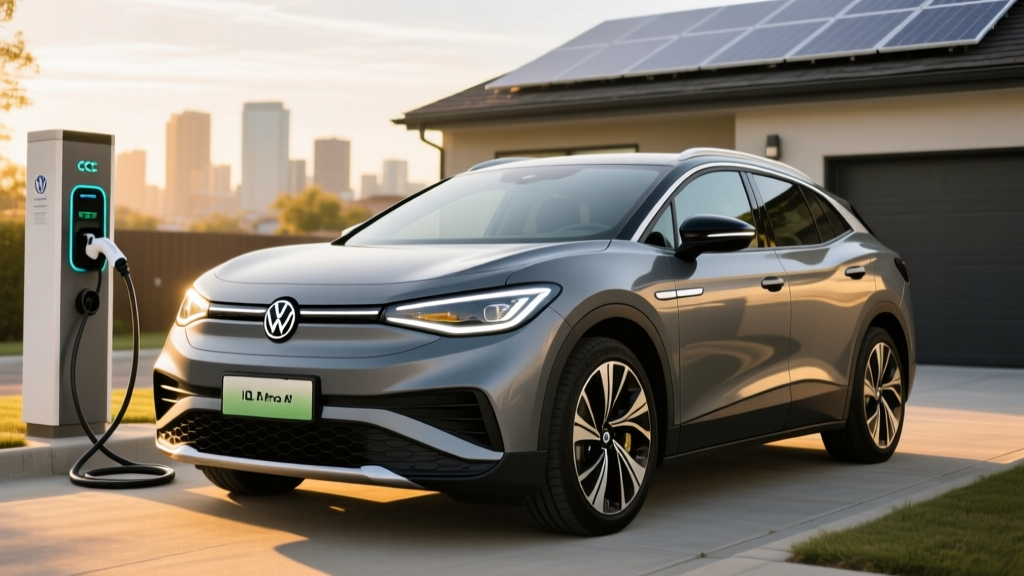
The 2025 Volkswagen ID.4 Pro RWD occupies a specific niche in the electric SUV market: a practical, comfortable, family-sized crossover that prioritizes daily livability over headline-grabbing performance. With an EPA-estimated 291 miles of range, a refined ride, and a starting MSRP that undercuts several rivals, the Pro RWD trim is the value sweet spot in the ID.4 lineup. But how does it hold up when you look past the brochure and into real-world driving, charging curves, and ownership costs? We break down every number that matters.
Quick Verdict: Who Should Buy the ID.4 Pro RWD?
The 2025 Volkswagen ID.4 Pro RWD is best suited for suburban families and daily commuters who need a spacious five-passenger EV with solid cargo capacity, comfortable highway manners, and enough range to cover most road trips with one DC fast-charge stop. It is not the quickest EV in its class, nor does it have the fastest charging speeds. What it does offer is a well-rounded package with a strong warranty, competitive pricing, and a driving experience that feels immediately familiar to anyone transitioning from a gas-powered crossover.
If you prioritize maximum range or sporty acceleration, competitors like the Hyundai Ioniq 5 or Tesla Model Y may serve you better. If you want a no-compromise family hauler at a reasonable price with dealer-supported service, the ID.4 Pro RWD makes a compelling case.
Range, Efficiency, and Real-World Expectations
Real-World Highway (70 mph, moderate weather): ~245–265 miles
Real-World Cold Weather (30°F, highway): ~200–225 miles
City/Commuter Driving (mild weather): ~280–300 miles (regen-friendly)
The ID.4 Pro RWD is equipped with an 82 kWh battery pack (77 kWh usable) using NMC (nickel manganese cobalt) chemistry. The EPA rates it at 104 MPGe combined, which translates to roughly 33 kWh per 100 miles — respectable for a 4,600-pound SUV, though not class-leading.
In practice, the ID.4's range is highly dependent on driving style and conditions. On a 70-mph highway loop in 65°F weather, expect to see consumption around 35–37 kWh/100mi, yielding approximately 245–265 miles before needing a charge. In cold weather (below freezing), the resistive heating system and battery thermal demands can push consumption above 40 kWh/100mi, reducing effective range to roughly 200–225 miles. City driving with frequent regenerative braking opportunities can actually exceed the EPA estimate, as the ID.4's one-pedal-style regen recovers energy efficiently at lower speeds.
The heat pump — standard on 2025 models — helps mitigate cold-weather losses compared to earlier model years, but the ID.4 still experiences the 20–30% range reduction common to NMC-based EVs in winter conditions. According to fueleconomy.gov, the combined MPGe rating of 104 places the ID.4 Pro RWD mid-pack among electric compact SUVs.
| Spec | Value |
|---|---|
| EPA Range | 291 miles |
| Battery (Gross / Usable) | 82 kWh / 77 kWh (NMC) |
| MPGe (City / Hwy / Combined) | 108 / 99 / 104 |
| Energy Consumption | ~33 kWh/100mi |
| Drivetrain | Rear-Wheel Drive (single motor) |
| Horsepower | 282 hp |
| Torque | 339 lb-ft |
| 0–60 mph | ~7.7 seconds |
| Max DC Fast Charge Rate | 170 kW (peak) |
| 10–80% DC Charge Time | ~30 minutes |
| Level 2 Charge Rate | 11 kW (~37 mi/hr) |
| Cargo Volume (rear seats up / down) | 30.3 / 64.2 cu ft |
| Base MSRP | $40,790 (before destination) |
Charging Speed: DC Fast Charge and Home Level 2
Charging performance is where the ID.4 Pro RWD shows its age relative to newer competitors. The 170 kW peak DC fast-charge rate is adequate but not exceptional — the Hyundai Ioniq 5 peaks at 240 kW, and the Tesla Model Y can sustain high rates on the Supercharger network.
| Charging Level | Power / Rate | Time / Range Added |
|---|---|---|
| Level 1 (120V, 12A) | ~1.4 kW | ~4 mi/hr (overnight: ~40 mi) |
| Level 2 (240V, 48A) | 11 kW | ~37 mi/hr (0–100% in ~7.5 hrs) |
| DC Fast Charge (peak) | 170 kW | 10–80% in ~30 min |
| DC Fast Charge (sustained avg) | ~110–130 kW | ~150 mi added in 30 min |
The critical detail for road-trippers: the ID.4's charging curve is relatively flat between 10% and 50% SoC, holding near peak rates, but tapers noticeably above 70%. If you consistently charge only to 80% (as recommended for NMC battery longevity), the 30-minute 10–80% figure is realistic. However, on a 300-mile road trip requiring an 80–90% top-up, expect that last 10% to add another 10–15 minutes.
The ID.4 uses the CCS1 connector for DC fast charging. With Volkswagen's announced transition to NACS (Tesla-style) on future models, the 2025 ID.4 still relies on CCS — but VW has confirmed Supercharger adapter compatibility for existing CCS vehicles, so access to Tesla's network is available with an approved adapter.
At home, the 11 kW onboard charger is a strong point. On a 48-amp Level 2 circuit, you'll add roughly 37 miles of range per hour, meaning a full overnight charge from 20% to 100% takes about 6 hours. This is more than sufficient for daily use — most owners will plug in each evening and wake up with a full battery.
Performance and Driving Dynamics
The Pro RWD's single rear-mounted motor produces 282 horsepower and 339 lb-ft of torque. The 0–60 mph time of approximately 7.7 seconds is perfectly adequate for merging and passing, but it won't win any stoplight drag races against the dual-motor AWD variants or sportier competitors. The instant torque delivery makes the ID.4 feel quicker around town than the 0–60 figure suggests.
Driving dynamics are tuned for comfort. The suspension absorbs bumps with a maturity that feels more premium than the price suggests, and the steering is light and predictable. Road noise is well-suppressed at highway speeds. The turning circle is tight for an SUV of this size, thanks to the rear-wheel-drive layout that frees up front-axle geometry — a practical advantage in parking lots and urban driving.
Regenerative braking in the ID.4 offers two modes: a coasting "D" mode that maximizes efficiency on highways, and a "B" mode that increases regen for stop-and-go driving. Unlike some competitors, the ID.4 does not offer true one-pedal driving to a full stop — the regen tapers off at very low speeds, requiring the friction brake for the final halt. This is a deliberate engineering choice (and one that some drivers prefer for its natural feel) but may disappoint those accustomed to full one-pedal operation.
Interior, Cargo, and Technology
The ID.4's cabin is spacious and minimalist, with a 106.3-inch wheelbase that translates to generous rear-seat legroom (37.6 inches) and a flat floor thanks to the dedicated MEB EV platform. Cargo volume is 30.3 cubic feet behind the rear seats and 64.2 cubic feet with them folded — competitive with the RAV4 and CR-V in gas form, and slightly behind the Model Y's 76 cubic feet.
The 12-inch infotainment touchscreen runs VW's ID. Software 4.0, which is a significant improvement over earlier versions. Wireless Apple CarPlay and Android Auto are standard, and the system supports over-the-air updates. However, the touch-capacitive sliders for volume and climate control remain a frustration point — they lack backlighting at night and can be imprecise while driving. The 2025 model year adds improved voice control responsiveness, which partially offsets the physical control shortcomings.
Driver-assistance technology includes VW's IQ.DRIVE suite: adaptive cruise control with stop-and-go, lane-keeping assist, front assist with automatic emergency braking, and blind-spot monitoring. Travel Assist combines adaptive cruise and lane centering for hands-on highway driving assistance. This is a Level 2 SAE driver-assist system — it requires continuous driver supervision and is not autonomous driving.
Pricing, Trims, and Federal Tax Credit Eligibility
The 2025 Volkswagen ID.4 Pro RWD starts at $40,790 (plus a $1,395 destination charge, bringing the total to $42,185). Key trim progression in the ID.4 RWD lineup:
| Trim | MSRP (incl. dest.) | Potential §30D Credit | Effective Price |
|---|---|---|---|
| Standard Range | $37,390 | Up to $7,500* | ~$29,890* |
| Pro (RWD) | $42,185 | Up to $7,500* | ~$34,685* |
| Pro S (RWD) | $45,785 | Up to $7,500* | ~$38,285* |
| AWD Pro | $47,585 | Up to $7,500* | ~$40,085* |
*Federal tax credit eligibility under IRS §30D depends on multiple requirements that change periodically. As of the 2025 tax year, key eligibility criteria include:
- Buyer income caps: Modified AGI must not exceed $150,000 (single), $225,000 (head of household), or $300,000 (married filing jointly).
- MSRP cap: SUVs/vans must have an MSRP at or below $80,000 (the ID.4 clears this easily).
- Battery sourcing requirements: A percentage of critical minerals and battery components must be sourced from the U.S. or FTA-partner countries. These thresholds increase annually. The ID.4's battery sourcing has been a moving target — verify current-year eligibility at irs.gov before purchase.
- Point-of-sale transfer: Eligible buyers can transfer the credit to the dealer at purchase, reducing the out-of-pocket price immediately rather than waiting for a tax refund.
- VIN verification: The vehicle must be assembled in North America. The ID.4 sold in the U.S. is built in Chattanooga, Tennessee, which satisfies this requirement.
Critical caveat: Battery component and critical mineral sourcing rules tightened significantly in 2024–2025. Some ID.4 configurations may qualify for the full $7,500, a partial $3,750, or no credit depending on the specific battery supply chain for that production batch. Always confirm with your dealer and consult a tax professional before relying on the credit in your purchase decision.
Warranty and Long-Term Battery Outlook
Volkswagen backs the ID.4 with a competitive warranty package:
- Basic vehicle warranty: 4 years / 50,000 miles
- Battery and powertrain warranty: 8 years / 100,000 miles (covers battery capacity below 70% of original)
- Roadside assistance: 4 years / 50,000 miles
The 70% capacity retention threshold over 8 years / 100,000 miles is industry-standard. Real-world degradation data from European ID.4 fleets and MEB-platform vehicles suggests NMC packs in VW's thermal management system lose approximately 5–8% capacity over the first 100,000 miles under normal use patterns. Keeping daily charge levels between 20% and 80%, avoiding frequent DC fast-charging to 100%, and preconditioning the battery before fast charging will maximize long-term battery health.
For buyers concerned about battery replacement cost: out-of-warranty MEB battery pack replacement currently ranges from $15,000 to $20,000+ depending on labor and pack availability, though individual module replacement (for isolated cell failures) can be significantly less. This cost is expected to decline as the EV market matures and recycling infrastructure scales.
Pros and Cons: The Honest Assessment
✓ Pros
- Comfortable, quiet ride quality that punches above its price
- Spacious interior with flat floor and generous rear legroom
- Strong home Level 2 charging (11 kW / ~37 mi/hr)
- Competitive base pricing, especially after potential tax credit
- Tight turning radius for easy urban maneuvering
- U.S.-built (Chattanooga, TN) — supports §30D assembly requirement
- Heat pump standard — improves cold-weather efficiency
- 8-year/100,000-mile battery warranty
✗ Cons
- DC fast-charge speed (170 kW peak) lags behind Ioniq 5, Model Y
- Touch-capacitive volume/climate sliders are frustrating to use
- No true one-pedal driving (regen tapers before full stop)
- Rear drum brakes (adequate but perceived as cost-cutting)
- 291-mile EPA range is mid-pack; highway/cold real-world is lower
- Infotainment learning curve; no physical shortcut buttons
- Tax credit eligibility uncertain due to evolving sourcing rules
- No frunk (front trunk) — MEB platform uses that space for components
How the ID.4 Pro RWD Compares to Key Competitors
The compact electric SUV segment is crowded. Here's how the ID.4 Pro RWD stacks up against its most common cross-shopped rivals:
| Spec | VW ID.4 Pro RWD | Hyundai Ioniq 5 SEL RWD | Tesla Model Y LR | Ford Mustang Mach-E Select RWD |
|---|---|---|---|---|
| EPA Range | 291 mi | 303 mi | 320 mi | 250 mi |
| Battery (usable) | 77 kWh | 77.4 kWh | ~75 kWh | 70 kWh |
| Peak DC Charge | 170 kW | 240 kW | 250 kW | 150 kW |
| 0–60 mph | 7.7 sec | 7.0 sec | 5.0 sec | 6.3 sec |
| Cargo (seats up) | 30.3 cu ft | 27.2 cu ft | 30.2 cu ft | 29.7 cu ft |
| Base MSRP | ~$42,185 | ~$46,700 | ~$46,630 | ~$42,495 |
- Choose the ID.4 Pro RWD if: You prioritize ride comfort, interior space, and value pricing over maximum range or charging speed. Ideal for suburban families who charge at home nightly and take occasional road trips.
- Choose the Ioniq 5 if: DC fast-charging speed matters to you (240 kW, 10–80% in ~18 min) and you prefer more aggressive styling.
- Choose the Model Y if: You want maximum range, Supercharger network access without adapters, and the strongest software/OTA ecosystem.
- Choose the Mach-E if: You prefer a sportier driving feel and don't mind slightly lower range.
Frequently Asked Questions
What is the real-world range of the 2025 Volkswagen ID.4 Pro RWD?
The EPA rates the ID.4 Pro RWD at 291 miles. In real-world highway driving at 70 mph in moderate temperatures, expect approximately 245–265 miles. In cold weather (below 30°F), effective range drops to roughly 200–225 miles due to battery thermal demands and cabin heating. City driving with regenerative braking can approach or slightly exceed the EPA figure.
How fast does the ID.4 Pro RWD charge at home and on the road?
On a Level 2 home charger (240V, 48A), the ID.4 charges at 11 kW, adding roughly 37 miles of range per hour — a full charge takes about 7.5 hours. On a DC fast charger, it peaks at 170 kW and can go from 10% to 80% in approximately 30 minutes. The sustained average charge rate is closer to 110–130 kW due to tapering above 70% SoC.
How much does the ID.4 Pro RWD cost after the federal tax credit?
The base MSRP including destination is $42,185. If you qualify for the full $7,500 federal tax credit under IRS §30D (meeting income caps, battery sourcing, and assembly requirements), the effective price drops to approximately $34,685. However, credit eligibility depends on evolving battery-sourcing rules — verify with the IRS and your dealer before purchasing.
Does the 2025 ID.4 qualify for the federal EV tax credit?
The ID.4 is assembled in Chattanooga, Tennessee, satisfying the North American assembly requirement. It is under the $80,000 SUV MSRP cap. However, the battery component and critical mineral sourcing requirements under §30D are complex and change annually. Some ID.4 units may qualify for the full $7,500, a partial $3,750, or potentially no credit depending on production batch sourcing. Check the DOE's qualified vehicle list and consult a tax professional for your specific situation.
Is the ID.4 Pro RWD worth buying over competitors?
It depends on your priorities. The ID.4 Pro RWD offers the best combination of price, interior space, and ride comfort in the segment. If fast DC charging and maximum range are your top concerns, the Ioniq 5 or Model Y are stronger choices. If you want a comfortable, practical family EV with strong dealer support and competitive pricing — especially after the tax credit — the ID.4 Pro RWD is a smart, rational purchase.
What is the ID.4's battery warranty?
Volkswagen covers the ID.4's battery pack for 8 years or 100,000 miles, whichever comes first. The warranty guarantees the battery will retain at least 70% of its original capacity during that period. The general vehicle warranty is 4 years / 50,000 miles.
Does the ID.4 have a front trunk (frunk)?
No. The MEB platform uses the front compartment for power electronics and auxiliary systems, leaving no frunk storage. Cargo space is limited to the 30.3 cu ft rear cargo area (64.2 cu ft with seats folded).
Sources: EPA fuel economy data via fueleconomy.gov; Volkswagen of America official specifications; IRS §30D clean vehicle credit guidelines via irs.gov. Pricing and tax credit rules reflect 2025 model year information and are subject to change. Verify all figures with your dealer and tax advisor before purchase.