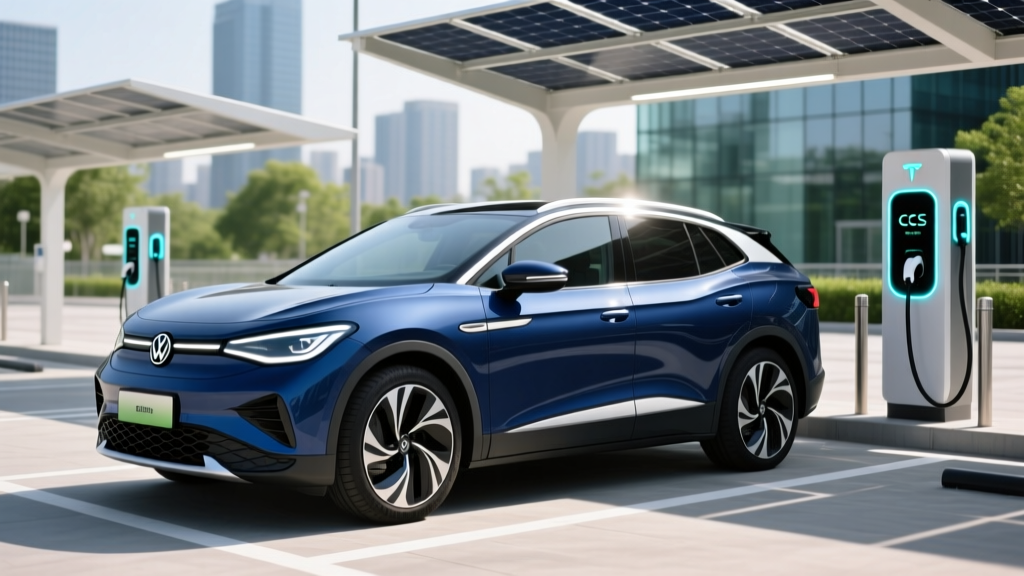
The 2025 Volkswagen ID.4 remains one of the most practical mainstream electric SUVs on the market, and for many buyers, leasing is the smartest path into it. With the ID.4 assembled in Chattanooga, Tennessee, and equipped with a refreshed infotainment system, Volkswagen has addressed many of the early-generation complaints. But before you sign a lease, you need the exact numbers — range, charging speed, pricing, and whether the federal tax credit actually applies to your situation.
This guide breaks down everything that matters for 2025 Volkswagen ID.4 leasing: real-world range expectations, charging infrastructure compatibility, total cost math, and how this electric compact SUV stacks up against the Hyundai Ioniq 5, Tesla Model Y, and Ford Mustang Mach-E.
2025 VW ID.4: Core Specs at a Glance
| Specification | RWD (Standard/Pro) | AWD (Pro S / Pro S Plus) |
|---|---|---|
| EPA Range | 291 miles (Standard) / 275 mi (Pro) | 263 mi (Pro S) |
| Battery (usable) | 77 kWh (Standard: 62 kWh) | 77 kWh |
| Battery Chemistry | NMC (Nickel Manganese Cobalt) | NMC |
| Max DC Fast Charge | 170 kW | 170 kW |
| 10–80% DCFC Time | ~28 minutes | ~28 minutes |
| Level 2 Home Charge Rate | 11 kW (~37 mi/hr) | 11 kW (~37 mi/hr) |
| Horsepower | 282 hp | 335 hp |
| 0–60 mph | 7.5 seconds | 5.4 seconds |
| Drivetrain | Rear-Wheel Drive | Dual-Motor AWD |
| MPGe (combined) | 104 MPGe | 95 MPGe |
| Efficiency | 32 kWh/100 mi | 35 kWh/100 mi |
| Cargo Volume (rear seats up) | 30.3 cu ft | 30.3 cu ft |
| Cargo Volume (rear seats folded) | 64.2 cu ft | 64.2 cu ft |
| Rear Legroom | 37.6 inches | 37.6 inches |
| Towing Capacity | 2,200 lbs | 2,700 lbs |
| Battery Warranty | 8 years / 100,000 miles (70% capacity retention) | |
| Base MSRP | $39,735 (Standard) | $46,135 (Pro S AWD) |
Real-World Range: What the EPA Number Doesn't Tell You
The 77 kWh usable battery pack (NMC chemistry) provides solid energy density, but the ID.4's aerodynamic profile and weight work against highway efficiency. According to fueleconomy.gov, the RWD model achieves 104 MPGe combined, translating to roughly 32 kWh per 100 miles. That's competitive but not class-leading — the Hyundai Ioniq 5 RWD pulls 114 MPGe combined from a similarly sized pack.
For daily commuting under 60 miles round-trip, the ID.4's range is more than adequate with home charging. Road-trippers should plan charging stops every 200–220 miles to stay in the optimal charge-curve window and avoid the steep taper above 80% State of Charge.
Charging Speed: DC Fast and Home Level 2
| Charging Level | Power (kW) | Speed (miles/hr) | Typical Use Case |
|---|---|---|---|
| Level 1 (120V) | ~1.4 kW | ~4–5 mi/hr | Emergency / overnight trickle |
| Level 2 (240V, 48A) | 11 kW | ~37 mi/hr | Home / workplace daily charging |
| DC Fast Charge | 170 kW (peak) | ~650 mi/hr (peak) | Road trips, Electrify America network |
The ID.4's 170 kW peak DC fast-charging rate is adequate but trails competitors. The Hyundai Ioniq 5 and Kia EV6 hit 240 kW on 800V architecture, while the Tesla Model Y peaks around 250 kW. In practice, the ID.4 sustains close to its peak rate between 10–50% SoC, then tapers progressively. The 10–80% charge takes approximately 28 minutes at a capable station.
One significant ownership perk: Volkswagen includes three years of unlimited Electrify America charging (or a kWh credit equivalent, depending on current program terms) with new ID.4 purchases and leases. Electrify America's network, while improving, still has reliability gaps in some regions — factor that into your road-trip planning.
For home Level 2 charging, the onboard 11 kW charger replenishes the 77 kWh pack from empty to full in roughly 7.5 hours. Most owners will plug in at 20–30% remaining and wake to a full battery. A 48-amp Level 2 home charger (requiring a 60-amp circuit) is the recommended setup. Expect installation costs of $800–$2,000 depending on your electrical panel capacity and run length — a licensed electrician should assess your 200-amp panel headroom before committing.
Lease Pricing, Tax Credits, and Total Cost
The 2025 ID.4 lineup starts at $39,735 for the Standard trim (62 kWh battery, 291-mile range) and climbs to approximately $53,035 for the fully loaded Pro S Plus AWD. Here's how the trims break down:
| Trim | Drivetrain | MSRP (incl. destination) | Key Features |
|---|---|---|---|
| Standard | RWD | $39,735 | 62 kWh pack, 291-mi range, 12.9" display |
| Pro | RWD | $43,735 | 77 kWh pack, 275-mi range, heated seats |
| Pro S | RWD | $47,235 | Panoramic roof, premium interior |
| Pro S | AWD | $46,135 | Dual-motor, 335 hp, 263-mi range |
| Pro S Plus | AWD | $53,035 | Full ADAS suite, ventilated seats, tow pkg |
Federal Tax Credit: The Leasing Advantage
Under IRS §30D rules, the federal EV tax credit of up to $7,500 has strict requirements for purchases: buyer income caps ($150K single / $300K joint), vehicle MSRP caps ($55,000 for SUVs), and battery critical-mineral and component sourcing thresholds that change annually. The ID.4, assembled in Tennessee, has historically met domestic content requirements, but the critical-minerals threshold tightens each year and must be verified at point of sale.
Here's where leasing gets interesting. When you lease an EV, the $7,500 credit technically goes to the lessor (the financing company), not to you. However, most major lessors pass this savings through as a lease capital-cost reduction, effectively lowering your monthly payment. This "lease loophole" (technically a commercial clean-vehicle credit under §45W that lessors utilize) has the added benefit of bypassing the buyer income caps and MSRP caps that apply to purchase credits. Confirm with your dealer that the lease quote reflects the passed-through credit before signing.
- MSRP Cap (purchases): $55,000 for SUVs — all ID.4 trims qualify
- Income Cap (purchases): $150K single / $225K head of household / $300K joint AGI
- Battery Sourcing: Critical-mineral and component thresholds increase annually; verify with dealer at time of purchase or lease
- Point-of-Sale Transfer: Eligible buyers can transfer the credit to the dealer for an immediate price reduction on purchases
- Lease Passthrough: Not guaranteed — confirm with lessor/dealer that the $7,500 is reflected in your lease terms
For a realistic lease scenario: a 2025 ID.4 Pro RWD ($43,735 MSRP) with the $7,500 credit applied as a cap-cost reduction, 36-month term, 10,000 miles/year, and typical money factor might land in the $350–$450/month range depending on your region, dealer incentives, and credit tier. Always get quotes from multiple VW dealers and compare the total lease cost (monthly × term + drive-offs + disposition fee), not just the headline monthly payment.
Tech, Interior, and Driver Assistance
Volkswagen overhauled the ID.4's software for the 2024–2025 model years, addressing the laggy, frustrating infotainment that plagued early models. The current 12.9-inch touchscreen (on Pro and above) runs VW's updated ID. Software 4.0 with faster response times, wireless Apple CarPlay and Android Auto, and a restructured menu hierarchy. It's not Tesla-fast, but it's no longer a dealbreaker.
The driver-assistance suite includes:
- Travel Assist: Adaptive cruise + lane-centering (SAE Level 2 — driver must remain engaged and hands on wheel)
- Park Assist Plus: Automated parking with memory for repeated spots
- Front Assist: Automatic emergency braking with pedestrian detection
- Rear Traffic Alert: Cross-traffic warning when reversing
Interior quality is a mixed bag. The materials are durable but hard-plastic-heavy compared to the Hyundai Ioniq 5's more premium feel. Front seats are comfortable for long drives, and the 37.6 inches of rear legroom is generous for the compact SUV segment. The panoramic fixed glass roof (Pro S and above) creates an airy cabin but adds weight and offers no shade beyond a powered curtain.
The 30.3 cu ft cargo area behind the rear seats is competitive, expanding to 64.2 cu ft with seats folded. There's no front trunk (frunk) on AWD models; RWD models have a small storage compartment but not a true frunk. This is a notable omission versus the Ioniq 5 and Mach-E, both of which offer usable front storage.
How the ID.4 Compares: Buy or Look Elsewhere?
| Spec | VW ID.4 Pro RWD | Hyundai Ioniq 5 SEL RWD | Tesla Model Y LR | Ford Mach-E Premium RWD |
|---|---|---|---|---|
| EPA Range | 275 mi | 303 mi | 320 mi | 290 mi |
| Battery | 77 kWh NMC | 77.4 kWh NMC | ~75 kWh NMC | 72 kWh NMC |
| Max DCFC | 170 kW | 240 kW | 250 kW | 150 kW |
| 10–80% DCFC | ~28 min | ~18 min | ~20 min | ~35 min |
| 0–60 mph | 7.5 sec | 7.0 sec | 4.8 sec | 6.1 sec |
| Base MSRP | $43,735 | $46,650 | $44,990 | $43,995 |
| Cargo (seats up) | 30.3 cu ft | 27.2 cu ft | 30.2 cu ft | 29.7 cu ft |
The ID.4's 170 kW charging speed is its most significant competitive disadvantage. If road-trip charging time matters to you, the Ioniq 5's 800V architecture (18-minute 10–80%) or Tesla's Supercharger network (20-minute 10–80%) are meaningfully faster. For daily commuters who rarely DC fast-charge, this gap matters far less.
Where the ID.4 wins: cargo volume (tied with Model Y, ahead of Ioniq 5), ride comfort (VW-tuned suspension absorbs road imperfections better than the firmer Ioniq 5 and Mach-E), and included Electrify America charging (three years free). The ID.4 also tends to receive strong lease incentives from VW Credit, often making it more affordable month-to-month than the sticker price suggests.
- Choose the ID.4 if: You prioritize ride comfort, need maximum cargo space, commute daily with home charging, and value VW's included Electrify America plan for occasional road trips.
- Choose the Ioniq 5 if: Fast DC charging is a priority, you prefer 800V architecture, or you want a more distinctive design and slightly better efficiency.
- Choose the Model Y if: Supercharger network access is critical for your road-trip routes, you want the quickest acceleration, or you prefer over-the-air feature updates.
- Choose the Mach-E if: You want sporty handling dynamics and don't mind slightly slower charging speeds.
Pros and Cons
Pros
- Spacious 30.3 cu ft cargo area, 37.6" rear legroom
- Comfortable, compliant ride quality
- 3 years included Electrify America charging
- Competitive lease pricing with credit passthrough
- Strong 8-year/100,000-mi battery warranty
- Improved infotainment software (ID. 4.0)
- Domestic assembly (Chattanooga, TN) supports credit eligibility
Cons
- 170 kW DC charging trails key competitors
- No usable frunk on AWD models
- Interior materials feel budget for the price point
- Touch-sensitive steering wheel controls are frustrating
- Efficiency (32 kWh/100 mi) lags Ioniq 5 and Model Y
- Electrify America reliability inconsistent in some regions
- 2,200-lb towing capacity (RWD) is limited
Who Should Lease the 2025 ID.4?
The 2025 ID.4 is best suited for daily commuters and small families who charge at home and take road trips two to four times per year. Its combination of spacious cargo area, comfortable ride, and included Electrify America charging makes it a practical family hauler. The AWD variant adds confidence in snow-belt states without a massive range penalty.
Leasing specifically makes sense if you want to avoid long-term battery-degradation risk (though VW's 8-year/100,000-mile warranty covers capacity below 70%), plan to upgrade to a next-generation EV in three years, or want to capture the $7,500 credit without worrying about income-cap eligibility. For high-mileage drivers (15,000+ miles/year), compare the lease mileage penalty ($0.20–$0.25/mile typical) against purchase economics — buying may be cheaper long-term.
According to IIHS ratings, the ID.4 has earned strong safety scores, adding peace of mind for family buyers. If your commute is under 60 miles, you rarely DC fast-charge, and you value comfort over cutting-edge charging tech, the ID.4 lease proposition is compelling in 2025.
Frequently Asked Questions
What is the real-world range of the 2025 VW ID.4?
The ID.4 Pro RWD is EPA-rated at 275 miles. In real-world mixed driving, expect 240–260 miles. Highway-only driving at 70+ mph yields roughly 220–240 miles. Cold weather (below freezing) can reduce range by 20–30%, bringing effective winter range to 175–210 miles.
How fast does the ID.4 charge at home and on the road?
At home on a Level 2 (240V, 48A) charger, the ID.4 charges at 11 kW, adding about 37 miles of range per hour — a full charge from empty takes roughly 7.5 hours. On DC fast chargers, it peaks at 170 kW and charges from 10–80% in approximately 28 minutes. This is slower than the Ioniq 5 (18 min) and Model Y (20 min).
How much does the 2025 ID.4 cost after the federal tax credit?
The ID.4 Pro RWD starts at $43,735. If you qualify for the full $7,500 federal credit on a purchase, the effective price drops to $36,235. On a lease, the credit typically passes through as a cap-cost reduction, lowering monthly payments — but confirm this with your dealer as it's not automatic.
Does the 2025 VW ID.4 qualify for the $7,500 federal EV tax credit?
The ID.4 qualifies on paper: its MSRP is under the $55,000 SUV cap, it's assembled in the US, and VW has historically met sourcing requirements. However, eligibility depends on your income (under $150K single / $300K joint for purchases), the specific battery-sourcing compliance at time of delivery, and whether you're purchasing or leasing. Leasing bypasses income and MSRP caps. Always verify with your dealer and consult a tax professional. See IRS guidelines for current rules.
Is the ID.4 worth leasing over the Hyundai Ioniq 5 or Tesla Model Y?
It depends on your priorities. The ID.4 offers the best ride comfort, generous cargo space, and included Electrify America charging. The Ioniq 5 charges significantly faster (240 kW vs 170 kW) and is more efficient. The Model Y offers the best Supercharger network access and acceleration. If daily comfort and family practicality matter more than peak charging speed, the ID.4 is a strong lease candidate — especially when VW runs aggressive lease incentives.
What's the battery warranty on the 2025 ID.4?
Volkswagen covers the ID.4's high-voltage battery for 8 years or 100,000 miles, whichever comes first. The warranty guarantees the battery will retain at least 70% of its original usable capacity. If degradation drops below this threshold within the warranty period, VW will repair or replace the battery at no cost.