The Retro-Electric Van That Actually Delivers Practicality
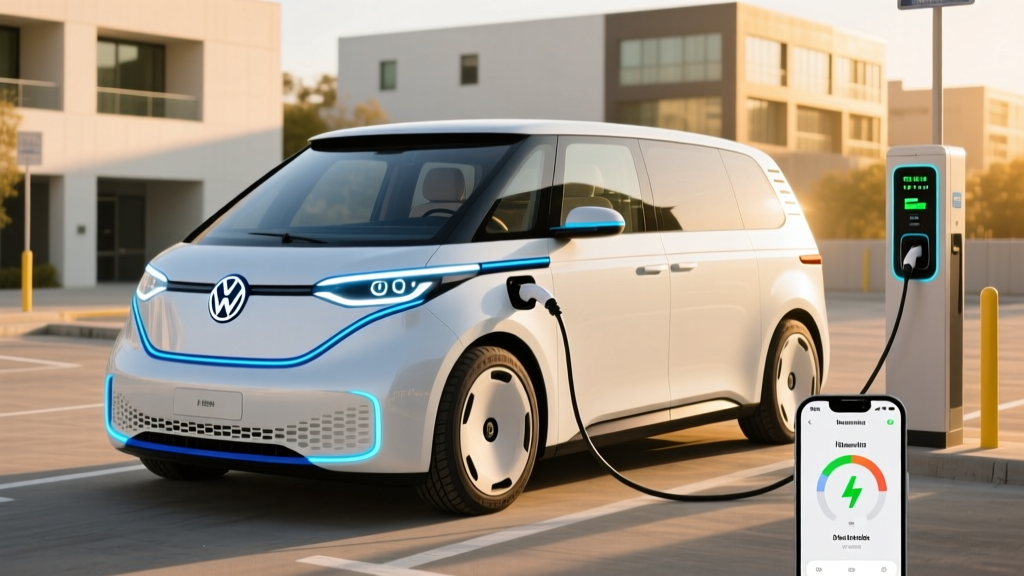
The 2025 Volkswagen ID. Buzz microbus arrives in the U.S. with a long wheelbase, three rows of seating, and the kind of head-turning design that makes strangers approach you in parking lots. But beneath the two-tone paint and surfboard-era nostalgia sits a serious 91 kWh (usable) electric minivan built on VW's MEB platform. After spending time with the specs, cross-referencing EPA data, and analyzing its charging behavior, here's what matters for buyers actually considering this vehicle.
The ID. Buzz isn't trying to be the longest-range EV or the quickest to 60 mph. It's a people-hauler with genuine cargo versatility, a usable fast-charging curve, and a starting price that — while steep — undercuts some luxury three-row SUVs. Let's break down every number that matters.
Range, Efficiency, and the Real-World Caveats
The EPA rates the 2025 ID. Buzz at 234 miles for the rear-wheel-drive Pro S trim and 231 miles for the all-wheel-drive 4Motion variant. Those numbers are modest for a vehicle with a 91 kWh usable battery, but the Buzz's aerodynamic profile — it's a van, not a teardrop — explains the efficiency gap versus sleeker crossovers.
EPA sticker: 234 mi (RWD Pro S) / 231 mi (AWD 4Motion)
Real-world highway (70-75 mph): Expect 185–205 miles before needing to charge. The tall, flat frontal area hits efficiency hard at speed.
Cold weather (below 32°F): Plan for 160–180 miles. The MEB platform's thermal management helps, but a large cabin volume demands significant heating energy.
City / suburban mixed driving: 215–230 miles is achievable with regenerative braking doing heavy lifting in stop-and-go traffic.
Efficiency lands at approximately 87 MPGe combined (roughly 38–40 kWh/100 mi) according to fueleconomy.gov. That's thirstier than a Tesla Model Y or Hyundai Ioniq 5, but comparable to the Rivian R1S or any large three-row electric SUV. If your daily driving stays under 150 miles and you charge at home, the range is perfectly livable. Road trippers will need to plan stops every 180 miles or so at highway speeds.
Battery Chemistry, Specs, and Longevity
Volkswagen equips the U.S.-spec ID. Buzz with an NMC (nickel manganese cobalt) lithium-ion battery pack. Unlike the LFP (lithium iron phosphate) chemistry found in some base-model Teslas, NMC offers higher energy density — important in a package-constrained van floor — but requires more careful state-of-charge management for long-term health.
| Spec | RWD Pro S | AWD 4Motion |
|---|---|---|
| Usable Battery Capacity | 91 kWh (NMC) | 91 kWh (NMC) |
| EPA Range | 234 mi | 231 mi |
| Horsepower | 282 hp | 335 hp |
| 0–60 mph | 7.9 sec (est.) | 6.5 sec (est.) |
| Drivetrain | Rear-Wheel Drive | Dual-Motor AWD |
| Max DC Fast Charge | 170 kW | 170 kW |
| 10–80% DC Charge Time | ~26 min | ~26 min |
| Level 2 Home Charge Rate | 11 kW (AC) | 11 kW (AC) |
| Efficiency (combined) | ~87 MPGe | ~85 MPGe |
| Seating | 7 passengers | 7 passengers |
| Cargo (behind 3rd row) | 18.3 cu ft | 18.3 cu ft |
| Cargo (3rd row folded) | 75.5 cu ft | 75.5 cu ft |
| Base MSRP | $59,995 | $63,495 |
VW backs the battery with an 8-year / 100,000-mile warranty guaranteeing at least 70% capacity retention. That's industry-standard and aligns with Hyundai, Kia, and Ford. For NMC chemistry, daily charging to 80% and avoiding prolonged 100% states will help preserve long-term health. VW's battery management system includes a buffer above and below the usable window, protecting the cells from the most damaging extremes.
Charging Speed: DC Fast, Level 2, and What to Expect
The ID. Buzz accepts up to 170 kW on a DC fast charger via its CCS1 connector (VW has not adopted NACS for the 2025 model year). On a 350 kW Electrify America or comparable station, you'll see peak rates near 170 kW in the 10–30% state-of-charge window, with a progressive taper above 60%. The 10–80% charge takes approximately 26 minutes under ideal thermal conditions.
| Charging Level | Power | Speed | Notes |
|---|---|---|---|
| Level 1 (120V household) | ~1.4 kW | ~4 mi/hr | Emergency/trickle only; full charge takes 60+ hours |
| Level 2 (240V home) | 11 kW (48A) | ~28 mi/hr | 0–100% in ~8.5 hours; overnight-friendly |
| DC Fast Charge | Up to 170 kW | 10–80% in ~26 min | Peak rate sustained to ~40% SoC, then tapers; preconditioning recommended |
For home charging, the onboard 11 kW AC charger means a full overnight replenishment on a Level 2 wallbox. If you install a 48-amp hardwired charger (requiring a 60-amp circuit), you'll max out the Buzz's AC capability. Expect to pay $800–$1,500 for a quality Level 2 station and $500–$2,000 for electrician installation, depending on panel proximity and whether your home needs a service upgrade.
One practical note: the ID. Buzz supports route-based battery preconditioning. When you navigate to a DC fast charger, the thermal management system warms the pack for optimal charge acceptance. Skip this step on a cold morning and your peak charge rate may drop to 100–120 kW until the pack self-heats.
Interior Space, Tech, and Driver Assistance
The long-wheelbase U.S. ID. Buzz stretches to 193.5 inches overall with a 118.7-inch wheelbase, unlocking legitimate third-row usability. Legroom measures 40.6 inches in the front, 39.6 inches in the second row, and 32.5 inches in the third — that third row accommodates adults on shorter trips, though it's tighter than a Chrysler Pacifica or Kia Carnival.
Cargo volume behind the third row is 18.3 cubic feet — enough for a few grocery bags or carry-on luggage. Fold the third row and you access 75.5 cubic feet, rivaling midsize SUVs. Fold both rear rows and maximum cargo hits approximately 130 cubic feet, making this a genuinely capable hauler for furniture, camping gear, or airport runs.
Infotainment runs on VW's ID. Software 4.0 with a 12.9-inch touchscreen. The interface has improved over early ID.4 implementations — response times are snappier and the capacitive slider controls for volume and temperature are less frustrating, though physical button enthusiasts will still grumble. Wireless Apple CarPlay and Android Auto are standard, along with a 10.25-inch digital driver display.
Driver assistance comes via VW's IQ.DRIVE suite: adaptive cruise control with stop-and-go, lane centering, automatic emergency braking, blind-spot monitoring, and rear cross-traffic alert. This is SAE Level 2 driver assistance — it supports you on highways but requires continuous hands-on-wheel engagement and visual attention. It is not autonomous driving, and VW makes no claims otherwise.
Pricing, Trims, and the Federal Tax Credit Question
The 2025 ID. Buzz starts at $59,995 for the RWD Pro S and climbs to $63,495 for the AWD 4Motion Pro S. A fully loaded 1st Edition model (available only at launch) pushes past $69,000. All trims include the full IQ.DRIVE suite, heated front seats, power sliding doors, and that distinctive two-tone roof treatment.
| Trim | MSRP | Federal §30D Credit | Effective Price |
|---|---|---|---|
| Pro S (RWD) | $59,995 | Eligibility varies* | Varies |
| Pro S (AWD 4Motion) | $63,495 | Eligibility varies* | Varies |
| 1st Edition (AWD) | ~$69,995 | Eligibility varies* | Varies |
Does the ID. Buzz qualify for the $7,500 federal EV tax credit? The answer depends on your specific situation and current IRS rules under IRS §30D. The ID. Buzz is assembled in Hanover, Germany, which historically has disqualified it from the full new-vehicle credit due to the North American final-assembly requirement. However, the commercial clean vehicle credit (§45W) pathway and potential lease-pass-through structures have allowed some VW dealers to offer credit-equivalent incentives. Key eligibility factors include:
- Final assembly location: Must be in North America for §30D — the ID. Buzz is built in Germany, which is a barrier.
- MSRP cap: Vans must be under $80,000 — all ID. Buzz trims clear this threshold.
- Buyer income cap: $300,000 joint / $150,000 single filer for §30D.
- Battery sourcing & critical minerals: Must meet escalating domestic-content thresholds per IRS guidance.
- Lease loophole: Lessors may claim the §45W commercial credit and pass savings as a capitalized-cost reduction, regardless of assembly location.
*Always consult a tax professional and verify current rules at irs.gov before relying on credit eligibility. Point-of-sale transfer is available for qualifying vehicles, but the assembly requirement remains the ID. Buzz's biggest credit hurdle.
How It Stacks Up Against Competitors
The ID. Buzz occupies a unique niche — there's no direct electric minivan rival in the U.S. market. Buyers cross-shop it against three-row electric SUVs and conventional minivans:
vs. Chrysler Pacifica PHEV: The Pacifica offers 32 miles of electric-only range before the gas engine fires, making it more versatile for road trips and apartment dwellers without charging access. The ID. Buzz is fully electric with lower operating costs but less range flexibility. If you regularly drive 400+ miles in a day, the Pacifica's gas backup matters.
vs. Kia EV9: The three-row EV9 offers up to 304 miles EPA range, faster 210 kW DC charging, and a lower starting price around $54,900. It's the more rational choice for range-priority buyers. But the EV9 can't match the Buzz's cargo volume, sliding-door convenience, or cultural cachet.
vs. Rivian R1S: More capable off-road, quicker, and longer-ranged, but starts above $75,000 and seats fewer in the third row. The R1S is an adventure vehicle; the Buzz is a family shuttle.
- Iconic design that draws positive attention everywhere
- Genuine 7-passenger seating with usable third row
- 130+ cu ft max cargo with both rows folded
- Power sliding doors — a minivan essential
- 170 kW DC charging is adequate for road trips
- Quiet, refined ride quality at highway speeds
- 234-mile EPA range is modest for the price
- Highway range drops significantly (185–205 mi real-world)
- German assembly complicates federal tax credit eligibility
- Starting near $60K is steep for a minivan
- CCS1 connector as NACS adoption accelerates industry-wide
- Capacitive touch controls still frustrate some drivers
Who Should Buy the 2025 ID. Buzz
This EV suits a specific buyer: families and commuters who want a distinctive, practical electric people-hauler and can charge at home. If your daily routine involves school drop-offs, grocery runs, and weekend activities within a 100-mile radius, the Buzz handles it all with room to spare. The sliding doors alone make it superior to any three-row SUV for tight parking lots and active kids.
It's less ideal for frequent long-distance travelers who can't tolerate 25-minute charge stops every 180 miles, or for apartment dwellers without reliable home or workplace charging. And if federal tax credit eligibility is a dealbreaker for your budget, the German assembly origin requires workarounds (like leasing) that may not suit everyone.
The ID. Buzz is not the most efficient or longest-range EV you can buy. It's the one that makes your family smile every time they climb aboard — and that emotional return has real value.
Frequently Asked Questions
What is the real-world range of the 2025 Volkswagen ID. Buzz?
The EPA rates it at 234 miles (RWD) or 231 miles (AWD). In real-world highway driving at 70–75 mph, expect 185–205 miles. In cold weather below freezing, plan for 160–180 miles. City driving with regenerative braking can approach the EPA number.
How fast does the ID. Buzz charge at home and on DC fast chargers?
On a Level 2 home charger (240V, 48A), it charges at 11 kW, adding roughly 28 miles per hour — a full charge takes about 8.5 hours overnight. On a DC fast charger, it peaks at 170 kW and charges from 10–80% in approximately 26 minutes under ideal conditions.
Does the 2025 ID. Buzz qualify for the $7,500 federal EV tax credit?
Likely not via the standard §30D new-vehicle credit, because it is assembled in Germany rather than North America. However, some buyers may access equivalent savings through dealer lease structures that utilize the §45W commercial clean vehicle credit. Verify current rules with a tax professional and at irs.gov.
Is the ID. Buzz worth buying over the Kia EV9 or Chrysler Pacifica?
If you prioritize cargo space, sliding-door convenience, and distinctive design, yes. If maximum range and tax-credit certainty are your top criteria, the Kia EV9 (304 mi EPA, faster charging, lower price) or Pacifica PHEV (gas backup, established credit eligibility) may be more practical. The Buzz trades some efficiency for versatility and character.
What are the biggest drawbacks of the ID. Buzz?
Modest 234-mile EPA range relative to its price, significant highway and cold-weather range reduction, complicated federal tax credit eligibility due to German assembly, and a starting MSRP near $60,000. The CCS1 connector also faces an uncertain future as the industry shifts to NACS.
How long will the ID. Buzz battery last?
VW warrants the battery for 8 years or 100,000 miles against capacity loss below 70%. With proper NMC care (daily 80% charge limit, avoiding extreme heat exposure), real-world data from VW's MEB platform suggests 85–90% capacity retention at 100,000 miles is realistic. Full battery replacement, if needed out of warranty, is estimated at $15,000–$20,000 based on current MEB pricing.