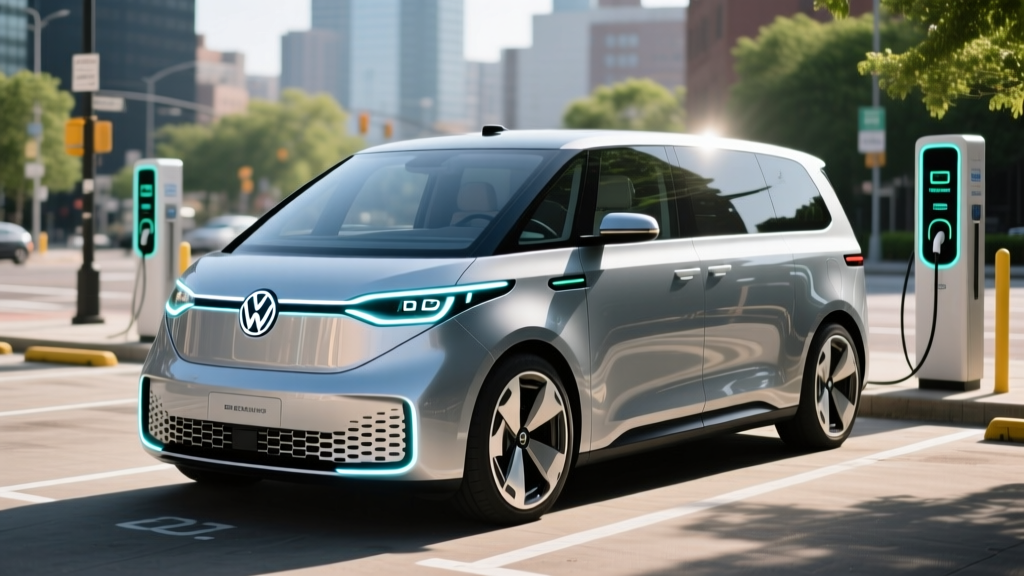
The 2025 Volkswagen ID. Buzz arrives in the United States carrying more than a half-century of Microbus nostalgia on its shoulders. Built on VW's MEB platform and stretched for American roads, this three-row electric van targets families, shuttle operators, and anyone who needs serious interior volume without burning fossil fuels. But nostalgia doesn't charge batteries, and the ID. Buzz enters a market where buyers demand hard numbers on range, charging speed, and total cost. Here's everything you need to know before signing the paperwork.
2025 Volkswagen ID. Buzz: Quick Specs at a Glance
| Specification | RWD (Standard) | AWD (Pro S) |
|---|---|---|
| EPA Range | 234 miles | 216 miles |
| Battery (usable) | 91 kWh (NMC) | 91 kWh (NMC) |
| Horsepower | 282 hp | 335 hp |
| 0–60 mph | ~7.9 sec | ~5.9 sec |
| DC Fast Charge (peak) | 170 kW | 170 kW |
| 10–80% DC Charge | ~26 min | ~26 min |
| Level 2 Home Charge | 11 kW (~30 mi/hr) | 11 kW (~30 mi/hr) |
| MPGe (combined) | 87 MPGe | 80 MPGe |
| Base MSRP | $59,995 | $63,495 |
| Battery Warranty | 8 years / 100,000 miles | |
Real-World Range: What the EPA Sticker Doesn't Tell You
Real-World Expectation: 195–220 miles on mixed highway driving; 160–185 miles in sub-freezing conditions
The EPA rates the rear-wheel-drive ID. Buzz at 234 miles, which is competitive for a vehicle of this size and weight. However, the ID. Buzz is a tall, boxy van with the aerodynamic profile of, well, a bus. At sustained highway speeds above 70 mph, expect efficiency to drop noticeably — our experience with similarly shaped EVs suggests 195 to 220 miles is a realistic highway figure in moderate temperatures.
Cold weather compounds the penalty. The ID. Buzz uses a liquid-cooled NMC (nickel manganese cobalt) battery pack, which performs well but still loses 15–25% of usable capacity in temperatures below 32°F. VW includes a heat pump across all trims, which helps preserve cabin comfort without draining the traction battery as aggressively as resistive heating. Still, if you live in Minnesota or Maine and plan winter road trips, budget for roughly 160–185 miles of usable range and plan charging stops accordingly.
Around town, where regenerative braking recaptures energy and speeds stay lower, hitting or even slightly exceeding the EPA number is achievable. The van's 91 kWh of usable capacity gives it a substantial energy buffer, and in stop-and-go commuting, that buffer works in your favor.
Charging Speed: DC Fast Charging and Home Setup
The ID. Buzz supports a peak DC fast-charge rate of 170 kW via its CCS connector. That's not class-leading — rivals like the Hyundai Ioniq 5 peak at 240 kW — but VW's charge curve is reasonably flat, meaning the van sustains useful speeds through the bulk of the session.
| Charging Method | Power (kW) | Speed (approx.) | Notes |
|---|---|---|---|
| Level 1 (120V outlet) | 1.2 kW | ~3 mi/hr | Emergency/trickle only |
| Level 2 (240V, 48A) | 11 kW | ~30 mi/hr | Full charge in ~9.5 hours |
| DC Fast Charge | 170 kW (peak) | 10–80% in ~26 min | Tapers significantly above 80% |
On a 150 kW or faster Electrify America or CCS-compatible station, you'll add roughly 130–150 miles in 20 minutes under ideal conditions. The charge curve holds near peak through approximately 40–50% state of charge, then tapers progressively. Above 80%, the rate drops sharply — a common trait of NMC chemistry designed to protect long-term battery health. If you're on a road trip, plan to unplug around 80% and drive; waiting for 100% at a DC station adds disproportionate time for minimal range gain.
For home charging, the 11 kW onboard charger means a full 0–100% session takes roughly 9.5 hours on a hardwired Level 2 station. That's an overnight affair and perfectly practical for daily use. Most owners will arrive home with 40–60% remaining and wake up fully charged. Installation of a 240V/48A home charger typically runs $800–$2,000 depending on your electrical panel's capacity and the run length from panel to garage — budget for a potential panel upgrade if you're still on a 100-amp service.
Performance, Drivetrain, and Efficiency
The standard rear-wheel-drive ID. Buzz puts 282 horsepower to the rear wheels via a single APP550 electric motor mounted on the rear axle. The 0–60 mph sprint takes approximately 7.9 seconds — adequate for merging and passing, though the van's 5,800+ pound curb weight is evident when you push the accelerator hard. The RWD layout gives the ID. Buzz a tighter turning circle than you'd expect from its dimensions, making it surprisingly manageable in parking structures and urban environments.
Step up to the AWD Pro S and a front induction motor joins the party, boosting combined output to 335 hp and cutting the 0–60 time to roughly 5.9 seconds. The dual-motor setup also provides genuine all-weather traction, which matters if you're driving the family to mountain ski resorts or navigating unplowed suburban streets. The trade-off is a 216-mile EPA range (down from 234) and a $3,500 price premium.
Efficiency lands at 87 MPGe combined for RWD and 80 MPGe for AWD. In more intuitive terms, the RWD model consumes roughly 39 kWh per 100 miles in mixed driving. That's thirstier than a Tesla Model Y or Hyundai Ioniq 5, but expected given the ID. Buzz's frontal area and weight. At the national average electricity rate of ~$0.16/kWh, fueling costs roughly $6.24 per 100 miles — still dramatically cheaper than a gas-powered minivan achieving 22 mpg at $3.50/gallon ($15.91 per 100 miles).
Interior Space, Cargo, and Family Practicality
This is where the ID. Buzz earns its keep. The US-spec long-wheelbase model stretches 195.3 inches overall on a 117.6-inch wheelbase, translating into genuinely usable three-row seating and substantial cargo volume.
- Behind 3rd row: 18.8 cu ft — enough for a few grocery bags or a compact stroller
- Behind 2nd row (3rd row folded): 75.5 cu ft — competitive with midsize SUVs
- Max cargo (2nd & 3rd folded): 134.5 cu ft — van territory, genuinely vast
- 2nd-row legroom: ~40.0 inches — generous for adults
- 3rd-row legroom: ~34.5 inches — suitable for children or shorter adults on longer trips
The second-row seats slide fore and aft on tracks, letting you prioritize legroom or cargo depending on the trip. The cabin is wide enough for three-across child seat installation in the second row, a genuine advantage over narrower SUVs. The flat floor (no transmission tunnel) makes cross-cabin movement easy, and the elevated seating position gives all passengers excellent outward visibility.
One practical limitation: the ID. Buzz does not offer a frunk (front trunk). The rear-mounted motor and associated electronics consume the space under the hood. All cargo must go in back, which is fine given the volume available but worth noting if you're used to the front-trunk storage in a Tesla or Rivian.
Pricing, Trims, and Federal Tax Credit Eligibility
| Trim | Drivetrain | MSRP | Est. After §30D Credit* |
|---|---|---|---|
| Standard | RWD | $59,995 | $52,495 |
| Pro S | RWD | $63,495 | $55,995 |
| Pro S Plus | AWD | $69,995 | $62,495 |
| 1st Edition | AWD | $73,495 | $65,995 |
*Estimated price assumes full $7,500 federal tax credit under IRS §30D. Actual eligibility depends on buyer income, battery sourcing, and MSRP caps. Consult a tax professional.
The ID. Buzz is classified as a van for §30D purposes, which means the MSRP cap is $80,000 (higher than the $55,000 sedan cap). All current trims fall under that threshold, which is good news. However, eligibility for the full $7,500 credit depends on two additional hurdles:
- Income caps: Modified AGI ≤ $300,000 (joint), ≤ $225,000 (head of household), ≤ $150,000 (single)
- MSRP cap: ≤ $80,000 for vans/SUVs/pickups (all ID. Buzz trims qualify)
- Battery sourcing: Critical minerals and battery components must meet escalating domestic/free-trade-partner thresholds — check VW's official compliance status at purchase, as these requirements tighten annually
- Point-of-sale transfer: Eligible buyers can apply the credit as an immediate price reduction at the dealer rather than waiting for a tax refund
The battery-sourcing requirement is the variable most likely to reduce the credit from $7,500 to $3,750 or eliminate it entirely. VW sources battery cells for the US-market ID. Buzz from supply chains that are still adapting to domestic-content mandates. Before committing to a purchase, confirm with your dealer which credit amount the vehicle currently qualifies for — this can change with supply-chain updates and IRS guidance revisions.
Tech, Safety, and Driver Assistance
The ID. Buzz runs VW's latest ID. Software 4.0 on a 12.9-inch touchscreen infotainment system. The interface is a meaningful improvement over earlier ID.4 software, with faster response times, better menu logic, and wireless Apple CarPlay and Android Auto. A 10.25-inch digital driver display handles speed, range, and navigation directions.
Standard driver-assistance features under VW's IQ.DRIVE umbrella include:
- Adaptive cruise control with stop-and-go
- Lane-keeping assist with lane-centering (SAE Level 2)
- Automatic emergency braking with pedestrian detection
- Blind-spot monitoring with rear cross-traffic alert
- Park Assist Plus with surround-view camera
One standout feature: the ID. Buzz offers Vehicle-to-Home (V2H) capability on select trims via an available bi-directional charger, meaning the van's 91 kWh battery can power essential home circuits during an outage. This is a genuine differentiator for buyers in areas prone to grid disruptions.
Pros and Cons: The Honest Assessment
- Class-leading interior volume — true three-row comfort with usable cargo
- Distinctive styling with genuine heritage appeal
- Strong standard feature set across all trims
- Tight turning circle for its size; easy urban driving
- Heat pump standard (preserves winter range)
- Available V2H bi-directional charging
- 8-year/100,000-mile battery warranty
- 170 kW peak DC charging is slower than key rivals
- Real-world highway range falls short of EPA estimate
- No frunk — all cargo goes in back
- $60K+ starting price before incentives
- Federal tax credit eligibility uncertain due to battery-sourcing rules
- No hands-free highway driving assist available
- Heavy vehicle = higher tire wear and insurance costs
Who Should Buy the 2025 Volkswagen ID. Buzz?
The ID. Buzz is purpose-built for a specific buyer: families or fleet operators who need genuine three-row seating, substantial cargo volume, and daily-drivable electric range. If your routine involves school runs, weekend gear hauling, or airport shuttle duties within a ~200-mile radius, the ID. Buzz is one of the few EVs that meets those needs without compromise on passenger comfort.
It's less ideal for buyers who prioritize maximum range or fastest charging. If your primary use case is long-distance road-tripping with minimal stops, a Tesla Model X or the upcoming generation of 350 kW-capable SUVs will serve you better. And if you only occasionally need three rows, a smaller two-row EV paired with a rental minivan for big trips may be more cost-effective.
Look elsewhere if: You regularly drive 300+ miles between charges, need the fastest possible DC charging, or want hands-free highway driving assist.
Frequently Asked Questions
What is the real-world range of the 2025 VW ID. Buzz?
The EPA rates the RWD model at 234 miles and the AWD at 216 miles. In real-world mixed highway driving at moderate temperatures, expect 195–220 miles. In cold weather (below 32°F), plan for 160–185 miles. City driving with regenerative braking can match or slightly exceed the EPA estimate.
How fast does the ID. Buzz charge?
On a DC fast charger, the ID. Buzz peaks at 170 kW and charges from 10–80% in approximately 26 minutes. At home on a Level 2 (240V/48A) station, it charges at 11 kW, adding roughly 30 miles per hour and completing a full charge in about 9.5 hours.
Does the 2025 ID. Buzz qualify for the $7,500 federal tax credit?
All trims fall under the $80,000 MSRP cap for vans, which is one requirement. However, eligibility also depends on buyer income (≤ $300,000 joint AGI) and battery-sourcing compliance, which can change. Confirm the exact credit amount with your dealer and consult a tax professional before purchase. The credit may be applied at the point of sale if you qualify.
Is the ID. Buzz worth buying vs. a Tesla Model X or Kia EV9?
The Tesla Model X offers more range (329+ miles EPA) and faster Supercharger access but starts above $80,000 and may not qualify for the federal credit due to MSRP caps. The Kia EV9 starts lower (~$54,900), offers up to 304 miles of range, and charges faster at 236 kW, but its third row is tighter than the ID. Buzz's. If maximum interior volume and heritage styling matter most, the ID. Buzz wins. If range and charging speed top your list, the EV9 is the stronger pick.
What is the battery warranty on the ID. Buzz?
Volkswagen covers the ID. Buzz's high-voltage battery for 8 years or 100,000 miles (whichever comes first), guaranteeing a minimum of 70% capacity retention over that period. The general vehicle warranty is 4 years/50,000 miles bumper-to-bumper.
Can the ID. Buzz tow?
Yes. The ID. Buzz is rated to tow up to 2,500 pounds when properly equipped — sufficient for a small utility trailer, a pair of dirt bikes, or a lightweight pop-up camper. Towing will reduce range by approximately 20–30% depending on trailer weight and aerodynamics.