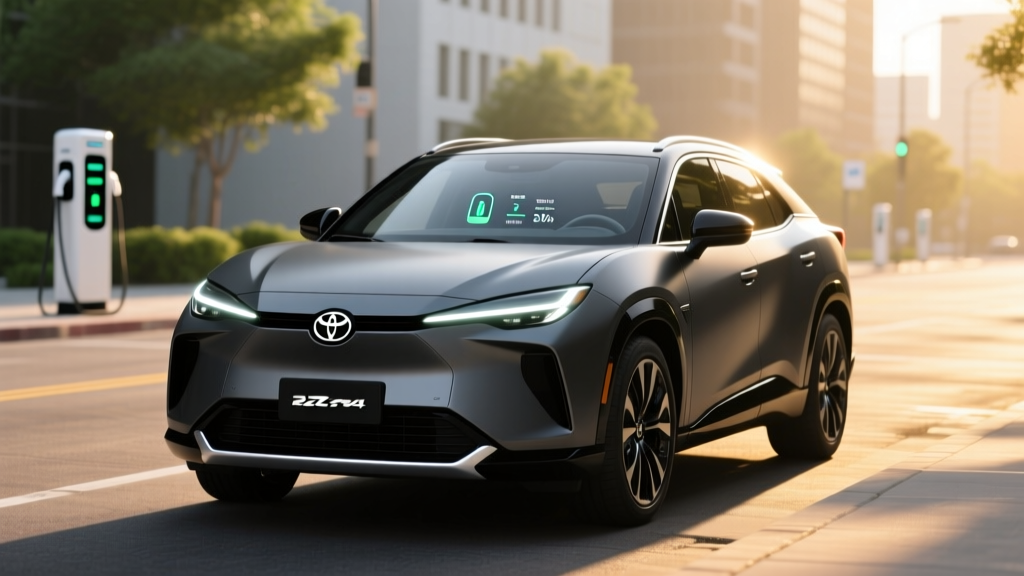
The 2025 Toyota bZ4X Nightshade arrives as a mid-cycle refresh of Toyota's first dedicated battery-electric vehicle, adding blacked-out styling cues and a slightly repositioned price point to an EV that has drawn both curiosity and criticism since its 2023 debut. The Nightshade edition — a Toyota trim tradition applied across its lineup — brings gloss-black 20-inch wheels, dark badging, and a black roof to the bZ4X's otherwise conventional crossover silhouette. But styling alone doesn't sell EVs in 2025. Buyers need to know about real-world range, charging speed, and whether this Toyota earns its place against rivals like the Hyundai Ioniq 5, Tesla Model Y, and Ford Mustang Mach-E.
We've compiled EPA data, manufacturer specifications, and real-world driving observations to give you a complete picture of what the bZ4X Nightshade delivers — and where it falls short.
2025 Toyota bZ4X Nightshade: Core Specifications
| Specification | bZ4X Nightshade (AWD) | bZ4X Limited (FWD) |
|---|---|---|
| EPA Range | 222 miles | 252 miles |
| Battery Capacity (Usable) | 65.6 kWh (NMC) | 65.6 kWh (NMC) |
| Drivetrain | Dual-motor AWD | Single-motor FWD |
| Horsepower | 214 hp combined | 201 hp |
| Torque | 248 lb-ft | 196 lb-ft |
| 0-60 mph | 5.8 seconds | 7.1 seconds |
| Max DC Fast Charge | 150 kW | 150 kW |
| 10-80% DCFC Time | ~30 minutes | ~30 minutes |
| Level 2 Home Charging | 6.6 kW (~25 mi/hr) | 6.6 kW (~25 mi/hr) |
| MPGe (Combined) | 102 MPGe | 114 MPGe |
| Efficiency | 33 kWh/100 mi | 29 kWh/100 mi |
| Base MSRP | $43,430 | $46,850 |
| Battery Warranty | 8 years / 100,000 miles | 8 years / 100,000 miles |
Source: fueleconomy.gov and Toyota Motor Corporation specifications.
Real-World Range: What the EPA Number Doesn't Tell You
Real-World Expectation: ~180-200 miles highway at 70 mph; ~160-175 miles in freezing temperatures with cabin heat; ~200-215 miles mixed city/suburban driving in mild weather.
The bZ4X's EPA range has been a flashpoint since the model launched. The 222-mile AWD figure (which applies to the Nightshade) trails key competitors by 50-80 miles on paper. But the EPA test cycle, while standardized, doesn't capture how range shifts under real conditions.
In mixed suburban and city driving at moderate temperatures (55-75°F), the bZ4X AWD consistently achieves 200-215 miles on a full charge. The regenerative braking system recovers meaningful energy in stop-and-go traffic, and the AWD model's efficiency penalty is most pronounced at sustained highway speeds.
At 70-75 mph on the interstate, expect the usable range to drop to roughly 180-200 miles. The bZ4X lacks a heat pump on US-spec models — a notable omission that Toyota has not corrected for 2025. In cold weather (below 32°F), resistive cabin heating draws heavily from the 65.6 kWh battery, and range can contract to 160-175 miles depending on trip length and preconditioning habits. If you live in a region with harsh winters, plan your daily driving around ~170 miles of reliable cold-weather range.
Compared to the Hyundai Ioniq 5's 266-mile AWD EPA rating or the Tesla Model Y Long Range's 308 miles, the bZ4X Nightshade requires more frequent charging stops on road trips exceeding 180 miles. For daily commuting under 80 miles round-trip, however, the range is entirely adequate — you'll charge at home every other night and rarely think about it.
Charging Speed: DC Fast Charging and Home Setup
| Charging Level | Power | Speed (Miles Added/Hour) | Notes |
|---|---|---|---|
| Level 1 (120V household) | ~1.2 kW | ~4 mi/hr | Emergency/trickle only; ~55 hrs for full charge |
| Level 2 (240V home) | 6.6 kW (max onboard) | ~25 mi/hr | Full charge in ~10 hours; requires 30A+ circuit |
| DC Fast Charge (CCS) | 150 kW peak | ~150 mi in 30 min (10-80%) | Peak rate brief; tapers significantly above 60% SoC |
The bZ4X charges at a maximum of 150 kW on DC fast chargers using the CCS1 connector. In practice, the charging curve tells a more important story than the peak number. The bZ4X reaches its peak charge rate only briefly in the 10-30% state-of-charge window, then tapers progressively. From 60% to 80%, the rate drops substantially, which is why Toyota quotes a 10-80% time of approximately 30 minutes rather than a faster figure.
For comparison, the Hyundai Ioniq 5 and Kia EV6 — built on the 800V E-GMP platform — sustain higher charge rates deeper into the session and achieve 10-80% in roughly 18 minutes on a 350 kW charger. The Tesla Model Y, on the NACS connector and Supercharger network, averages around 25 minutes for the same 10-80% window. The bZ4X's 30-minute result is functional but not class-leading.
At home on a Level 2 charger, the bZ4X's 6.6 kW onboard charger is adequate for overnight replenishment. A full charge from empty takes approximately 10 hours. Most owners will plug in each evening and wake to a full battery — the standard EV ownership rhythm. If your daily drive is under 60 miles, a Level 2 session of 2-3 hours restores your daily consumption.
Home installation note: A Level 2 home charger requires a dedicated 240V circuit (typically 40A for a 32A charger). Installation costs range from $500-$2,000 depending on panel proximity and local permit requirements. Always consult a licensed electrician for a site-specific quote.
Performance and Driving Dynamics
The Nightshade trim comes exclusively with Toyota's dual-motor AWD powertrain, producing 214 combined horsepower and 248 lb-ft of torque. Each axle has its own electric motor — 80 kW front, 80 kW rear — managed by Toyota's X-MODE traction system, which provides selectable drive modes for snow, mud, and sand.
The 0-60 mph time of 5.8 seconds is respectable for a compact crossover and provides confident highway merging. The bZ4X's acceleration curve is linear and immediate, as expected from electric motors, though it lacks the punchy thrust of the Model Y Performance (3.5 seconds) or Ioniq 5 AWD (5.0 seconds).
Ride quality is a genuine strength. The bZ4X is tuned for comfort over sportiness, absorbing road imperfections with composure that outclasses the firmer-riding Ioniq 5. Steering is light and precise, if lacking in feedback. At highway speeds, cabin noise is well-managed — a benefit of the dedicated EV platform's lower center of gravity and structural rigidity.
One-pedal driving is available but requires activation through the drive mode selector. Toyota's regenerative braking implementation is less aggressive than competitors; some drivers will prefer blending regen with the friction brakes for a more natural deceleration feel.
Interior, Cargo, and Technology
The Nightshade's interior distinguishes itself with black Softex (synthetic leather) upholstery, dark metallic trim accents, and the gloss-black exterior elements that define the trim. The cabin layout uses a distinctive "island" center console with a floating design that opens up foot space for front passengers.
Passenger space:
- Front legroom: 42.1 inches
- Rear legroom: 35.7 inches
- Front headroom: 39.9 inches
- Rear headroom: 38.1 inches
Cargo volume:
- Behind rear seats: 27.7 cu ft
- Rear seats folded: 56.9 cu ft
- Frunk (front trunk): None — the bZ4X does not offer a front trunk, a missed opportunity given the EV platform
The 12.3-inch touchscreen runs Toyota's latest Audio Multimedia system with wireless Apple CarPlay and Android Auto. The system is responsive and logically menued, though the bZ4X still relies on a separate digital gauge cluster positioned high on the dash — designed to approximate a head-up display without actually projecting onto the windshield. It works, but some drivers find the placement requires a slightly longer eye diversion than a traditional instrument cluster or a true HUD.
Driver assistance: Toyota Safety Sense 3.0 is standard across all bZ4X trims, including:
- Pre-Collision System with Pedestrian Detection
- Lane Departure Alert with Steering Assist
- Lane Tracing Assist (centering)
- Full-Speed Range Dynamic Radar Cruise Control
- Road Sign Assist
- Proactive Driving Assist (low-speed collision avoidance)
These features constitute a SAE Level 2 driver-assistance system. The driver must remain fully engaged, with hands on the wheel and eyes on the road, at all times. This is not autonomous or self-driving capability.
Pricing, Trims, and Federal Tax Credit Eligibility
| Trim | MSRP | Destination | Total Before Incentives | Est. After §30D Credit* |
|---|---|---|---|---|
| bZ4X XLE (FWD) | $37,070 | $1,395 | $38,465 | Varies — see below |
| bZ4X XLE (AWD) | $39,130 | $1,395 | $40,525 | Varies — see below |
| bZ4X Nightshade (AWD) | $43,430 | $1,395 | $44,825 | Varies — see below |
| bZ4X Limited (FWD) | $46,850 | $1,395 | $48,245 | Varies — see below |
| bZ4X Limited (AWD) | $48,780 | $1,395 | $50,175 | Varies — see below |
*Federal tax credit eligibility under IRS §30D depends on multiple factors that change periodically.
The 2025 bZ4X Nightshade's $44,825 as-priced total places it in a competitive segment, but federal tax credit eligibility is complex and cannot be assumed. Under current §30D rules, a qualifying buyer may receive up to $7,500 — but only if all of the following conditions are met:
- MSRP cap: SUVs/crossovers must have an MSRP at or below $80,000 (the bZ4X clears this easily)
- Buyer income cap: Modified adjusted gross income must not exceed $150,000 (single), $225,000 (head of household), or $300,000 (joint filers)
- Battery sourcing: A percentage of critical minerals and battery components must be sourced from the US or free-trade-agreement countries — these thresholds increase annually and may affect eligibility depending on the specific battery cell supply chain for the model year
- Point-of-sale transfer: As of 2024, buyers can transfer the credit to the dealer at purchase, reducing the sale price directly rather than waiting for a tax refund
Critical caveat: Battery-sourcing and critical-mineral requirements have tightened significantly since §30D was enacted. Many EVs that qualified in 2023 no longer qualify in 2025 due to stricter thresholds. Always verify current eligibility on the fueleconomy.gov tax credit page and consult a tax professional before relying on the credit in your purchase decision.
Battery Chemistry, Degradation, and Warranty
The bZ4X uses a 71.4 kWh gross / 65.6 kWh usable lithium-ion battery pack with NMC (nickel-manganese-cobalt) chemistry. Toyota deliberately limits the usable buffer — the gap between gross and net capacity — to reduce stress on the cells and slow long-term degradation. This conservative approach is consistent with Toyota's historical caution on battery management.
The battery warranty covers 8 years or 100,000 miles (whichever comes first) against defects and excessive capacity loss. Toyota defines "excessive" as dropping below 70% of original capacity during the warranty period. This 70% threshold is standard across the industry, though some competitors (like Hyundai) warrant to 70% for 10 years/100,000 miles.
NMC chemistry offers higher energy density than LFP (lithium iron phosphate) but is more sensitive to sustained high states of charge. Best practice for long-term health: charge to 80% for daily use and reserve 100% charges for road trips. The bZ4X's onboard software allows you to set a charge limit, which we strongly recommend using.
Based on early fleet data and Toyota's historical battery management track record (excellent in the hybrid space), projected degradation over 8 years of typical use is approximately 10-15%. That translates to roughly 190-200 miles of range from a full charge by year 8 for the AWD Nightshade — still functional for most daily needs but a noticeable reduction.
How the bZ4X Nightshade Stacks Up Against Competitors
| Attribute | bZ4X Nightshade AWD | Ioniq 5 SEL AWD | Model Y Long Range AWD | Mach-E Premium AWD |
|---|---|---|---|---|
| EPA Range | 222 mi | 266 mi | 308 mi | 250 mi |
| Battery (usable) | 65.6 kWh | 77.4 kWh | ~75 kWh | 70 kWh (ext. range: 91 kWh) |
| DCFC 10-80% | ~30 min | ~18 min | ~25 min | ~30 min |
| 0-60 mph | 5.8 sec | 5.0 sec | 4.8 sec | 5.1 sec |
| Horsepower | 214 hp | 320 hp | 384 hp | 346 hp (ext. range) |
| Cargo (rear seats up) | 27.7 cu ft | 27.2 cu ft | 30.2 cu ft | 29.7 cu ft |
| Base MSRP (AWD) | $43,430 | $49,600 | $47,730 | $48,995 |
| Heat Pump (US) | No | Yes | Yes | Yes |
The bZ4X Nightshade's most compelling advantage is price. At $43,430, it undercuts every AWD competitor listed above by $4,000-$6,000. For buyers who prioritize entry cost and Toyota's reliability reputation over maximum range and charging speed, the value proposition is real.
However, the gaps are measurable. The Ioniq 5 charges nearly twice as fast on DC and offers 44 more EPA miles. The Model Y's range advantage exceeds 80 miles, and Tesla's Supercharger network remains the most reliable public charging ecosystem in the US. The Mach-E provides more power and a slightly larger battery at a higher price.
Who Should Buy the bZ4X Nightshade?
- Your daily commute is under 80 miles round-trip and you have reliable home Level 2 charging
- You value Toyota's dealer network, resale reputation, and conservative engineering over cutting-edge EV performance
- You want an AWD electric crossover under $45,000 and don't regularly take road trips exceeding 200 miles
- Cold-weather range loss is acceptable because your trips are short and predictable
- You frequently drive 250+ miles between charges (the range deficit adds real inconvenience)
- Fast public charging is critical to your use case (the 30-min 10-80% time and taper curve lag rivals)
- You live in a very cold climate and need maximum winter range (the lack of a heat pump is a meaningful drawback)
- You want a frunk, one-pedal driving as default, or the most advanced infotainment system in the segment
Pros
- Competitive pricing for an AWD EV crossover
- Comfortable ride quality and well-isolated cabin
- Toyota Safety Sense 3.0 standard across all trims
- X-MODE AWD system with genuine light off-road/traction capability
- Conservative battery management may yield strong long-term SoH
- Strong Toyota dealer service network nationwide
Cons
- EPA range (222 mi AWD) trails competitors by 40-80+ miles
- No heat pump on US-spec models — cold-weather range suffers
- DC fast charging peaks at 150 kW with early taper — 30 min 10-80%
- No frunk (front trunk) despite dedicated EV platform
- 6.6 kW onboard charger limits Level 2 speed vs some 11.5 kW rivals
- Federal tax credit eligibility uncertain due to battery-sourcing rules
Frequently Asked Questions
What is the real-world range of the 2025 Toyota bZ4X Nightshade?
The EPA rates the AWD Nightshade at 222 miles. In real-world mixed driving at moderate temperatures, expect 200-215 miles. Highway driving at 70+ mph reduces this to roughly 180-200 miles. In freezing weather without a heat pump, plan for 160-175 miles of reliable range.
How fast does the bZ4X Nightshade charge?
On a DC fast charger, the bZ4X peaks at 150 kW and achieves 10-80% in approximately 30 minutes, though the charge rate tapers significantly above 60% state of charge. At home on Level 2 (240V), the 6.6 kW onboard charger adds about 25 miles per hour, reaching a full charge in roughly 10 hours.
Does the 2025 bZ4X qualify for the $7,500 federal EV tax credit?
Eligibility under IRS §30D depends on buyer income (capped at $150K-$300K depending on filing status), the vehicle's MSRP (under the $80K SUV cap — the bZ4X qualifies), and battery component/critical mineral sourcing requirements that change annually. As of 2025, sourcing rules have tightened, and eligibility cannot be assumed. Verify current status on fueleconomy.gov and consult a tax professional.
Is the bZ4X Nightshade worth buying over the Ioniq 5 or Model Y?
It depends on your priorities. The bZ4X Nightshade undercuts both on price by $4,000-$6,000 and offers a comfortable, well-built crossover with Toyota's reliability pedigree. However, both the Ioniq 5 (faster charging, more range, heat pump) and Model Y (significantly more range, Supercharger access) are more capable EVs for road-trip-heavy or cold-climate buyers. If you charge at home and commute short distances, the bZ4X's value makes it a strong choice.
Does the bZ4X have a heat pump?
No. US-spec bZ4X models do not include a heat pump. Toyota uses a conventional resistive heating system, which draws more energy from the battery in cold weather compared to a heat pump. This is a notable drawback for buyers in northern climates.
What is the bZ4X Nightshade's battery warranty?
Toyota covers the bZ4X battery for 8 years or 100,000 miles against defects and capacity loss below 70% of original capacity. The basic vehicle warranty is 3 years/36,000 miles, and the powertrain warranty is 5 years/60,000 miles.