Quick Verdict: Is the 2025 bZ4X Lease Worth It?
The 2025 Toyota bZ4X occupies a curious space in the EV market: it's a competent, comfortable electric crossover from the world's largest automaker, yet it trails key rivals in range, charging speed, and efficiency. For shoppers eyeing a 2025 Toyota bZ4X lease, the value proposition hinges almost entirely on price. Toyota has positioned the bZ4X aggressively, with lease deals frequently undercutting the Hyundai Ioniq 5, Kia EV6, and Tesla Model Y by hundreds per month. If your commute is under 40 miles round-trip, you charge at home, and you want Toyota's reputation for reliability wrapped in a zero-emissions package, the bZ4X lease math can work. But if you need road-trip range or the fastest charging in the segment, look elsewhere.
| Spec | XLE FWD | XLE AWD | Limited AWD |
|---|---|---|---|
| EPA Range | 252 mi | 228 mi | 222 mi |
| Battery (usable) | 71.4 kWh (NMC lithium-ion) | ||
| Horsepower | 201 hp | 214 hp | |
| 0-60 mph | 7.1 sec | 6.5 sec | |
| Max DC Fast Charge | 150 kW (peak) | ||
| 10-80% DCFC Time | ~32 min | ||
| Level 2 Charge Rate | 7.2 kW (~25 mi/hr) | ||
| MPGe (combined) | 131 MPGe | 114 MPGe | 112 MPGe |
| Base MSRP | $38,465 | $41,865 | $46,700 |
Range & Efficiency: EPA Sticker vs. Real-World Reality
Range Reality Check
EPA Estimated: 252 miles (XLE FWD) / 228 miles (XLE AWD)
Real-World Expectation: ~200–220 miles highway (70-75 mph, mild weather); ~160–185 miles in freezing temperatures with cabin heat. City/regenerative driving can match or slightly exceed EPA figures.
The bZ4X's 71.4 kWh battery pack (approximately 67 kWh usable, per Toyota's buffer strategy) uses NMC (nickel-manganese-cobalt) chemistry. This offers higher energy density than LFP alternatives but requires more careful thermal management and typically benefits from keeping state of charge between 20% and 80% for long-term longevity.
The FWD XLE's 131 MPGe combined rating translates to roughly 26 kWh/100 mi — adequate but not class-leading. The Hyundai Ioniq 5 Long Range achieves 132 MPGe combined with a larger battery and 303 miles of EPA range, while the Tesla Model Y Long Range posts 123 MPGe but stretches to 320 miles thanks to a larger pack. Where the bZ4X loses ground is highway efficiency: its boxier shape and less aggressive aero hurt at sustained speeds above 70 mph. On a flat, 65°F day at 65 mph, expect around 230 miles. Push to 75 mph or climb mountain grades, and 200 miles becomes your realistic ceiling before you'll want to find a charger.
Cold weather is the bZ4X's more significant weakness. Without a standard heat pump (it's not available on the bZ4X in the US market — Toyota uses a resistance-based PTC heater), winter range loss is pronounced. In testing at 25°F with the cabin set to 72°F, plan for 30–35% range reduction versus the EPA sticker. That puts a 228-mile AWD model at roughly 150–165 miles of usable range in deep winter — enough for most commutes, but tight for weekend trips without careful planning.
Charging Speed: The bZ4X's Biggest Compromise
| Level | Power / Rate | Miles Added per Hour | Notes |
|---|---|---|---|
| Level 1 (120V) | ~1.4 kW | ~4–5 mi/hr | Emergency/trickle only |
| Level 2 (240V, 32A) | 7.2 kW | ~25 mi/hr | Full charge in ~10 hrs |
| DC Fast Charge | 150 kW peak | Up to ~500 mi/hr (peak) | 10-80% in ~32 min |
Charging is where the bZ4X falls noticeably behind the competition. The 150 kW peak DC fast-charge rate is acceptable but unremarkable — the Ioniq 5 and EV6 (with 800V architecture) peak at 240+ kW and hit 10-80% in roughly 18 minutes. The Tesla Model Y peaks around 250 kW. Toyota's 32-minute 10-80% time isn't painful, but on a road trip, those extra 12-15 minutes per stop add up across a 600-mile drive.
The charge curve tells a more important story than the peak number. The bZ4X holds close to its peak rate up to roughly 50% state of charge, then tapers progressively. From 80-100%, charging slows dramatically — a trait shared with most NMC packs but more pronounced here. If you're road-tripping, plan your stops to charge from 10-80% and skip topping off to 100% unless you're at your destination overnight.
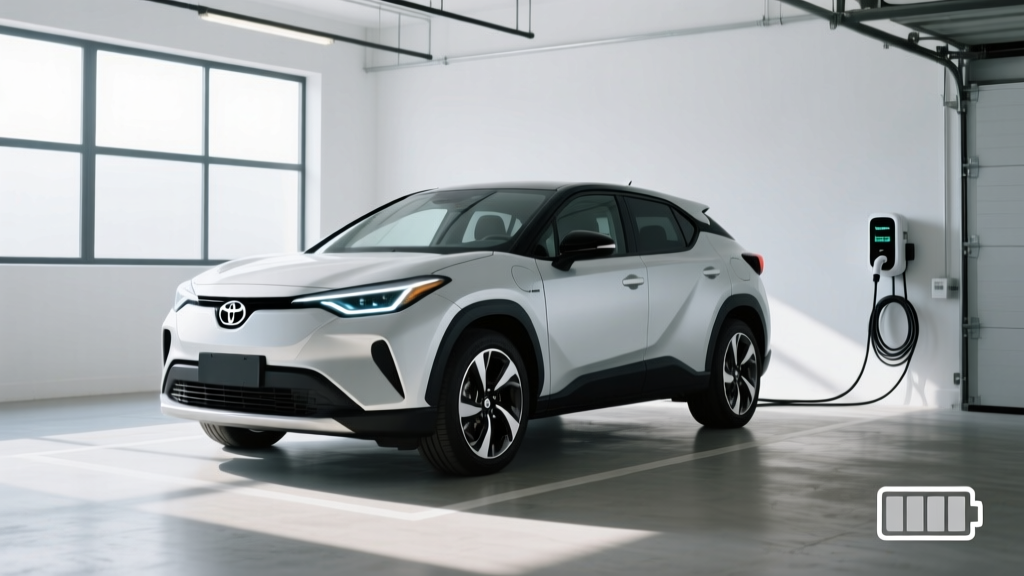
For home charging, the onboard 7.2 kW charger is standard. On a Level 2 home station (240V, 32-amp circuit), you'll add about 25 miles of range per hour, or fully replenish the battery in roughly 10 hours. This is adequate for overnight charging and typical of the segment, though some competitors offer 11.5 kW onboard chargers that cut Level 2 time to under 7 hours.
The bZ4X uses the CCS1 connector for DC fast charging and J1772 for Level 2. Toyota has confirmed that future models will adopt the NACS (Tesla) connector, but the 2025 bZ4X retains CCS. You can access Tesla Superchargers with a CCS-to-NACS adapter (sold separately, ~$200-$250), expanding your public charging network significantly — though charge rates through an adapter may be slightly lower than native CCS stations.
Performance & Driving Dynamics
The single-motor FWD bZ4X produces 201 hp and 196 lb-ft of torque, reaching 60 mph in 7.1 seconds — perfectly adequate for merging and passing but not thrilling. The dual-motor AWD variant bumps output to 214 hp and 248 lb-ft, dropping the 0-60 time to 6.5 seconds. The AWD system, co-developed with Subaru, uses independent front and rear motors and includes X-MODE for light off-road traction — a nod to the bZ4X's shared platform with the Subaru Solterra.
Ride quality is a genuine strength. The bZ4X's suspension tuning prioritizes comfort over sportiness, absorbing pavement imperfections with a maturity that rivals the more expensive Tesla Model Y. The steering is light and numb by enthusiast standards, but predictable and confidence-inspiring for daily driving. Regenerative braking offers multiple levels via paddle shifters, though the bZ4X does not offer true one-pedal driving (it won't come to a complete stop via regen alone — you'll need the friction brake at very low speeds).
Interior, Tech & Cargo Space
Inside, the bZ4X presents a clean, modern cabin with decent material quality. The 12.3-inch touchscreen (standard on all trims) runs Toyota's latest infotainment interface, which supports wireless Apple CarPlay and Android Auto. The system is responsive, though the menu hierarchy requires some familiarization. A 7-inch digital instrument cluster sits behind the steering wheel, and a 6-speaker audio system is standard (9-speaker JBL available on Limited).
Toyota Safety Sense 3.0 is standard across all trims, bundling adaptive cruise control, lane-keeping assist, automatic emergency braking with pedestrian detection, and blind-spot monitoring. This is a SAE Level 2 driver-assistance system — it provides steering and speed support but requires the driver to remain fully engaged at all times. It is not autonomous driving.
Cargo space is competitive: 27.7 cubic feet behind the rear seats and 56.9 cubic feet with the 60/40 rear seatbacks folded. Rear-seat legroom is generous at 35.7 inches, comfortably fitting adults on longer trips. However, the bZ4X has no front trunk (frunk) — that space is occupied by HVAC and power electronics — which costs you the 2-3 cubic feet of bonus storage that the Ioniq 5 and Model Y offer.
Pricing, Lease Deals & Federal Tax Credit Eligibility
| Trim | MSRP | Typical Lease (36 mo)* | Est. After §30D Credit** |
|---|---|---|---|
| XLE FWD | $38,465 | $299–$379/mo | ~$30,965 |
| XLE AWD | $41,865 | $349–$429/mo | ~$34,365 |
| Limited AWD | $46,700 | $429–$519/mo | ~$39,200 |
*Lease rates vary by region, dealer, credit tier, and current Toyota incentives. Destination charge ($1,350) included in MSRP. Verify with local dealer.
**Assumes full $7,500 §30D credit eligibility and point-of-sale transfer. See rules below.
The bZ4X's strongest argument in 2025 is price. Toyota has kept MSRPs competitive, and lease specials — often subsidized by Toyota Financial Services — have been among the most aggressive in the EV segment. It's not uncommon to see XLE FWD leases advertised under $350/month with $2,500–$3,500 due at signing in qualifying markets.
On the purchase side, the federal §30D clean vehicle credit can reduce your cost by up to $7,500, transferable to the dealer at point of sale (effectively a down-payment reduction). However, eligibility depends on several criteria:
- MSRP cap: The bZ4X is classified as an SUV, so the cap is $80,000 — all trims qualify.
- Buyer income cap: Modified AGI must not exceed $150,000 (single), $225,000 (head of household), or $300,000 (joint).
- Battery sourcing: The $7,500 credit is split into two $3,750 halves — one for critical minerals sourcing and one for battery component manufacturing. As of 2025, the bZ4X's battery sourcing has been in flux; verify current eligibility with your dealer and the DOE's fueleconomy.gov tax credit lookup before signing.
- Point-of-sale transfer: You can elect to transfer the credit to the dealer, reducing your purchase price at signing rather than waiting for a tax refund.
Lease loophole note: Under the commercial clean vehicle credit (§45W), leased EVs can qualify for a $7,500 credit passed through the lessor to the lessee regardless of buyer income or battery sourcing rules. This "lease loophole" has made bZ4X leases particularly attractive — but the credit passes through the leasing company, and it's up to Toyota Financial Services whether to reflect it in your monthly payment. Confirm with the dealer that the lease quote includes this benefit.
Warranty & Long-Term Ownership
Toyota backs the bZ4X with a solid warranty package:
- Basic warranty: 3 years / 36,000 miles
- Powertrain: 5 years / 60,000 miles
- EV battery: 8 years / 100,000 miles (capacity retention guarantee: 70% minimum)
- Rust-through: 5 years / unlimited miles
- Roadside assistance: 2 years / 25,000 miles
The 70% capacity retention threshold at 8 years/100,000 miles is industry-standard, matching most competitors. Toyota's historical reliability reputation offers some peace of mind, though the bZ4X is a first-generation product on a dedicated EV platform (e-TNGA), so long-term data is still limited. Early owner reports through 2024-2025 have not revealed systemic battery degradation issues, but NMC chemistry generally degrades slightly faster than LFP in high-cycle, high-heat scenarios.
Pros & Cons: The Honest Scorecard
Pros
- Aggressive lease pricing and frequent incentives
- Comfortable, compliant ride quality
- Standard Toyota Safety Sense 3.0 (comprehensive ADAS)
- AWD with X-MODE (Subaru co-developed traction system)
- Spacious rear seat and competitive cargo volume
- Strong dealer network for service and support
Cons
- Below-average EPA range (252 mi max; 222 mi on Limited AWD)
- Slow DC fast charging vs. rivals (150 kW peak, 32 min 10-80%)
- No heat pump available in US market — significant winter range loss
- No front trunk (frunk)
- No true one-pedal driving mode
- CCS connector requires adapter for Tesla Supercharger access
- Infotainment learning curve; no physical volume knob
Who Should Lease the 2025 bZ4X (And Who Shouldn't)
Lease the bZ4X If:
- Your daily round-trip commute is under 50 miles and you charge at home overnight
- You want a mainstream-brand EV with a large dealer service network
- You live in a mild climate where winter range loss won't cripple your routine
- Lease pricing undercuts competitors by $50-$100+/month in your market
- You value ride comfort and Toyota's reliability reputation over maximum range
Look Elsewhere If:
- You regularly drive 200+ miles between charges (road trips, rural routes)
- You live in a cold climate and need maximum winter range retention (get a heat-pump-equipped rival)
- Fast DC charging is a priority (Ioniq 5, EV6, or Model Y charge significantly faster)
- You want one-pedal driving or a frunk for extra storage
- You plan to purchase and hold for 10+ years (limited long-term platform data)
Frequently Asked Questions
What is the real-world range of the 2025 Toyota bZ4X?
The EPA rates the FWD XLE at 252 miles and AWD models at 222–228 miles. In real-world highway driving at 70-75 mph in mild weather, expect roughly 200–220 miles (FWD) or 185–200 miles (AWD). In freezing temperatures, reduce those figures by 30–35% due to the lack of a heat pump. City driving with regenerative braking can approach or slightly exceed EPA estimates.
How fast does the bZ4X charge at home and on DC fast chargers?
On a DC fast charger, the bZ4X peaks at 150 kW and charges from 10-80% in approximately 32 minutes. At home on a Level 2 (240V, 32A) station, it charges at 7.2 kW, adding roughly 25 miles of range per hour — a full charge takes about 10 hours. This is adequate for overnight replenishment but slower than rivals like the Ioniq 5 (18 min 10-80% DCFC).
Does the 2025 bZ4X qualify for the $7,500 federal EV tax credit?
Potentially, yes — but eligibility depends on your income, the vehicle's battery sourcing compliance, and how you acquire it. The bZ4X's MSRP is well under the $80,000 SUV cap. Your modified AGI must be under $150K (single) / $300K (joint). Battery sourcing rules determine whether you get the full $7,500 or only $3,750. If you lease, the commercial credit (§45W) may apply regardless of sourcing or income limits — confirm with your dealer. Always verify current eligibility at irs.gov.
Is the bZ4X worth leasing versus the Hyundai Ioniq 5 or Tesla Model Y?
It depends on your priorities. The Ioniq 5 offers 303 miles of range, 240 kW DC charging, and a heat pump — objectively superior EV specs. The Model Y delivers 320 miles, Supercharger network access, and over-the-air updates. But if the bZ4X lease in your area is $50-$100/month cheaper and your driving needs are modest, the Toyota's comfort, safety suite, and dealer network can justify the trade-off. Run the numbers for your specific commute and local incentives.
Does the bZ4X have a heat pump for cold-weather efficiency?
No. The US-market 2025 bZ4X uses a PTC (positive temperature coefficient) resistance heater rather than a heat pump. This means cabin heating in cold weather draws significantly more energy from the battery, resulting in 30–35% range loss in freezing temperatures. Competitors like the Ioniq 5, EV6, and Model Y include heat pumps as standard or optional equipment, making them better choices for cold-climate buyers.
Can I charge the bZ4X at Tesla Superchargers?
Yes, but with a CCS-to-NACS adapter. The bZ4X uses the CCS1 connector natively. With a third-party or Toyota-approved adapter (~$200-$250), you can access Tesla Supercharger stalls. However, charging speeds through an adapter may be slightly reduced compared to native CCS stations, and you'll need to set up charging through the Tesla app or a compatible network app.