The 2025 Tesla Model Y Rear-Wheel Drive occupies a rare position in the EV market: it is simultaneously one of the least expensive electric SUVs available and one of the most capable in terms of efficiency and charging infrastructure access. After Tesla's mid-cycle "Juniper" refresh, the base RWD Model Y received updated styling, a quieter cabin, and revised suspension tuning — while maintaining a starting price that undercuts most competitors once federal incentives are applied.
This review covers the single-motor, rear-wheel-drive variant specifically. If you need all-wheel drive or the extended range of the Long Range trim, we cover those separately. Here, we focus on whether the RWD Model Y delivers enough range, charging speed, and daily practicality to justify its position as Tesla's entry-level SUV.
Quick Verdict: Who Should Buy the RWD Model Y?
The 2025 Tesla Model Y Rear-Wheel Drive is best suited for urban and suburban drivers who charge primarily at home, commute under 60 miles round-trip, and live in moderate climates. It's an excellent first EV for buyers who want access to the Supercharger network without paying a premium. It is not ideal for frequent long-distance highway travel in cold climates, heavy towing, or buyers who prioritize luxury interior materials over software-driven minimalism.
Choose the Model Y RWD if: You want the lowest-cost entry into Tesla's ecosystem, charge at home nightly, and drive mostly in temperate conditions.
Consider the Long Range AWD instead if: You regularly take 300+ mile road trips, live in a cold-weather state, or need the traction of dual-motor AWD.
Range and Efficiency: EPA vs. Real World
The 2025 Model Y RWD carries an EPA-estimated range of 320 miles on a full charge. That figure comes from a usable battery capacity of approximately 57.5 kWh (gross capacity ~60 kWh) using LFP (lithium iron phosphate) chemistry. The energy efficiency rating is 122 MPGe combined, or roughly 28 kWh per 100 miles — among the most efficient electric SUVs sold.
EPA Range: 320 miles
Real-World Expectations:
- City/suburban driving (moderate climate): 310–330 miles — LFP cells and strong regenerative braking shine in stop-and-go traffic.
- Highway driving at 70–75 mph: 250–275 miles — aerodynamic drag and single-speed reduction gearing reduce efficiency at sustained speed.
- Cold weather (below 32°F): 210–260 miles — expect 20–30% range loss depending on cabin heat usage and whether you precondition. LFP chemistry is slightly more affected by cold than NMC.
- Worst-case (cold + highway + hills): ~190–210 miles — plan charging stops accordingly on winter road trips.
The LFP battery is a deliberate trade-off. Compared to the NMC cells in the Long Range AWD model, LFP offers lower energy density (hence the shorter range despite a similar physical pack size) but delivers superior cycle life, lower degradation over time, and reduced fire risk. Tesla recommends charging LFP batteries to 100% regularly — unlike NMC, which prefers an 80% daily limit — so you actually get to use the full 320 miles more often.
Charging Speed: DC Fast, Level 2, and Level 1
The Model Y RWD supports a peak DC fast-charge rate of 170 kW via its NACS connector. On a V3 or V4 Tesla Supercharger (or any NACS-compatible DC station), you can expect the following charge curve:
| Charging Method | Power / Rate | Speed (Miles Added) | Notes |
|---|---|---|---|
| DC Fast Charge (Supercharger V3+) | Peak 170 kW | ~10–80% in 28 min | Curve tapers sharply above 80%; peak sustained only from ~5–40% SoC |
| Level 2 (Tesla Wall Connector / NACS L2) | 11.5 kW (48A) | ~37 miles per hour | Full charge in ~6 hours from 10% |
| Level 2 (generic J1772 w/ adapter) | 7.2–11.5 kW | ~24–37 mi/hr | Requires NACS-to-J1772 adapter (included) |
| Level 1 (120V household outlet) | ~1.4 kW (12A) | ~4–5 miles per hour | Emergency/trickle only; ~48 hours for full charge |
Charging-curve reality check: The 170 kW peak is only sustained in a narrow state-of-charge window (roughly 5–40%). By 60% SoC, the rate drops to approximately 100 kW, and by 80% it falls below 50 kW. If you arrive at a Supercharger at 10% SoC, the 10–80% charge takes about 28 minutes. But charging from 80–100% adds another 35–40 minutes — which is why Tesla's navigation system will almost always route you to charge only up to the percentage needed to reach your next stop.
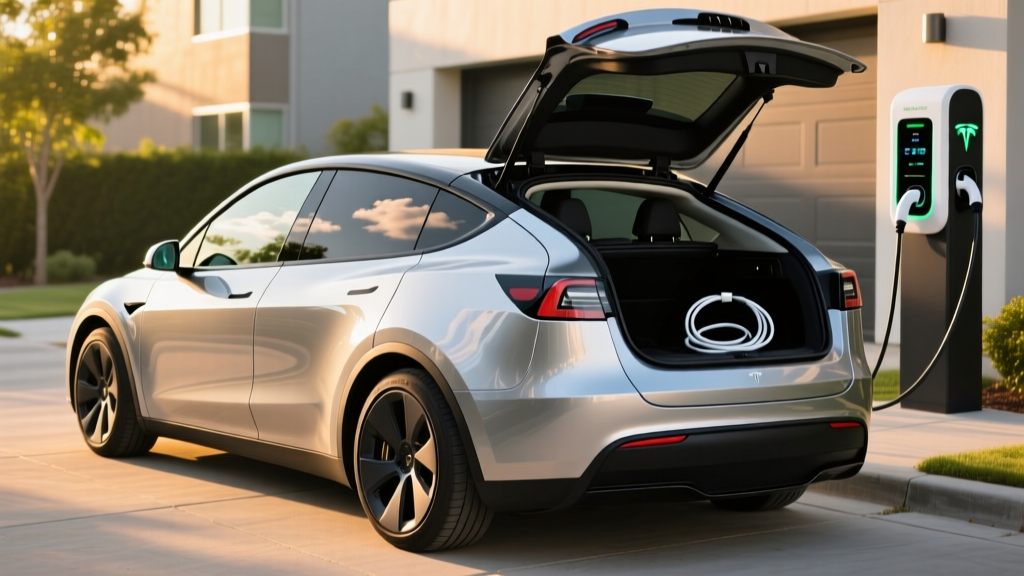
For home charging, a Tesla Wall Connector on a 60-amp circuit delivers the full 11.5 kW (48 amps continuous). A typical overnight session from 30% to 80% takes about 3.5 hours — more than sufficient for daily use. Installation costs for a Wall Connector setup typically range from $500 to $2,000 depending on your electrical panel's proximity to the garage and whether a panel upgrade is needed.
Performance and Drivetrain
The single rear-mounted motor produces 295 horsepower and 310 lb-ft of torque. Tesla rates the 0–60 mph sprint at 6.6 seconds. That's brisk enough for confident highway merging and passing, though noticeably a step behind the Long Range AWD (5.0 seconds) and the dual-motor Performance variant.
| Specification | 2025 Model Y RWD |
|---|---|
| Drivetrain | Rear-Wheel Drive (single motor) |
| Horsepower | 295 hp |
| Torque | 310 lb-ft |
| 0–60 mph | 6.6 seconds |
| Top Speed | 135 mph |
| Battery (Usable) | ~57.5 kWh, LFP |
| EPA Range | 320 miles |
| Efficiency | 122 MPGe / 28 kWh/100mi |
| DC Fast Charge | 170 kW peak (NACS) |
| Level 2 Charge | 11.5 kW (48A) |
| Towing Capacity | 3,500 lbs (when equipped) |
| Cargo Volume | 30.2 cu ft (rear seats up) / 72.1 cu ft (folded) |
| Frunk | 4.1 cu ft |
| Base MSRP | $44,990 (incl. destination) |
| Battery Warranty | 8 years / 100,000 miles (70% retention) |
| Vehicle Warranty | 4 years / 50,000 miles |
Regenerative braking is strong and offers near one-pedal driving in most conditions, though Tesla removed the user-adjustable regen setting several model years ago. The Juniper refresh added a slightly softer suspension tune that improves ride quality over rough pavement compared to the pre-2025 Model Y, though it still leans firm by midsize-SUV standards.
Interior, Cargo, and Technology
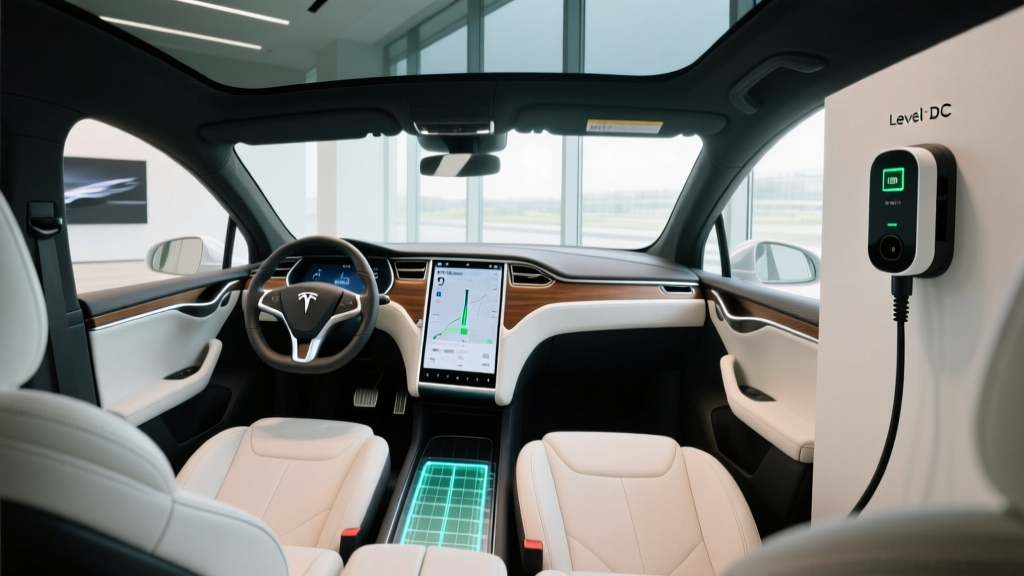
The Juniper update brought a noticeably quieter cabin (acoustic glass all around), ambient lighting, ventilated front seats, and a rear-seat touchscreen for climate and media control. The 15.4-inch center touchscreen remains the primary interface for nearly all vehicle functions — there are still no physical buttons for climate, mirrors, or glovebox release.
Passenger space:
- Front headroom: 40.7 in | Legroom: 41.8 in
- Rear headroom: 39.4 in | Legroom: 38.8 in
Rear-seat comfort is adequate for adults on trips up to two hours. The seat cushion is relatively flat and low to the floor (a consequence of packaging the battery underneath), which some passengers find less supportive than competing SUVs like the Hyundai Ioniq 5 or Ford Mustang Mach-E.
Cargo capacity is a genuine strength: 30.2 cubic feet behind the rear seats and 72.1 cubic feet with them folded flat. The 4.1-cubic-foot frunk adds useful space for charging cables or a laptop bag. With a maximum towing rating of 3,500 pounds (when equipped with the tow package), the RWD Model Y handles light trailer duty, though towing will cut range by roughly 40–50%.
Tech highlights:
- Tesla's infotainment system remains the industry benchmark for responsiveness, over-the-air updates, and integrated navigation with real-time Supercharger routing.
- Standard Autopilot includes adaptive cruise control, lane centering, and automatic emergency braking. Full Self-Driving (Supervised) is an optional add-on but remains an SAE Level 2 driver-assist system — the driver must remain attentive and keep hands on the wheel at all times.
- Dashcam and Sentry Mode use the vehicle's cameras for security recording while parked.
- No Apple CarPlay or Android Auto — Tesla's native system handles all functions, which is either a non-issue or a dealbreaker depending on your preference.
Pricing, Tax Credit, and Total Cost
The 2025 Tesla Model Y RWD starts at $44,990 including the $1,390 destination charge. As of current IRS §30D rules, the RWD Model Y qualifies for the full $7,500 federal tax credit — available as a point-of-sale transfer to the dealer, effectively reducing the purchase price at delivery.
| Item | Amount |
|---|---|
| Base MSRP (incl. destination) | $44,990 |
| Federal Tax Credit (§30D) | −$7,500 |
| Effective Price (before state incentives) | $37,490 |
| Estimated state/local incentives | Varies ($0–$5,000+) |
Critical eligibility requirements for the $7,500 credit:
- MSRP cap: The vehicle must have an MSRP at or below $80,000 for SUVs — the RWD Model Y clears this easily.
- Buyer income cap: Modified adjusted gross income must not exceed $150,000 (single), $225,000 (head of household), or $300,000 (married filing jointly).
- Battery sourcing: The vehicle must meet critical-mineral and battery-component requirements that phase in annually. Tesla has sourced LFP cells primarily from CATL (China), and eligibility depends on the specific build date and supply-chain composition. Always verify current eligibility on the IRS clean vehicle credit page or with your tax professional before purchasing.
- Point-of-sale transfer: You can elect to transfer the credit to the dealer at purchase, reducing your out-of-pocket cost immediately rather than waiting for a tax refund.
Five-year ownership cost estimate (assuming 15,000 miles/year, $0.13/kWh home charging, $3.50/gal gas equivalent):
- Electricity cost (5 years): ~$3,100
- Comparable gas vehicle fuel cost (5 years): ~$9,800
- Maintenance savings: ~$2,200 (no oil changes, fewer brake replacements due to regen)
- Insurance: Typically 15–25% higher than comparable gas SUVs — get quotes before buying.
Pros, Cons, and How It Compares
Pros
- Lowest effective price in the compact electric SUV segment after tax credit (~$37,490)
- Access to Tesla's Supercharger network — the most reliable and extensive DC fast-charging network in North America
- Class-leading efficiency at 122 MPGe combined
- LFP battery chemistry offers excellent longevity and can be charged to 100% daily
- Strong cargo capacity (30.2 cu ft rear / 72.1 cu ft folded)
- Excellent over-the-air software updates and integrated navigation
- Top safety ratings from NHTSA (5-star overall) and IIHS (Top Safety Pick+)
Cons
- 170 kW peak DC charge rate trails competitors like the Hyundai Ioniq 5 (240 kW) and Kia EV6 (239 kW)
- No Apple CarPlay or Android Auto support
- Firm ride quality even after Juniper suspension revisions
- Cold-weather range loss more pronounced with LFP chemistry (20–30% at freezing)
- Rear seat comfort is average for the class — low cushion height
- No physical buttons; all controls via touchscreen can be distracting while driving
- Insurance premiums run higher than non-Tesla competitors
Key competitor comparison: The Hyundai Ioniq 5 SE Standard Range starts lower ($42,600) but offers only 220 miles of range on its base battery. The Ioniq 5 SEL (318 miles, ~$49,000 before credit) is a closer match but costs more and uses CCS, which currently has less reliable public charging infrastructure than NACS/Superchargers. The Ford Mustang Mach-E Select ($42,995, 250 miles) falls short on range. The Model Y RWD's combination of 320 miles, Supercharger access, and sub-$38K effective price remains unmatched in the segment.
Battery Warranty and Longevity
Tesla covers the Model Y's battery and drive unit for 8 years or 100,000 miles (whichever comes first) with a guaranteed minimum of 70% capacity retention. LFP chemistry historically degrades more slowly than NMC, and real-world data from high-mileage Tesla owners suggests LFP packs often retain 90%+ capacity at 100,000 miles when charged to 100% regularly as recommended.
Out-of-warranty battery replacement for the Model Y currently ranges from $8,000 to $14,000 depending on the service center and whether a refurbished pack is available. Given LFP's durability profile, most owners are unlikely to need a replacement within typical ownership periods.
Frequently Asked Questions
What is the real-world range of the 2025 Tesla Model Y Rear-Wheel Drive?
Expect 310–330 miles in city driving, 250–275 miles on the highway, and 210–260 miles in freezing temperatures. The EPA rates it at 320 miles combined. Real-world range varies significantly with speed, temperature, elevation changes, and HVAC usage.
How fast does the Model Y RWD charge at home and on road trips?
At home on a Level 2 Tesla Wall Connector (11.5 kW), you add approximately 37 miles of range per hour — a full overnight charge is easily achievable. On a DC fast charger (Supercharger V3+), the 10–80% charge takes about 28 minutes at a peak rate of 170 kW. Charging above 80% slows significantly.
Does the 2025 Model Y RWD qualify for the $7,500 federal EV tax credit?
Yes, as of current IRS rules, the Model Y RWD qualifies for the full $7,500 §30D credit, available as a point-of-sale reduction. However, eligibility depends on your income (under $150K single / $300K joint), the vehicle's MSRP (under $80K — easily met), and battery-sourcing requirements that can shift. Always confirm eligibility with your tax advisor or the IRS clean vehicle credit page before purchasing.
Is the Model Y RWD worth buying over the Long Range AWD?
If you live in a mild climate, charge at home, and don't regularly drive more than 200 miles in a single trip, the RWD saves you $4,000–$5,000 and gives up only 30–40 miles of real-world range. The Long Range AWD is worth the premium if you need all-wheel drive for snow, frequently road-trip in cold weather, or want the additional 130 miles of EPA range (360 miles total).
Is Tesla's Autopilot or FSD self-driving?
No. Both Autopilot and Full Self-Driving (Supervised) are SAE Level 2 driver-assistance systems. They require the driver to remain fully attentive, keep hands on the steering wheel, and be prepared to take over at any moment. They do not make the vehicle autonomous. Only Level 4 services like Waymo operate without a human driver, and those are limited to specific geofenced areas.
How much does it cost to charge a Model Y RWD at home?
At the US average residential electricity rate of ~$0.16/kWh, charging the 57.5 kWh battery from 10% to 100% costs approximately $8.30. For a typical daily commute of 30 miles (consuming ~8.4 kWh), your daily electricity cost is about $1.35 — roughly one-fifth the cost of gasoline for an equivalent gas SUV.
Can I use non-Tesla chargers with the Model Y RWD?
Yes. The Model Y uses the NACS connector natively. Tesla includes a NACS-to-J1772 adapter for Level 2 public chargers. For CCS-equipped DC fast chargers, Tesla sells a CCS adapter (or you may use third-party options). Many non-Tesla networks (Electrify America, EVgo) are adding NACS cables, and by 2025 most major networks support NACS either natively or via adapter.