The Tesla Model Y has been the best-selling EV in America for years, and the refreshed "Juniper" update for the 2025 model year sharpens an already compelling package. Updated styling, a quieter cabin, revised suspension tuning, and a new interior layout keep it competitive against a growing field of midsize electric crossovers. But with rivals like the Hyundai Ioniq 5, Ford Mustang Mach-E, and Chevrolet Equinox EV closing the gap, the question for buyers in 2026 is whether the Model Y still justifies its price premium and whether the federal tax credit applies to your specific situation.
This 2025 Model Y review breaks down every number that matters — EPA range versus what you'll actually see on the highway in January, real charging speeds at a Supercharger, total cost after incentives, and the practical ownership realities no brochure will tell you.
Quick Verdict: Who the 2025 Model Y Is For
The 2025 Model Y excels as a daily commuter and road-trip vehicle for tech-forward buyers who prioritize charging-network access, software sophistication, and efficiency above traditional luxury finishes. It's the default choice for Tesla-curious families who want Supercharger reliability without a second thought. It's less ideal for buyers who want a plush ride, physical controls, or maximum rear-seat headroom compared to boxier competitors.
Choose the 2025 Model Y if: You want the lowest-friction EV ownership experience, the most reliable public fast-charging network, and best-in-class efficiency.
Look at competitors if: You prioritize ride comfort, physical buttons, maximum cargo height, or need a third row (Kia EV9).
Range, Efficiency, and the Real-World Gap
| Spec | Long Range AWD | Performance (est.) |
|---|---|---|
| EPA Range | 320 miles | 295 miles |
| Battery (usable) | ~75 kWh, NMC | ~75 kWh, NMC |
| Efficiency | 123 MPGe / 27 kWh/100mi | 115 MPGe / 29 kWh/100mi |
| Drivetrain | Dual-motor AWD | Dual-motor AWD |
| 0-60 mph | 4.8 sec | 3.5 sec |
| Horsepower | 384 hp | 456 hp |
The Long Range AWD carries an EPA-estimated 320 miles of range — an excellent figure for a dual-motor crossover. Tesla's NMC (nickel manganese cobalt) chemistry provides high energy density, which is why the Model Y squeezes more miles from a ~75 kWh pack than most competitors do from larger batteries.
Real-world range reality: Expect 270–290 miles in mixed driving at moderate temperatures. Sustained highway speeds above 75 mph drop that to roughly 240–260 miles. In cold weather (below 30°F), plan for 200–230 miles without preconditioning, or 250–270 miles with the battery warmed via navigation to a Supercharger. The Model Y's heat pump — standard since 2021 — reduces but does not eliminate winter range loss.
Efficiency is where the Model Y continues to dominate. At roughly 27 kWh per 100 miles (Long Range), it converts electricity into motion more effectively than nearly every other crossover on the market. That translates to lower per-mile charging costs whether you're on a home Level 2 charger or paying public DC fast-charging rates.
Charging Speed: Supercharger Network Advantage
| Level | Power / Rate | Miles Added |
|---|---|---|
| Level 1 (120V) | ~1.4 kW | ~4 mi/hr |
| Level 2 (240V / 48A) | 11.5 kW | ~44 mi/hr |
| DC Fast Charge (peak) | 250 kW | ~150 mi in 15 min |
| 10–80% DCFC time | ~25 minutes (with preconditioning) | |
The 2025 Model Y peaks at 250 kW on V3 Superchargers. As with all EVs, that peak rate is not sustained — the charge curve tapers significantly above 50% State of Charge (SoC) and drops further above 80%. The 10–80% sprint takes roughly 25 minutes if the battery is preconditioned (which happens automatically when you navigate to a Supercharger). Without preconditioning, add 5–10 minutes to that time, particularly in cold weather.
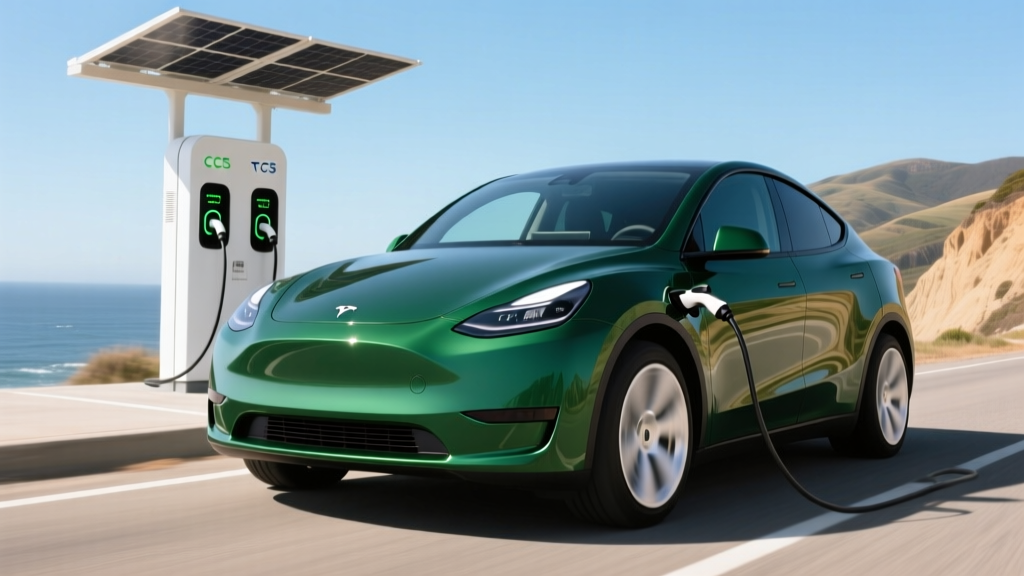
The Model Y's native NACS connector gives it seamless access to Tesla's Supercharger network — over 20,000 stalls across North America and the most reliable public charging infrastructure by a wide margin. Non-Tesla CCS vehicles now access Superchargers via a Magic Dock adapter, but the native plug-and-charge experience remains a Model Y advantage.
For home charging, the onboard charger accepts up to 11.5 kW (48 amps) on a Level 2 circuit. A full charge from 10% to 100% takes approximately 7 hours — easily achievable overnight. Installation of a 60-amp circuit with a Tesla Wall Connector typically costs $800–$2,000 depending on panel proximity and local permitting, though a panel upgrade can push that higher.
Pricing, Trims, and Federal Tax Credit Eligibility
| Trim | Base MSRP | Est. After §30D Credit |
|---|---|---|
| Long Range AWD | $44,990 | ~$37,490* |
| Performance | $48,990 | ~$41,490* |
*Assumes full $7,500 §30D credit eligibility. Your actual credit depends on income, battery sourcing, and tax liability. Always consult a tax professional.
The 2025 Model Y qualifies for the IRS §30D federal tax credit — up to $7,500 — but eligibility is not automatic. Here's the checklist:
- MSRP cap: Vehicle must be under $80,000 (Model Y qualifies easily)
- Buyer income cap: AGI ≤ $150,000 (single) / $300,000 (joint) / $225,000 (head of household)
- Battery sourcing: Critical minerals and battery components must meet phased-in percentage thresholds that tighten each year through 2030
- Assembly: Final assembly must occur in North America (Fremont, CA — qualifies)
- Point-of-sale transfer: As of 2024, you can transfer the credit to the dealer for an immediate price reduction at purchase, even if your tax liability is lower than $7,500
- FEOC restriction: Vehicles with battery components from a "foreign entity of concern" (primarily Chinese suppliers) may be disqualified — check the latest fueleconomy.gov listing for current eligibility
The base Long Range AWD at $44,990 — potentially $37,490 after the credit — represents strong value for a 320-mile AWD crossover. Adding Full Self-Driving (Supervised) for $8,000, premium paint ($1,000–$2,500), or 20-inch wheels ($2,000) can push the as-tested price past $55,000 before incentives.
Interior, Cargo, and Daily Practicality
The Juniper refresh brought a redesigned interior: ventilated front seats, a rear-seat touchscreen, ambient lighting, improved sound insulation, and updated materials. The minimalist approach remains — a single 15.4-inch center display handles nearly all controls, including climate, mirrors, and glovebox. Some buyers love this; others find it distracting.
| Dimension | Measurement |
|---|---|
| Cargo (rear seats up) | 30.2 cu ft |
| Cargo (rear seats folded) | 72.1 cu ft |
| Front trunk (frunk) | 4.1 cu ft |
| Rear legroom | 40.5 in |
| Front headroom | 40.7 in |
Cargo space is competitive but not class-leading. The sloping roofline limits vertical space for tall items compared to the boxier Hyundai Ioniq 5 or Kia EV6. The frunk is useful for charging cables or a small bag but modest in size. Five adults fit comfortably for short trips; four is the sweet spot for long drives.
The infotainment system is responsive and feature-rich — Netflix, YouTube, and gaming while charging; over-the-air updates; and phone-as-key functionality. However, there is no Apple CarPlay or Android Auto, which remains a dealbreaker for some buyers.
Driver Assistance: Autopilot and FSD (Supervised)
SAE Level 2 — not self-driving. Tesla's Autopilot and optional Full Self-Driving (Supervised) are Level 2 driver-assistance systems. The driver must remain fully attentive, hands on the wheel, and ready to intervene at all times. Tesla's "Supervised" branding is accurate — you are the supervisor.
Standard Autopilot includes adaptive cruise control and lane centering on highways and works well. FSD (Supervised) adds automated lane changes, traffic-light recognition, and city-street navigation. It has improved significantly through 2025, but it still makes unpredictable decisions in construction zones, unprotected left turns, and complex intersections. Treat it as a fatigue-reduction tool, not a replacement for driving.
What FSD (Supervised) does NOT do: It does not make the Model Y autonomous. It does not handle all weather conditions. It does not eliminate your legal and safety responsibility as the driver. NHTSA continues to investigate Autopilot/FSD incidents — check nhtsa.gov for current recalls and investigations before purchasing.
Ownership Costs, Warranty, and Longevity
Tesla provides a 4-year/50,000-mile basic warranty and an 8-year/120,000-mile battery and drive-unit warranty with a minimum 70% capacity retention threshold. That battery warranty is competitive with the industry standard (most competitors offer 8 years/100,000 miles with the same 70% floor).
| Cost Category (5 yr / 75,000 mi) | Model Y LR AWD (est.) | Gas Crossover Baseline |
|---|---|---|
| Fuel / Electricity | $3,200 (home charging) | $8,400 (25 MPG avg) |
| Maintenance | $1,500 | $3,800 |
| Insurance | $9,500 | $6,800 |
| Depreciation | $18,000 | $14,000 |
| Estimated 5-yr Total | ~$32,200 | ~$33,000 |
Insurance is the Model Y's ownership Achilles' heel. Tesla vehicles carry higher premiums than most competitors — often 30–50% more than an equivalently priced gas crossover — due to repair costs and claims data. Get a quote before committing. Depreciation has also been steeper than historical EV norms, partly due to Tesla's aggressive price cuts in 2023–2024.
On the positive side, electricity costs for home charging are dramatically lower than gasoline. At a national average of $0.16/kWh, charging the Model Y costs roughly $0.04 per mile versus $0.11–$0.14 per mile for a 25-MPG gas crossover.
2025 Model Y vs. Key Competitors
| Spec | 2025 Model Y LR | Hyundai Ioniq 5 | Ford Mach-E ER AWD |
|---|---|---|---|
| EPA Range | 320 mi | 310 mi | 300 mi |
| Peak DC Charge | 250 kW | 238 kW (800V) | 150 kW |
| 10–80% DCFC | ~25 min | ~18 min | ~38 min |
| 0–60 mph | 4.8 sec | 5.1 sec | 5.6 sec |
| Base MSRP | $44,990 | $42,600 | $43,495 |
| CarPlay / Android Auto | No | Yes | Yes |
| Charging Network | Native Supercharger | NACS adapter (2025+) | NACS adapter (2025+) |
The Ioniq 5 charges faster on 800V architecture and offers physical controls plus CarPlay. The Mach-E provides a more traditional crossover feel. But neither matches the Model Y's combination of efficiency, Supercharger seamlessness, and software depth.
Pros
- Best-in-class efficiency (27 kWh/100mi)
- Native Supercharger access — no adapters, no app friction
- Class-leading software and OTA updates
- 320-mile EPA range with strong real-world usability
- Strong performance even in base Long Range trim
- Excellent safety ratings (IIHS Top Safety Pick)
Cons
- No Apple CarPlay or Android Auto
- Higher insurance costs than competitors
- Minimalist controls frustrate some drivers
- Ride quality firmer than rivals (improved but not plush)
- FSD (Supervised) remains an $8,000 option with limitations
- Depreciation uncertainty after recent price volatility
Frequently Asked Questions
What is the real-world range of the 2025 Model Y?
Expect 270–290 miles in mixed driving at moderate temperatures, 240–260 miles on sustained highway trips, and 200–250 miles in cold weather depending on preconditioning. The EPA 320-mile sticker is achievable in city driving at mild temperatures.
How fast does the 2025 Model Y charge at home and on the road?
On a Level 2 home charger (240V/48A), it adds roughly 44 miles per hour, fully charging overnight in ~7 hours. On a V3 Supercharger, it peaks at 250 kW and charges from 10–80% in about 25 minutes with battery preconditioning.
Does the 2025 Model Y qualify for the $7,500 federal tax credit?
It can, but eligibility depends on your income (AGI caps apply), the vehicle's battery-sourcing compliance with FEOC rules, and your tax situation. The Model Y is assembled in Fremont, CA, and its MSRP is well under the $80,000 cap. Check the latest status on fueleconomy.gov and consult a tax professional.
Is the 2025 Model Y worth buying over the Ioniq 5 or Mach-E?
If Supercharger reliability, software depth, and efficiency are your top priorities, yes. If you prefer physical controls, CarPlay, a softer ride, or faster peak charging (Ioniq 5), the competitors are strong alternatives. Test-drive all three.
What are the biggest drawbacks of the 2025 Model Y?
Insurance costs are significantly higher than competitors. The all-touchscreen interface is polarizing. There's no Apple CarPlay. And FSD (Supervised) remains a Level 2 system that requires constant driver attention despite its name and price.
How long will the Model Y battery last?
Tesla warranties the battery for 8 years/120,000 miles at 70% minimum capacity. Real-world data from earlier Model Y vehicles suggests NMC packs retain roughly 85–90% capacity at 100,000 miles with typical charging habits (avoiding frequent 100% charges and deep discharges). Replacement cost, if needed out of warranty, is estimated at $12,000–$16,000.