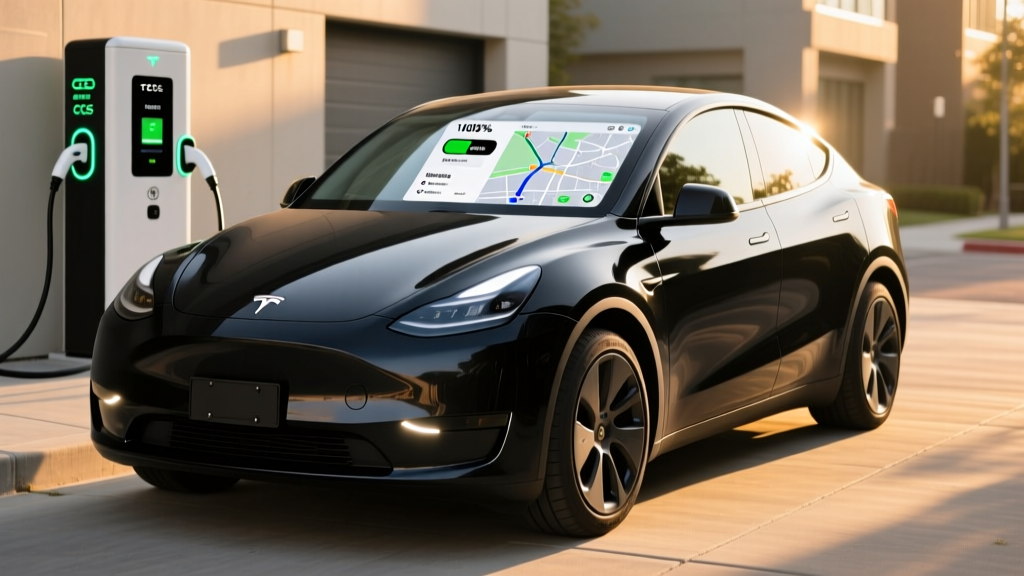
The Tesla Model Y has been the world's best-selling EV for two years running, and the 2025 refresh — internally dubbed "Juniper" — brings meaningful updates to styling, cabin quietness, and suspension tuning. If you've been searching for 2025 Tesla Model Y images to see how the redesign looks in person, you'll notice a sleeker light bar up front, a full-width rear taillight strip, and a slightly more planted stance. But the real question for buyers isn't just cosmetic — it's whether the 2025 Model Y still leads the compact electric SUV segment on range, charging speed, and value against a field of increasingly capable rivals.
We've compiled everything you need: exact EPA numbers, real-world range expectations, charging curves, pricing with tax credit context, and a clear verdict on who should buy one.
2025 Tesla Model Y at a Glance: Key Specs
| Spec | Long Range AWD | Performance | Standard Range RWD |
|---|---|---|---|
| EPA Range | 320 miles | 298 miles | 302 miles |
| Battery (usable) | ~78 kWh (NMC) | ~78 kWh (NMC) | ~60 kWh (LFP) |
| Drivetrain | Dual-Motor AWD | Dual-Motor AWD | Rear-Wheel Drive |
| Horsepower | 384 hp | 456 hp | 295 hp |
| 0–60 mph | 4.8 sec | 3.5 sec | 5.8 sec |
| Peak DC Charge Rate | 250 kW | 250 kW | 170 kW |
| 10–80% DCFC Time | ~27 min | ~27 min | ~30 min |
| Level 2 Home Rate | 11.5 kW (~44 mi/hr) | 11.5 kW (~44 mi/hr) | 11.5 kW (~44 mi/hr) |
| MPGe (combined) | 111 MPGe | 104 MPGe | 118 MPGe |
| Base MSRP | $48,990 | $53,490 | $44,990 |
Source: EPA Fueleconomy.gov, Tesla.com (2025 model year). Specs reflect current production vehicles.
Design Refresh: What the New Images Reveal
The 2025 Model Y borrows heavily from the Cybertruck and refreshed Model 3 "Highland" design language. The front fascia ditches the old slim headlights for a split LED setup with a continuous light bar running across the hood line. The rear gets a full-width LED strip replacing the previous standalone lamps, and a subtle integrated spoiler improves aero. New wheel designs (19" Gemini standard on Long Range, 20" Helix available) and two new paint colors — a metallic teal and a deep gray — round out the exterior changes.
Inside, the changes are more substantial. Ventilated front seats are now standard across all trims (previously a common complaint in hot climates). Ambient lighting strips run along the dash and door panels, the center console gets a cleaner layout with wireless charging pads repositioned for easier access, and rear passengers now get a small 8" touchscreen for climate and media control — a feature lifted directly from the Model 3 Highland.
Cabin noise is noticeably reduced. Tesla added acoustic laminated glass to the rear windows and additional sound-deadening material in the floor pan. At 70 mph, road and wind noise are measurably lower than the 2024 model, making long highway drives less fatiguing.
Real-World Range: Beyond the EPA Sticker
EPA sticker: 320 miles
Real-world highway (70–75 mph, mild weather): ~265–285 miles
Real-world mixed city/highway (55–65 mph): ~290–310 miles
Cold-weather highway (30°F, heater on): ~220–250 miles
Range loss of 15–30% in freezing temps is typical for NMC packs. The Model Y's heat pump helps, but it can't fully offset HVAC draw and battery chemistry limits.
The 320-mile EPA figure for the Long Range AWD is competitive, but real-world results depend heavily on driving style and conditions. In our experience, sustained highway driving at 75 mph yields roughly 270 miles before hitting 10% State of Charge (SoC). City-heavy driving with regenerative braking engaged pushes closer to the EPA number.
The Standard Range RWD model's LFP (lithium iron phosphate) battery handles cold weather slightly worse than NMC in percentage terms, but Tesla recommends charging LFP packs to 100% regularly — so you can start each trip with a full battery without degradation concerns. The NMC Long Range and Performance models are best kept at 80% for daily use, reserving 100% for road trips.
Charging Speed: DC Fast, Level 2, and the Supercharger Advantage
Charging speed remains one of the Model Y's strongest selling points, particularly when paired with Tesla's Supercharger network — the most reliable and extensive DC fast-charging network in North America.
| Charging Level | Power | Speed (Miles Added) | Notes |
|---|---|---|---|
| Level 1 (120V household) | ~1.4 kW | ~3–5 mi/hr | Emergency/trickle only |
| Level 2 (240V home) | 11.5 kW max | ~44 mi/hr | Full charge in ~7–8 hrs (Long Range) |
| DC Fast (Tesla Supercharger V3) | 250 kW peak | ~1,000 mi/hr at peak | 10–80% in ~27 min |
| DC Fast (CCS adapter, non-Tesla) | Up to 250 kW | Varies by station | Requires CCS adapter (included) |
Charging curve reality check: The 250 kW peak rate on Long Range and Performance trims is not sustained across the full session. You'll see 250 kW between roughly 10–30% SoC, tapering to ~170 kW by 50%, and dropping below 100 kW past 70%. This is normal for NMC chemistry, and the 10–80% time of approximately 27 minutes remains excellent for road-trip stops.
The Standard Range RWD model peaks at 170 kW due to its smaller LFP pack. While slower, the smaller battery also means less total energy to move — so 10–80% in ~30 minutes is still practical.
For home charging, a 48-amp Level 2 wall connector on a 60-amp circuit delivers the full 11.5 kW, adding roughly 44 miles per hour of charging. Most owners who plug in overnight start every morning with a full battery, making public charging an occasional road-trip necessity rather than a daily chore.
Performance and Driving Dynamics
The Performance trim's 3.5-second 0–60 mph time is genuinely quick — sports-car territory in an SUV that seats five and carries 76 cubic feet of cargo. The Long Range AWD's 4.8-second run is more than adequate for merging and passing, and the RWD model's 5.8 seconds is respectable for a base trim.
The 2025 suspension retuning is the most noticeable driving improvement. Tesla softened the low-speed ride (the old Model Y was notoriously harsh over potholes and expansion joints) while keeping body roll controlled in corners. It's still firmer than a Hyundai Ioniq 5 or Ford Mustang Mach-E, but it no longer feels punishing on broken pavement.
One-pedal driving via regenerative braking remains excellent. Tesla's regen is strong enough to bring the car to a complete stop without touching the brake pedal in most traffic situations, reducing brake wear significantly — many Model Y owners report original brake pads lasting 80,000+ miles.
Pricing, Trims, and Federal Tax Credit Eligibility
| Trim | Base MSRP | Destination | Total Before Credit | Est. After §30D Credit |
|---|---|---|---|---|
| Standard Range RWD | $44,990 | $1,390 | $46,380 | ~$38,880* |
| Long Range AWD | $48,990 | $1,390 | $50,380 | ~$42,880* |
| Performance | $53,490 | $1,390 | $54,880 | ~$47,380* |
*Estimated price assumes full $7,500 federal tax credit eligibility. Actual eligibility depends on buyer income, battery sourcing, and point-of-sale transfer rules. See details below.
Federal tax credit (§30D) eligibility for the 2025 Model Y:
- MSRP cap: SUVs must be under $80,000 — all Model Y trims qualify.
- Buyer income cap: AGI must not exceed $150,000 (single), $225,000 (head of household), or $300,000 (joint filing).
- Battery sourcing: A percentage of critical minerals and battery components must be sourced from the U.S. or FTA partners. Tesla's U.S. production and supply chain shifts have kept the Model Y eligible for the full $7,500, but sourcing rules tighten annually. Verify current eligibility on IRS.gov's qualified vehicle list before purchasing.
- Point-of-sale transfer: As of 2024, buyers can transfer the credit to the dealer at purchase, reducing the upfront price by $7,500 rather than waiting for a tax refund. This is available for the Model Y.
For complete and current rules, consult IRS Publication on the New Clean Vehicle Credit or a qualified tax professional. State and local incentives (e.g., California's CVRP, Colorado's $5,000 credit) may stack on top but vary by jurisdiction.
Interior Space, Cargo, and Practicality
The Model Y's cargo capacity remains a benchmark for the segment:
- Cargo behind rear seats: 30.2 cu ft
- Cargo with rear seats folded: 72.1 cu ft (76.2 cu ft including the front trunk/frunk)
- Frunk (front trunk): 4.1 cu ft — useful for charging cables, a gym bag, or groceries
- Rear legroom: 41.6 inches (generous for adults on long trips)
- Front headroom: 41.0 inches; rear headroom: 39.4 inches
The flat floor (no transmission tunnel) and wide-opening rear hatch make loading bulky items easy. The optional third-row seat (available on Long Range, adds $3,000) provides two small seats suitable for children only — legroom in the third row is under 28 inches, and it eliminates most of the rear cargo area. For families needing genuine seven-passenger space, a three-row SUV like the Kia EV9 is a better fit.
Technology, Autopilot, and Driver Assistance
The 2025 Model Y runs Tesla's latest software on the familiar 15.4" center touchscreen. The interface is responsive, navigation includes real-time Supercharger availability and battery preconditioning, and the phone-as-key system is seamless. Notable tech features include:
- Sentry Mode: Records video from all cameras when parked, triggered by proximity or impact
- Dog Mode: Maintains cabin temperature with a display message for passersby
- Over-the-air updates: Regular software improvements (new features, UI changes, efficiency tweaks)
- Tesla app: Remote preconditioning, charging monitoring, location tracking, and Summon (low-speed remote parking)
Tesla's Autopilot and Full Self-Driving (Supervised) are SAE Level 2 driver-assistance systems. They provide steering, acceleration, and braking support, but the driver must remain fully attentive, keep hands on the wheel (or demonstrate engagement via camera monitoring), and be prepared to take over at any time. These systems are not self-driving. Level 4 autonomy (no driver required) is currently limited to geofenced robotaxi services like Waymo in select cities.
Autopilot (basic lane-keeping and adaptive cruise) is standard. Full Self-Driving (Supervised) remains an $8,000 add-on (or $99/month subscription) and adds automatic lane changes, traffic light/stop sign recognition, and city-street navigation. FSD has improved incrementally with each software version, but it still requires active supervision and makes occasional errors — particularly in construction zones, unusual intersections, and poor weather.
Pros, Cons, and Key Competitors
- Best-in-class Supercharger network access
- 320-mile EPA range (Long Range) is segment-leading
- Fast 250 kW DC charging, 10–80% in ~27 min
- Spacious cargo area (72+ cu ft) and practical frunk
- Strong software/OTA update track record
- Improved ride comfort in 2025 refresh
- Eligible for full $7,500 federal tax credit
- No Apple CarPlay or Android Auto
- FSD ($8,000) still requires full driver supervision
- Minimalist interior lacks physical buttons (climate, mirrors adjusted via screen)
- Insurance costs above segment average
- Optional third row is impractical for adults
- Competitors (Ioniq 5, Mach-E) offer more traditional controls
Key competitors to cross-shop:
- Hyundai Ioniq 5 — 800V architecture enables 10–80% in 18 min at 350 kW chargers; more conventional interior with physical buttons; slightly less range (305 mi).
- Ford Mustang Mach-E — Sportier styling, Apple CarPlay standard, but lower range (290 mi Extended Range) and slower charging.
- Kia EV6 — Shares Ioniq 5's 800V platform, sportier design, similar charging speed; cargo space is smaller.
- Volkswagen ID.4 — More affordable entry point, comfortable ride, but slower DC charging (170 kW) and less range (275 mi).
Who Should Buy the 2025 Tesla Model Y?
Buy it if: You value the Supercharger network for road trips, want the longest range in the segment without paying luxury-SUV prices, prefer software-driven features and OTA updates, and are comfortable with a touchscreen-centric interface. The Model Y is particularly strong for one-car households that need to handle daily commuting and occasional long-distance travel without range compromise.
Consider alternatives if: You need Apple CarPlay/Android Auto, prefer physical buttons and knobs, want the fastest possible DC charging (Ioniq 5/EV6 at 800V chargers), or need genuine three-row seating for adults.
Frequently Asked Questions
What is the real-world range of the 2025 Tesla Model Y?
The Long Range AWD achieves an EPA-estimated 320 miles, but real-world highway driving at 70–75 mph typically yields 265–285 miles. In freezing temperatures, expect 220–250 miles. City driving with regenerative braking can approach or match the EPA figure.
How fast does the Model Y charge at home and on the road?
On a Level 2 home charger (240V, 48A), the Model Y charges at 11.5 kW, adding roughly 44 miles per hour — a full overnight charge. On a Tesla V3 Supercharger (250 kW DC), the Long Range and Performance trims charge from 10–80% in approximately 27 minutes. The Standard Range RWD peaks at 170 kW with a 10–80% time of about 30 minutes.
How much does the 2025 Model Y cost after tax credits?
The Standard Range RWD starts at $44,990 + $1,390 destination ($46,380 total). With the full $7,500 federal §30D credit applied at point of sale, the effective price drops to approximately $38,880. The Long Range AWD comes to roughly $42,880 after credit. Eligibility depends on buyer income (AGI caps), battery sourcing compliance, and MSRP limits — verify on IRS.gov before purchase.
Does the 2025 Model Y qualify for the full $7,500 federal EV tax credit?
As of the current model year, the Model Y qualifies for the full $7,500 credit. All trims are under the $80,000 SUV MSRP cap, and Tesla's U.S. manufacturing and supply chain meet current critical-mineral and battery-component sourcing thresholds. However, buyers must also meet AGI income limits ($150K single / $300K joint). Sourcing rules tighten annually — always confirm eligibility on the IRS qualified vehicles list.
Is the 2025 Model Y worth buying vs. the Hyundai Ioniq 5 or Ford Mach-E?
The Model Y wins on range (320 mi vs. 305 mi for Ioniq 5, 290 mi for Mach-E), Supercharger network reliability, and cargo space. The Ioniq 5 wins on DC charging speed at 800V stations (18 min 10–80%) and offers a more conventional interior with physical controls. The Mach-E offers sportier styling and standard Apple CarPlay. For road-trip-heavy buyers, the Model Y's charging infrastructure advantage is significant. For buyers who prioritize interior ergonomics and ultra-fast charging, the Ioniq 5 is a compelling alternative.
What is the battery warranty on the 2025 Model Y?
Tesla covers the battery and drive unit for 8 years or 120,000 miles (Long Range/Performance) and 8 years or 100,000 miles (Standard Range RWD), whichever comes first. The warranty guarantees the battery will retain at least 70% of its original capacity during the coverage period. Real-world degradation data from Tesla's fleet suggests most packs retain 85–90% capacity at 100,000 miles.
Does the Model Y have Apple CarPlay or Android Auto?
No. Tesla uses its proprietary infotainment system exclusively. It includes built-in navigation, Spotify, Netflix/YouTube (while parked), Bluetooth phone integration, and a web browser, but it does not support Apple CarPlay or Android Auto. This is a dealbreaker for some buyers who prefer phone-mirrored interfaces.
Final Verdict
The 2025 Tesla Model Y remains the default recommendation for buyers entering the EV space for the first time — and for good reason. Its combination of 320-mile range, 250 kW charging, Supercharger network access, and practical cargo space is difficult to match at this price point, especially after the $7,500 federal tax credit. The Juniper refresh addresses the most common complaints (harsh ride, cabin noise, lack of rear-seat amenities) without raising the base price.
It's not the right EV for everyone. If you need CarPlay, prefer physical buttons, or want the fastest possible DC charging at non-Tesla stations, the Ioniq 5 and EV6 deserve serious consideration. But for the majority of EV shoppers — particularly those who road-trip more than a few times a year — the 2025 Model Y's infrastructure advantage and proven efficiency make it the segment benchmark.