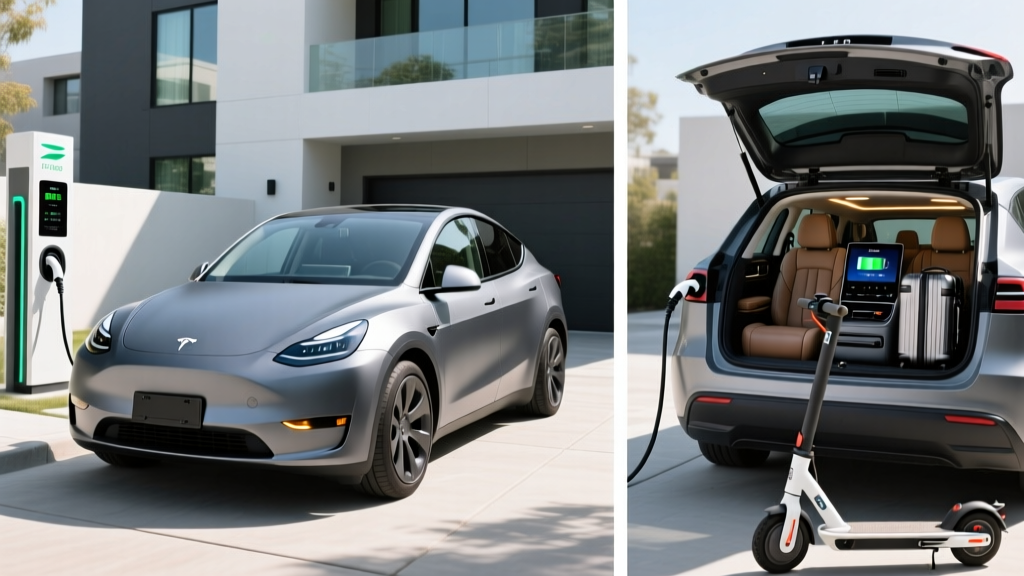
The Tesla Model Y has been the best-selling electric vehicle in the world for good reason: it blends strong range, fast charging, and a practical crossover footprint. But for families needing more than five seats, the 2025 Tesla Model Y 7-seater adds a compact third row that transforms the vehicle's utility — at least on paper. After examining EPA data, real-world driving behavior, charging performance, and third-row dimensions, we break down exactly what this configuration delivers and where it falls short compared to three-row EV rivals like the Kia EV9 and Hyundai Ioniq 9.
EPA Range vs. Real-World Expectations
EPA Estimated Range: 303 miles (Long Range AWD, 19" wheels) / 295 miles (20" Gemini wheels)
Real-World Expectation: Plan for roughly 260–280 miles on mixed highway driving at 70–75 mph. In cold weather (below 30°F), expect a 15–25% reduction, bringing usable range to approximately 220–250 miles depending on cabin heating demands and whether you precondition the battery. The 7-seat option adds roughly 50 lbs over the 5-seat configuration, which has a negligible effect on range but slightly affects handling feel when fully loaded with passengers.
Battery, Chemistry, and Efficiency Breakdown
The 2025 Model Y Long Range AWD — the only trim that offers the 7-seat option — uses an NMC (nickel manganese cobalt) lithium-ion battery pack with approximately 75 kWh of usable capacity (total pack capacity is slightly higher, with a buffer reserved to protect long-term health). Tesla does not officially publish usable kWh figures, but independent teardowns and charging-session data confirm this range.
Why NMC and not LFP? Tesla reserves its LFP (lithium iron phosphate) chemistry for the rear-wheel-drive Model Y Standard Range, which does not offer the 7-seat option. NMC provides higher energy density, which is necessary to deliver 300+ miles of range in an AWD dual-motor configuration while keeping pack weight manageable.
| Spec | Value |
|---|---|
| EPA Range | 303 miles (19" wheels) |
| Battery (usable) | ~75 kWh, NMC chemistry |
| Efficiency | 117 MPGe combined / 29 kWh/100 mi |
| Drivetrain | Dual-motor AWD |
| Horsepower | 384 hp (combined) |
| 0–60 mph | 4.8 seconds |
| Max DC Fast Charge | 250 kW (peak) |
| 10–80% DC Charge Time | ~27 minutes |
| Level 2 Home Charge Rate | 11.5 kW (~44 mi/hr) |
| Base MSRP | $48,630 (incl. destination) |
| 7-Seat Option | +$2,500 |
| Battery Warranty | 8 years / 120,000 miles (70% retention) |
The efficiency rating of 117 MPGe combined (approximately 29 kWh per 100 miles, per fueleconomy.gov) places the Model Y among the most efficient AWD electric crossovers available. For context, the Kia EV9 Land AWD achieves roughly 85 MPGe combined — a significant gap that translates to lower per-mile charging costs for the Model Y over years of ownership.
Charging Performance: DC Fast and Home Level 2
The 2025 Model Y Long Range supports a peak DC fast-charge rate of 250 kW at V3 Superchargers and compatible CCS/NACS stations. However, peak rate is not sustained rate — a critical distinction many buyers overlook.
| Charge Level | Power | Miles Added per Hour | Notes |
|---|---|---|---|
| Level 1 (120V) | ~1.4 kW | ~5 mi/hr | Emergency/trickle only |
| Level 2 (240V, 48A) | 11.5 kW | ~44 mi/hr | Home Wall Connector; full charge in ~7 hrs |
| DC Fast (V3 Supercharger) | 250 kW peak | ~162 mi in 15 min | 10–80% in ~27 min; tapers above 80% |
| DC Fast (V4 Supercharger) | 250 kW peak | Similar to V3 | Newer cabinet design; same vehicle-side limit |
Charging curve reality: The Model Y pulls its maximum 250 kW only between roughly 10–30% state of charge. From 30–60%, the rate drops to approximately 150–180 kW, and from 60–80%, it further tapers to around 80–100 kW. This is normal for NMC chemistry and thermal management — but it means your actual average charging rate over a 10–80% session is closer to 140–150 kW, not 250 kW. Plan road-trip stops accordingly.
At home, Tesla's Wall Connector on a 60-amp circuit delivers 11.5 kW (48 amps continuous), adding roughly 44 miles of range per hour. A full overnight charge from 10% to 90% takes about 6–7 hours. Installation costs for a 240V/60A circuit typically range from $800 to $2,500 depending on panel proximity and local permitting — a licensed electrician should assess your panel capacity before committing.
Third-Row Space: Who Actually Fits Back There?
The 7-seat option adds a two-passenger third row to the Model Y, bringing total seating to seven (2-3-2 configuration). Here are the critical dimensions:
- Third-row legroom: ~26.5 inches
- Third-row headroom: ~34.6 inches
- Cargo behind 3rd row: ~12.6 cu ft
- Cargo behind 2nd row (3rd row folded): ~30.2 cu ft
- Cargo behind 1st row (all rear seats folded): ~72.1 cu ft
- Front trunk (frunk): ~4.1 cu ft
Let's be direct: the third row is best suited for children or very short adults on brief trips. A 5'6" adult will find their knees pressed into the second-row seatback, and the low floor height forces a knees-up seating position that becomes uncomfortable within 20–30 minutes. Access requires folding and sliding the second-row seat, which is manageable but not as convenient as the walk-through aisles in larger three-row SUVs.
Cargo space behind the third row (12.6 cu ft) is enough for a couple of grocery bags or a small stroller, but not much more. Fold the third row and you recover 30.2 cu ft — adequate for a family road trip with luggage for four or five. This is fundamentally a 5-passenger SUV with occasional 2-passenger overflow, not a true 7-passenger hauler.
Pricing, Tax Credits, and Total Cost
The 2025 Tesla Model Y Long Range AWD starts at $48,630 (including the $1,390 destination fee). Adding the 7-seat option brings the price to $51,130. Popular add-ons include:
- Full Self-Driving (Supervised): $8,000 or $99/month
- Premium interior (white): $1,000
- 20" Gemini wheels: included (19" Gemini standard)
| Item | Cost |
|---|---|
| Long Range AWD base MSRP | $48,630 |
| 7-Seat option | +$2,500 |
| Destination fee | Included |
| Base 7-Seat MSRP | $51,130 |
| Federal §30D tax credit (if eligible) | Up to −$7,500 |
| Effective price after max credit | ~$43,630 |
Federal EV Tax Credit Eligibility (§30D)
The Model Y Long Range AWD currently qualifies for the full $7,500 federal tax credit under IRS §30D, provided the buyer meets all requirements. As of 2025 rules (per IRS.gov):
- MSRP cap: Vehicle must be under $80,000 for SUVs — the Model Y clears this easily at ~$51,130.
- Buyer income cap: Modified AGI must not exceed $150,000 (single), $225,000 (head of household), or $300,000 (joint filers).
- Battery sourcing: Critical minerals and battery components must meet phased-in domestic-content thresholds. Tesla's supply chain currently qualifies, but this is subject to change — always verify at the point of sale.
- Point-of-sale transfer: You can transfer the credit to the dealer at purchase to reduce your out-of-pocket cost directly, rather than waiting to claim it on your tax return.
Important caveat: Tax credit rules, particularly battery-sourcing requirements, have shifted multiple times since 2023. Always confirm current eligibility with your tax professional and check the IRS's qualified vehicle list before finalizing your purchase.
Performance, Ride, and Daily Driving
The dual-motor AWD powertrain produces 384 horsepower and launches the Model Y to 60 mph in 4.8 seconds — brisk for a family crossover and more than adequate for highway merging and passing. The instant torque delivery makes it feel quicker than the numbers suggest in city driving.
Ride quality has improved in the latest Model Y refresh (sometimes referred to as the "Juniper" update), with revised suspension tuning that reduces the harshness over sharp bumps that plagued earlier models. Cabin noise is lower thanks to acoustic glass and additional sound deadening. However, the Model Y still rides firmer than comfort-oriented rivals like the Hyundai Ioniq 9 or Kia EV9, and you'll feel expansion joints and potholes more than you would in those vehicles.
Regenerative braking remains strong and predictable, enabling one-pedal driving in most conditions. The heat pump (standard) significantly improves cold-weather efficiency by drawing heat from ambient air rather than relying solely on resistive heating — a meaningful advantage for buyers in northern climates.
Technology, Autopilot, and Driver Assistance
The Model Y's 15.4-inch center touchscreen handles nearly all vehicle functions — climate, navigation, media, and vehicle settings — with minimal physical buttons. The interface is responsive and well-organized, though the lack of a dedicated instrument cluster means speed and navigation info are displayed on the left portion of the center screen, which some drivers find less intuitive than a head-up display or traditional gauge cluster.
SAE Automation Level: Level 2 (Not Self-Driving)
Tesla's Autopilot (standard) and Full Self-Driving Supervised ($8,000 option) are both SAE Level 2 driver-assistance systems. This means the vehicle can manage steering, acceleration, and braking under certain conditions, but the driver must remain fully engaged, hands on or near the wheel, and eyes on the road at all times. FSD Supervised adds features like city-street navigation and traffic-light recognition, but it is not autonomous driving. Only Level 4 services like Waymo operate without a human driver.
Standard Autopilot includes adaptive cruise control, lane-centering, and automatic emergency braking — all competent and well-tuned for highway use. The optional FSD Supervised system performs impressively in many scenarios but still requires frequent driver interventions, particularly in construction zones, unprotected left turns, and unusual road configurations. For most buyers, standard Autopilot covers the daily commute adequately; FSD is an enthusiast premium, not a necessity.
Warranty and Long-Term Ownership
Tesla provides the following coverage for the 2025 Model Y:
- Basic vehicle warranty: 4 years / 50,000 miles
- Battery and drive unit warranty: 8 years / 120,000 miles (with a minimum 70% capacity retention guarantee)
The 70% retention threshold is consistent with industry norms. Real-world data from high-mileage Tesla owners suggests that NMC packs in the Model Y typically retain 85–90% capacity after 100,000 miles when charged primarily to 80–90% daily and avoiding prolonged storage at 100% SoC. Battery replacement, should it become necessary out of warranty, currently runs approximately $12,000–$16,000 at Tesla service centers — a figure worth factoring into very long-term ownership plans.
Insurance costs for the Model Y tend to run 15–25% higher than comparable non-electric crossovers, reflecting repair costs and parts pricing. Get quotes from your insurer before purchasing — this is often an overlooked line item in total cost of ownership.
2025 Tesla Model Y 7-Seater vs. Key Competitors
| Spec | 2025 Tesla Model Y LR AWD (7-seat) | 2025 Kia EV9 LR AWD | 2025 Hyundai Ioniq 9 LR AWD |
|---|---|---|---|
| EPA Range | 303 mi | 280 mi | 311 mi |
| Battery (usable) | ~75 kWh (NMC) | 99.8 kWh (NMC) | 110.3 kWh (NMC) |
| Max DC Charge | 250 kW | 236 kW | 350 kW (800V) |
| 10–80% Time | ~27 min | ~24 min | ~20 min |
| 3rd-Row Legroom | ~26.5" | ~32.0" | ~33.0" |
| Cargo (behind 3rd row) | 12.6 cu ft | 20.2 cu ft | 21.0 cu ft |
| Base MSRP (7-seat capable) | $51,130 | ~$60,000 | ~$62,000 |
| Federal Credit Eligible | Yes (up to $7,500) | Yes (up to $7,500) | Yes (up to $7,500) |
The Model Y's primary advantage is price and efficiency — it undercuts both Korean rivals by $9,000–$11,000 while delivering better MPGe. Its disadvantages are clear in the tape measure: significantly less third-row space and cargo volume. If your third row will see regular use by teenagers or adults, the EV9 or Ioniq 9 are meaningfully more livable. If it's a just-in-case option for carpools or visiting grandparents, the Model Y's savings and Supercharger network access may tip the scales.
Pros
- Best-in-class efficiency at 117 MPGe combined
- Lowest entry price for a 7-seat EV at ~$51,130
- Tesla Supercharger network reliability
- Strong real-world range (303 mi EPA) for the segment
- Quick 4.8-second 0–60 and responsive dual-motor AWD
- Over-the-air updates continuously improve the vehicle
Cons
- Third row is cramped — best for children only
- Minimal cargo space (12.6 cu ft) behind third row
- No head-up display or traditional instrument cluster
- FSD Supervised is expensive and still requires full driver attention
- Insurance premiums higher than segment average
- Firmer ride quality than comfort-focused rivals
Who Should Buy the 2025 Model Y 7-Seater?
Choose the Model Y 7-Seat If:
- You primarily need a 5-seat SUV but want occasional 2-seat overflow for carpools, playdates, or visiting family.
- Budget matters — you want a 7-seat EV under $55,000 after tax credits.
- You value efficiency and low per-mile charging costs over maximum interior volume.
- You take regular road trips and want reliable Tesla Supercharger access across North America.
Look Elsewhere If:
- Adults or teenagers will ride in the third row regularly — choose the Kia EV9 or Hyundai Ioniq 9.
- You need substantial cargo space with all seats in use (e.g., sports equipment, strollers for twins).
- You prefer a traditional instrument cluster, physical climate controls, or a softer ride.
Frequently Asked Questions
What is the real-world range of the 2025 Tesla Model Y 7-seater?
Expect approximately 260–280 miles in mixed highway driving and 220–250 miles in cold weather (below 30°F). The EPA estimate is 303 miles, but sustained highway speeds, cold temperatures, and a fully loaded cabin reduce that figure. Preconditioning the battery before driving and using seat heaters instead of cabin heat can help recover some lost range.
How fast does the Model Y 7-seater charge?
On a DC fast charger (V3/V4 Supercharger or equivalent), the Model Y peaks at 250 kW and charges from 10–80% in approximately 27 minutes. At home on a Level 2 Wall Connector (11.5 kW), a full charge takes about 7 hours. The charge curve tapers significantly above 80%, so plan to charge to 80% on road trips unless you need the full battery for your next leg.
Does the 2025 Model Y 7-seater qualify for the federal EV tax credit?
Yes, the Model Y Long Range AWD currently qualifies for the full $7,500 federal tax credit under IRS §30D, assuming you meet income caps ($300,000 joint / $150,000 single) and the vehicle's battery sourcing continues to comply with domestic-content rules. The credit can be transferred at the point of sale to reduce your purchase price directly. Always verify current eligibility with your tax professional and the IRS qualified vehicles list.
Is the Model Y 7-seater worth it vs. the Kia EV9 or Hyundai Ioniq 9?
It depends on third-row usage. The Model Y is $9,000–$11,000 cheaper, more energy-efficient, and benefits from the Supercharger network. However, its third row is significantly smaller and less comfortable than either Korean rival. If the third row is an occasional convenience, the Model Y offers outstanding value. If it's a daily necessity, the EV9 or Ioniq 9 provide genuinely usable space for older passengers.
What are the biggest drawbacks of the Model Y 7-seater?
The tight third-row legroom (~26.5 inches), limited cargo space behind the third row (12.6 cu ft), and firm ride quality are the primary trade-offs. Additionally, the lack of a head-up display, higher-than-average insurance costs, and the $8,000 price of the FSD Supervised option are worth considering.
Can I tow with the 2025 Model Y 7-seater?
Yes. The Model Y Long Range AWD is rated to tow up to 3,500 pounds with the optional tow hitch. Keep in mind that towing significantly reduces range — expect a 30–50% reduction depending on trailer weight and aerodynamics.