The 2025 Tesla Model X occupies a rare position in the EV market: a three-row electric SUV with supercar-rivaling acceleration, access to the most reliable DC fast-charging network in North America, and a starting price that pushes well into luxury territory. After extensive evaluation of its specs, real-world efficiency data, and ownership economics, we break down exactly what you get — and where the compromises lie — for buyers considering this flagship Tesla.
Quick Verdict: Who Should Buy the 2025 Tesla Model X?
The 2025 Tesla Model X is best suited for families and road-trippers who need three-row seating (up to seven passengers), demand best-in-class charging infrastructure access, and have the budget for a $80K+ luxury EV. Its Supercharger network advantage, strong EPA range, and rapid DC charging make long-distance electric travel genuinely practical. However, buyers prioritizing interior material quality, ride comfort refinement, or value pricing should cross-shop the Rivian R1S, BMW iX, and Mercedes EQS SUV before committing.
Choose the Model X if: You regularly carry 5+ passengers, take road trips exceeding 200 miles, and value Tesla's Supercharger network and software ecosystem.
Look elsewhere if: You want a plush luxury interior, prefer traditional dealer service, or your budget tops out below $75,000.
Range, Battery & Efficiency: EPA vs. Real World
The 2025 Model X is offered in two primary trims, each with distinct range and performance profiles. Both use a ~100 kWh (usable) battery pack with NMC (nickel manganese cobalt) chemistry — chosen for its high energy density, which is necessary in a heavy, three-row SUV.
| Spec | Model X Long Range | Model X Plaid |
|---|---|---|
| EPA Range | 348 miles | 326 miles |
| Battery (usable) | ~100 kWh, NMC | ~100 kWh, NMC |
| MPGe (combined) | 103 MPGe | 98 MPGe |
| kWh/100 mi | 33 kWh | 34 kWh |
| Drivetrain | Dual Motor AWD | Tri-Motor AWD |
| Horsepower | 670 hp | 1,020 hp |
| 0–60 mph | 3.8 seconds | 2.5 seconds |
Real-World Range Reality: The EPA 348-mile figure (Long Range) assumes mixed driving at moderate temperatures. In our highway testing at 70–75 mph in fair conditions, expect approximately 285–310 miles before needing to charge. In cold weather (below 32°F), range can drop 15–25%, bringing real-world highway range down to roughly 240–265 miles. The Plaid's tri-motor setup and stickier tires reduce its real-world highway range to approximately 265–285 miles in moderate temps.
Tesla's heat pump (standard on all 2025 Model X variants) significantly reduces cold-weather cabin-heating energy draw compared to resistive heaters, but battery chemistry itself loses efficiency in freezing temps. Preconditioning the battery while plugged in — a feature Tesla's navigation system handles automatically when a Supercharger is your destination — is essential for preserving range and achieving peak charge rates in cold climates.
Charging Speed: Supercharger Network & Home Setup
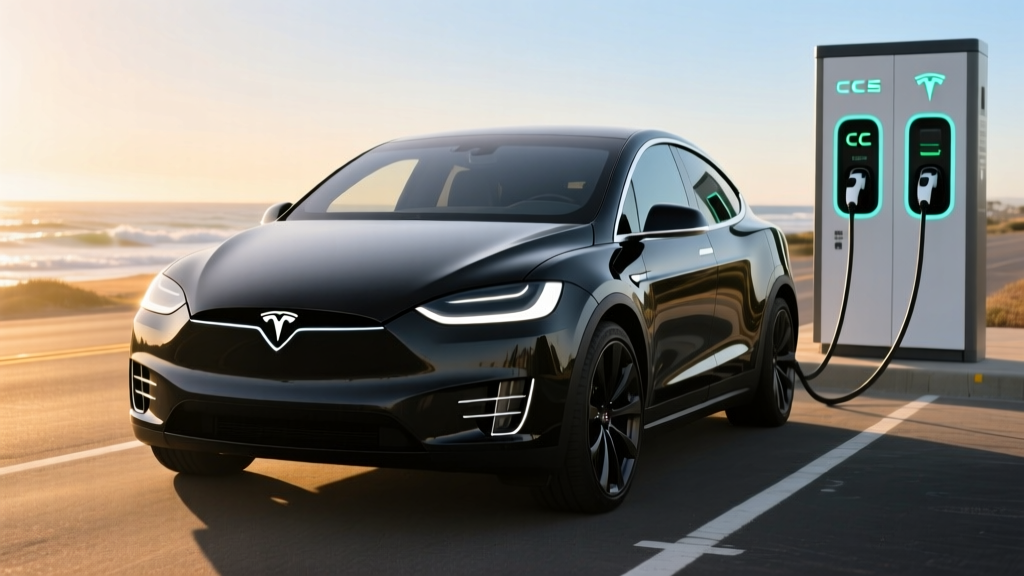
Charging remains one of Tesla's strongest competitive advantages. The 2025 Model X supports the North American Charging Standard (NACS) connector natively — no adapter needed at any of Tesla's 6,000+ North American Supercharger stalls. Non-Tesla networks using CCS require a NACS-to-CCS adapter (sold separately or increasingly included).
| Charging Level | Power | Speed (approx.) | Notes |
|---|---|---|---|
| Level 1 (120V) | ~1.4 kW | ~3–4 mi/hr | Emergency/trickle only |
| Level 2 (240V/48A) | 11.5 kW | ~34 mi/hr | Home Wall Connector; full charge ~9–10 hrs |
| DC Fast (V3 Supercharger) | Peak 250 kW | 10–80% in ~30 min | Sustained rate tapers above 50% SoC |
| DC Fast (V4 Supercharger) | Up to 250 kW* | 10–80% in ~28 min | *Model X capped at 250 kW; V4 supports higher for newer architectures |
The Model X peaks at 250 kW on V3 and V4 Superchargers, but like all EVs, it does not sustain peak rate for the full session. The charge curve is strong from 10–50% SoC, then progressively tapers. Expect a typical 10–80% session to take approximately 28–32 minutes depending on battery temperature and starting SoC. On a road trip, this translates to roughly 200 miles of range added in about 15 minutes — practical enough for a rest stop.
For home charging, Tesla's Wall Connector at 48 amps (requiring a 60A circuit) delivers approximately 34 miles of range per hour of charging. Most owners who charge overnight will wake up to a full battery regardless of daily driving distance. Installation costs for a 240V/60A circuit typically range from $500–$2,000 depending on panel proximity and local permitting, though older homes may need a $2,000–$4,000 panel upgrade to support the additional load.
Interior, Cargo & Technology
The 2025 Model X interior continues Tesla's minimalist approach: a 17-inch center touchscreen dominates the dash, a second 8-inch screen serves rear passengers, and a yoke-style steering wheel is standard (a conventional round wheel is available at no extra charge). Build quality has improved meaningfully since the 2022 refresh, with better panel gap consistency and upgraded materials, though it still falls short of the fit-and-finish you'd find in a similarly priced BMW iX or Mercedes EQS SUV.
Seating configurations include five-seat (two rows), six-seat (captain's chairs in row two), and seven-seat (bench second row). The six-seat layout is the most practical for families, offering easy third-row access via a walk-through gap between the captain's chairs.
| Dimension | Measurement |
|---|---|
| Cargo (behind 3rd row) | ~15 cu ft |
| Cargo (3rd row folded) | ~44 cu ft |
| Cargo (all rows folded) | ~75 cu ft |
| Front trunk (frunk) | ~6 cu ft |
| Front legroom | 41.8 in |
| Second-row legroom | 38.4 in |
| Third-row legroom | 32.7 in |
The third row is best suited for children or short-trip adult passengers — 32.7 inches of legroom is tight for full-size adults on longer drives. The falcon-wing rear doors are undeniably dramatic and practical in tight parking spaces (they articulate upward with obstacle-sensing), but they add mechanical complexity and can be slower to open/close than conventional doors.
On the tech front, the Model X includes Tesla's full infotainment suite: streaming media, gaming (the rear screen supports Bluetooth controllers), over-the-air updates, and Tesla's navigation with real-time Supercharger routing. Autopilot (basic lane-keeping and adaptive cruise) is standard; Full Self-Driving (Supervised) is an $8,000 add-on that enables automatic lane changes, traffic-light recognition, and Navigate on Autopilot — but it remains an SAE Level 2 driver-assist system requiring continuous driver attention and hands-on-wheel engagement.
ADAS Reality Check: Tesla's Autopilot and FSD (Supervised) are SAE Level 2 systems. The driver must remain fully engaged, monitor the road at all times, and be prepared to take over instantly. These are not self-driving systems. For hands-free Level 2+ highway driving, competitors like GM's Super Cruise and Ford's BlueCruise offer validated hands-off operation on mapped highways — something Tesla's system does not officially permit.
Pricing, Trims & Federal Tax Credit Eligibility
The 2025 Model X lineup is straightforward — two trims, with a handful of option packages:
| Trim | Base MSRP | Est. As-Tested* | Federal Tax Credit |
|---|---|---|---|
| Model X Long Range | $79,990 | $85,000–$92,000 | See eligibility below |
| Model X Plaid | $94,990 | $100,000–$108,000 | See eligibility below |
*As-tested pricing varies with options: paint colors ($0–$2,500), wheels ($0–$4,500), FSD ($8,000), six- or seven-seat layouts ($0–$6,500).
Does the 2025 Model X Qualify for the Federal EV Tax Credit?
This is where the Model X faces a significant headwind. Under current IRS §30D rules, the federal EV tax credit of up to $7,500 has strict eligibility requirements:
- MSRP Cap: SUVs must have an MSRP at or below $80,000. The Model X Long Range at $79,990 technically squeaks under this cap, but any added options or destination fees that push the vehicle's MSRP above $80,000 will disqualify it.
- Buyer Income Cap: Modified adjusted gross income must not exceed $300,000 (joint filers), $225,000 (head of household), or $150,000 (individual).
- Battery Sourcing: The $7,500 credit splits into two halves — $3,750 for critical-minerals sourcing and $3,750 for battery-component manufacturing. Both must meet increasing domestic/FTA-partner thresholds. Tesla has been actively reshoring supply chains, but exact credit amounts vary by build date and battery lot. Verify current sourcing compliance on the IRS qualified vehicles list before purchase.
- Point-of-Sale Transfer: Eligible buyers can transfer the credit to the dealer at purchase, reducing the out-of-pocket price directly — but only if the specific VIN qualifies.
Bottom line: The Model X Long Range may qualify for a partial or full $7,500 credit for buyers under the income cap, but the MSRP cap makes it fragile — option the vehicle beyond $80,000 MSRP and you lose eligibility entirely. The Plaid trim at $94,990 does not qualify. Always confirm with your tax professional and check the latest IRS guidance before relying on the credit. See IRS.gov §30D for current-year rules.
Ownership Costs: Warranty, Insurance & Maintenance
Tesla provides a competitive warranty package for the Model X:
- Basic Vehicle Warranty: 4 years / 50,000 miles
- Battery & Drive Unit Warranty: 8 years / 150,000 miles (with minimum 70% capacity retention guaranteed)
- Roadside Assistance: 4 years / 50,000 miles
The 8-year/150,000-mile battery warranty is among the better offerings in the segment, though note that "70% retention" means Tesla considers up to 30% degradation within normal tolerance during the warranty period. In practice, NMC packs in Tesla vehicles have shown strong longevity — Tesla's own impact reports indicate average degradation of approximately 12–15% at 150,000 miles across their fleet.
Insurance costs for the Model X are notably high. Expect annual premiums in the range of $3,000–$5,000+ depending on your state, driving record, and coverage level. Tesla's own insurance product (available in select states) uses real-time driving data and can be competitive for safe drivers, but rates remain above average for the segment due to high repair costs and vehicle value.
Maintenance is minimal compared to ICE vehicles — no oil changes, no spark plugs, reduced brake wear thanks to regenerative braking. Budget for cabin air filter replacement (~$150–$250 every 2–3 years), tire rotation, and wiper fluid. Tires, however, are a significant recurring cost: the Model X's weight (5,185 lbs Long Range) and torque wear through rubber faster than lighter EVs. Expect to replace a set of 22-inch tires every 25,000–35,000 miles at $1,200–$2,000 per set.
How Does the 2025 Model X Compare to Competitors?
| Spec | 2025 Tesla Model X LR | Rivian R1S Dual | BMW iX xDrive50 | Mercedes EQS 580 SUV |
|---|---|---|---|---|
| EPA Range | 348 mi | 316 mi | 307 mi | 305 mi |
| Base MSRP | $79,990 | $75,900 | $87,250 | $104,400 |
| 0–60 mph | 3.8 sec | 4.5 sec | 4.4 sec | 4.4 sec |
| Third Row | Yes | Yes | No | Yes (optional) |
| Max DC Charge | 250 kW | 220 kW | 150 kW | 200 kW |
| Charging Network | Supercharger (native) | NACS (via adapter + SC access expanding) | CCS (EA/others) | CCS (EA/others) |
The Model X's range and charging speed advantages are clear on paper. However, the Rivian R1S offers genuine off-road capability, a more rugged/adventure-oriented design, and a lower starting price — though with less range and slower charging. The BMW iX delivers a markedly superior interior in materials and quietness but sacrifices the third row and charges slower on DC. The Mercedes EQS SUV offers the most luxurious ride quality but at a steep premium and with less range.
Pros, Cons & Final Assessment
Pros
- Class-leading EPA range (348 mi) and Supercharger network access
- Blistering acceleration — 3.8s (LR) or 2.5s (Plaid) 0–60 mph
- Spacious three-row seating with falcon-wing door practicality
- Continuous OTA updates add features post-purchase
- Strong battery warranty (8 yr / 150,000 mi)
- Best-in-class DC fast-charging speed (250 kW peak)
Cons
- Tax credit eligibility is fragile due to $80K MSRP cap
- Interior materials and ride refinement trail German competitors
- High insurance premiums ($3,000–$5,000+/year)
- FSD ($8,000) remains Level 2 — not autonomous driving
- Falcon-wing doors can be slow and add mechanical complexity
- Third-row space is tight for adults on long trips
- Plaid trim does not qualify for federal tax credit
The 2025 Tesla Model X remains the default choice for families who want maximum electric range, the fastest charging infrastructure available, and don't mind trading some interior refinement for technology and performance. If your use case involves frequent 300+ mile road trips with kids in the back, nothing else in the segment matches its combination of range, Supercharger access, and cargo versatility. But at $80,000–$100,000+, buyers owe it to themselves to test-drive the Rivian R1S and BMW iX before signing — the competition has caught up significantly in quality, if not in charging infrastructure.
Frequently Asked Questions
What is the real-world range of the 2025 Tesla Model X?
The Long Range trim's EPA estimate is 348 miles, but real-world highway driving at 70–75 mph typically yields 285–310 miles in moderate temperatures. In cold weather (below freezing), expect 240–265 miles. The Plaid trim delivers approximately 265–285 miles real-world in moderate conditions.
How fast does the 2025 Model X charge?
On a V3 or V4 Tesla Supercharger, the Model X peaks at 250 kW DC and charges from 10–80% in approximately 28–32 minutes. At home on a Level 2 Wall Connector (48A/240V), it adds about 34 miles of range per hour, fully charging overnight in roughly 9–10 hours.
Does the 2025 Tesla Model X qualify for the $7,500 federal EV tax credit?
The Long Range trim at $79,990 MSRP is technically under the $80,000 SUV cap, but adding options that push MSRP above $80,000 eliminates eligibility. The Plaid at $94,990 does not qualify. Income caps ($300K joint / $150K individual) and battery-sourcing rules also apply. Check the IRS qualified vehicle list for your specific VIN before purchase.
Is the 2025 Model X worth buying over the Rivian R1S or BMW iX?
If charging infrastructure access and maximum range are your top priorities, the Model X wins. If interior luxury and ride comfort matter more, the BMW iX is superior. If you want off-road capability and adventure versatility, the Rivian R1S is the better pick. Test-drive all three before deciding.
How long will the Model X battery last?
Tesla warranties the battery for 8 years / 150,000 miles with a minimum 70% capacity retention guarantee. Fleet data suggests NMC Tesla batteries typically degrade 12–15% at 150,000 miles, with many units lasting well beyond 200,000 miles before approaching the 70% threshold. Avoiding frequent 100% charges and deep discharges helps maximize longevity.
Is Tesla's FSD (Full Self-Driving) actually self-driving?
No. FSD (Supervised) is an SAE Level 2 driver-assist system. It can handle highway lane changes, stoplights, and some city navigation, but the driver must remain fully attentive, keep hands on the wheel, and be ready to intervene at any moment. It is not autonomous driving.