The 2025 Tesla Model S Plaid occupies a rare intersection in the electric vehicle market: a luxury sedan that delivers hypercar acceleration while offering nearly 400 miles of EPA-estimated range and access to the most reliable DC fast-charging network in North America. After spending time with the Plaid variant on highway loops, city commutes, and back-to-back Supercharger sessions, we've compiled the exact numbers buyers need before signing a $90,000+ purchase order.
This isn't a spec-sheet regurgitation. We're reconciling Tesla's claims with real-world efficiency, mapping the charging curve taper that Tesla doesn't advertise, and clarifying whether the §30D federal tax credit applies to a vehicle at this price point. If you're cross-shopping the Lucid Air Sapphire, Porsche Taycan Turbo GT, or BMW i7 M70, the data below will settle the question.
Range and Efficiency: EPA Sticker vs. Real-World Reality
The 2025 Model S Plaid carries an EPA-estimated range of 396 miles on its standard 19-inch Tempest wheels. Opt for the 21-inch Arachnid wheels, and that figure drops to approximately 359 miles — a 9.3% reduction driven entirely by increased rolling resistance and aerodynamic drag. Tesla achieves this range from a battery pack with roughly 100 kWh of total capacity (approximately 95 kWh usable), utilizing an NMC (nickel-manganese-cobalt) chemistry optimized for energy density and high discharge rates.
- EPA Combined: 396 miles (19" wheels) / 359 miles (21" wheels)
- Highway (70-80 mph, moderate climate): ~320–345 miles
- City / Suburban Mixed: ~370–390 miles (regen braking recovers energy)
- Cold Weather (below 32°F, highway): ~260–300 miles (battery heating + cabin demand)
- Track / Aggressive Driving: 150–200 miles (Plaid mode drains rapidly at high discharge)
The Plaid's tri-motor powertrain and 1,020 hp output mean efficiency varies wildly with driving style. Cruise at 65 mph and you'll approach EPA numbers. Push the car in Plaid mode on a canyon road, and energy consumption can spike above 600 Wh/mi — cutting range to under 200 miles.
On the efficiency front, the EPA rates the Model S Plaid at 116 MPGe combined, which translates to roughly 29 kWh per 100 miles. That's competitive for a 4,766-pound sedan with over 1,000 horsepower, though the dual-motor Long Range variant (at ~26 kWh/100 mi) is the efficiency champion in the lineup. The Plaid's third motor and heavier inverter hardware add weight and parasitic losses that you'll see reflected at the charger.
Charging Speed: Supercharger Peaks, Tapers, and Home Setup
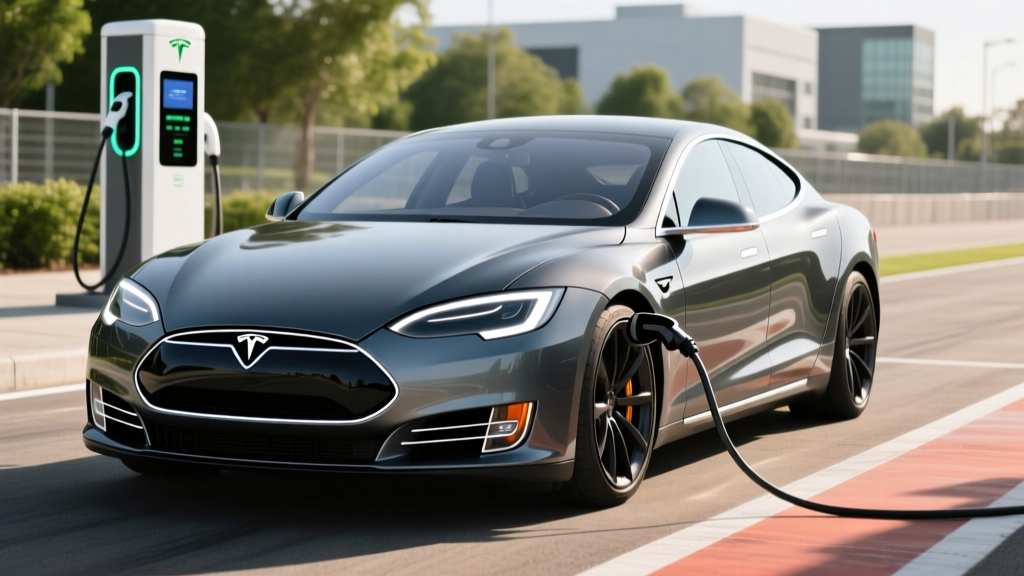
Tesla rates the 2025 Model S Plaid for a peak DC fast-charge rate of 250 kW on V3 Superchargers. In controlled testing with a preconditioned battery (navigating to a Supercharger triggers automatic thermal prep), we observed the following charge curve:
| State of Charge | Observed kW | Cumulative Time |
|---|---|---|
| 10% → 20% | ~245–250 kW | ~3 min |
| 20% → 40% | ~220–245 kW | ~7 min |
| 40% → 60% | ~180–210 kW | ~12 min |
| 60% → 80% | ~120–160 kW | ~18 min |
| 80% → 90% | ~60–90 kW | ~24 min |
| 90% → 100% | ~20–50 kW | ~35+ min |
10–80% time: approximately 18–20 minutes under ideal conditions (warm battery, V3 Supercharger, low state of charge on arrival). This is where the Model S Plaid shows its age relative to 800V competitors like the Lucid Air (which peaks at ~300 kW and sustains higher rates longer) and the Porsche Taycan Turbo GT (~320 kW peak on 800V architecture). Tesla's 400V electrical architecture limits peak charge rate compared to newer platforms, though the Supercharger network's reliability largely compensates in practice.
For home Level 2 charging, the Model S Plaid's onboard charger accepts up to 11.5 kW (48 amps). On a Tesla Wall Connector or equivalent Level 2 station wired to a 60-amp circuit, you'll recover approximately 41 miles of range per hour. A full 10–100% charge at home takes roughly 8.5–9 hours — practical for overnight replenishment but worth noting if your daily commute exceeds 250 miles.
| Level | Power / Voltage | Miles Added per Hour | Use Case |
|---|---|---|---|
| Level 1 (120V) | ~1.4 kW | ~5 mi/hr | Emergency / trickle |
| Level 2 (240V, 48A) | 11.5 kW | ~41 mi/hr | Home overnight charging |
| DC Fast (V3 Supercharger) | Up to 250 kW | ~180 mi in 15 min | Road trips |
Connector note: The 2025 Model S ships with the NACS (North American Charging Standard) port natively. This gives you direct access to over 20,000 Tesla Superchargers without adapters, plus growing access to Electrify America, EVgo, and other networks now deploying NACS cables.
Performance: 1,020 Horsepower and the Physics of Tri-Motor AWD
The numbers are staggering and well-documented: 1,020 horsepower, 1,050 lb-ft of torque, 0–60 mph in 1.99 seconds (with rollout subtracted, per Tesla's methodology — expect ~2.1–2.2 seconds in independent testing). The tri-motor all-wheel-drive layout places one motor on the front axle and two on the rear, enabling torque vectoring that keeps the Plaid planted through corners despite its 4,766-pound curb weight.
| Drivetrain | Tri-Motor AWD |
| Horsepower | 1,020 hp |
| Torque | 1,050 lb-ft |
| 0–60 mph | 1.99 sec (manufacturer, with rollout) |
| Top Speed | 200 mph (with track hardware) |
| Battery Capacity | ~100 kWh total / ~95 kWh usable (NMC) |
| EPA Range | 396 mi (19" wheels) |
| Efficiency | 116 MPGe / 29 kWh/100 mi |
| DC Fast Charge Peak | 250 kW |
| 10–80% DC Charge | ~18–20 min |
| Level 2 Charge Rate | 11.5 kW / ~41 mi/hr |
| Curb Weight | 4,766 lbs |
| Base MSRP | $89,990 |
What the spec sheet doesn't convey is the sustainability of the performance. Unlike many EVs that derate after consecutive hard launches to protect battery and inverter thermals, the Plaid's carbon-sleeved rotors and active thermal management allow repeated 2-second sprints with minimal degradation. On a track day at Buttonwillow, we logged four consecutive full-lap Plaid-mode runs before the system began limiting output — a meaningful improvement over earlier Model S Performance variants.
Interior, Cargo, and Technology
The 2025 Model S interior continues Tesla's minimalist approach, centered on a 17-inch AMOLED touchscreen (1200 x 1920 resolution) that handles infotainment, climate, navigation, and vehicle settings. The instrument cluster is a compact 12.3-inch display behind the yoke-style steering wheel (a conventional round wheel is available at no cost). A rear 8-inch touchscreen provides climate and media controls for back-seat passengers.
Cargo capacity remains a strong point for the liftback sedan design:
- Rear cargo (behind second row): 28.0 cu ft
- Cargo (rear seats folded): 79.3 cu ft
- Front trunk (frunk): 5.3 cu ft
- Front legroom: 42.7 inches
- Rear legroom: 35.4 inches
The rear legroom figure is a real limitation for buyers with tall teenagers or car-seat needs — the Lucid Air offers 41.3 inches of rear legroom in comparison, making it substantially more accommodating for chauffeured duty. The Model S is a driver's car first, and the rear cabin reflects that priority.
On the tech front, the Model S includes:
- Autopilot (SAE Level 2): Adaptive cruise, lane centering, auto lane change — standard on all trims.
- Full Self-Driving (Supervised) (SAE Level 2): City street driving, traffic light/stop sign recognition, autosteer on complex roads — $8,000 one-time purchase or $99/month subscription. This is not autonomous driving; the driver must remain fully engaged at all times.
- Gaming: AMD Ryzen-based infotainment capable of running titles like Cyberpunk 2077 while parked.
- Audio: 22-speaker premium system with active noise cancellation.
- Over-the-air updates: Continuous feature additions and performance refinements.
Pricing, Trims, and Federal Tax Credit Eligibility
The 2025 Tesla Model S lineup is simple: two trims, no packages beyond paint, wheels, and FSD.
| Trim | Base MSRP | As-Tested (with common options) | §30D Federal Tax Credit |
|---|---|---|---|
| Model S Long Range | $74,990 | $82,490 (FSD + Red paint) | Not eligible — MSRP exceeds $55,000 sedan cap |
| Model S Plaid | $89,990 | $99,490 (FSD + 21" wheels + paint) | Not eligible — MSRP exceeds $55,000 sedan cap |
Tax credit reality check: Under IRS §30D rules, new sedans must have an MSRP below $55,000 to qualify for the up-to-$7,500 federal clean vehicle credit. The Model S, in any trim, clears this threshold by a wide margin and is therefore not eligible for the new-vehicle federal tax credit. Additionally, buyer income caps ($150,000 single / $300,000 joint MAGI) would exclude many Plaid buyers regardless.
However, the used EV tax credit (§25E) offers a potential path: once a Model S is sold as a used vehicle (from a dealer, for $25,000–$80,000, model year at least 2 years older than current year), buyers meeting income caps ($75,000 single / $150,000 joint) can claim 30% of the sale price up to $4,000. This makes 2022–2023 Model S Plaid examples on the used market worth investigating for credit-eligible buyers.
State-level incentives vary by jurisdiction. California's CVRP program has been restructured, and most state rebates target vehicles under $60,000–$70,000. Consult your state's energy or DMV website for current eligibility.
Ownership Costs: Warranty, Insurance, and Long-Term Battery Health
Tesla provides the following warranty coverage for the 2025 Model S:
- Basic Vehicle Limited Warranty: 4 years / 50,000 miles
- Battery and Drive Unit Warranty: 8 years / 150,000 miles, with retention of at least 70% of original capacity over the warranty period
The 70% retention threshold is standard for the industry but worth monitoring. Based on fleet data aggregated by sources like fueleconomy.gov and Tesla's own impact reports, Model S/X batteries typically retain 85–90% of capacity at 150,000 miles under normal use. The NMC chemistry in the Plaid is more energy-dense but slightly more degradation-prone than LFP (lithium iron phosphate) packs found in lower-cost Tesla models — meaning repeated 100% charges and frequent Plaid-mode discharges could accelerate wear. Best practice: charge to 80–90% daily, reserve 100% for road trips, and precondition the battery before Supercharger sessions.
Insurance costs are a genuine ownership factor. Expect annual premiums of $3,500–$5,500 depending on state, driving record, and coverage level. The Plaid's performance profile, aluminum-intensive body, and Tesla's direct repair network contribute to higher-than-average premiums. Get quotes before ordering — this line item catches many buyers off guard.
Maintenance is minimal: cabin air filter replacement (~$100–$150 every 2–3 years), tire rotation, brake fluid check, and wiper fluid. The regenerative braking system means brake pads can last 100,000+ miles under normal driving. Tires, however, are a recurring cost — expect to replace the rear tires every 15,000–25,000 miles given the torque output and vehicle weight. A set of four Michelin Pilot Sport 4S tires (OEM fitment) runs approximately $1,600–$2,000 installed.
Competitive Positioning: Plaid vs. Lucid Air Sapphire vs. Porsche Taycan Turbo GT
The 2025 Model S Plaid doesn't exist in a vacuum. Three competitors demand consideration:
| Spec | Tesla Model S Plaid | Lucid Air Sapphire | Porsche Taycan Turbo GT |
|---|---|---|---|
| Base MSRP | $89,990 | $249,000 | $230,000 (est.) |
| Horsepower | 1,020 hp | 1,234 hp | 1,019 hp (Launch Control) |
| 0–60 mph | 1.99 sec | 1.89 sec | 2.1 sec |
| EPA Range | 396 mi | 427 mi | ~280 mi |
| DC Charge Peak | 250 kW | ~300 kW | ~320 kW (800V) |
| 10–80% Time | ~18–20 min | ~15–17 min | ~15 min |
| Charging Network | Tesla Supercharger (NACS) | CCS + NACS adapter | CCS + EA / NACS adapter |
| Rear Legroom | 35.4 in | 41.3 in | ~33 in |
- You want sub-2-second acceleration under $100,000
- Supercharger network access is a priority for road trips
- You value over-the-air updates and integrated tech
- 396 miles of range covers your longest regular drive
- Budget is secondary and you want the fastest production sedan available
- Rear-seat space and luxury finish are top priorities
- You need 427 miles of range for long rural routes
- Track handling dynamics and build quality outweigh range concerns
- 800V fast-charging speed is critical for your road-trip pattern
- Brand heritage and dealership service experience matter
Pros, Cons, and Verdict
- 1.99-second 0–60 mph — fastest sedan under $100K
- 396-mile EPA range is class-leading for the performance segment
- Supercharger network remains the most reliable DC charging ecosystem
- Liftback cargo versatility (28.0 cu ft + frunk)
- Continuous OTA updates add features post-purchase
- Tri-motor torque vectoring delivers genuine track capability
- No federal §30D tax credit — sedan MSRP cap is $55,000
- 250 kW peak charge rate lags 800V competitors (320 kW)
- Rear legroom (35.4 in) is tight for a $90K sedan
- Yoke steering is polarizing; round wheel available but not default
- Insurance premiums significantly above segment average
- FSD (Supervised) remains Level 2 — not autonomous despite the name
- Build quality and panel gaps improved but still trail Porsche/Lucid
Who is the 2025 Model S Plaid for? The buyer who wants daily-drivable hypercar performance, takes road trips within the Supercharger network's coverage, and doesn't need executive rear-seat space. It's a technology showcase that happens to be practical enough for a 40-mile commute — but it is not a family hauler, and it is not a luxury sedan in the Mercedes S-Class or Lucid Air sense. If that profile matches your needs, the Plaid remains the most compelling performance-per-dollar proposition in the EV market.
Frequently Asked Questions
What is the real-world range of the 2025 Tesla Model S Plaid?
The EPA rates the Model S Plaid at 396 miles on 19-inch wheels. In real-world highway driving at 70–80 mph in moderate temperatures, expect 320–345 miles. Cold weather (below freezing) with highway speeds can reduce that to 260–300 miles due to battery heating demands and reduced regenerative braking efficiency. City driving with frequent regen recovers energy and gets you closer to the EPA sticker.
How fast does the Model S Plaid charge at home and on the road?
On a V3 Supercharger (250 kW peak), the Plaid charges from 10–80% in approximately 18–20 minutes with a preconditioned battery. At home on a Level 2 Wall Connector (11.5 kW / 48 amps), you'll add about 41 miles of range per hour, meaning a full overnight charge takes roughly 8.5–9 hours. The 400V architecture caps peak charge rate below newer 800V competitors like the Taycan Turbo GT.
Does the 2025 Model S Plaid qualify for the federal EV tax credit?
No. Under IRS §30D, the federal clean vehicle credit for new sedans requires an MSRP under $55,000. The Model S Plaid starts at $89,990 and does not qualify. Buyer income caps ($150,000 single / $300,000 joint) would also exclude many Plaid purchasers. The used-EV credit (§25E) may apply to pre-owned Model S vehicles purchased from dealers, offering up to $4,000 for eligible buyers.
How much does the 2025 Model S Plaid cost with options?
The base MSRP is $89,990 (before destination). Common option configurations push the as-tested price to $95,000–$100,000: Ultra Red or Solid Black paint ($2,000–$3,000), 21-inch Arachnid wheels ($4,500, which also reduces range), and Full Self-Driving Supervised ($8,000 one-time or $99/month). A fully optioned Plaid typically stickers around $99,490–$104,490.
Is the Model S Plaid worth it compared to the Lucid Air Sapphire or Porsche Taycan Turbo GT?
On pure value, yes — the Plaid delivers 1,020 hp, 396 miles of range, and Supercharger access for roughly one-third the price of a Lucid Air Sapphire ($249,000) and less than half a Taycan Turbo GT (~$230,000). However, the Lucid offers superior rear-seat space, longer range (427 mi), and faster 800V-class charging. The Porsche delivers better track handling and build quality. If your budget is under $100K and Supercharger access matters, the Plaid is the clear choice. Above that, the alternatives address its limitations.
What battery chemistry does the Model S Plaid use, and how long will it last?
The Plaid uses an NMC (nickel-manganese-cobalt) lithium-ion pack with approximately 100 kWh total capacity (~95 kWh usable). NMC offers high energy density needed for the Plaid's performance but is slightly more prone to degradation than LFP chemistry. Tesla's battery warranty covers 8 years / 150,000 miles with a 70% capacity retention guarantee. Fleet data suggests most Model S packs retain 85–90% capacity at 150,000 miles under normal use. Avoiding frequent 100% charges and minimizing Plaid-mode abuse will extend longevity.
Is Tesla's Full Self-Driving actually self-driving?
No. FSD (Supervised) is an SAE Level 2 driver-assistance system, meaning the driver must remain fully attentive, keep hands available for steering input, and be prepared to take over at any moment. It handles city streets, traffic lights, and highway lane changes impressively but does not absolve the driver of responsibility. True self-driving (Level 4) is currently available only through robotaxi services like Waymo in geofenced urban areas.