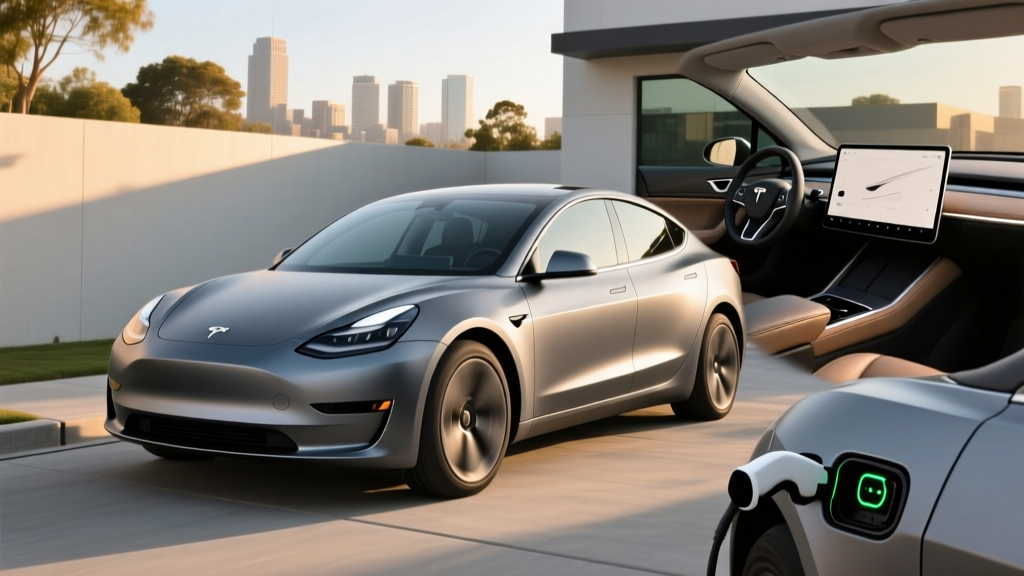
The 2025 Tesla Model 3 RWD (often called the Standard Range) remains the entry point into Tesla ownership, but "entry" no longer means compromise. After the Highlandland refresh, this rear-wheel-drive sedan delivers 363 miles of EPA range, a revamped interior, and access to the largest fast-charging network in North America — all starting at $38,990 before incentives. For buyers cross-shopping the Hyundai Ioniq 6, BMW i4 eDrive35, and Polestar 2, the Model 3 RWD makes a compelling, data-backed case.
Real-World Range Expectations
EPA Estimated: 363 miles (18-inch wheels) / 341 miles (19-inch Nova wheels)
Real-World Highway (70 mph, mild weather): ~300–320 miles
Cold Weather (below 32°F, mixed driving): ~240–270 miles
The LFP battery's lower energy density is offset by Tesla's thermal management and heat pump. Expect 10–15% highway range loss at sustained speeds above 70 mph, and 20–30% loss in deep winter. Preconditioning the battery while plugged in recovers much of this in cold climates.
Battery, Efficiency, and the LFP Trade-Off
The 2025 Model 3 RWD uses a ~60 kWh (usable) lithium iron phosphate (LFP) battery pack. Unlike the nickel-manganese-cobalt (NMC) chemistry in Long Range and Performance trims, LFP offers distinct ownership advantages and a few trade-offs:
| Attribute | LFP (Model 3 RWD) | NMC (Long Range/Performance) |
|---|---|---|
| Usable Capacity | ~60 kWh | ~79 kWh |
| Cycle Life | 3,000+ cycles | 1,500–2,000 cycles |
| Daily Charging to 100% | Recommended by Tesla | 80% daily; 100% for trips only |
| Cold-Weather Range Loss | Higher (~25–30%) | Moderate (~15–25%) |
| Energy Density | Lower (heavier for same kWh) | Higher |
| Long-Term Degradation | Slower, more linear | Faster initial, then plateaus |
The practical upshot: LFP owners can charge to 100% daily without accelerating degradation, effectively giving you the full 363 miles every morning. This matters for commuters who need maximum range from a home charger. The trade-off is more pronounced cold-weather loss, since LFP chemistry is inherently less tolerant of freezing temperatures.
Efficiency is rated at 132 MPGe combined (124 city / 142 highway per fueleconomy.gov), or roughly 25 kWh per 100 miles. That's among the most efficient sedans in its class, trailing only the Hyundai Ioniq 6 SE's 140 MPGe.
Charging Speed: DC Fast, Level 2, and the Curve Reality
| Charging Level | Power / Rate | Time / Miles Added |
|---|---|---|
| DC Fast Charge (Peak) | 170 kW | 10–80% in ~25 minutes |
| DC Fast Charge (Sustained avg.) | ~100–120 kW | ~170 miles in 15 min (Tesla est.) |
| Level 2 (240V, 48A Wall Connector) | 11.5 kW | ~44 miles per hour of charging |
| Level 2 (240V, 32A mobile connector) | 7.7 kW | ~30 miles per hour |
| Level 1 (120V household) | ~1.4 kW | ~5 miles per hour |
The 170 kW peak DC fast-charge rate is the headline number, but the charge curve tells the real story. The LFP pack sustains peak power from roughly 5% to 35% SoC, then tapers progressively. From 80% to 100%, charging slows dramatically — adding the final 20% can take as long as the first 60%. For road trips, plan stops around the 10–80% window to minimize time at the charger.
At home, Tesla's Wall Connector at 48 amps adds roughly 44 miles of range per hour. A full overnight charge (8 hours) easily replenishes the entire pack. Most owners will never need more than a 32-amp setup, which still adds 30 miles per hour — more than enough for daily commuting.
Connector note: The 2025 Model 3 uses the NACS (North American Charging Standard) connector natively, granting access to 20,000+ Tesla Superchargers without adapters. Non-Tesla CCS networks (Electrify America, EVgo) require a CCS-to-NACS adapter, though most major networks are transitioning to NACS through 2025–2026.
Performance and Drivetrain
| Spec | 2025 Model 3 RWD |
|---|---|
| Drivetrain | Rear-Wheel Drive (single motor) |
| Horsepower | 271 hp |
| Torque | 317 lb-ft |
| 0–60 mph | 5.8 seconds |
| Top Speed | 125 mph |
| Curb Weight | ~3,862 lbs |
The single rear motor delivers 271 horsepower and 317 lb-ft of torque, enough for a 5.8-second 0–60 mph sprint. That's quick for a base-trim sedan and genuinely fun in daily driving. The RWD layout also means a slightly lighter curb weight than the Long Range AWD, contributing to its efficiency advantage. Regenerative braking is strong enough for one-pedal driving in most conditions, though Tesla removed the user-adjustable regen setting — it's always on at maximum.
Interior, Cargo, and Technology
The Highland refresh brought meaningful interior upgrades: ventilated front seats, ambient lighting, rear-seat touchscreen for climate and media, acoustic glass all around, and a redesigned steering wheel. The minimalist cabin removes physical stalks — turn signals and gear selection live on the steering wheel and touchscreen, respectively. This remains polarizing; some owners adapt quickly, others find it frustrating in roundabouts and parking lots.
Cargo and passenger dimensions:
- Trunk: 21.0 cu ft (rear seats up) / 64.9 cu ft (folded)
- Front frunk: 3.1 cu ft
- Front legroom: 42.4 in
- Rear legroom: 35.3 in
- Rear headroom: 37.0 in
The trunk is generous for a sedan, and the frunk adds useful space for charging cables. Rear legroom is adequate for adults on shorter trips but tight for anyone over 6 feet on long drives — a common complaint versus the Hyundai Ioniq 6 or BMW i4.
Tech highlights:
- 15.4-inch center touchscreen (all vehicle functions, media, navigation)
- Tesla Autopilot (standard): adaptive cruise, lane centering, auto emergency braking
- FSD Supervised (optional, $8,000): auto lane change, navigate on Autopilot, traffic light recognition — still SAE Level 2, requires full driver attention
- Over-the-air updates, Sentry Mode, Dog Mode, phone-as-key
- No Apple CarPlay or Android Auto (Tesla's native infotainment only)
⚠️ Autopilot & FSD Are NOT Self-Driving
Tesla Autopilot and FSD (Supervised) are SAE Level 2 driver-assistance systems. You must keep your hands on the wheel and eyes on the road at all times. These systems do not make the Model 3 autonomous. Tesla's naming conventions have drawn scrutiny from NHTSA — treat them as advanced cruise control with lane centering, not a replacement for attentive driving.
Pricing, Tax Credits, and Total Cost
| Item | Amount |
|---|---|
| Base MSRP (Model 3 RWD) | $38,990 |
| Destination Fee | $1,390 |
| As-Tested (with Midnight Cherry Red, 19" wheels) | ~$42,880 |
| Federal Tax Credit (§30D, max) | Up to $7,500 |
| Estimated Price After Max Credit | ~$32,880 |
The 2025 Tesla Model 3 RWD qualifies for the full $7,500 federal EV tax credit under IRS §30D — provided you meet all eligibility requirements. As of 2025, buyers can also elect to transfer the credit to the dealer at point of sale, effectively reducing the purchase price by $7,500 on the spot.
- MSRP Cap: Sedans must be under $55,000 — the Model 3 RWD clears this easily
- Buyer Income Cap (MAGI): $150,000 single / $225,000 head of household / $300,000 joint filers
- Battery Sourcing: Critical minerals and battery components must meet phased percentages from US/FTA countries — Tesla's LFP supply chain from CATL (China) has faced scrutiny, but Tesla has confirmed 2025 Model 3 RWD eligibility as of current guidance
- Final Assembly: Must be in North America — the Model 3 is assembled in Fremont, CA and Austin, TX
Important: Tax credit rules are subject to change. Always verify current eligibility on irs.gov or consult a tax professional before relying on the credit in your purchase decision.
Warranty and Long-Term Ownership
| Coverage | Term |
|---|---|
| Basic Vehicle | 4 years / 50,000 miles |
| Battery & Drive Unit | 8 years / 100,000 miles (70% minimum capacity retention) |
Tesla's 8-year/100,000-mile battery warranty guarantees at least 70% capacity retention. If the LFP pack degrades below that threshold within the warranty period, Tesla will repair or replace it. Real-world data from Tesla's fleet suggests LFP packs degrade more slowly than NMC in the first few years, with many owners reporting 95%+ State of Health (SoH) after 50,000 miles. Long-term replacement cost for an out-of-warranty LFP pack is estimated at $8,000–$12,000, though this is expected to decline as LFP cell costs fall.
Pros, Cons, and Who Should Buy
✅ Pros
- 363-mile EPA range — best in its price class
- LFP battery allows daily 100% charging without degradation guilt
- Access to 20,000+ Supercharger stations natively (NACS)
- 132 MPGe combined — extremely low per-mile energy cost
- Strong OTA updates continuously add features
- Qualifies for full $7,500 federal tax credit
❌ Cons
- No Apple CarPlay or Android Auto
- Stalkless steering wheel frustrates some drivers
- Rear legroom is tight for tall passengers
- LFP battery loses more range in extreme cold vs. NMC
- FSD Supervised costs $8,000 and remains Level 2
- No physical buttons for climate, wipers, or mirrors
Who Is the 2025 Model 3 RWD For?
Choose this EV if: You commute 30–80 miles daily, want the lowest cost-per-mile in a premium sedan, have home Level 2 charging, and value Supercharger access for road trips. The LFP battery's daily 100% charging recommendation means you wake up with the full 363 miles every morning.
Look elsewhere if: You regularly carry rear-seat passengers over 6 feet tall, live in a deep-winter climate where LFP range loss matters, or need Apple CarPlay for your workflow. The Long Range AWD ($47,740) or a Hyundai Ioniq 6 may better serve those needs.
Frequently Asked Questions
What is the real-world range of the 2025 Tesla Model 3 RWD?
The EPA rates it at 363 miles on 18-inch wheels. In real-world highway driving at 70 mph in mild weather, expect roughly 300–320 miles. In freezing temperatures, that drops to approximately 240–270 miles. The LFP battery is more sensitive to cold than NMC chemistry, so winter commuters in northern states should plan accordingly.
How fast does the Model 3 RWD charge?
On a DC fast charger, it peaks at 170 kW and charges from 10–80% in approximately 25 minutes. Sustained average power is closer to 100–120 kW due to the charge curve taper. At home on a Level 2 Tesla Wall Connector (48A/240V), it adds about 44 miles of range per hour — a full charge takes roughly 6–7 hours.
Does the 2025 Model 3 RWD qualify for the $7,500 federal tax credit?
Yes, as of current IRS guidance, the Model 3 RWD qualifies for the full $7,500 §30D credit — assuming you meet income caps ($150K single / $300K joint) and the vehicle's MSRP stays under the $55,000 sedan cap. You can transfer the credit to the dealer at point of sale for an instant price reduction. Always verify on irs.gov before purchasing, as battery sourcing rules are subject to change.
Is it worth buying versus the Hyundai Ioniq 6 or BMW i4?
The Model 3 RWD wins on range (363 mi vs. Ioniq 6's 361 mi and i4 eDrive35's 301 mi), Supercharger network access, and price after tax credits. The Ioniq 6 offers slightly better efficiency (140 MPGe) and CarPlay. The BMW i4 offers a more traditional luxury interior and physical controls but costs significantly more. If Supercharger access and software matter to you, the Model 3 is the stronger value. If you prioritize interior materials and rear-seat comfort, test-drive the Ioniq 6 and i4 before deciding.
What's the biggest drawback of the LFP battery?
Cold-weather range loss is more pronounced with LFP chemistry — expect 25–30% reduction in freezing temperatures versus 15–25% for NMC packs. If you live in Minnesota, Maine, or similar climates, the Long Range AWD (NMC battery, 341-mile EPA) may be a better fit. For mild-to-moderate climates, the LFP's longevity and daily 100% charging advantage outweigh the cold-weather penalty.
Is Tesla Autopilot self-driving?
No. Autopilot and FSD (Supervised) are SAE Level 2 driver-assistance systems. You are required to remain fully engaged — hands on the wheel, eyes on the road. These systems handle adaptive cruise control and lane centering but cannot navigate all road scenarios autonomously. Only Level 4 services like Waymo operate without a human driver.