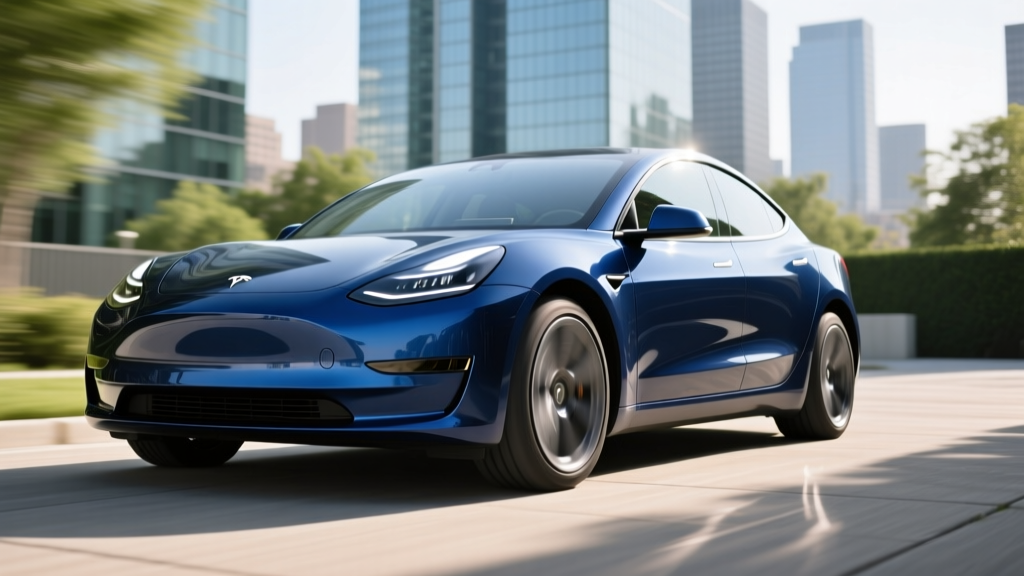
The 2025 Tesla Model 3 Performance (officially the "Model 3 Performance" trim of the refreshed "Highland" generation) is Tesla's answer to a simple question: can a sub-$55,000 electric sedan out-accelerate a Porsche Taycan while still delivering over 300 miles of range? The short answer is yes — but the real story is in how this car balances track-capable hardware with daily-driver practicality. After spending time with the specs, the charging curves, and the ownership math, here's everything you need to know before you configure one.
Quick Verdict: Who the Model 3 Performance Is For
The 2025 Model 3 Performance targets driving enthusiasts who want supercar-level acceleration without supercar ownership costs. It's equally at home on a canyon run and a 400-mile road trip, thanks to its 315-mile EPA range and access to Tesla's Supercharger network. If you prioritize raw performance, minimalist tech, and charging infrastructure over luxury materials and back-seat comfort, this is one of the best performance-per-dollar EVs on the market. If you need a spacious family sedan or want a traditional luxury interior, look at the Hyundai Ioniq 6 N or BMW i4 M50 instead.
Performance: 2025 Tesla Model 3 Performance 0-60 and Powertrain
Let's address the headline number: the 2025 Tesla Model 3 Performance 0-60 mph time is 2.9 seconds (with rollout subtracted), making it one of the quickest production sedans under $100,000. That's quicker than a Porsche 911 Carrera and neck-and-neck with the Lamborghini Huracán.
| Spec | Value |
|---|---|
| 0-60 mph | 2.9 seconds |
| Top Speed | 163 mph |
| Horsepower | 510 hp (combined) |
| Torque | 546 lb-ft |
| Drivetrain | Dual-motor AWD |
| Front Motor | Permanent-magnet (induction in prior gen) |
| Rear Motor | Permanent-magnet synchronous |
| Quarter Mile | ~11.1 seconds @ 125 mph |
The dual-motor setup pairs a new rear Performance motor (introduced with the Highland refresh) with a front motor optimized for efficiency during cruising. Tesla's torque-vectoring software can shift power front-to-rear in milliseconds, and the new Track Mode V3 allows drivers to customize stability control, regen, and torque split on a closed course.
What makes this powertrain special isn't just the peak output — it's the repeatability. Unlike many performance EVs that overheat after two or three hard launches, the Model 3 Performance's thermal management system (including an octovalve heat pump and active battery cooling) allows consistent 2.9-second sprints without power derating, even in warm conditions.
Range, Battery, and Real-World Efficiency
The 2025 Model 3 Performance uses a 79 kWh usable battery pack (approximately 82 kWh gross) with NMC (nickel-manganese-cobalt) chemistry. Tesla does not publish cell-level chemistry details, but teardowns and supplier data confirm NMC from Panasonic's 2170 cells. This chemistry offers higher energy density than LFP, which is essential for fitting 315 miles of range into a relatively compact sedan footprint.
EPA vs. Real-World Range
EPA Estimated Range: 315 miles (combined)
Real-World Expectations:
- City/commute driving (moderate temps): 290-315 miles — regen-heavy driving maximizes efficiency
- Highway driving (70+ mph, 75°F): 250-275 miles — aerodynamic drag dominates at speed
- Cold weather (below 32°F, highway): 200-230 miles — battery resistance and cabin heating reduce range 20-35%
- Track use: Expect 80-120 miles of range per session, depending on intensity
Source: fueleconomy.gov
The EPA efficiency rating is 119 MPGe combined, which translates to approximately 28 kWh per 100 miles. That's slightly less efficient than the Long Range AWD (132 MPGe) due to the Performance's stickier Michelin Pilot Sport 4S tires, more aggressive alignment, and additional cooling hardware.
Charging Speed: DC Fast Charging and Home Level 2
Charging speed is where the Model 3 Performance shines — and where Tesla's vertical integration pays off. The car supports a peak DC fast-charge rate of 250 kW on V3 Superchargers and compatible CCS stations (via the NACS-to-CCS adapter or native NACS at Superchargers).
| Charging Method | Power / Rate | Time / Range Added |
|---|---|---|
| DC Fast Charge (V3 Supercharger) | Peak 250 kW | 10-80% in ~25 minutes; 175 miles in 15 min |
| DC Fast Charge (third-party CCS) | Peak 150-250 kW (varies) | 10-80% in 25-35 minutes depending on station |
| Level 2 Home (48A / 11.5 kW) | 11.5 kW | ~44 miles per hour of charging; full charge in ~8 hours |
| Level 2 Home (32A / 7.7 kW) | 7.7 kW | ~30 miles per hour; full charge in ~11 hours |
| Level 1 (120V / 12A) | 1.4 kW | ~5 miles per hour; emergency/top-up only |
Charging curve reality check: The 250 kW peak is only sustained between roughly 10-30% state of charge. Above 50%, the rate tapers to approximately 150 kW, and above 80%, it drops further to 50-70 kW. This is normal lithium-ion behavior — the battery management system reduces current to protect cell longevity. For road trips, plan stops around the 10-80% window to minimize time plugged in.
For home charging, Tesla recommends the Wall Connector ($475) installed on a 60A circuit, delivering up to 48A (11.5 kW) to the car. Most Model 3 Performance owners with a 240V/50A outlet (NEMA 14-50) will see 32A/7.7 kW, which is sufficient for overnight replenishment of daily driving. A licensed electrician should assess your panel capacity before installation — a 200A service panel is typically required for a 60A EV circuit.
Pricing, Trims, and Federal Tax Credit Eligibility
The 2025 Tesla Model 3 Performance has a base MSRP of $54,990 (including destination). That's a single-trim offering — there are no options packages beyond paint color, wheels, and Full Self-Driving (Supervised) software.
| Configuration | Price |
|---|---|
| Base MSRP (Pearl White, 19" wheels) | $54,990 |
| + Solid Black paint | $56,490 |
| + Ultra Red paint | $57,490 |
| + 20" Performance wheels (reduces range to ~297 mi) | +$2,500 |
| + Full Self-Driving (Supervised) | +$8,000 |
| As-tested (Ultra Red, 20" wheels, no FSD) | $59,990 |
Does the Model 3 Performance Qualify for the Federal EV Tax Credit?
Yes, with important caveats. Under IRS §30D rules (current for 2025-2026), the Model 3 Performance is eligible for up to $7,500 in federal tax credits, which can now be transferred to the dealer at point of sale as an instant price reduction. However, eligibility depends on three factors:
- MSRP cap: The vehicle must have an MSRP at or below $55,000 for sedans. The base Model 3 Performance at $54,990 qualifies. Adding paint or wheels that pushes the MSRP above $55,000 may disqualify the credit — confirm with Tesla before ordering.
- Buyer income cap: Modified adjusted gross income (MAGI) must not exceed $150,000 (single), $225,000 (head of household), or $300,000 (joint filers).
- Battery sourcing: A percentage of critical minerals and battery components must be sourced from the US or FTA partners. Tesla's Fremont-built Model 3 with Panasonic cells has consistently met these thresholds, but rules tighten annually. Verify current eligibility at IRS.gov's qualified vehicles list.
Tax credit rules are subject to change. Consult a tax professional for your specific situation.
Interior, Cargo, and Daily Practicality
The Highland-generation Model 3 interior is a significant step up from the pre-2024 model. Ventilated front seats, ambient lighting, acoustic glass (front and rear), and a rear-seat touchscreen are now standard. The minimalist aesthetic remains — there are no physical buttons, and all climate, mirror, and glovebox controls live on the 15.4-inch center display.
| Dimension | Measurement |
|---|---|
| Front Headroom | 40.3 inches |
| Front Legroom | 42.7 inches |
| Rear Headroom | 37.8 inches |
| Rear Legroom | 35.2 inches |
| Trunk (rear cargo) | 23.1 cu ft |
| Front Trunk (frunk) | 3.1 cu ft |
| Total Cargo | 26.2 cu ft |
The rear seat is tighter than a BMW i4 or Hyundai Ioniq 6, and the fixed glass roof (no shade) can make the cabin feel warm in direct summer sun. Cargo space is adequate for two suitcases and a week's groceries, but the trunk opening is narrow compared to a hatchback. If you regularly carry four adults or bulky cargo, the Model Y or Ioniq 5 are better fits.
Technology, Driver Assistance, and Safety
The Model 3 Performance runs Tesla's latest software stack, including:
- 15.4-inch center touchscreen with navigation, streaming, and gaming
- 8-inch rear touchscreen for climate and entertainment
- Tesla Autopilot (standard): adaptive cruise control, lane centering, automatic emergency braking
- Full Self-Driving (Supervised) ($8,000 option): adds automatic lane changes, traffic light/stop sign recognition, and supervised city-street navigation
- Track Mode V3: customizable torque vectoring, stability control, and regen for closed-course driving
- Adaptive damping suspension: new for the Performance trim, with frequency-selective dampers
SAE Automation Level: Level 2
Tesla Autopilot and FSD (Supervised) are SAE Level 2 driver-assistance systems. The driver must remain fully engaged, hands on the wheel (or torque-applied), and eyes on the road at all times. These systems do NOT make the car self-driving. Only Level 4 services like Waymo operate without a human driver in defined areas.
Safety ratings are strong: the Model 3 earned a 5-star overall rating from NHTSA and the IIHS Top Safety Pick+ designation (when equipped with specific headlights). The structural battery pack contributes to a low center of gravity and excellent rollover resistance.
Warranty and Long-Term Ownership
| Coverage | Term |
|---|---|
| Basic Vehicle | 4 years / 50,000 miles |
| Battery & Drive Unit | 8 years / 120,000 miles (whichever comes first) |
| Battery Capacity Retention | Minimum 70% over warranty period |
Tesla's battery warranty guarantees that the pack will retain at least 70% of its original capacity over 8 years or 120,000 miles. Real-world data from Tesla's fleet suggests NMC packs in the Model 3 degrade approximately 8-12% over the first 100,000 miles, well within the warranty threshold. The Performance trim's more aggressive cooling may actually slow degradation compared to Long Range models.
Insurance costs are a consideration: the Model 3 Performance typically carries premiums 30-50% higher than the Long Range AWD due to its power output and repair costs. Expect $2,500-$4,000 annually depending on your profile and location. Tesla offers its own insurance product in many states, which uses real-time driving data to set premiums — safe drivers may save significantly.
Pros and Cons
Pros
- 2.9-second 0-60 mph — supercar acceleration at a fraction of the price
- 315-mile EPA range covers most road trips with one charge stop
- Access to Tesla Supercharger network (17,000+ stalls in North America)
- Adaptive suspension and Track Mode V3 make it genuinely track-capable
- Over-the-air updates continuously add features
- Eligible for up to $7,500 federal tax credit (base MSRP)
- Low center of gravity and 5-star NHTSA safety rating
Cons
- Rear seat is tight for adults on long trips
- No physical buttons — all controls on touchscreen
- FSD (Supervised) is $8,000 and still requires full driver attention
- Insurance premiums significantly higher than Long Range trim
- Glass roof lacks a shade — cabin can get hot in summer
- No Apple CarPlay or Android Auto
- 20" wheels reduce range by ~18 miles
Frequently Asked Questions
What is the real-world range of the 2025 Tesla Model 3 Performance?
The EPA rates it at 315 miles combined, but expect 250-275 miles on the highway at 70+ mph in moderate temperatures, and 200-230 miles in cold weather (below freezing). City driving with regenerative braking can approach the EPA number.
How fast does the Model 3 Performance charge?
On a V3 Supercharger, it peaks at 250 kW and charges from 10-80% in approximately 25 minutes, adding up to 175 miles of range in 15 minutes. At home on a 48A Level 2 charger, it adds about 44 miles per hour of charging.
How much does the Model 3 Performance cost after tax credits?
The base MSRP is $54,990. If you qualify for the full $7,500 federal tax credit (and the vehicle meets MSRP, income, and battery-sourcing requirements), the effective price drops to approximately $47,490. Point-of-sale transfer is available, meaning the credit can be applied as an instant discount at delivery.
Is the Model 3 Performance worth buying vs. competitors?
If you prioritize acceleration, range, and charging infrastructure, yes — nothing at this price matches its combination of 2.9-second 0-60 and 315-mile range. If you want a more luxurious interior, more rear-seat space, or physical buttons, consider the BMW i4 M50 ($67,000+, less range) or Hyundai Ioniq 6 N (similar performance, less charging infrastructure).
Does the Model 3 Performance qualify for the federal EV tax credit?
Yes, the base configuration ($54,990 MSRP) qualifies for up to $7,500 under IRS §30D, provided the buyer's income is within limits ($150K single / $300K joint) and the battery meets critical-mineral sourcing requirements. Adding options that push MSRP above $55,000 may disqualify the credit. Verify at IRS.gov before ordering.
Can I daily-drive the Model 3 Performance?
Absolutely. The adaptive suspension is compliant in its default setting, the cabin is quieter than the pre-2024 model (thanks to acoustic glass), and the 315-mile range means most commuters charge only once or twice per week at home. The main compromises are rear-seat space and the lack of physical controls.
What's the difference between the Model 3 Performance and the Long Range AWD?
The Long Range AWD ($47,490) has 363 miles of EPA range, 346 hp, and a 4.2-second 0-60. The Performance adds 164 hp, adaptive suspension, Track Mode, larger brakes, and sport seats — but sacrifices 48 miles of range and costs $7,500 more. Choose Long Range for commuting efficiency; choose Performance for driving engagement.