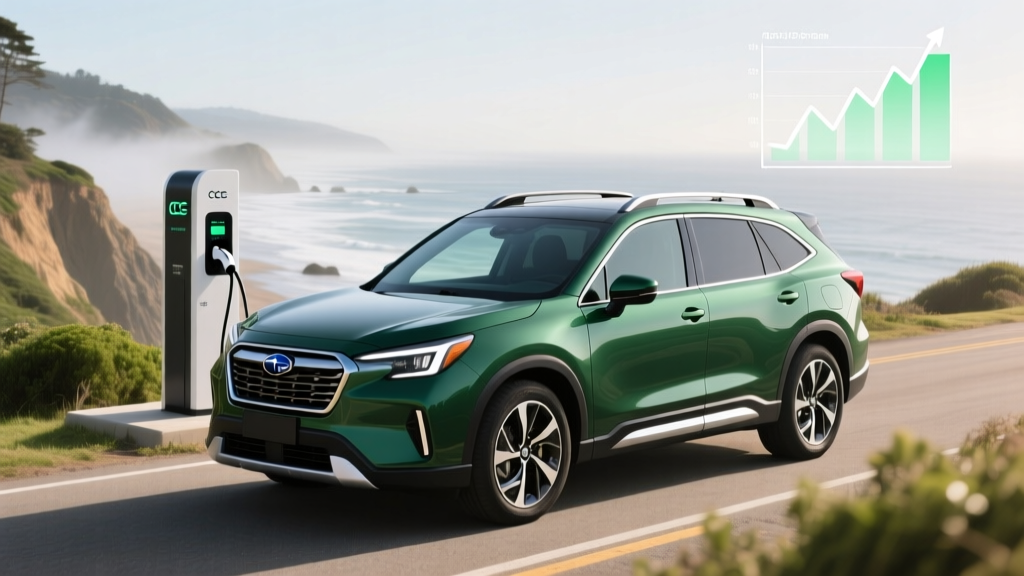
The 2025 Subaru Solterra Premium sits at the intersection of rugged brand loyalty and electric pragmatism. Built on the shared Toyota-Subaru e-TNGA platform (it's mechanically a twin to the Toyota bZ4X), this compact electric SUV targets outdoorsy drivers who want standard all-wheel drive, elevated ground clearance, and a badge they trust — without paying luxury-EV premiums. But with a 72.8 kWh battery delivering an EPA-estimated 222 miles of range, the Solterra Premium asks buyers to weigh trail credibility against highway-range limitations.
We've spent time with the Solterra across mixed driving conditions to separate Subaru's spec sheet from real-world ownership reality. Here's what matters before you sign.
Range and Efficiency: The 222-Mile Reality Check
Real-World Expectation: 190–210 miles in mixed highway/city driving at 65–70 mph; 160–180 miles in sustained sub-freezing temperatures or aggressive mountain driving. City-heavy commutes with regen braking can push closer to the 222-mile sticker.
The Premium trim's 18-inch all-season tires help it achieve the highest range figure in the Solterra lineup. Step up to the Limited or Touring trims with 20-inch wheels, and the EPA estimate drops to 207 miles — a meaningful 15-mile penalty for larger alloys.
Efficiency lands at 104 MPGe combined (114 city / 94 highway) according to fueleconomy.gov, which translates to roughly 32 kWh per 100 miles. That's competitive with the Hyundai Ioniq 5 AWD (33 kWh/100mi) but trails the Tesla Model Y Long Range AWD's 28 kWh/100mi. On a 250-mile road trip, expect to consume approximately 80 kWh — meaning a single full charge won't quite cover it without a DC fast-charge stop.
The Solterra's boxy silhouette and 8.3 inches of ground clearance create more aerodynamic drag than sleeker crossovers, which explains the highway efficiency penalty. If your commute is mostly under 55 mph, the range picture improves considerably.
Battery, Charging, and the Heat Pump Advantage
| Attribute | Specification |
|---|---|
| Battery Capacity | 72.8 kWh (gross) / ~65.4 kWh (usable) |
| Battery Chemistry | Lithium-ion (NMC — Nickel Manganese Cobalt) |
| EPA Range | 222 miles (Premium, 18" wheels) |
| Max DC Fast Charge | 150 kW peak |
| 10–80% DC Fast Charge | ~35 minutes (optimal battery temp) |
| Level 2 Home Charging | 7.6 kW onboard charger (~25 miles/hr) |
| Charge Port | CCS1 (J1772 AC + CCS DC combo) |
| Drivetrain | Dual-motor AWD (X-MODE) |
| Horsepower / Torque | 215 hp / 248 lb-ft |
| 0–60 mph | 6.5 seconds |
| Ground Clearance | 8.3 inches |
| Towing Capacity | Not rated for towing |
The 72.8 kWh pack uses NMC chemistry, which offers higher energy density than LFP but requires more careful state-of-charge management for long-term health. Subaru recommends daily charging to 80% for routine use and reserving 100% charges for road trips — a practice that extends NMC battery longevity.
DC Fast Charging: The Solterra peaks at 150 kW on a CCS-equipped DC fast charger. In practice, the charge curve is moderate: expect roughly 100–130 kW sustained through the 20–60% range, tapering significantly above 80%. A 10–80% session takes approximately 35 minutes under ideal thermal conditions. However, cold-soaked batteries (below 40°F) can extend that time to 45+ minutes unless you precondition using the navigation-routed battery warming feature. Subaru added battery preconditioning for the 2024 model year and it carries forward — plan your charging stops through the built-in nav to activate it.
Level 2 Home Charging: The 7.6 kW onboard charger replenishes the battery at roughly 25 miles of range per hour. A full 0–100% charge on a 32-amp Level 2 home station takes approximately 9–10 hours, making overnight top-ups practical for daily driving. A 48-amp circuit won't speed things up, as the onboard charger is the bottleneck at 7.6 kW.
Performance and the X-MODE Drivetrain
The dual-motor AWD system produces 215 horsepower and 248 lb-ft of torque — adequate for merging and passing but not thrilling. The 6.5-second 0–60 mph time trails the Hyundai Ioniq 5 AWD (5.1 seconds) and the Tesla Model Y Long Range (4.8 seconds), but matches the Toyota bZ4X exactly (same powertrain).
Where the Solterra differentiates itself is X-MODE, Subaru's traction-management system adapted for electric torque delivery. It offers Snow/Dirt and Deep Snow/Mud settings, modulating torque distribution between the front and rear motors along with brake-based torque vectoring. On gravel fire roads and light snow, X-MODE provides genuine confidence that most electric crossovers can't match. This is not a dedicated off-roader — there are no locking differentials or skid plates — but for forest service roads, boat ramps, and snowy driveways, it's the most capable EV in its price class.
Ride quality is compliant, with well-damped suspension tuning that absorbs rough pavement without excessive body roll. Steering is light and numb by enthusiast standards, but predictable and appropriate for the target buyer. The 37.4-foot turning circle is reasonable for urban maneuvering.
Interior, Cargo, and Daily Livability
The Solterra's cabin is functional rather than luxurious, with cloth upholstery on the Premium trim (SofTex synthetic leather arrives on Limited and Touring). The 12.3-inch touchscreen runs Subaru's latest Starlink infotainment with wireless Apple CarPlay and Android Auto. Physical climate controls below the screen are a welcome ergonomic choice — no sub-menu hunting to adjust temperature.
Cargo volume: 23.8 cubic feet behind the rear seats, expanding to approximately 56.9 cubic feet with the 60/40 rear seats folded. There is no front trunk (frunk) — the space is occupied by power electronics. Competitors like the Ioniq 5 (27.2 cu ft rear / 56.2 cu ft total) and VW ID.4 (30.3 cu ft rear / 64.2 cu ft total) offer more rear cargo room.
Passenger space: Front legroom measures 42.1 inches; rear legroom is 35.7 inches. Headroom is generous front and rear thanks to the tall roofline. Three adults in the rear is tight on width but feasible for short trips. The rear seatbacks recline slightly, improving long-drive comfort.
Driver Assistance: Subaru's EyeSight 4.0 suite is standard across all trims, including adaptive cruise control with lane centering, lane departure prevention, pre-collision braking, and blind-spot detection with rear cross-traffic alert. This is an SAE Level 2 driver-assist system — it does not replace the driver and requires hands-on-wheel engagement. It performs reliably in highway cruising but lacks the automated lane-change capability of Tesla's Autopilot or GM's Super Cruise.
Pricing, Trims, and Federal Tax Credit Eligibility
| Trim | Base MSRP | With Est. Destination | §30D Credit Eligible? |
|---|---|---|---|
| Premium | $38,495 | ~$39,995 | Up to $7,500 (see rules below) |
| Limited | $41,995 | ~$43,495 | Up to $7,500 |
| Touring | $44,995 | ~$46,495 | Up to $7,500 |
The Premium trim is the value play: you get the full powertrain, the best range figure (thanks to 18-inch wheels), heated front seats, heated steering wheel, dual-zone climate control, the 12.3-inch touchscreen, and the complete EyeSight 4.0 suite. The Limited adds SofTex upholstery, a panoramic fixed glass roof, a 360-degree camera, and a hands-free power liftgate. The Touring tops the range with ventilated front seats, a Harman Kardon audio system, and a digital rearview mirror.
Federal Tax Credit: §30D Rules That Apply
- MSRP Cap: The Solterra qualifies as an SUV under IRS rules, so the MSRP cap is $80,000 — all trims clear this easily.
- Buyer Income Cap: Adjusted gross income must not exceed $150,000 (single), $225,000 (head of household), or $300,000 (married filing jointly).
- Battery Sourcing: The credit amount (up to $7,500) depends on critical-mineral and battery-component sourcing requirements that shift annually. The Solterra is assembled at Toyota's Motomachi plant in Japan, and battery cell sourcing involves Panasonic and CATL supply chains. Check the latest IRS qualified vehicle list before purchasing, as partial ($3,750) or full ($7,500) credit eligibility can change with updated sourcing documentation.
- Point-of-Sale Transfer: As of 2024, buyers can transfer the credit to the dealer at purchase, reducing the out-of-pocket price immediately rather than waiting for a tax refund. The dealer must be IRS-registered.
- Lease Loophole: Leased Solterras may qualify for the full $7,500 commercial credit (§45W) passed through as a lease incentive, regardless of buyer income or battery sourcing — ask the dealer about current lease offers.
With the full $7,500 credit applied at point of sale, a 2025 Solterra Premium effectively drops to approximately $32,495 — competitive with a well-equipped RAV4 Hybrid and significantly undercutting a Tesla Model Y Long Range AWD. Consult a tax professional to confirm your personal eligibility.
Warranty Coverage and Long-Term Battery Outlook
Subaru provides a 3-year/36,000-mile limited vehicle warranty and a 5-year/60,000-mile powertrain warranty. The high-voltage battery is covered for 8 years / 100,000 miles against defects and capacity loss below 70% of original capacity. This is industry-standard, matching Toyota, Hyundai, and most mainstream competitors. Tesla offers 8 years / 120,000 miles on the Model Y battery — a slight edge in mileage coverage.
NMC batteries in liquid-cooled packs like the Solterra's typically degrade 10–15% over the first 100,000 miles under normal use patterns, based on fleet data from similar e-TNGA vehicles. Avoiding repeated DC fast charging above 80%, minimizing extended storage at 100% SoC, and leveraging the heat pump in extreme temperatures will maximize longevity.
Who Should Buy the Solterra Premium — And Who Shouldn't
- You live in a snow-belt state and prioritize AWD traction over maximum range
- Your daily commute is under 80 miles round-trip with home Level 2 charging
- You regularly drive on unpaved roads, forest service routes, or steep driveways
- You value physical controls, straightforward infotainment, and Subaru brand loyalty
- You qualify for the full §30D credit, bringing the effective price near $32,500
- You need 300+ miles of range for frequent road trips (consider the Hyundai Ioniq 5, Tesla Model Y, or Chevy Blazer EV)
- You need to tow — the Solterra is not rated for towing
- Fast DC charging is a priority — 150 kW peak is slower than the Ioniq 5's 240 kW or the Tesla Model Y's 250 kW
- Maximum cargo space matters — the VW ID.4 offers 30% more rear cargo volume
- Standard dual-motor AWD with X-MODE — genuinely capable on loose surfaces
- 8.3 inches of ground clearance exceeds most EV crossovers
- Competitive pricing after federal tax credit (as low as ~$32,500 effective)
- Physical climate controls and straightforward infotainment
- Standard heat pump improves cold-weather range retention
- Comprehensive EyeSight 4.0 driver-assist suite on every trim
- 222-mile EPA range trails key competitors by 30–80 miles
- 150 kW peak DC charging is slow for the segment; 35-min 10–80% time
- No front trunk (frunk); cargo space is tight vs. ID.4 and Ioniq 5
- Not rated for towing — a dealbreaker for boat/trailer owners
- Rear-seat USB-C ports only on Limited/Touring trims
- Modest 215 hp feels leisurely next to 300+ hp rivals
Frequently Asked Questions
What is the real-world range of the 2025 Subaru Solterra Premium?
The EPA estimates 222 miles, but real-world highway driving at 70 mph typically yields 190–210 miles. In freezing temperatures with cabin heat running, expect 160–180 miles. City driving with regenerative braking can match or slightly exceed the EPA figure. The standard heat pump helps mitigate cold-weather losses compared to EVs without one.
How fast does the Solterra charge at home and on the road?
On a Level 2 home charger (240V, 32A), the Solterra adds approximately 25 miles of range per hour, with a full charge taking 9–10 hours. On a DC fast charger, it peaks at 150 kW and charges from 10–80% in roughly 35 minutes under optimal conditions. Cold batteries can add 10+ minutes — always use navigation-based preconditioning before arriving at a charger.
Does the 2025 Solterra qualify for the $7,500 federal EV tax credit?
It can, but eligibility depends on your income (under $150K single / $300K joint), and the vehicle's battery-sourcing compliance with current-year IRS rules. All Solterra trims fall under the $80,000 SUV MSRP cap. The credit can be transferred to the dealer at point of sale for an immediate price reduction. Check the IRS qualified vehicles list and consult a tax professional before relying on the credit.
Is the Solterra worth buying over the Toyota bZ4X, Hyundai Ioniq 5, or Tesla Model Y?
If AWD capability on rough or snowy roads is your top priority, the Solterra has no direct rival at this price point. If range and charging speed matter more, the Hyundai Ioniq 5 AWD (290 mi EPA, 240 kW DC charging) or Tesla Model Y Long Range (310+ mi, 250 kW Supercharging) are objectively superior road-trip vehicles. The Toyota bZ4X is mechanically identical to the Solterra but lacks X-MODE and has slightly less ground clearance — choose based on which dealer network and styling you prefer.
Can the Subaru Solterra tow a trailer?
No. Subaru does not rate the Solterra for towing, and no factory hitch receiver is available. If you need to tow even a light utility trailer or bike rack, consider the Hyundai Ioniq 5 (1,650 lb rating), VW ID.4 (2,700 lb), or Tesla Model Y (3,500 lb).
What charging connector does the Solterra use?
The 2025 Solterra uses the CCS1 connector (J1772 for AC, CCS Combo for DC). It does not have a NACS (Tesla) port. Subaru has not yet announced a NACS transition timeline for the Solterra. Adapters for Tesla destination chargers (J1772 adapter included with the vehicle) work for Level 2 charging at Tesla locations, but DC Supercharger access requires a CCS-to-NACS adapter — check current compatibility before relying on this.
Sources: fueleconomy.gov, Subaru USA, IRS §30D Qualified Vehicles.