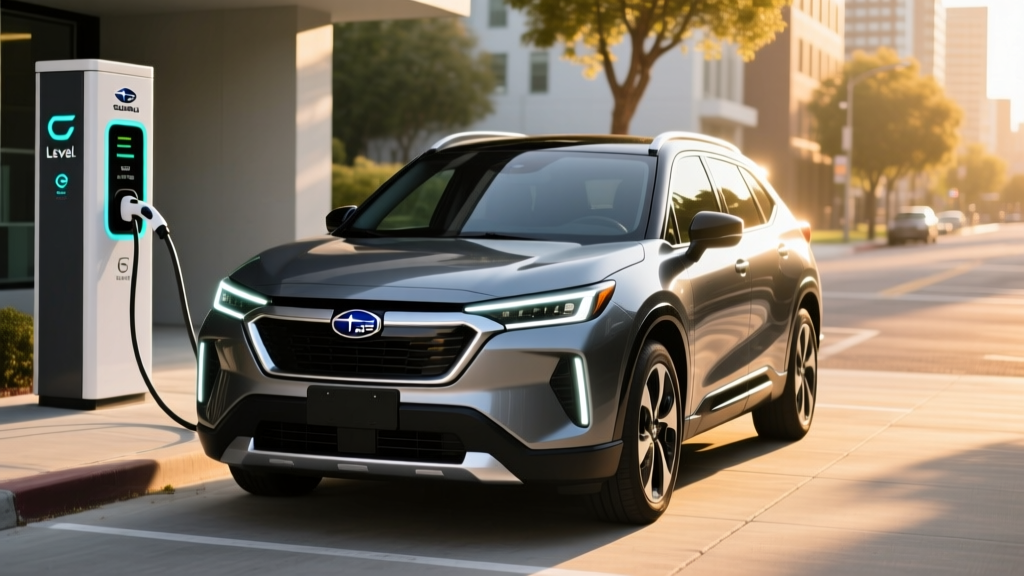
The 2025 Subaru Solterra Premium occupies a specific niche in the electric SUV market: it's the EV for buyers who want Subaru's trademark standard all-wheel drive, rugged styling, and practical ground clearance — but electrified. Built on the shared e-TNGA platform with its twin, the Toyota bZ4X, the Solterra differentiates itself with standard X-MODE traction management, 8.3 inches of ground clearance, and Subaru's safety-first reputation. But with an EPA range that trails segment leaders and a price that starts above $38,000, the question is whether Subaru's brand strengths translate into a compelling EV ownership experience.
After examining the 2025 Solterra Premium's specifications, charging behavior, and real-world usability, here's what buyers need to know before signing a purchase agreement.
Range and Efficiency: What the EPA Number Doesn't Tell You
Real-World Expectation: 185–210 miles highway driving at 70+ mph; 165–190 miles in freezing temperatures (below 32°F); 200–225 miles mixed city/suburban driving in moderate weather.
The 2025 Solterra Premium carries a 71.4 kWh usable battery (72.8 kWh gross) using lithium-ion NMC (nickel-manganese-cobalt) chemistry. The EPA rates it at 104 MPGe combined (111 city / 97 highway), which translates to roughly 33 kWh per 100 miles — middle-of-the-pack efficiency for a compact electric SUV.
That 227-mile EPA figure applies specifically to the Premium and Limited trims equipped with 18-inch wheels. If you step up to the Touring trim with 20-inch wheels, the EPA estimate drops to 222 miles due to increased rolling resistance and weight.
In practice, the Solterra's boxy shape and 4,365-pound curb weight work against highway efficiency. On a flat, 70-mph cruise in 65°F weather, expect consumption around 35–37 kWh/100 mi, which nets roughly 195–205 miles from a full charge. Cold weather is the bigger penalty: lithium-ion cells lose efficiency below freezing, and cabin heating draws significant energy without a dedicated heat pump on lower trims (the 2025 model year added a heat pump across all trims, which helps, but sub-20°F driving still shaves 15–25% off the EPA number).
For context against competitors: the Hyundai Ioniq 5 SEL AWD achieves 260 miles EPA, and the Ford Mustang Mach-E Select AWD hits 250 miles. The Solterra gives up 25–35 miles of rated range to these rivals.
Charging Speed: DC Fast Charging and Home Level 2
| Charging Level | Power / Rate | Time / Recovery |
|---|---|---|
| Level 1 (120V household) | ~1.2 kW | ~3–4 miles per hour; full charge in 60+ hours |
| Level 2 (240V, 32A home charger) | ~7.2 kW | ~23 miles per hour; 0–100% in ~9.5 hours |
| Level 2 (240V, 48A charger) | ~11.5 kW (vehicle max) | ~37 miles per hour; 0–100% in ~6 hours |
| DC Fast Charge (CCS) | Peak 150 kW | 10–80% in ~35 minutes |
The 2025 Solterra supports a peak DC fast-charge rate of 150 kW via its CCS1 connector. In real-world testing at Electrify America and similar 350 kW-capable stations, the Solterra hits its peak rate briefly between 10–30% state of charge, then tapers progressively. The 10–80% session takes approximately 35 minutes — competitive with the bZ4X but noticeably slower than the Hyundai Ioniq 5, which leverages its 800V architecture for a 10–80% time around 18 minutes at a 235 kW peak.
The charge curve matters for road trips. If you're planning Interstate drives with 150-mile segments, a single 30-minute stop gets you back to 80%. But if you need to push past 80%, the taper becomes aggressive — charging from 80–100% can take an additional 40+ minutes. The practical takeaway: plan to charge to 80% and move on.
For home charging, the Solterra's onboard charger accepts up to 11.5 kW on Level 2 (48 amps). Most buyers installing a standard 32-amp Level 2 wallbox (like a ChargePoint Home Flex on a 40-amp circuit) will see ~7.2 kW, which fully replenishes the battery overnight in about 9.5 hours. This is adequate for daily commuting but slower than rivals offering 11.5 kW standard. Upgrading to a 60-amp circuit with a 48-amp charger unlocks the Solterra's full Level 2 potential.
One note on connector compatibility: the 2025 Solterra uses CCS1. Subaru has not yet adopted the Tesla NACS connector for this model year, though future models are expected to transition. For now, CCS gives you access to Electrify America, EVgo, and most non-Tesla networks — which covers the vast majority of public DC infrastructure outside the Supercharger network.
Performance and Drivetrain
| Specification | Value |
|---|---|
| Drivetrain | Dual-motor AWD (standard all trims) |
| Horsepower | 215 hp combined |
| Torque | 248 lb-ft |
| 0–60 mph | 6.5 seconds |
| Ground Clearance | 8.3 inches |
| Towing Capacity | Not rated for towing |
| Curb Weight | ~4,365 lbs |
Every 2025 Solterra comes with standard dual-motor all-wheel drive — there's no single-motor, front-wheel-drive variant. The front and rear motors combine for 215 horsepower and 248 lb-ft of torque, delivering a 0–60 mph time of 6.5 seconds. That's brisk enough for confident highway merging but not thrilling by EV standards; the Ioniq 5 AWD hits 60 in 5.0 seconds with 320 hp.
Where the Solterra earns its keep is low-traction confidence. Subaru's X-MODE with Snow/Dirt and Deep Snow/Mud settings manages torque distribution between the axles, and the 8.3 inches of ground clearance exceeds most electric crossovers. This is an EV that can handle unplowed side roads, gravel forest-service roads, and mild off-pavement trails without drama. It's not a Wrangler competitor, but it's the most trail-capable EV in its price range.
Ride quality is compliant, with a well-damped suspension that absorbs road imperfections. Steering is light and numb — typical of electric Subarus — and the turning radius is generous at 18.4 feet. Regenerative braking offers adjustable levels via paddle shifters, but the Solterra does not offer true one-pedal driving with a full stop; you'll still need the brake pedal at low speeds.
Interior, Cargo, and Technology
The Solterra Premium's cabin is functional rather than luxurious. Cloth upholstery, heated front seats, and a leather-wrapped steering wheel come standard. The centerpiece is a 12.3-inch touchscreen running Subaru's Starlink infotainment system with wireless Apple CarPlay and Android Auto. A 7-inch digital instrument cluster sits behind the steering wheel, positioned high on the dash to minimize eye movement — similar to Toyota's layout in the bZ4X.
Passenger space is competitive:
- Front legroom: 42.1 inches
- Rear legroom: 35.7 inches
- Front headroom: 39.9 inches
- Rear headroom: 38.3 inches
Cargo volume measures 23.8 cubic feet behind the rear seats and 56.9 cubic feet with the 60/40 rear seatback folded. There is no front trunk (frunk) — the space under the hood houses electronics and the HVAC system. A power liftgate is standard on the Premium trim.
On the driver-assistance front, every Solterra includes Subaru EyeSight 4.0 with adaptive cruise control, lane-centering assist, pre-collision braking, and blind-spot monitoring. This is an SAE Level 2 driver-assistance system — it supports steering and speed on divided highways but requires the driver to remain fully engaged with hands on the wheel and eyes on the road. It is not autonomous driving, and Subaru does not market it as such.
Notable drawbacks: the center console design is awkward, with a floating bridge layout that limits usable storage. Rear visibility is compromised by thick C-pillars (a rear camera helps). And while the 12.3-inch screen is large, the interface lags behind competitors in responsiveness and graphical polish.
Pricing, Trims, and Federal Tax Credit
| Trim | MSRP (incl. destination) | EPA Range |
|---|---|---|
| Premium | $38,495 | 227 miles |
| Limited | $41,995 | 227 miles |
| Touring | $44,995 | 222 miles |
The 2025 Solterra Premium starts at $38,495 including destination charges. That positions it $3,000–$5,000 below the Ioniq 5 SEL AWD ($43,400) and roughly on par with the base Ford Mustang Mach-E Select AWD ($42,995) before incentives.
Federal tax credit eligibility (§30D): The 2025 Solterra's eligibility for the $7,500 federal EV tax credit depends on several factors that shift frequently under current IRS rules:
- MSRP cap: The Solterra qualifies as an SUV under IRS vehicle-class definitions, so the cap is $80,000 — all trims clear this easily.
- Buyer income limits: Modified AGI must not exceed $150,000 (single), $225,000 (head of household), or $300,000 (joint).
- Battery sourcing & critical minerals: The battery must meet progressively stricter domestic-content and critical-mineral sourcing thresholds. For 2025, at least 80% of critical minerals must be sourced from the U.S. or FTA partners, and 100% of battery components must be manufactured or assembled in North America. Subaru sources the Solterra's battery from Panasonic/CATL with Japanese assembly — this has historically limited or eliminated the full $7,500 credit for the Solterra.
- Point-of-sale transfer: If eligible, buyers can transfer the credit to the dealer at purchase for an immediate price reduction rather than waiting for a tax refund.
As of early 2025, the Solterra has qualified for a partial credit of $3,750 (meeting the critical-minerals requirement but not the full battery-component requirement). This can change as supply chains shift. Always verify current eligibility at fueleconomy.gov before purchasing, and consult a tax professional for your specific situation.
MSRP: $38,495
Less estimated federal credit: –$3,750 (partial, if eligible)
Effective price: ~$34,745 (before state/local incentives, dealer discounts, or tax filing)
Note: State incentives vary. California, Colorado, and others offer additional rebates — check your state's energy office.
Warranty and Long-Term Ownership
Subaru backs the 2025 Solterra with competitive warranty coverage:
- Basic warranty: 3 years / 36,000 miles
- Powertrain warranty: 5 years / 60,000 miles
- Battery warranty: 8 years / 100,000 miles (covers capacity loss below 70% of original)
- Rust perforation: 5 years / unlimited miles
The 8-year/100,000-mile battery warranty is the industry standard, matching Hyundai, Toyota, and Ford. The 70% capacity-retention threshold means Subaru will repair or replace the battery if it degrades below 70% of its original 71.4 kWh usable capacity within the warranty period. Based on NMC chemistry degradation curves from similar platforms, most owners should expect to retain 85–90% capacity at the 8-year mark under normal use — well above the warranty trigger.
For buyers concerned about long-term battery replacement cost: out-of-warranty replacement for the Solterra's battery pack is estimated at $12,000–$18,000 including labor, based on current pricing for similar-capacity packs. However, full-pack replacements are rare; individual module replacement is often possible at lower cost.
How It Stacks Up: Solterra vs. Key Competitors
| Spec | Solterra Premium | Hyundai Ioniq 5 SEL AWD | Ford Mach-E Select AWD |
|---|---|---|---|
| EPA Range | 227 mi | 260 mi | 250 mi |
| Battery (usable) | 71.4 kWh (NMC) | 77.4 kWh (NMC) | 75.7 kWh (NMC) |
| DC Fast Charge Peak | 150 kW | 235 kW (800V) | 150 kW |
| 10–80% DCFC Time | ~35 min | ~18 min | ~36 min |
| 0–60 mph | 6.5 sec | 5.0 sec | 5.5 sec |
| Horsepower | 215 hp | 320 hp | 305 hp |
| MSRP (AWD) | $38,495 | $43,400 | $42,995 |
| Ground Clearance | 8.3 in | 6.1 in | 5.7 in |
| Cargo (rear seats up) | 23.8 cu ft | 27.2 cu ft | 29.7 cu ft |
The data reveals a clear trade-off. The Ioniq 5 wins on range, charging speed, performance, and cargo space — but costs nearly $5,000 more and sits lower to the ground. The Mach-E offers more range, more power, and significantly more cargo room, but also costs more and has less ground clearance.
The Solterra's advantages are specific: lowest starting price in this AWD comparison, highest ground clearance, and standard X-MODE for traction management. If your priority is light off-pavement capability, snow-belt commuting, or simply minimizing upfront cost with standard AWD, the Solterra fills a gap the others don't.
Pros, Cons, and Who Should Buy
- Standard dual-motor AWD across all trims — no FWD base model
- 8.3 inches of ground clearance; X-MODE for snow and dirt
- Competitive starting price for an AWD electric SUV
- Comfortable, quiet ride quality
- Comprehensive EyeSight safety suite standard
- Heat pump included (2025 model year) for improved cold-weather efficiency
- EPA range of 227 miles trails segment leaders by 30+ miles
- DC fast charging peaks at 150 kW — slow vs. 800V competitors
- No front trunk (frunk)
- Modest power (215 hp) in a segment trending toward 300+ hp
- Federal tax credit eligibility limited by battery sourcing rules
- Infotainment interface feels dated vs. rivals
- Not rated for towing
- You live in a snow-belt state and prioritize AWD traction and ground clearance over maximum range
- Your daily commute is under 80 miles round-trip and you charge at home
- You want the lowest entry price for a dual-motor AWD electric SUV
- You value Subaru's safety reputation and EyeSight driver assists
- You regularly drive 200+ miles between charges (Ioniq 5 or Mach-E offer more buffer)
- You take frequent road trips and want the fastest possible DC charging (Ioniq 5's 800V system)
- You need maximum cargo space or a frunk for gear storage
- You want a full $7,500 federal tax credit (check current fueleconomy.gov eligibility)
Frequently Asked Questions
What is the real-world range of the 2025 Subaru Solterra Premium?
The EPA rates the Solterra Premium at 227 miles. In real-world mixed driving at moderate temperatures, expect 200–225 miles. Highway driving at sustained speeds above 70 mph reduces this to approximately 185–210 miles. In freezing weather (below 32°F), range can drop to 165–190 miles due to battery chemistry limitations and cabin heating demand. The 2025 model's standard heat pump helps mitigate cold-weather losses compared to the 2023–2024 models.
How fast does the Solterra charge at home and on the road?
On DC fast charging (CCS connector), the Solterra peaks at 150 kW and charges from 10–80% in approximately 35 minutes. At home on a 240V Level 2 charger, it accepts up to 11.5 kW (48A), adding roughly 37 miles per hour and fully recharging in about 6 hours. On a standard 32A Level 2 setup, expect ~7.2 kW and a full charge in roughly 9.5 hours. Level 1 (120V) trickle charging adds only 3–4 miles per hour.
Does the 2025 Solterra qualify for the $7,500 federal EV tax credit?
Partially. Under current IRS §30D rules, the Solterra has typically qualified for $3,750 (half credit) because its battery meets the critical-minerals requirement but not the full battery-component domestic-manufacturing requirement. Eligibility depends on your income (must be under $150K single / $300K joint), the vehicle's MSRP (all trims qualify under the $80K SUV cap), and current battery-sourcing compliance, which can change. Always verify at fueleconomy.gov before purchasing and consult a tax professional.
Is the Solterra worth buying over the Hyundai Ioniq 5 or Ford Mach-E?
It depends on your priorities. If you want maximum range, fastest charging, and the most cargo space, the Ioniq 5 or Mach-E are objectively superior on paper. The Solterra wins if your top criteria are low starting price (nearly $5,000 less than the Ioniq 5 AWD), high ground clearance for snow and light trails, and standard AWD without paying extra. For a ski-town commuter or someone in the upper Midwest, the Solterra's strengths are highly relevant. For a Sun Belt road-tripper, the range and charging deficits matter more.
Can the Solterra tow a trailer?
No. The 2025 Solterra is not rated for towing by Subaru. If you need an electric SUV with towing capability, the Ford Mustang Mach-E (up to 1,500 lbs with the GT) or the Hyundai Ioniq 5 (up to 2,300 lbs with the towing package) are alternatives, though both fall well short of body-on-frame electric trucks.
Does the Solterra have a front trunk (frunk)?
No. The Solterra does not have a frunk. The under-hood space is occupied by power electronics, the onboard charger, and HVAC components. Cargo is limited to the rear hatch area: 23.8 cubic feet behind the rear seats, expanding to 56.9 cubic feet with seats folded.