The 2025 Subaru Solterra arrives with a clear mission: bring Subaru's all-weather credibility to the electric SUV segment. Developed jointly with Toyota (its twin is the bZ4X), the Solterra targets buyers who want standard all-wheel drive, genuine ground clearance, and a cabin built for outdoor life — not just spec-sheet supremacy. But with the EV market maturing fast, how does the Solterra stack up on the metrics that matter most: real-world range, charging speed, and daily usability?
We've spent time with the 2025 Solterra across trims, evaluating the 2025 Subaru Solterra interior, its updated charging hardware, and whether its 228-mile EPA range holds up outside the lab. Here's everything you need to decide if it's the right electric SUV for your garage.
Quick Verdict: Who the Solterra Is For
The Solterra is a strong pick for cold-climate commuters and outdoor-oriented drivers who prioritize standard AWD, 8.3 inches of ground clearance, and Subaru's safety reputation over maximum range. It's less ideal for road-trippers who need 300+ miles between stops or buyers hunting for the lowest cost per mile of range. If you live where winters bite and value traction over bragging rights, the Solterra earns a serious look.
Range, Battery & Efficiency
The 2025 Solterra uses a 71.4 kWh lithium-ion battery pack (NMC chemistry — nickel manganese cobalt). Subaru quotes 228 miles of EPA range for the Premium and Touring trims equipped with 18-inch wheels. Step up to the Limited trim's 20-inch alloys and that figure dips to 222 miles due to increased rolling resistance.
Efficiency lands at 104 MPGe combined (114 city / 94 highway) according to fueleconomy.gov, translating to roughly 32 kWh per 100 miles. That's middling for the segment — the Hyundai Ioniq 5 RWD achieves 114 MPGe combined, for reference — but the Solterra's standard dual-motor AWD adds weight and drivetrain losses that single-motor rivals avoid.
| Spec | Value |
|---|---|
| EPA Range | 228 mi (Premium/Touring) / 222 mi (Limited) |
| Battery Capacity | 71.4 kWh usable, NMC chemistry |
| MPGe (combined) | 104 MPGe (114 city / 94 hwy) |
| Max DC Fast Charge | ~150 kW peak |
| 10–80% DC Charge Time | ~35 minutes |
| Level 2 Charge Rate | 6.6 kW (~22 mi/hr) |
| Drivetrain | Dual-motor AWD (standard all trims) |
| Horsepower / Torque | 215 hp / 248 lb-ft |
| 0–60 mph | ~6.5 seconds |
| Ground Clearance | 8.3 inches |
| Cargo Volume | 23.8 cu ft (rear seats up) / 56.9 cu ft (folded) |
| Base MSRP | $38,495 (Premium) – $45,495 (Touring) |
Charging: DC Fast, Level 2 & the Charging Curve Reality
Subaru upgraded the Solterra's DC fast-charging capability for 2025, addressing one of the original model's biggest criticisms. The SUV now accepts up to ~150 kW peak on a DC fast charger, with a 10–80% charge time of approximately 35 minutes. That's a meaningful improvement over the 2023 model's ~100 kW peak and ~56-minute 10–80% time.
However, charging-curve reality matters: the Solterra, like most EVs, sustains peak rate only in the lower portion of the battery (roughly 10–50% SoC). Above 60%, the rate tapers noticeably. If you're in a rush and only need to 80%, 35 minutes is competitive. If you regularly charge to 90%+ on road trips, budget closer to 55–60 minutes total.
At home on a Level 2 (240V) charger, the Solterra's onboard charger handles 6.6 kW, adding roughly 22 miles of range per hour. A full 0–100% charge takes about 11 hours — fine for overnight replenishment. Subaru includes a dual-voltage Level 1/Level 2 portable charging cable with the vehicle, which can plug into a NEMA 14-50 outlet for Level 2 speeds without a dedicated wall unit.
| Level | Power | Speed | Use Case |
|---|---|---|---|
| Level 1 (120V) | ~1.4 kW | ~4 mi/hr | Emergency / trickle |
| Level 2 (240V) | 6.6 kW | ~22 mi/hr | Home overnight |
| DC Fast Charge | ~150 kW peak | 10–80% in ~35 min | Road trips |
The Solterra uses the CCS1 connector for DC fast charging and J1772 for Level 2 AC. It does not currently have a NACS (Tesla Supercharger) port, though adapters may become available as the industry transitions.
2025 Subaru Solterra Interior: Cabin, Cargo & Technology
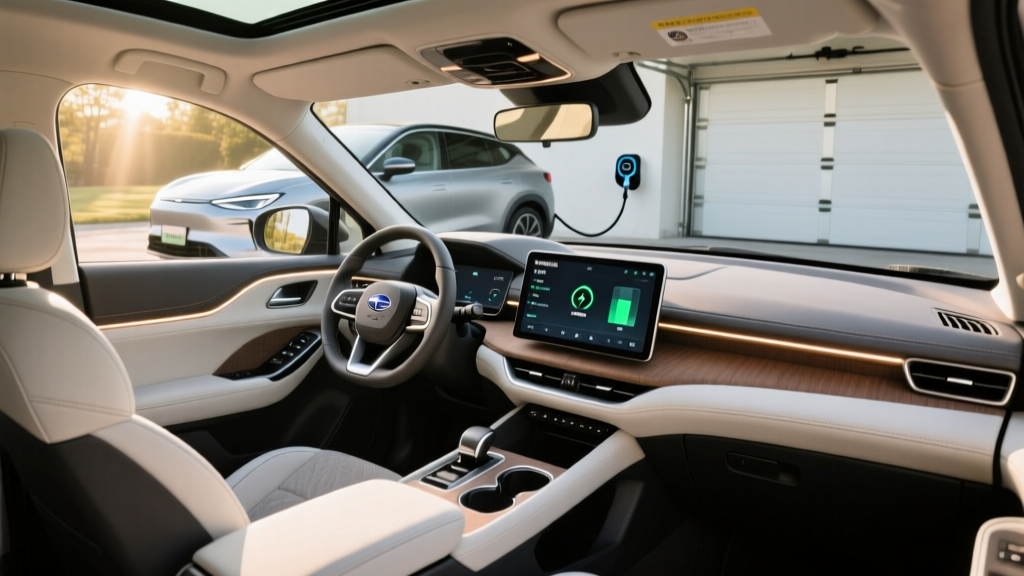
The 2025 Subaru Solterra interior reflects its utilitarian, outdoor-ready positioning. Materials are durable rather than luxurious — think hardy cloth and SofTex synthetic leather rather than Nappa hides. The dashboard layout uses a layered, horizontal design with a prominent center touchscreen and physical knobs for climate control, a decision many buyers will appreciate over touch-only interfaces.
Infotainment: The Premium trim features an 8-inch touchscreen, while the Limited and Touring step up to a 12.3-inch display running Subaru's latest Starlink multimedia system with wireless Apple CarPlay and Android Auto. The system is responsive, if not class-leading in graphics polish. A 7-inch digital instrument cluster sits behind the steering wheel, and the Touring trim adds a digital rearview mirror and a 360-degree surround-view camera.
Passenger space is generous for a compact electric SUV: front legroom measures 42.1 inches, with 35.7 inches in the rear — enough for adults on longer trips. Headroom is ample front and rear thanks to the flat battery floor. The center rear seat is narrow but usable for a child or short adult.
Cargo capacity: 23.8 cubic feet behind the second row expands to 56.9 cubic feet with the 60/40 split rear seats folded. That trails the Hyundai Ioniq 5 (27.2 / 59.3 cu ft) and Kia EV6 (24.4 / 50.2 cu ft) only slightly. A modest under-floor storage area adds space for charging cables. There is no front trunk (frunk), a missed opportunity given the platform's packaging potential.
Driver assistance: Every Solterra comes with Subaru's EyeSight suite, which includes adaptive cruise control with lane centering, pre-collision braking, lane departure warning, and blind-spot detection. This is a SAE Level 2 driver-assist system — it requires your hands on the wheel and eyes on the road at all times. It is not autonomous driving.
Performance & Driving Impressions
The Solterra's dual-motor all-wheel-drive powertrain produces 215 horsepower and 248 lb-ft of torque, launching it from 0–60 mph in approximately 6.5 seconds. That's adequate for merging and passing but won't win any drag races against the Ford Mustang Mach-E Extended Range AWD (4.8 seconds) or Ioniq 5 AWD (5.1 seconds).
Where the Solterra shines is off-pavement and in foul weather. The 8.3 inches of ground clearance exceeds most electric crossovers, and Subaru's X-MODE traction management system (with Snow/Dirt and Deep Snow/Mud settings) is genuinely useful on unplowed roads and light trail duty. The 2,000-pound towing capacity is modest but sufficient for a small utility trailer or bike rack setup.
Ride quality is composed, with well-damped suspension tuning that absorbs broken pavement without floating. Steering is light and predictable rather than sporty. Regenerative braking offers adjustable levels via paddle shifters, though it doesn't quite achieve true one-pedal driving — you'll still use the brake pedal for final stops.
Pricing, Trims & Federal Tax Credit Eligibility
The 2025 Solterra is offered in three trims. Pricing (including destination) breaks down as follows:
| Trim | MSRP (incl. destination) | Key Features |
|---|---|---|
| Premium | $38,495 | 18" wheels, 8" touchscreen, heated front seats, dual-zone climate, EyeSight |
| Limited | $41,995 | 20" wheels, 12.3" touchscreen, SofTex upholstery, power liftgate, 360° camera |
| Touring | $45,495 | Panoramic fixed glass roof, Harman Kardon audio, ventilated front seats, digital rearview mirror |
Federal EV Tax Credit (§30D) Eligibility
The Solterra's eligibility for the federal §30D clean vehicle tax credit (up to $7,500) depends on several factors that change periodically. As of current IRS guidelines, key requirements include:
- MSRP cap: The vehicle's MSRP must not exceed $80,000 for SUVs — all Solterra trims clear this easily.
- Buyer income limits: Adjusted gross income must not exceed $300,000 (joint filers), $225,000 (head of household), or $150,000 (single).
- Battery component & critical mineral sourcing: The vehicle must meet phased-in percentages for North American battery component manufacturing and critical mineral sourcing. These thresholds tighten annually. The Solterra's battery is manufactured in Japan by Panasonic, which has historically complicated full $7,500 eligibility.
- Point-of-sale transfer: Eligible buyers can transfer the credit to the dealer at purchase for an immediate price reduction rather than waiting for tax filing.
Important: Battery sourcing rules are subject to change. Always verify current eligibility on fueleconomy.gov or consult a tax professional before relying on the credit in your purchase decision. Some buyers may qualify for the full $7,500, others for $3,750 (if only one of the two sourcing thresholds is met), and some may not qualify at all depending on the model year's specific battery supply chain.
Warranty, Ownership Costs & Reliability
Subaru backs the Solterra with a competitive warranty package:
- Basic vehicle warranty: 3 years / 36,000 miles
- Powertrain warranty: 5 years / 60,000 miles
- EV battery warranty: 8 years / 100,000 miles (covers capacity loss below 70% of original)
The 70% capacity retention threshold is industry-standard, matching most competitors. Subaru's reputation for long-term reliability in ICE vehicles provides some buyer confidence, though the Solterra is still early in its lifecycle for long-term EV-specific durability data.
Insurance costs tend to run 10–20% higher than comparable gas-powered Subaru models due to EV repair costs and battery replacement considerations. Expect annual premiums in the $1,800–$2,400 range depending on your profile and location.
Pros & Cons
Pros
- Standard dual-motor AWD on every trim
- 8.3 inches of ground clearance — best-in-class for electric crossovers
- Genuine off-road capability with X-MODE
- Physical climate controls (no touchscreen-only menus)
- Competitive 150 kW DC fast-charging speed (2025 upgrade)
- Generous rear-seat legroom (35.7 inches)
- Comprehensive EyeSight safety suite standard
Cons
- 228-mile EPA range trails key rivals (Ioniq 5: 303 mi, EV6: 310 mi)
- No front trunk (frunk)
- 215 hp feels modest for the price point
- CCS1 connector only — no native NACS/Supercharger access
- Federal tax credit eligibility uncertain due to battery sourcing
- Interior materials feel budget-adjacent at $45K Touring trim
- 35-minute 10–80% charge time lags 800V rivals (Ioniq 5: ~18 min)
How It Compares: Solterra vs. Key Rivals
| Spec | Subaru Solterra | Hyundai Ioniq 5 AWD | Ford Mach-E AWD |
|---|---|---|---|
| EPA Range | 228 mi | 290 mi | 250 mi |
| Battery | 71.4 kWh NMC | 77.4 kWh NMC | 75.7 kWh NMC |
| DC Fast Charge | ~150 kW / 35 min | ~240 kW / 18 min | ~150 kW / 38 min |
| 0–60 mph | 6.5 sec | 5.1 sec | 5.5 sec |
| Ground Clearance | 8.3 in | 6.1 in | 5.7 in |
| Starting MSRP | $38,495 | $46,650 | $42,995 |
- Choose the Solterra if: You need serious ground clearance, live in snow country, value standard AWD without a trim upcharge, and your daily commute fits within 180–200 real-world miles.
- Choose the Ioniq 5 if: Maximum range, ultra-fast 800V charging, and NACS/Supercharger access matter most to you.
- Choose the Mach-E if: You want a balance of range, performance, and BlueCruise hands-free highway driving capability.
Frequently Asked Questions
What is the real-world range of the 2025 Subaru Solterra?
The EPA rates it at 228 miles (222 for the Limited trim with 20-inch wheels). In real-world highway driving, expect 190–210 miles. In freezing weather, plan for 170–190 miles. The heat pump helps, but cold temperatures and high speeds reduce all EV range.
How fast does the Solterra charge at home and on the road?
At home on Level 2 (240V), it charges at 6.6 kW, adding about 22 miles per hour — a full charge takes roughly 11 hours. On DC fast chargers, it peaks at ~150 kW and reaches 10–80% in approximately 35 minutes.
Does the 2025 Solterra qualify for the $7,500 federal EV tax credit?
It depends on current battery sourcing rules under IRS §30D. The Solterra's MSRP is well under the $80,000 SUV cap, and buyer income limits apply. However, its Japanese-manufactured battery may limit eligibility to $3,750 or disqualify it entirely depending on the model year's critical mineral and component sourcing percentages. Always check fueleconomy.gov for the latest status.
Is the Solterra worth buying over the Ioniq 5 or Mach-E?
If your priority is all-weather capability, ground clearance, and off-pavement confidence, the Solterra has no direct rival in the segment. If range and charging speed top your list, the Ioniq 5 and Mach-E are stronger choices. The Solterra's lower starting price is also a genuine advantage.
Does the Solterra have a frunk (front trunk)?
No. Unlike some rivals, the Solterra does not offer a front trunk. Cargo space is limited to the 23.8 cu ft rear cargo area and under-floor storage compartment.
Can the Solterra tow?
Yes, with a maximum towing capacity of 2,000 pounds when properly equipped. That's enough for a small trailer, kayak rack, or lightweight camper — but not a large boat or travel trailer.