Quick Verdict: A Range King With a Premium Price Tag
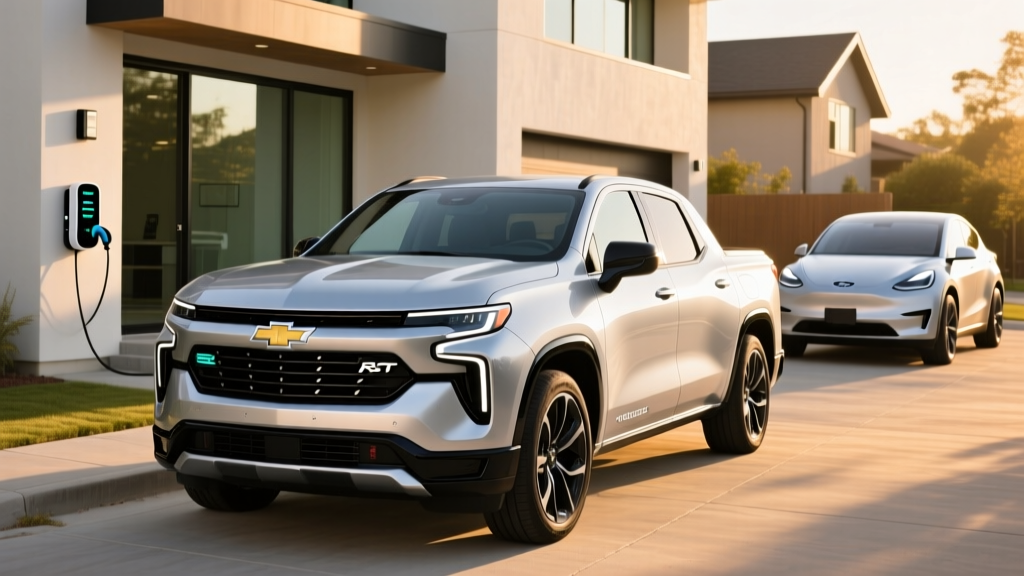
The 2025 Chevrolet Silverado EV RST is GM's flagship electric truck, built on the Ultium platform with a massive battery, serious towing credentials, and a price that places it firmly in premium territory. With an EPA-estimated 440 miles of range on the RST trim equipped with the larger battery pack, it leads the full-size electric pickup segment in range. But range stickers don't tell the full story — and neither does the spec sheet without context.
We've analyzed the Silverado EV RST's real-world efficiency, charging behavior, ownership costs, and practical limitations so you can decide whether this $87,000-plus electric truck earns a spot in your driveway — or whether a Ford F-150 Lightning, Rivian R1T, or even a Silverado EV WT (Work Truck) makes more sense for your needs.
| Spec | Value |
|---|---|
| EPA Range (Max Battery Pack) | 440 miles |
| Battery Capacity (Usable) | ~205 kWh (NMC, Ultium) |
| Drivetrain | Dual-motor AWD (e4WD) |
| Horsepower | 664 hp (780 lb-ft torque) |
| 0–60 mph | ~4.5 seconds |
| Max DC Fast-Charge Rate | 350 kW (peak) |
| 10–80% DC Charge Time | ~30 minutes (estimated) |
| Level 2 Home Charging | 19.2 kW onboard charger (~52 mi/hr) |
| MPGe (Combined) | ~51 MPGe (est. based on efficiency) |
| Efficiency | ~66 kWh/100 mi |
| Max Towing Capacity | 10,000 lbs (12,000 lbs w/ available package) |
| Bed Length | 5 ft 11 in (Multi-Flex tailgate extends to ~9 ft load floor) |
| Base MSRP (RST) | $87,300 |
| Battery/Powertrain Warranty | 8 years / 100,000 miles |
Range & Efficiency: 440 EPA Miles, but What's the Real Number?
The Silverado EV RST with the available Max Range battery pack carries an EPA-estimated 440 miles of range — the highest of any production electric pickup as of the 2025 model year. The standard battery pack (expected ~170 kWh usable) delivers roughly 380 miles EPA on the RST, though most RST buyers opt for the larger pack.
- EPA Sticker: 440 miles
- Real-World Highway (70 mph, 75°F): ~340–370 miles
- Real-World City/Suburban (mixed): ~390–420 miles
- Cold Weather (20°F, highway): ~260–300 miles (30–40% reduction)
- Towing (5,000-lb trailer, flat terrain): ~180–220 miles
The Silverado EV is a heavy vehicle (over 9,000 lbs curb weight) with a large frontal area. Highway efficiency drops significantly above 65 mph. Regenerative braking recovers meaningful energy in stop-and-go driving, which is why city range exceeds highway range — the opposite of gas vehicles.
The ~205 kWh usable Ultium battery uses NMC (nickel manganese cobalt) chemistry, which offers higher energy density than LFP (lithium iron phosphate) — critical for fitting this much energy into a truck platform. NMC batteries generally tolerate fast charging well but benefit from keeping daily state-of-charge between 20–80% for long-term longevity. Reserve 100% charges for road trips.
At roughly 66 kWh per 100 miles (combined driving), the Silverado EV RST is less efficient than smaller EVs — the Tesla Model Y uses about 28 kWh/100mi — but competitive within the full-size truck segment. The EPA's fueleconomy.gov database lists official MPGe figures; expect approximately 51 MPGe combined, which translates to about $0.07–$0.10 per mile on residential electricity ($0.16/kWh national average).
Charging Speed: 350 kW Peak, But the Curve Tells the Real Story
The Silverado EV RST supports up to 350 kW peak DC fast charging on 800-volt architecture — among the fastest in any production vehicle. However, peak rate and sustained rate are very different things, and understanding the charge curve is essential for trip planning.
| Charging Level | Power | Speed (Miles Added/Hour) | Notes |
|---|---|---|---|
| Level 1 (120V household) | ~1.4 kW | ~3 mi/hr | Emergency/trickle only |
| Level 2 (240V, 48A) | 11.5 kW | ~31 mi/hr | Standard home charging |
| Level 2 (240V, 80A) | 19.2 kW | ~52 mi/hr | Full onboard charger capacity |
| DC Fast Charge (peak) | 350 kW | N/A (session-based) | Requires 350 kW+ station |
| DC Fast Charge 10–80% | Variable | ~30 minutes total | Tapers above 60% SoC |
Charge curve reality: The 350 kW peak applies only in a narrow state-of-charge window — typically 10–35% SoC on a preconditioned battery. Above 60% SoC, the rate tapers significantly, dropping to ~150 kW, and below 50 kW past 85%. This is normal lithium-ion behavior to protect cell health, but it means a 10–90% session takes considerably longer than 10–80%.
For home Level 2 charging, the Silverado EV's 19.2 kW onboard charger is among the most powerful available. Running at 80 amps on a hardwired 100-amp circuit, you can add roughly 52 miles of range per hour — meaning a full overnight charge (10 hours) restores over 500 miles, far exceeding the truck's battery capacity. Most owners installing a standard 48-amp Level 2 charger on a 60-amp circuit will see ~11.5 kW and ~31 mi/hr, which still fully replenishes the battery in about 18 hours.
The Silverado EV uses the NACS (North American Charging Standard) connector natively, giving it direct access to the Tesla Supercharger network — the most extensive and reliable DC fast-charging network in North America. This is a significant practical advantage over CCS-only vehicles relying on Electrify America or EVgo.
Performance & Capability: 664 HP and Real Truck Utility
The RST's dual-motor all-wheel-drive powertrain produces 664 horsepower and 780 lb-ft of torque, launching this 9,000-plus-pound truck to 60 mph in approximately 4.5 seconds. That's sports-car territory in a vehicle with a bed. The instant torque delivery characteristic of electric motors makes the Silverado EV RST feel dramatically quicker than its 0–60 time suggests, especially in passing maneuvers.
The available Wide Open Watts (WOW) mode unlocks maximum power output, while the e4WD system provides independent front and rear motor control for traction management. Ride quality benefits from the available Adaptive Ride Control suspension, though the sheer weight of the Ultium battery pack is noticeable in cornering and braking — this is a heavy truck, and it drives like one when pushed hard.
Towing and payload: The standard towing rating is 10,000 lbs, with an available Max Trailering Package bumping it to 12,000 lbs. However, towing at or near capacity cuts range roughly in half — expect 180–220 miles with a 5,000-lb enclosed trailer on flat terrain at 65 mph. For frequent heavy towing, plan charging stops carefully or consider whether a diesel remains more practical for your use case.
The Multi-Flex midgate is a standout feature: the rear cabin wall folds down into the bed, extending the load floor from about 5 feet 11 inches to nearly 9 feet with the tailgate closed (or over 10 feet with the tailgate down). This lets you carry long items like lumber or kayaks while maintaining a closed cabin when the midgate is up. The front trunk (frunk) offers roughly 10.7 cubic feet of lockable storage — useful for groceries or charging cables, though smaller than the F-150 Lightning's mega-power frunk.
Interior, Tech & Driver Assistance
The RST trim gets a portrait-oriented 17.7-inch infotainment touchscreen running GM's latest Google-based infotainment system with built-in Google Maps, Google Assistant, and access to the Play Store. An 11-inch digital driver display sits behind the steering wheel. Wireless Apple CarPlay and Android Auto are standard, as is a Wi-Fi hotspot.
The available Super Cruise hands-free driver-assistance system is one of the best Level 2 systems on the market, operating on over 750,000 miles of mapped highways in North America. It includes automatic lane changes, curve-speed adaptation, and driver-attention monitoring via infrared camera.
Other notable tech includes the available rear-camera mirror, head-up display, 360-degree camera system with trailer-view integration, and over-the-air (OTA) software updates that can add features and improve performance over time.
Notable drawbacks: The sheer size of the Silverado EV (over 233 inches long, nearly 84 inches wide with mirrors) makes tight parking lots and older garages challenging. The rear seat is comfortable but doesn't recline as much as some competitors. The RST's premium price point doesn't always translate to premium interior materials — some hard plastics on the lower door panels and center console feel out of place at this MSRP.
Pricing, Tax Credits & Total Cost of Ownership
The 2025 Silverado EV RST starts at $87,300 (including destination). The Max Range battery pack adds several thousand dollars, and fully optioned examples with Super Cruise, 24-inch wheels, and premium packages can push past $100,000. The lower-trim Silverado EV WT (Work Truck) starts around $55,000, but that's a fleet-oriented model with far fewer features.
| Item | Amount |
|---|---|
| Base MSRP (RST, Standard Range) | $87,300 |
| RST with Max Range Pack | ~$94,000+ |
| Federal §30D Tax Credit (max) | Up to $7,500 (if eligible) |
| Point-of-Sale Transfer | Available — reduces purchase price at dealer |
| Effective Price (with max credit) | ~$79,800+ |
Federal Tax Credit Eligibility (§30D)
The Silverado EV qualifies as a truck under IRS §30D rules, meaning the MSRP cap is $80,000 for vans, SUVs, and pickup trucks (vs. $55,000 for sedans). However, the RST's base MSRP of $87,300 exceeds this cap, which creates a complex eligibility picture:
- MSRP Cap: The RST at $87,300 exceeds the $80,000 truck MSRP cap. If a specific RST configuration falls at or below $80,000 MSRP (including mandatory options but before destination), it could qualify — but most RST builds will exceed the threshold.
- Income Caps: Buyer AGI must not exceed $150,000 (single), $225,000 (head of household), or $300,000 (joint filing).
- Battery Sourcing: The $7,500 credit requires meeting both critical-mineral ($3,750) and battery-component ($3,750) sourcing requirements. GM has been actively reshoring Ultium battery production to US plants, and the Silverado EV assembled in Michigan benefits from domestic battery manufacturing — but exact credit amounts vary by model year and batch. Verify current eligibility on fueleconomy.gov.
- Point-of-Sale Transfer: As of 2024, buyers can transfer the credit to the dealer at purchase, reducing the purchase price upfront rather than waiting for a tax refund. This requires dealer participation and proper documentation.
Bottom line on the credit: Do not assume you'll receive $7,500. The RST's MSRP is the primary barrier. Consult IRS.gov guidance on clean vehicle credits and speak with a tax professional before factoring the credit into your purchase decision.
Five-Year Ownership Cost Estimate
Compared to a gas Silverado 1500 (similar trim, ~$65,000 MSRP, 19 MPG combined), the EV RST costs more upfront but saves on fuel and maintenance:
- Annual fuel savings: ~$1,800–$2,500/year (based on 15,000 miles/year, $3.50/gal gas vs. $0.16/kWh electricity)
- Maintenance savings: ~$500–$800/year (no oil changes, fewer brake replacements due to regen, no transmission service)
- Insurance: Expect premiums 15–25% higher than gas Silverado (EV repair costs and parts pricing drive this)
- Depreciation: EVs have seen steeper depreciation than gas trucks in 2023–2025; the Silverado EV's long-term resale value is still establishing
Over five years, fuel and maintenance savings of ~$12,000–$16,000 partially offset the higher purchase price, but the Silverado EV RST remains a premium purchase that may not pencil out purely on economics vs. a gas truck unless you drive high miles annually or value the performance and tech.
Who Should Buy the Silverado EV RST?
Pros
- Class-leading 440-mile EPA range
- 350 kW DC fast charging with NACS connector (Supercharger access)
- 664 hp with instant torque — genuinely quick
- Multi-Flex midgate for extended cargo
- Super Cruise hands-free driving on mapped highways
- Quiet, smooth ride quality with adaptive suspension
- OTA updates and Google-based infotainment
Cons
- $87,300+ MSRP — likely exceeds §30D tax credit cap
- Over 9,000 lbs — heavy even for a full-size truck
- Towing range drops to ~200 miles under load
- Massive footprint — difficult in tight urban spaces
- Some interior materials don't match the premium price
- Real-world highway range ~340–370 mi, not 440
- Long-term resale value still unproven
Decision Framework
- Choose the Silverado EV RST if: You need maximum electric range in a truck, value Super Cruise for highway commuting, want Supercharger access via NACS, and have a budget that accommodates $87K+ without relying on the tax credit.
- Choose the Ford F-150 Lightning if: You want a more affordable electric truck (~$55K–$75K range), prefer a traditional truck layout with a larger frunk, and don't need 440 miles of range.
- Choose the Rivian R1T if: You prioritize off-road capability, a more compact footprint, and a more premium interior — and can accept ~350 miles of range and a higher starting price for comparable trims.
- Stick with a gas Silverado 1500 if: You tow heavy loads frequently (over 7,000 lbs over long distances), lack reliable home charging access, or need to keep purchase price under $60K.
Warranty & Battery Longevity
Chevrolet covers the Silverado EV's battery and powertrain for 8 years or 100,000 miles (whichever comes first), with a capacity retention guarantee that the battery will not fall below 60% of original capacity during the warranty period. The basic vehicle warranty is 3 years / 36,000 miles.
GM's Ultium battery platform uses advanced thermal management — liquid cooling and heating — to maintain optimal cell temperatures, which is critical for longevity and consistent charging performance in extreme climates. Based on data from the Bolt EV/EUV (which used earlier-generation Ultium-adjacent chemistry), GM battery packs have shown degradation of roughly 8–12% over 100,000 miles in typical use. The larger Silverado pack, with its higher cell count and lower average C-rate per cell during normal driving, may show even less proportional degradation.
For maximum battery health: keep daily SoC between 20–80%, precondition the battery before DC fast charging (the truck does this automatically when a charger is set as a navigation destination), and avoid letting the truck sit at 100% SoC for extended periods in hot weather.
Frequently Asked Questions
What is the real-world range of the 2025 Silverado EV RST?
The EPA rates it at 440 miles with the Max Range pack, but real-world highway driving at 70 mph yields approximately 340–370 miles. City and suburban driving with regenerative braking recovers more energy, reaching 390–420 miles. In cold weather (below freezing), expect a 30–40% reduction, bringing highway range down to 260–300 miles. Towing cuts range roughly in half.
How fast does the Silverado EV RST charge at home and on the road?
At home on a 240V Level 2 charger, the 19.2 kW onboard charger adds up to 52 miles of range per hour (on an 80-amp circuit). Most standard 48-amp home chargers deliver ~31 mi/hr. On DC fast chargers, it peaks at 350 kW, with a 10–80% session taking approximately 30 minutes — though the rate tapers significantly above 60% state of charge.
Does the 2025 Silverado EV RST qualify for the federal EV tax credit?
Likely not the full amount. The RST's $87,300 base MSRP exceeds the $80,000 truck cap for §30D credit eligibility. Some lower-configured RST builds might fall under the cap, but most will not. Additionally, you must meet income caps ($150K single / $300K joint) and the vehicle must meet battery-sourcing requirements. Check fueleconomy.gov for the latest eligible VINs and consult a tax professional.
Is the Silverado EV RST worth buying vs. the F-150 Lightning or Rivian R1T?
It depends on priorities. The Silverado EV RST wins on range (440 vs. ~320 for Lightning, ~352 for R1T) and has the fastest charging. The F-150 Lightning wins on price (starting ~$55K) and practicality (larger frunk, more familiar truck proportions). The Rivian R1T wins on off-road capability, interior quality, and compact footprint. If maximum range and Supercharger access are your top priorities and budget allows, the Silverado EV RST is compelling.
How much does it cost to charge a Silverado EV at home?
A full charge from empty to 100% on the ~205 kWh battery at the national average of $0.16/kWh costs roughly $32.80. In practice, most owners charge from 20–80% (~123 kWh), costing about $19.68. That translates to approximately $0.07–$0.10 per mile — compared to $0.20–$0.25/mile for a gas Silverado 1500 at $3.50/gallon and 19 MPG.
Can the Silverado EV RST power my home during an outage?
GM has announced vehicle-to-home (V2H) capability for the Silverado EV via the available PowerBase system, which requires a compatible bidirectional home charger and electrical panel integration. When equipped, the truck's massive battery can provide backup power to essential home circuits for multiple days. Verify availability and compatible equipment with your dealer, as bidirectional charging infrastructure is still rolling out.