Quick Verdict: A Commercial EV Van With Real Legs
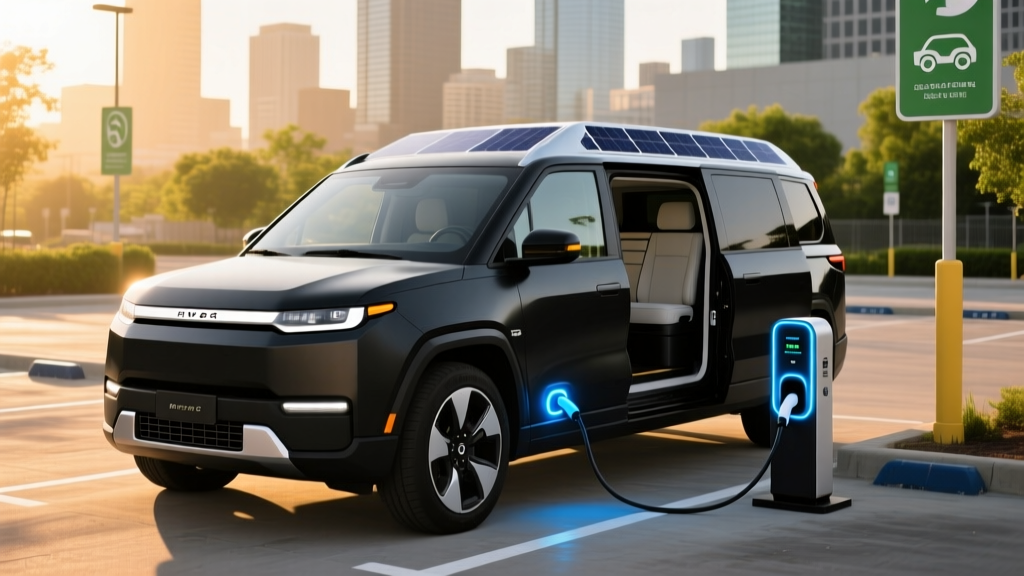
The 2025 Rivian RCV (Rivian Commercial Van) is the purpose-built electric delivery van Rivian manufactures for Amazon and, increasingly, for other fleet buyers. Born from the same skateboard architecture underpinning the R1T and R1S, the RCV trades consumer luxury for cargo volume, upfit-friendly wiring, and duty cycles measured in stops-per-day rather than 0-60 bragging rights. For 2025, Rivian has expanded the RCV's availability beyond its anchor customer, making it a legitimate option for last-mile fleets evaluating electrification.
This review focuses on the specs, charging behavior, and ownership economics that matter to fleet managers and small-business buyers considering the RCV alongside competitors like the Ford E-Transit and BrightDrop Zevo 600.
Range, Battery, and Efficiency
The 2025 RCV is offered in two primary body lengths — the RCV 500 (shorter wheelbase) and RCV 700 (extended) — with usable battery packs in the neighborhood of 110 kWh to 150 kWh depending on configuration. Rivian uses large-format NMC (nickel manganese cobalt) cylindrical cells in a structural pack, consistent with its Gen 2 architecture.
Real-World Expectation: Expect 120–150 miles in stop-and-go urban delivery routes with frequent door openings and HVAC load; highway-range drops sharply above 65 mph. Cold-weather (sub-32°F) losses of 20–30% are typical for NMC packs without aggressive preconditioning.
| Spec | RCV 500 | RCV 700 |
|---|---|---|
| EPA Range | ~190 mi | ~161 mi |
| Battery (usable) | ~110 kWh, NMC | ~150 kWh, NMC |
| Efficiency | ~2.0 kWh/mi | ~2.2 kWh/mi |
| MPGe (combined) | ~1.7 MPGe (diesel-gal-eq) | ~1.5 MPGe |
| Drivetrain | Dual-motor AWD | Dual-motor AWD |
| Horsepower | ~500 hp | ~500 hp |
| 0-60 mph | ~6.5 sec (empty) | ~7.0 sec (empty) |
| Cargo Volume | ~450 cu ft | ~650 cu ft |
| Payload Capacity | ~2,500 lbs | ~2,700 lbs |
Charging Speed: DC Fast and Depot Level 2
Fleet duty cycles live and die by depot charging, so the RCV is engineered around overnight Level 2 replenishment with DC fast-charge capability for midday top-ups or longer routes.
| Level | Power | Speed / Time | Use Case |
|---|---|---|---|
| Level 1 (120V) | ~1.4 kW | ~3 mi/hr | Emergency only |
| Level 2 (240V, depot) | 11.5 kW (AC) | ~22 mi/hr; full charge 10–13 hr | Overnight depot |
| DC Fast Charge | Peak ~190 kW | 10–80% in ~40 min | Midday top-up, en-route |
As with most large NMC packs, the charge curve tapers noticeably past 80% state of charge. Fleets targeting 90%+ SoC should budget an extra 25–35 minutes for that final top slice — a reason most operators set charge targets at 80% for daily turnaround.
The RCV uses a CCS1 connector for public DC charging. Fleets deploying private depot chargers typically spec 19.2 kW AC units (requiring 100A circuits), which trim overnight charge time to roughly 7–9 hours on the larger pack.
Performance, Drivetrain, and Ride
The RCV's dual-motor AWD layout delivers torque to all four wheels — useful for snow-belt delivery routes and loaded starts on grades. Rivian rates the system around 500 hp and substantial low-end torque, which translates to confident merging even at GVWR. The air-sprung rear axle (standard on RCV 700) keeps the load floor level under varying payloads, a detail that matters for shelving upfits and driver comfort over a 150-stop shift.
Regenerative braking is aggressive and configurable, enabling near one-pedal driving in urban traffic — a meaningful brake-pad saver on stop-dense routes.
Interior, Tech, and Driver Assistance
The cab is engineered for ingress/egress frequency: a low step-in height, grab handles on both A-pillars, and a walk-through bulkhead option. The driver display is a 12.3-inch cluster paired with a 15.6-inch central touchscreen running Rivian's commercial fleet OS, which integrates telematics, route optimization, and remote preconditioning.
Standard ADAS includes automatic emergency braking, lane-keep assist, blind-spot monitoring with trailer-length awareness, and a 360-degree camera system. Rivian's Driver+ system is SAE Level 2 — it assists with steering and speed but requires continuous driver supervision. It is not self-driving.
Pricing, Trims, and Federal Tax Credit
The RCV is sold primarily through fleet channels, so pricing is negotiated per order rather than listed on a consumer window sticker. Based on 2025 fleet order disclosures and industry reports:
| Configuration | Estimated Base MSRP | As-Tested / Upfitted |
|---|---|---|
| RCV 500 (base fleet) | ~$70,000–$75,000 | ~$80,000+ with shelving/wrap |
| RCV 700 (base fleet) | ~$80,000–$85,000 | ~$95,000+ fully upfitted |
Does the RCV Qualify for the §30D Federal Tax Credit?
Short answer: §30D is a consumer credit and generally does not apply to commercial fleet purchases. However, fleet buyers can typically access the Commercial Clean Vehicle Credit (§45W), which offers up to $7,500 for vehicles under 14,000 lbs GVWR and up to $40,000 for heavier classes, subject to domestic content and battery-sourcing rules. Per IRS guidance on §45W, eligibility hinges on manufacturer certification of critical-mineral and battery-component sourcing. Fleets should confirm credit availability with their tax advisor before signing purchase orders — rules tighten annually.
Warranty and Service
Rivian backs the RCV with a commercial-oriented warranty package:
- Battery & Drive Units: 8 years / 100,000 miles (retaining ≥70% capacity)
- Bumper-to-Bumper: 5 years / 60,000 miles
- Corrosion: 5 years / unlimited miles
- Mobile Service: Rivian's mobile service vans cover many warranty and recall items at the fleet depot, reducing downtime versus dealer visits.
The 70% capacity retention threshold is industry-standard but fleets running 30,000+ miles annually should model degradation into their 7-year replacement cycles.
Pros and Cons
Pros
- Class-leading cargo volume and walk-in height
- Dual-motor AWD standard — rare in the segment
- Integrated telematics and fleet OS reduce third-party add-ons
- Mobile service minimizes depot downtime
- Strong regenerative braking extends brake life
Cons
- Real-world range (120–150 mi loaded) limits intercity routes
- DC fast-charge taper past 80% slows turnaround
- Higher base cost than Ford E-Transit (~$55k)
- Limited public charging network compatibility vs. NACS-equipped rivals
- Production allocation still Amazon-priority; lead times for third-party fleets can stretch
Who the 2025 Rivian RCV Suits Best
The RCV is engineered for urban and suburban last-mile delivery fleets averaging 80–130 miles per day with depot-based overnight charging. It's a strong fit for parcel carriers, food distributors, and service fleets operating in cold or hilly regions where AWD traction matters. It is not the right tool for long-haul regional routes exceeding 150 daily miles without midday DC charging access.
Consider Ford E-Transit if: upfront cost is the binding constraint and routes stay under 100 miles.
Consider BrightDrop Zevo 600 if: you want GM's Ultium platform and a growing dealer-service footprint.
FAQ
What is the real-world range of the 2025 Rivian RCV?
Expect 120–150 miles on typical urban delivery routes with a loaded cargo area and HVAC running. Highway-only driving at 70 mph cuts that to roughly 110–130 miles. Cold weather (below freezing) can reduce range another 20–30%.
How fast does the RCV charge?
On a DC fast charger, it peaks near 190 kW and reaches 10–80% in approximately 40 minutes. On a 11.5 kW depot Level 2, expect a full overnight charge in 10–13 hours depending on pack size.
How much does the RCV cost after tax incentives?
Base pricing runs ~$70,000–$85,000 before upfit. Fleet buyers generally qualify for the §45W Commercial Clean Vehicle Credit (up to $7,500 for lighter configs, up to $40,000 for heavier), not the consumer §30D credit. Consult a tax professional for your specific case.
Is the RCV worth buying versus the Ford E-Transit?
The RCV offers more cargo volume, standard AWD, and integrated fleet software — but at a higher base price and slightly lower range. If your routes demand AWD or walk-in height, the RCV justifies the premium. If cost-per-van is the top KPI, the E-Transit remains the value benchmark.
Does the RCV qualify for the federal EV tax credit?
The consumer §30D credit generally does not apply to fleet-owned commercial vehicles. Instead, the §45W Commercial Clean Vehicle Credit is the relevant incentive, with eligibility dependent on battery sourcing and manufacturer certification per IRS rules.
What's the battery warranty?
Rivian covers the battery and drive units for 8 years / 100,000 miles with a 70% capacity retention guarantee — consistent with DOE guidance on modern NMC pack longevity expectations.