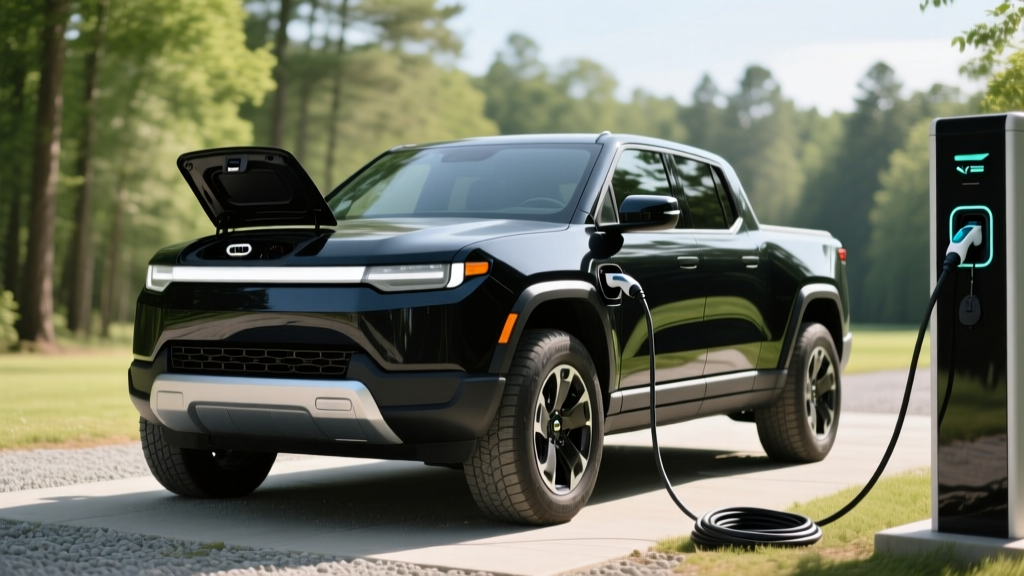
The Rivian R1T entered its second generation for the 2025 model year with a comprehensive overhaul that touched nearly every system — new battery packs, faster charging architecture, a redesigned interior, and the introduction of the Tri-Motor powertrain. For buyers researching 2025 Rivian R1T specs, the numbers tell a story of genuine improvement rather than cosmetic refresh. This review breaks down every critical spec with real-world context, because EPA stickers and peak charge rates only tell half the story.
2025 Rivian R1T Spec Sheet at a Glance
| Specification | Dual-Motor Standard | Dual-Motor Max | Tri-Motor Max |
|---|---|---|---|
| EPA Range | 270 miles | 420 miles | 380 miles |
| Battery Capacity (usable) | 92 kWh (LFP) | 109 kWh (NMC) | 109 kWh (NMC) |
| Horsepower | 533 hp | 533 hp | 850 hp |
| Torque | 610 lb-ft | 610 lb-ft | 1,103 lb-ft |
| 0-60 mph | 4.5 sec | 4.5 sec | 2.9 sec (est.) |
| Drivetrain | AWD (dual-motor) | AWD (dual-motor) | AWD (tri-motor) |
| Max DC Fast Charge | 200 kW | 220+ kW | 220+ kW |
| 10-80% DC Charge Time | ~28 min | ~22 min | ~22 min |
| Level 2 Home Charging | 11.5 kW (~25 mi/hr) | 11.5 kW (~25 mi/hr) | 11.5 kW (~25 mi/hr) |
| Towing Capacity | 11,000 lbs | 11,000 lbs | 11,000 lbs |
| Payload Capacity | ~1,760 lbs | ~1,760 lbs | ~1,760 lbs |
| Base MSRP | $69,900 | $83,900 | $99,900 |
EPA Range vs. Real-World Expectations
Real-World Expectation: Plan for 340–370 miles on highway road trips at 70-75 mph; expect 280–320 miles in freezing temperatures with cabin heat. The Standard Pack's 270-mile EPA figure translates to roughly 220 miles highway in winter conditions.
Rivian's 420-mile Max Pack figure is legitimate for mixed driving in moderate climates. However, the R1T's truck aerodynamics — a tall, flat-faced vehicle with an open bed — impose a significant highway efficiency penalty. At sustained 75 mph, energy consumption climbs to roughly 48-52 kWh/100mi, compared to the EPA combined rating of approximately 42 kWh/100mi. That's a 15-20% reduction from the sticker range on long road trips.
Cold weather compounds this. In sub-30°F conditions, battery resistance increases and cabin heating draws substantial power even with the standard heat pump. Owners in northern climates should budget a 25-30% range reduction in deep winter. The LFP Standard Pack is more resilient to cold-weather charging (lithium iron phosphate chemistry tolerates low-temperature charging better than NMC), but its smaller 92 kWh capacity means fewer total miles regardless.
The 109 kWh Max Pack uses NMC (nickel manganese cobalt) chemistry, chosen for its higher energy density — necessary to hit that 420-mile target in a heavy truck platform. According to fueleconomy.gov, the Dual-Motor Max achieves an EPA combined 73 MPGe, translating to roughly 2.1 miles per kWh.
Charging Speed: DC Fast Charging and Home Setup
Rivian upgraded the R1T's electrical architecture for 2025, moving to a higher-voltage system that enables faster DC charging. Here's what that means at the plug:
| Charging Level | Power / Rate | Miles Added Per Hour | Notes |
|---|---|---|---|
| Level 1 (120V household) | 1.4 kW | ~3 mi/hr | Emergency/trickle only |
| Level 2 (240V home, 48A) | 11.5 kW | ~25 mi/hr | Full overnight charge in 9-11 hours |
| DC Fast Charge (Standard) | Peak 200 kW | ~140 mi in 15 min | Tapers above 80% SoC |
| DC Fast Charge (Max Pack) | Peak 220+ kW | ~190 mi in 15 min | 10-80% in ~22 minutes |
The critical nuance: peak kW is not sustained kW. The Max Pack hits its 220+ kW peak between roughly 15-40% State of Charge, then the charge curve tapers progressively. By 70% SoC, you're seeing roughly 120-140 kW; above 85%, speeds drop below 50 kW to protect battery longevity. This is standard for NMC chemistry and is managed by the R1T's thermal preconditioning system.
Preconditioning matters. If you navigate to a DC fast charger using the R1T's built-in navigation, the battery management system begins warming the pack to optimal charging temperature. Arriving without preconditioning — especially in cold weather — can add 5-10 minutes to your 10-80% session. Always route through the vehicle's nav for public charging stops.
For home charging, the R1T accepts up to 11.5 kW on Level 2 (48 amps on a 60-amp circuit). This adds roughly 25 miles of range per hour, meaning a depleted Max Pack takes about 10-11 hours for a full charge. Most owners who charge nightly from 30-80% will see a full top-up in 4-5 hours. Rivian offers the Wall Charger+ at 11.5 kW, and the truck's NACS (North American Charging Standard) port gives direct access to Tesla Supercharger V4 stalls without an adapter, plus CCS networks via the included adapter.
Performance and Powertrain Breakdown
The 2025 R1T offers three distinct powertrain configurations, all with standard all-wheel drive:
Dual-Motor (Standard & Max Pack): 533 horsepower and 610 lb-ft of torque, delivered via one motor per axle. The 0-60 mph time of 4.5 seconds is genuinely quick for a 7,000+ lb truck. This is the volume configuration and the one most buyers should target.
Tri-Motor (Max Pack only): 850 horsepower and 1,103 lb-ft of torque, with one motor on the front axle and two on the rear. Rivian claims a 0-60 time under 3 seconds, placing it in supercar territory. The tri-motor setup also enables torque vectoring across the rear axle, improving off-road capability and high-speed cornering stability. This is a performance flagship, not a value proposition.
All configurations feature adaptive air suspension with 6.5 inches of travel, allowing ride height adjustment from an easy-entry mode to a maximum 14.9 inches of ground clearance for off-road use. The quad-motor configuration from the prior generation has been replaced by the tri-motor for 2025, simplifying the lineup while retaining the highest-performance option.
Pricing, Trims, and Federal Tax Credit Eligibility
The 2025 R1T is offered in three trim levels: Adventure, Ascend, and Ascend Tri-Motor. Pricing before destination and options:
| Configuration | Trim | Base MSRP | Federal Credit Eligible? |
|---|---|---|---|
| Dual-Motor Standard (270 mi) | Adventure | $69,900 | Yes — under $80K truck cap |
| Dual-Motor Max (420 mi) | Adventure | $83,900 | No — exceeds $80K MSRP cap |
| Dual-Motor Max (420 mi) | Ascend | $89,900 | No — exceeds $80K MSRP cap |
| Tri-Motor Max (380 mi) | Ascend | $99,900 | No — exceeds $80K MSRP cap |
- MSRP must be at or below $80,000 (trucks/vans/SUVs) — only the Dual-Motor Standard Pack qualifies
- Buyer adjusted gross income caps: $300K joint / $225K head of household / $150K single
- Battery critical minerals and component sourcing must meet escalating annual thresholds per IRS guidance
- Credit can be transferred to the dealer at point of sale for an immediate price reduction
- Credit amount: up to $7,500 (split between critical minerals and battery components — partial credit possible)
Only the Dual-Motor Standard Pack at $69,900 clears the $80,000 MSRP cap for trucks. Add options like the Max Tow package or premium paint, and you risk pushing the build above the threshold — so configure carefully if credit eligibility is a priority. Consult a tax professional before relying on credit eligibility, as IRS sourcing requirements tighten annually and individual tax situations vary.
Cargo, Passenger Space, and Practical Utility
The R1T is a midsize truck by footprint but punches above its class in clever storage:
- Bed length: 4.5 feet (standard) with the Gear Tunnel providing an additional 11 cu ft of enclosed, weatherproof storage accessible from both sides
- Bed capacity: ~1,760 lbs payload, with integrated tie-downs and a powered tonneau cover (standard on Ascend, optional on Adventure)
- Frunk (front trunk): 11 cu ft, lockable, with a drain plug — useful as a cooler or secure storage
- Gear Tunnel: 11 cu ft pass-through behind the rear seats, accessible via side-hinged doors — exclusive to the R1T and a genuine differentiator for camping gear, tools, or groceries
- Rear seat legroom: 38.2 inches — adequate for adults on shorter trips, tighter than a full-size crew cab
- Towing: 11,000 lbs max (with Max Tow package); expect a 40-50% range reduction when towing near max capacity
The Gear Tunnel is the R1T's signature feature. It transforms what would be dead space behind the rear seats into a secure, lit, weather-sealed compartment. For overlanding, job-site use, or families who need separation between muddy gear and the cabin, it's a feature no competitor currently matches.
Technology, Driver Assistance, and Software
The 2025 R1T runs Rivian's second-generation software stack on a 15.6-inch center touchscreen and a 12.3-inch digital instrument cluster. Key technology highlights:
- Rivian Driver+: A Level 2 driver-assistance system combining adaptive cruise control, lane centering, and automatic lane changes on divided highways. Per SAE classification, this requires continuous driver supervision — it is not autonomous driving.
- Over-the-air updates: Rivian regularly pushes software improvements covering everything from range optimization to new features. The 2025 model year shipped with enhanced route planning and charge preconditioning logic.
- Infotainment: Wireless Apple CarPlay and Android Auto, native Spotify and Tidal integration, and a built-in Wi-Fi hotspot. The interface is clean and responsive, though some owners note the absence of physical climate knobs as a frustration for gloved use.
- Camp Kitchen & Gear Guard: Available slide-out kitchen system (partnered with Snow Peak) integrates into the Gear Tunnel. Gear Guard provides exterior camera recording when the vehicle is parked and detects proximity.
- V2L (Vehicle-to-Load): The R1T can export up to 3.6 kW of AC power from bed outlets, sufficient for powering tools, camp appliances, or emergency home backup for critical circuits.
Battery Warranty and Long-Term Ownership
Rivian covers the R1T's battery and drive unit with an 8-year / 175,000-mile warranty (whichever comes first), with a capacity retention threshold of 70%. This is competitive with the industry standard, though some rivals offer 100,000-mile battery warranties. The bumper-to-bumper coverage runs 5 years / 60,000 miles.
For the LFP Standard Pack, long-term degradation expectations are favorable — LFP chemistry typically retains 90%+ capacity after 1,000 equivalent full cycles, translating to well over 200,000 miles before meaningful loss. The NMC Max Pack will degrade somewhat faster, but Rivian's thermal management system and charge-rate tapering above 80% are designed to minimize calendar aging. Real-world data from 2022-2024 R1T owners suggests 3-5% loss in the first year, stabilizing to roughly 1-2% annually thereafter.
Insurance costs tend to run 15-25% higher than comparable gas trucks due to repair complexity and parts cost. Get quotes before ordering — premiums vary significantly by state and driver profile.
Pros and Cons
- 420-mile Max Pack range is class-leading for electric trucks
- Gear Tunnel is a uniquely practical storage solution
- NACS port provides native Tesla Supercharger access
- Sub-3-second 0-60 (Tri-Motor) with genuine off-road capability
- 11,000-lb towing with integrated trailer software
- Over-the-air updates continue improving the vehicle post-purchase
- Only the base $69,900 trim qualifies for the federal tax credit
- Highway range drops significantly (15-25%) due to truck aerodynamics
- Rear seat legroom is tighter than full-size crew cabs
- No physical climate controls — touchscreen-only for HVAC
- Insurance premiums run higher than gas truck equivalents
- Towing near max capacity cuts range by 40-50%
Who Should Buy the 2025 Rivian R1T?
- You need a truck for weekend towing, job-site use, or overlanding — not just daily commuting
- You want 350+ real-world highway miles between charges (Max Pack)
- The Gear Tunnel and frunk solve real storage problems for your lifestyle
- You value OTA software improvements and a growing Supercharger-compatible network
- You need maximum rear-seat space for three adults regularly (consider the F-150 Lightning or Silverado EV)
- You want the lowest possible price with full tax credit eligibility (the Standard Pack qualifies, but range is limited)
- You primarily tow heavy loads long distances — range while towing remains the Achilles heel of all electric trucks
Frequently Asked Questions
What is the real-world range of the 2025 Rivian R1T?
The EPA rates the Dual-Motor Max Pack at 420 miles and the Standard Pack at 270 miles. In real-world highway driving at 70-75 mph, expect 340-370 miles from the Max Pack and 220-240 miles from the Standard Pack. Cold weather (below 30°F) reduces these figures by an additional 20-30%.
How fast does the 2025 R1T charge?
On DC fast charging, the Max Pack peaks at 220+ kW and charges from 10-80% in approximately 22 minutes. The Standard Pack peaks at 200 kW with a 10-80% time of about 28 minutes. At home on Level 2 (240V, 48A), the R1T charges at 11.5 kW, adding roughly 25 miles of range per hour.
How much does the 2025 R1T cost after tax credits?
Only the Dual-Motor Standard Pack at $69,900 qualifies for the federal §30D tax credit (up to $7,500), potentially bringing the effective price to ~$62,400 — assuming you meet income caps and battery sourcing requirements. All Max Pack and Tri-Motor configurations exceed the $80,000 MSRP cap for trucks and are ineligible for the federal credit.
Does the 2025 Rivian R1T qualify for the federal EV tax credit?
The Dual-Motor Standard Pack (Adventure trim, $69,900) qualifies, provided the buyer meets IRS income limits ($150K single / $300K joint) and the vehicle meets critical-mineral and battery-component sourcing thresholds. The credit can be applied as a point-of-sale rebate through the dealer. Always verify current eligibility on IRS.gov before purchasing.
Is the 2025 R1T worth buying vs. the Ford F-150 Lightning or Chevy Silverado EV?
The R1T wins on innovation (Gear Tunnel, NACS native charging, air suspension, tri-motor performance) and Max Pack range. The F-150 Lightning offers a lower entry price, more rear-seat room, and broader dealer support. The Silverado EV (4WT and Trail Boss trims) provides a larger bed and competitive range. If you prioritize adventure capability and tech, the R1T is the strongest choice. If you need fleet-friendly pricing or maximum interior space, the Lightning remains compelling.
What is the battery warranty on the 2025 R1T?
Rivian covers the battery pack and drive unit for 8 years or 175,000 miles, whichever comes first, with a minimum 70% capacity retention guarantee. The bumper-to-bumper warranty covers 5 years or 60,000 miles.