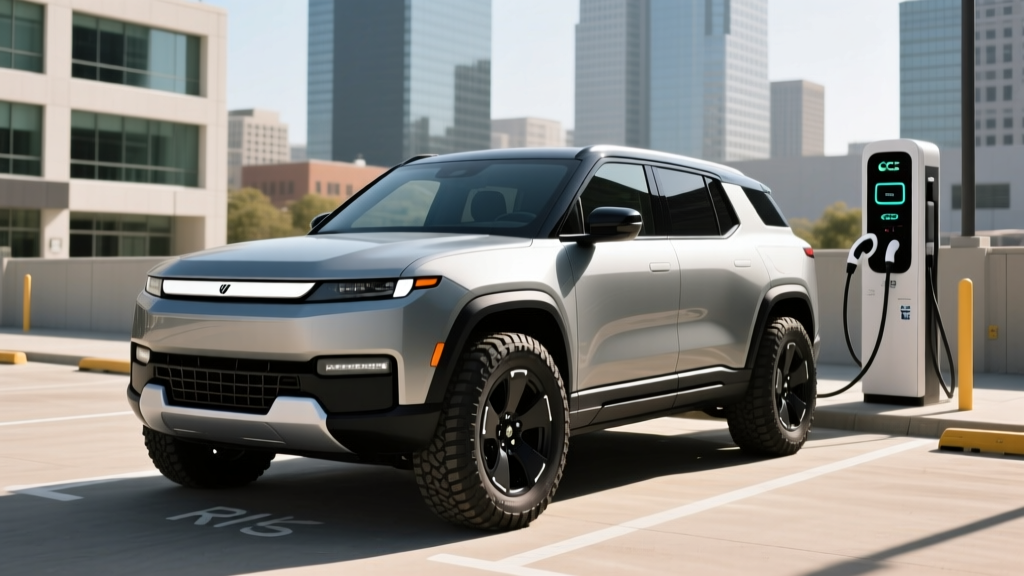
The 2025 Rivian R1S enters its second generation with a comprehensive overhaul that touches the battery pack, drive units, electrical architecture, and interior. For buyers researching the 2025 Rivian R1S SUV, the headline numbers are compelling: up to 410 miles of EPA-estimated range on the Max Pack, a new 102 kWh Standard battery option, and dual-, tri-, and quad-motor powertrains producing up to 1,025 horsepower. But spec sheets only tell part of the story. This review pairs Rivian's official figures with real-world ownership data — charging-curve behavior, cold-weather range loss, and actual tax-credit eligibility — so you can make an informed decision on this three-row electric SUV.
Range and Efficiency: EPA Numbers vs. Real-World Driving
The 2025 R1S offers three battery configurations, each with distinct range and efficiency profiles. Rivian's Gen 2 platform introduces a new 102 kWh Standard pack alongside the carryover 128 kWh Large and 149 kWh Max packs. All use nickel-manganese-cobalt (NMC) chemistry supplied by Samsung SDI, optimized for energy density over cycle life — a deliberate trade-off for a vehicle in this price segment.
| Configuration | Battery (usable kWh) | Chemistry | EPA Range (mi) | MPGe (combined) | kWh/100 mi |
|---|---|---|---|---|---|
| Dual-Motor Standard | 102 | NMC | 270 | 73 | 46 |
| Dual-Motor Large | 128 | NMC | 340 | 73 | 46 |
| Dual-Motor Max | 149 | NMC | 410 | 70 | 48 |
| Tri-Motor Large | 128 | NMC | 320 | 68 | 49 |
| Quad-Motor Max | 149 | NMC | 380 | 65 | 52 |
The EPA's 410-mile Max Pack figure assumes a mix of city and moderate-speed driving. In sustained 75 mph highway testing, expect roughly 330–350 miles from the Max Pack. Cold weather (below 32°F) can reduce range by 20–30%, bringing the Max Pack down to approximately 280–310 miles in winter highway conditions. The Standard pack's 270-mile EPA rating translates to about 210–230 miles highway and potentially under 200 miles in freezing temps. The R1S's heat pump helps mitigate cabin-heating losses, but the large frontal area and 6,800+ lb curb weight work against highway efficiency regardless of pack size.
Efficiency varies noticeably by drivetrain. The dual-motor models achieve roughly 46 kWh/100 mi, competitive with the EPA's published figures. Adding motors increases consumption — the tri-motor and quad-motor variants sacrifice 30–40 miles of range and 5–8 MPGe for the performance payoff. If range-per-dollar is your priority, the Dual-Motor Large offers the best balance: 340 miles EPA at a lower MSRP than the Max Pack, with faster charging to boot.
Charging Speed: DC Fast Charge and Home Level 2
Rivian upgraded the Gen 2 R1S's charging architecture significantly. The SUV now supports up to 220 kW peak DC fast charging on Large and Max packs, and approximately 180 kW on the Standard pack. The vehicle uses the NACS (North American Charging Standard) connector natively, giving direct access to Tesla Supercharger stalls — a major practical advantage over CCS-only competitors now that the Supercharger network has opened to NACS-equipped non-Tesla vehicles.
| Charging Method | Power (kW) | Speed (mi/hr added) | 10–80% Time |
|---|---|---|---|
| DC Fast Charge (Large/Max) | 220 kW peak | ~140 mi/hr (peak) | ~27 minutes |
| DC Fast Charge (Standard) | 180 kW peak | ~115 mi/hr (peak) | ~28 minutes |
| Level 2 Home (11.5 kW / 48A) | 11.5 kW | ~27 mi/hr | ~9–13 hours (full) |
| Level 2 Home (7.7 kW / 32A) | 7.7 kW | ~18 mi/hr | ~14–19 hours (full) |
| Level 1 (120V / 12A) | 1.4 kW | ~3 mi/hr | Not practical |
The charge curve matters more than peak kW. The R1S holds near-peak charging speeds between 10–40% State of Charge (SoC), then begins a gradual taper. Between 60–80%, expect sustained rates closer to 100–130 kW. This means the 10–80% time of roughly 27 minutes is achievable at a capable 250+ kW charger (like a V3 Supercharger or Electrify America 350 kW stall), but at a 150 kW station, plan for 35–40 minutes. Always precondition the battery using the vehicle's navigation-directed preconditioning before arriving at a fast charger — skipping this step in cold weather can double your charging time.
For home charging, the R1S's onboard charger accepts up to 11.5 kW (48 amps) on a Level 2 circuit. This requires a 60-amp dedicated breaker and a NEMA 14-50 outlet or hardwired wall connector. A full overnight charge is realistic for most daily driving needs: a 200-mile commute consumes roughly 60% of the Standard pack, replenished in about 6 hours at 11.5 kW. Budget for a professional electrical installation — a typical Level 2 home setup costs $1,200–$2,500 including equipment, wiring, and permits, with panel upgrades adding $1,500–$3,000 if your home's service is maxed out.
Performance and Drivetrain: Gen 2 Drive Units
The Gen 2 R1S replaces the original Bosch-sourced motors with Rivian's in-house Endurance drive units. The result is more power, faster acceleration, and improved efficiency across the lineup.
| Powertrain | Horsepower | Torque (lb-ft) | 0–60 mph | Drivetrain | Towing Capacity |
|---|---|---|---|---|---|
| Dual-Motor AWD | 533 | 610 | 4.5 sec | AWD | 7,700 lb |
| Performance Dual-Motor | 665 | 827 | 3.4 sec | AWD | 7,700 lb |
| Tri-Motor | 850 | 1,103 | 2.9 sec | AWD | 7,700 lb |
| Quad-Motor | 1,025 | 1,198 | 2.5 sec | AWD (tank turns) | 7,700 lb |
For most buyers, the standard Dual-Motor at 533 hp and a 4.5-second 0–60 is more than adequate — it already outpaces most V8 SUVs. The Performance Dual-Motor's 3.4-second run puts it in sports-car territory while maintaining practicality. The Tri- and Quad-Motor variants are engineering showcases: the Quad-Motor enables tank turns (360-degree pivots on loose surfaces) and independent torque vectoring at each wheel, useful for off-road crawling and dramatic acceleration. However, these upper trims add $15,000–$25,000 to the price and reduce range by 30–60 miles.
The R1S retains its body-on-frame skateboard architecture with a double-wishbone front and multi-link rear suspension. Air suspension with 6.5 inches of adjustable ride height (from 7.9 to 14.4 inches ground clearance) is standard. In Sport mode on pavement, the R1S corners flat for its 6,800–7,100 lb mass. In Off-Road mode, it handles rock crawling and deep snow with genuine capability — not just marketing claims. The 7,700-lb towing capacity matches the best in the electric SUV segment, though expect a 40–50% range reduction when towing at highway speeds with a heavy trailer.
Interior, Cargo, and Technology
The 2025 R1S seats up to seven across three rows. The Gen 2 interior refresh brings improved materials, a redesigned center console, and an updated 15.6-inch infotainment display running Rivian's proprietary software. The digital driver display is a 12.3-inch unit, and a 6.8-inch rear touchscreen controls climate and media for second-row passengers.
| Dimension | Measurement |
|---|---|
| Cargo (behind 3rd row) | 20.0 cu ft |
| Cargo (behind 2nd row) | 56.3 cu ft |
| Cargo (behind 1st row, max) | 104.7 cu ft |
| Front legroom | 41.1 in |
| 2nd-row legroom | 38.2 in |
| 3rd-row legroom | 30.4 in |
| Front trunk (frunk) | 11.0 cu ft |
Third-row legroom at 30.4 inches is tight for adults on long trips — children and teens fit fine, but six-foot passengers will feel cramped beyond 30-minute rides. With all three rows up, 20 cubic feet of cargo space handles a week's groceries but not much more; folding the third row unlocks a practical 56.3 cu ft. The 11-cu-ft frunk is useful for charging cables and small bags but won't replace a dedicated luggage compartment.
On the technology front, the R1S includes Rivian's Driver+ suite as standard: adaptive cruise control, lane-centering assist, blind-spot monitoring, and automatic emergency braking. This is an SAE Level 2 driver-assistance system — it requires your hands on the wheel and eyes on the road at all times. Rivian does not currently offer a hands-free highway driving feature comparable to GM's Super Cruise or Ford's BlueCruise, which is a notable gap in this price range. The infotainment system supports wireless Apple CarPlay and Android Auto, over-the-air updates, and built-in navigation with integrated charging-route planning.
Pricing, Trims, and Federal Tax Credit Eligibility
The 2025 R1S lineup starts at $79,900 (including destination) for the Dual-Motor Standard pack and climbs to over $115,000 for a fully optioned Quad-Motor Max Pack.
| Trim / Configuration | Base MSRP | Est. As-Tested |
|---|---|---|
| Dual-Motor Standard (102 kWh) | $79,900 | $82,000–$85,000 |
| Dual-Motor Large (128 kWh) | $86,900 | $89,000–$95,000 |
| Dual-Motor Max (149 kWh) | $94,900 | $97,000–$103,000 |
| Tri-Motor Large | $101,900 | $105,000–$110,000 |
| Quad-Motor Max | $112,900 | $115,000–$120,000 |
- MSRP cap: SUVs must have an MSRP at or below $80,000. Only the base Dual-Motor Standard at $79,900 qualifies; all other trims exceed the cap.
- Income limits: Modified AGI must not exceed $300,000 (joint filers), $225,000 (head of household), or $150,000 (single).
- Battery sourcing: At least a percentage of critical minerals and battery components must meet North American sourcing or FTA-partner requirements. These thresholds increase annually — verify current-year compliance on IRS.gov's qualified vehicle list.
- Point-of-sale transfer: Eligible buyers can transfer the credit to the dealer at purchase, reducing the upfront price by up to $7,500 instead of waiting for a tax refund.
- Credit amount: Up to $7,500 if both critical-mineral and battery-component requirements are met; $3,750 if only one is satisfied.
Consult a tax professional and verify eligibility on IRS.gov before purchasing. Rules and qualified-vehicle lists change frequently.
The tax-credit situation for the R1S is constrained: because most trims exceed the $80,000 SUV MSRP cap, only buyers choosing the base Dual-Motor Standard pack — and who meet income and sourcing requirements — can claim the full $7,500 credit. This effectively brings the entry price to roughly $72,400 after credit, which remains competitive against luxury three-row EVs. For buyers eyeing the Large or Max packs, the credit is unavailable regardless of income, making those configurations a pure out-of-pocket decision.
Warranty and Long-Term Ownership
Rivian provides a warranty package that aligns with industry standards for premium EVs:
| Coverage | Term |
|---|---|
| Basic vehicle warranty | 5 years / 60,000 miles |
| Battery & powertrain | 8 years / 175,000 miles |
| Battery capacity retention | ≥70% over 8 yr / 175,000 mi |
| Corrosion perforation | 12 years / unlimited miles |
| Roadside assistance | 5 years / 60,000 miles |
The 175,000-mile battery warranty is generous — 75,000 miles longer than the federal minimum requirement and more than most competitors offer. The 70% capacity retention threshold is standard; if your Max Pack drops below roughly 104 usable kWh within the warranty period, Rivian will repair or replace it. Long-term degradation data for the Gen 2 packs isn't yet available (the platform launched mid-2024), but NMC chemistry with active liquid thermal management typically shows 8–12% degradation over 100,000 miles based on industry averages. The 5-year/60,000-mile basic warranty is slightly shorter than Hyundai/Kia's 10-year coverage but typical for the luxury segment.
Insurance costs for the R1S tend to run 15–25% higher than comparable ICE SUVs, driven by repair-cost complexity and the vehicle's MSRP. Expect annual premiums in the $2,800–$4,200 range depending on your location, driving record, and coverage level. Get quotes before committing — some insurers have adjusted EV rates downward as collision data matures.
Pros, Cons, and the Competition
- Class-leading off-road capability with air suspension and up to 14.4" ground clearance
- Up to 410 miles EPA range (Max Pack) — best in three-row EV SUV segment
- Native NACS connector for direct Tesla Supercharger access
- 7,700-lb towing capacity with integrated trailer brake controller
- Quad-motor tank turns and genuine off-road credibility
- Strong OTA update cadence adding features post-purchase
- 175,000-mile battery warranty exceeds most competitors
- Only the base $79,900 trim qualifies for the federal tax credit (MSRP cap)
- No hands-free highway driving assist (unlike Super Cruise or BlueCruise)
- Third row is tight for adults; best suited for children
- Efficiency drops significantly with tri/quad-motor configurations
- Rivian's service-center footprint is still growing — wait times in some markets
- Premium pricing: realistic builds land $90,000–$110,000+
- Heavy curb weight (6,800–7,100 lb) impacts tire wear and braking distances
The R1S competes primarily with the Tesla Model X (348-mile EPA range, falcon-wing doors, available hands-free Autopilot, starting around $79,990), the Kia EV9 (304-mile range, more affordable at $54,900–$73,900, but less off-road focus), and the Mercedes EQS SUV (305-mile range, $104,400+ starting, more luxury-oriented). The R1S occupies a unique niche: it's the only three-row electric SUV with genuine off-road credentials, a frunk, and native Supercharger access. If you need a premium family hauler that can also tackle trails and tow a boat, it has no direct equal. If your priorities are pure on-road luxury or the lowest possible price, the EQS SUV or EV9 respectively may be stronger fits.
- You need three rows plus genuine off-road and towing capability
- You want maximum range in an electric SUV (Max Pack, 410 mi EPA)
- Direct Tesla Supercharger access is important for your road-trip routes
- You value adventure-oriented features (gear tunnel, camp kitchen, air suspension)
- You need hands-free highway driving assist (consider the Cadillac Escalade IQ or Model X with FSD)
- Budget is under $70,000 (consider the Kia EV9)
- Third-row adult comfort is a priority (consider the Model X or a PHEV minivan)
Frequently Asked Questions
What is the real-world range of the 2025 Rivian R1S?
The EPA rates the R1S Max Pack at 410 miles, but real-world highway driving at 70–75 mph yields approximately 330–350 miles. In cold weather (below freezing), expect 280–310 miles from the Max Pack. The Standard pack delivers about 210–230 miles on the highway in mild conditions. Your actual range depends heavily on speed, temperature, elevation changes, and climate-control usage.
How fast does the 2025 R1S charge at home and on the road?
On a DC fast charger capable of 250+ kW, the R1S Large and Max packs charge from 10–80% in approximately 27 minutes at a peak rate of 220 kW. At home on a Level 2 (240V, 48A) connection, the onboard charger accepts 11.5 kW, adding roughly 27 miles of range per hour — enough to fully replenish overnight. Level 1 (120V) charging adds only about 3 miles per hour and is not practical for daily use.
Does the 2025 Rivian R1S qualify for the $7,500 federal EV tax credit?
Only the base Dual-Motor Standard configuration at $79,900 MSRP qualifies, because IRS §30D rules cap SUV eligibility at $80,000. All other R1S trims exceed this limit. Even for the base model, you must meet income caps ($300K joint / $150K single) and the vehicle must satisfy battery critical-mineral and component sourcing thresholds. Verify current eligibility on IRS.gov's qualified vehicles list and consult a tax professional.
Is the Rivian R1S worth buying over the Tesla Model X or Kia EV9?
The R1S wins on off-road capability, towing (7,700 lb), and adventure-oriented design. The Model X offers hands-free Autopilot capability and a slightly lower starting price, but its third row is similarly tight and its styling is aging. The Kia EV9 is far more affordable ($54,900+) and offers solid range, but lacks the R1S's off-road hardware and towing capacity. If you need a do-it-all adventure SUV and budget allows, the R1S is worth the premium. If value or autonomous-driving tech is your priority, look at the EV9 or Model X respectively.
What are the biggest drawbacks of the 2025 R1S?
The primary limitations are the tight third row (30.4 inches of legroom — kids only for long trips), the absence of a hands-free driving-assist system, and the tax-credit MSRP cap that excludes all but the base trim. Service-center availability is also expanding but may involve longer wait times in some regions compared to legacy automakers. Finally, the tri- and quad-motor variants sacrifice meaningful range for performance that most buyers won't use daily.
Can the R1S tow a trailer, and how does it affect range?
Yes — the R1S is rated to tow up to 7,700 pounds across all configurations, with an available integrated trailer brake controller and built-in tow/haul driving mode. When towing a 5,000–7,000 lb trailer at highway speeds, expect range to drop by 40–50%. A Max Pack rated at 410 miles may deliver roughly 200–240 miles while towing, requiring more frequent charging stops on long hauls.