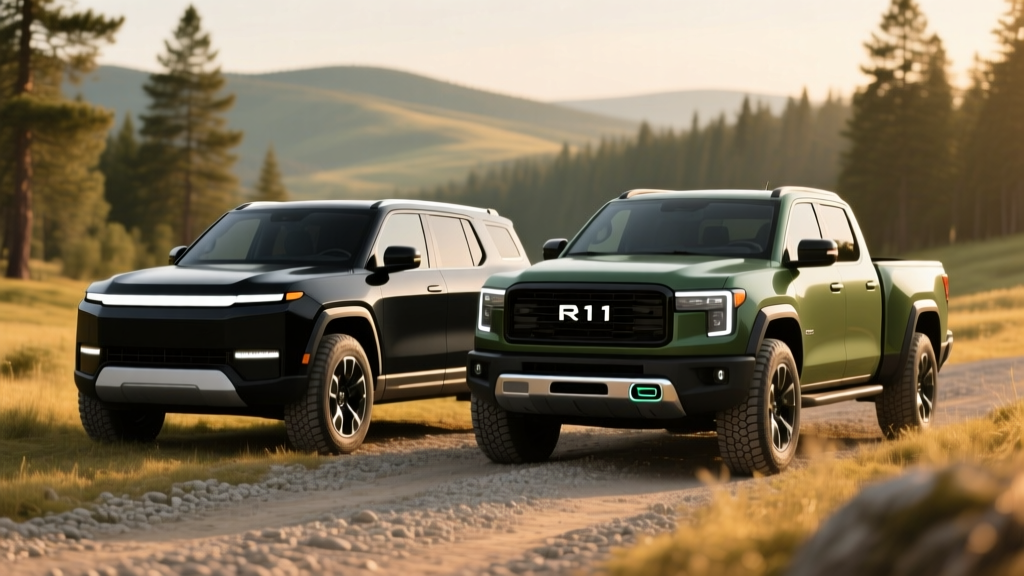
Rivian's second-generation R1S SUV and R1T pickup arrived for the 2025 model year with a comprehensively reworked platform, new battery chemistries, and faster charging. After extensive time with both models across multiple trims, the verdict is clear: these are among the most capable and well-rounded electric vehicles on the market — but pricing has climbed, and the real-world ownership picture requires careful evaluation.
This review covers both the R1S (three-row SUV) and R1T (crew-cab pickup) together, since they share the same Gen 2 skateboard platform, battery options, and powertrain configurations for 2025. Where specs diverge between the two body styles, we call it out explicitly.
2025 Rivian R1S and R1T: Core Specifications at a Glance
| Spec | R1S (SUV) | R1T (Pickup) |
|---|---|---|
| EPA Range (Standard, Dual-Motor) | 270 mi (est.) | 270 mi (est.) |
| EPA Range (Max Pack, Dual-Motor) | ~410 mi | ~400 mi |
| Battery Capacity (Standard) | ~95 kWh usable (LFP) | ~95 kWh usable (LFP) |
| Battery Capacity (Large) | ~109 kWh usable (NMC) | ~109 kWh usable (NMC) |
| Battery Capacity (Max) | ~141 kWh usable (NMC) | ~141 kWh usable (NMC) |
| Max DC Fast Charge | ~220 kW peak | ~220 kW peak |
| 10–80% DC Charge Time | ~30 min (Large Pack) | ~30 min (Large Pack) |
| Level 2 Home Charging | 11.5 kW (~30 mi/hr) | 11.5 kW (~30 mi/hr) |
| 0–60 mph (Dual-Motor) | ~4.5 sec | ~4.5 sec |
| 0–60 mph (Tri-Motor) | ~2.9 sec | ~2.9 sec |
| Horsepower (Dual-Motor) | 533 hp | 533 hp |
| Horsepower (Tri-Motor) | 850 hp | 850 hp |
| Drivetrain | AWD (Dual or Tri-Motor) | AWD (Dual or Tri-Motor) |
| Max Towing | 7,700 lb | 11,000 lb |
| MPGe (Dual-Motor, Combined) | ~70 MPGe | ~68 MPGe |
| Base MSRP (Dual-Motor Standard) | $75,900 | $69,900 |
| Battery Warranty | 8 yr / 120,000 mi | 8 yr / 120,000 mi |
Note: Specs reflect the latest available 2025 model-year data from Rivian's official R1S page and fueleconomy.gov. Max Pack and Tri-Motor configurations were announced and began limited delivery in late 2024/early 2025. Always confirm exact specs with Rivian at time of order, as battery supplier and chemistry details can shift by build date.
Real-World Range: What the EPA Number Doesn't Tell You
Highway cruising at 75 mph: expect ~270–290 miles before needing a charge. In cold weather (below 30°F), subtract another 15–25%, bringing effective range to roughly 220–250 miles. City driving with regenerative braking recovers closer to the EPA sticker or slightly above.
The 2025 Rivian lineup offers three battery tiers. The Standard Pack uses LFP (lithium iron phosphate) chemistry — slightly lower energy density but excellent cycle life, and you can charge it to 100% daily without degradation concerns. The Large and Max Packs use NMC (nickel manganese cobalt) chemistry, which packs more energy into a similar volume but benefits from an 80–90% daily charge limit to maximize longevity.
For the dual-motor R1S with the Large Pack (the volume-selling configuration), the EPA rates range around 330 miles. That's a strong number, but real-world experience in Rivian's Gen 1 vehicles — combined with Gen 2's improved aero and thermal management — suggests you'll see 270–290 miles at sustained highway speeds in moderate temperatures. Cold weather is the great equalizer for all EVs, and the R1 platform is no exception. Rivian's heat pump (standard on Gen 2) mitigates cabin-heating energy draw, but battery chemistry itself becomes less efficient in freezing conditions.
The Max Pack pushes the R1S past 400 miles EPA, which is genuinely road-trip territory — you can realistically cover 320–350 highway miles between stops even accounting for real-world losses. For the R1T pickup, expect slightly lower range across all packs due to the open bed's aerodynamic drag, especially at highway speeds.
Efficiency Breakdown
The dual-motor R1S achieves approximately 70 MPGe combined (roughly 48 kWh/100 mi). That's competitive with the BMW iX and slightly behind the Tesla Model X, which benefits from lighter weight. The tri-motor configurations trade efficiency for performance — expect roughly 60–65 MPGe combined with the extra motor's weight and power draw.
Charging Speed: DC Fast Charge and Home Level 2
| Charging Method | Standard (LFP ~95 kWh) | Large (NMC ~109 kWh) | Max (NMC ~141 kWh) |
|---|---|---|---|
| Max DC Fast Charge (peak kW) | ~200 kW | ~220 kW | ~220 kW |
| 10–80% DC Fast Charge | ~28 min | ~30 min | ~42 min |
| Level 2 (240V, 48A) | 11.5 kW (~27 mi/hr) | 11.5 kW (~30 mi/hr) | 11.5 kW (~28 mi/hr) |
| Level 2 Full Charge (0–100%) | ~9.5 hr | ~11 hr | ~14 hr |
| Level 1 (120V, 12A) | ~1.4 kW (~3 mi/hr) | ~1.4 kW (~3 mi/hr) | ~1.4 kW (~3 mi/hr) |
Rivian's Gen 2 platform brought meaningful charging improvements over the first-generation R1 vehicles. The Large Pack's ~220 kW peak DC fast-charge rate is competitive with the Hyundai Ioniq 5 and Kia EV6, though those vehicles' 800V architectures allow slightly faster sustained charging curves.
Charging curve reality check: Like all EVs, the Rivian does not sustain its peak kW for the entire session. You'll see ~220 kW in the 10–30% state-of-charge window, then the rate tapers progressively. The 10–80% time of ~30 minutes for the Large Pack is a realistic figure at a 350 kW-capable Electrify America or Tesla Supercharger station. At older 150 kW chargers, expect 10–80% to take roughly 40–45 minutes.
For home charging, the onboard 11.5 kW Level 2 charger is excellent. On a 48-amp, 240V circuit (the most common Level 2 home installation), you'll add roughly 27–30 miles of range per hour of charging. An overnight charge from 20% to 80% takes about 6–7 hours — perfectly suited to a nightly top-up routine.
NACS compatibility: The 2025 Rivian R1S and R1T come equipped with the NACS (North American Charging Standard) port, giving native access to Tesla's Supercharger network — the largest and most reliable DC fast-charging network in the US. This is a significant practical advantage over CCS-equipped competitors that still require adapters for Supercharger access.
Performance and Drivetrain: Dual-Motor vs. Tri-Motor
The 2025 Rivian lineup offers two powertrain configurations:
- Dual-Motor AWD: One motor per axle, 533 hp, 610 lb-ft torque. 0–60 mph in approximately 4.5 seconds. This is the configuration most buyers should choose — it's quick by any standard, maximizes range, and keeps the MSRP lower.
- Tri-Motor AWD: One front motor and two rear motors, 850 hp, 1,100+ lb-ft torque. 0–60 mph in approximately 2.9 seconds. This is supercar-rivaling acceleration in a 7,000-lb vehicle. It's thrilling but comes with an efficiency penalty and a significant price premium.
Rivian's quad-motor configuration from the Gen 1 launch has been consolidated into the tri-motor for Gen 2, simplifying the lineup while retaining staggering performance. The torque-vectoring capability of multiple independent motors gives the R1 platform exceptional traction control in off-road and low-grip conditions.
The air suspension (standard on Adventure trim, available on others) provides up to 14.9 inches of ground clearance for off-road use and automatically lowers at highway speeds for improved aerodynamics and range. Ride quality in the Gen 2 is noticeably refined over the first generation, with better damping calibration and reduced road noise.
Pricing, Trims, and Federal Tax Credit Eligibility
| Configuration | R1S MSRP | R1T MSRP |
|---|---|---|
| Dual-Motor, Standard Pack (LFP) | $75,900 | $69,900 |
| Dual-Motor, Large Pack (NMC) | $81,900 | $75,900 |
| Dual-Motor, Max Pack (NMC) | $89,900 | $83,900 |
| Tri-Motor, Large Pack | $99,900 | $93,900 |
| Tri-Motor, Max Pack | $107,900 | $101,900 |
Destination fee (~$1,800) not included. Prices reflect latest available 2025 model-year data and are subject to change.
Does the 2025 Rivian Qualify for the Federal EV Tax Credit?
This is where things get nuanced. Under IRS §30D rules, the federal clean vehicle credit provides up to $7,500 — but eligibility depends on several requirements that shift frequently. Here's the current framework:
- MSRP Cap: SUVs, vans, and pickups must have an MSRP at or below $80,000. Sedans: $55,000.
- Buyer Income Cap: Modified AGI must not exceed $300,000 (joint), $225,000 (head of household), or $150,000 (single).
- Battery Sourcing: A percentage of critical minerals and battery components must be sourced from the US or free-trade-agreement countries. These thresholds increase annually.
- Final Assembly: Vehicle must undergo final assembly in North America. (Rivian's Normal, Illinois plant qualifies.)
- Point-of-Sale Transfer: As of 2024, eligible buyers can transfer the credit to the dealer at purchase, reducing the upfront cost rather than waiting for a tax refund.
Bottom line for Rivian: The R1S with Standard or Large Pack (dual-motor) and the R1T with Standard Pack fall at or below the $80,000 MSRP cap and may qualify for the full or partial $7,500 credit, depending on the buyer's income and the battery sourcing requirements at time of delivery. The Max Pack and Tri-Motor configurations exceed the MSRP cap and do not qualify. Always verify current eligibility on IRS.gov and consult a tax professional before relying on the credit in your purchase decision.
Interior, Cargo, and Technology
R1S Interior and Cargo
The R1S seats up to seven across three rows. Cargo volume behind the third row is approximately 10.5 cu ft, expanding to 46.7 cu ft with the third row folded and 104.7 cu ft with both rear rows down. The front trunk (frunk) adds 11.1 cu ft of lockable storage — large enough for a full carry-on suitcase or charging cables.
Third-row space is genuinely usable for adults on shorter trips, which puts the R1S ahead of many three-row EV competitors. Legroom measures 38.2 inches (front), 36.5 inches (second row), and 32.1 inches (third row).
R1T Interior and Cargo
The R1T is a crew-cab pickup with seating for five. The 4.5-foot bed (extendable to ~6 feet with the midgate folded) is compact by full-size truck standards but practical for most recreational use. The R1T's signature Gear Tunnel — a pass-through compartment behind the rear seats — provides 11.7 cu ft of enclosed, lockable storage accessible from both sides of the vehicle. The frunk adds 11.1 cu ft.
Infotainment and Driver Assistance
The Gen 2 platform runs Rivian's latest software on a 15.6-inch center touchscreen and a 12.3-inch digital instrument cluster. The system is responsive, with native navigation, over-the-air updates, and integrated trip planning that factors in charging stops and battery preconditioning.
Rivian's Driver+ system provides hands-on-wheel adaptive cruise control and lane-centering on divided highways. This is an SAE Level 2 driver-assistance system — it requires continuous driver supervision and does not constitute self-driving. It performs well in testing, with smooth steering inputs and reasonable following-distance logic, but it is not competitive with GM's Super Cruise (which allows hands-off on mapped highways) in terms of convenience.
Warranty, Ownership Costs, and Long-Term Outlook
Rivian provides the following warranty coverage for the 2025 R1S and R1T:
- Battery Pack: 8 years / 120,000 miles (capacity retention threshold: 70% of original capacity)
- Powertrain (motors, reduction gears): 8 years / 120,000 miles
- Bumper-to-Bumper (Limited): 5 years / 60,000 miles
- Corrosion Perforation: 5 years / unlimited miles
The 120,000-mile battery warranty is competitive with Tesla's 120,000-mile coverage on the Model X/S and exceeds some competitors at 100,000 miles. Rivian's 70% capacity retention threshold is standard for the industry.
Ownership cost considerations: Insurance premiums for the R1S and R1T tend to run 15–30% higher than comparable gas-powered SUVs and trucks, driven by repair costs and vehicle price. Rivian has expanded its service center network significantly since 2023, and mobile service vans handle many routine repairs at your home or office. However, in rural areas, service access may still require a drive to a metro-area center.
Who Should Buy the 2025 Rivian — and Who Should Look Elsewhere
- Class-leading off-road capability with air suspension and tank turns (tri-motor)
- Native NACS port — full Tesla Supercharger network access
- Genuine three-row usability (R1S) and clever storage (R1T Gear Tunnel)
- Strong real-world range with Large and Max packs
- Excellent build quality improvement in Gen 2
- Up to 11,000 lb towing (R1T)
- Over-the-air updates continuously add features
- MSRP has climbed — most configurations exceed $80,000, limiting tax credit access
- Insurance costs are above segment average
- Driver+ (Level 2 ADAS) lags behind Super Cruise and BlueCruise in hands-free convenience
- Service center density still limited in some regions
- Towing significantly reduces range (expect 50%+ range loss at max trailer weight)
- Tri-motor configurations carry a steep price premium for performance most buyers won't use
Choose the 2025 Rivian If:
- You need a three-row electric SUV with real off-road chops and don't want to wait for competitors like the electric Toyota 4Runner or next-gen Jeep Recon.
- You want an electric pickup (R1T) for outdoor recreation — camping, biking, skiing — and value the Gear Tunnel and compact-but-usable bed.
- Access to the Tesla Supercharger network matters to you for road trips, and you want native NACS without an adapter.
- You can charge at home most nights and your daily driving is under 100 miles, making the Standard or Large Pack ideal.
Look at Competitors If:
- Budget is a primary concern — the Hyundai Ioniq 5, Kia EV9, and Ford F-150 Lightning offer strong value at lower MSRPs.
- You want hands-free highway driving — GM's Super Cruise on the Cadillac Lyriq or the Silverado EV offers a more relaxed Level 2+ experience.
- You need maximum towing range — the Ford F-150 Lightning Extended Range offers comparable towing with a larger dealer/service network.
Frequently Asked Questions
What is the real-world range of the 2025 Rivian R1S and R1T?
With the Large Pack and dual-motor configuration, expect roughly 270–290 miles at highway speeds in moderate temperatures, versus the ~330-mile EPA estimate. Cold weather (below 30°F) can reduce that to 220–250 miles. The Max Pack extends real-world highway range to approximately 320–350 miles for the R1S.
How fast does the 2025 Rivian charge at home and on the road?
On a DC fast charger, the Large Pack peaks at ~220 kW and charges from 10–80% in approximately 30 minutes. At home on a 48-amp Level 2 charger (11.5 kW), you'll add about 27–30 miles per hour, with a full charge taking 9–14 hours depending on the battery pack size.
How much does the 2025 Rivian cost after the federal tax credit?
The R1T Standard Pack starts at $69,900 and the R1S Standard Pack at $75,900. If you qualify for the full $7,500 §30D credit (subject to income caps, MSRP limits, and battery sourcing rules), the effective price drops to $62,400 and $68,400 respectively. Configurations above $80,000 MSRP do not qualify for the federal credit. Verify current rules at IRS.gov.
Is the 2025 Rivian worth buying over the Tesla Model X or Ford F-150 Lightning?
It depends on your priorities. The R1S offers better off-road capability and a more practical third row than the Model X, at a lower starting price. The R1T is more refined and technologically advanced than the F-150 Lightning but costs more and has a smaller service network. For adventure-oriented buyers who value build quality and clever design, the Rivian platform is a compelling choice.
Does the 2025 Rivian qualify for the federal EV tax credit?
Dual-motor configurations with Standard or Large Pack that fall at or below the $80,000 MSRP cap may qualify, depending on your income, battery sourcing compliance at time of delivery, and current IRS rules. Max Pack and Tri-Motor configurations exceed the MSRP cap and do not qualify. Always confirm eligibility before purchase.
What is Rivian's battery warranty?
Rivian covers the battery pack for 8 years or 120,000 miles, whichever comes first, with a capacity retention threshold of 70% of original capacity. The powertrain is covered for the same 8-year/120,000-mile period.
Can the 2025 Rivian use Tesla Superchargers?
Yes. The 2025 R1S and R1T come with a native NACS charge port, providing direct access to Tesla's Supercharger network without any adapter. This is one of the strongest practical advantages of the Gen 2 platform.