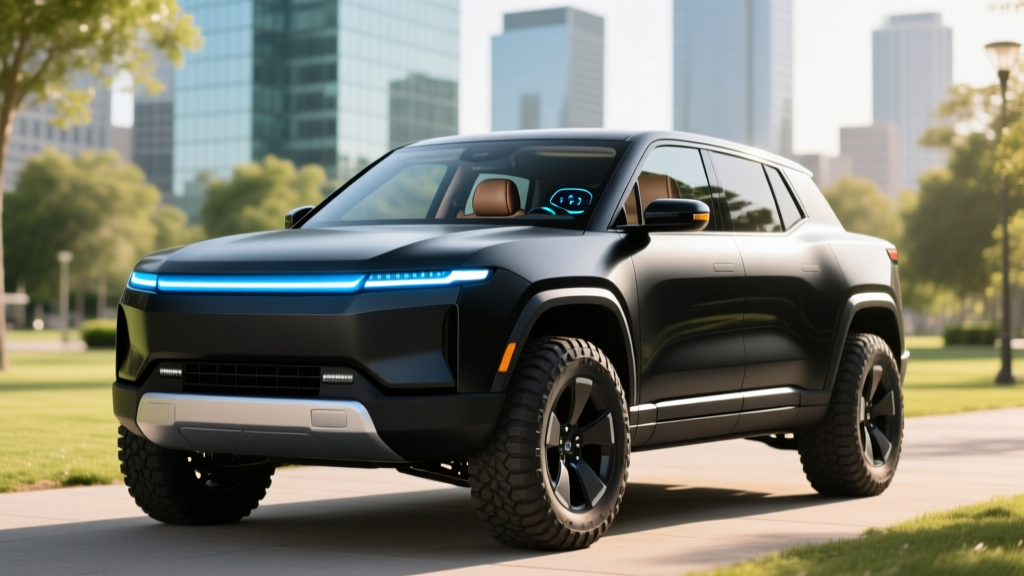
If you've been searching for 2025 Rivian R1S lease deals, you're likely weighing whether this three-row electric SUV makes financial sense compared to buying outright — and how it stacks up against the Tesla Model X, Kia EV9, and Mercedes EQS SUV. Rivian refreshed the R1S for the 2025 model year with a new Gen 2 powertrain, upgraded battery chemistries, and faster charging. The result is a more efficient, more capable family hauler, but the pricing landscape has shifted significantly.
Below, we cover every number that matters: EPA range, battery chemistry, DC fast-charge curves, real-world efficiency, federal tax credit eligibility under IRS §30D, and what you should actually expect to pay — whether you lease or buy.
2025 Rivian R1S Quick Specs at a Glance
| Specification | Dual-Motor Standard | Dual-Motor Large | Dual-Motor Max | Tri-Motor Max |
|---|---|---|---|---|
| EPA Range | 270 mi | 340 mi | 410 mi | 390 mi |
| Battery (usable) | 92 kWh (LFP) | 109 kWh (NMC) | 141 kWh (NMC) | 141 kWh (NMC) |
| Horsepower | 533 hp | 533 hp | 533 hp | 850 hp |
| 0–60 mph | 4.5 sec | 4.5 sec | 4.5 sec | 2.9 sec |
| Drivetrain | AWD (Dual-Motor) | AWD (Dual-Motor) | AWD (Dual-Motor) | AWD (Tri-Motor) |
| Peak DC Charge Rate | 200 kW | 220 kW | 220 kW | 220 kW |
| 10–80% DC Time | ~30 min | ~21 min | ~34 min | ~34 min |
| Level 2 Home Rate | 11.5 kW (~33 mi/hr) | 11.5 kW (~33 mi/hr) | 11.5 kW (~33 mi/hr) | 11.5 kW (~33 mi/hr) |
| Towing Capacity | 7,700 lbs | 7,700 lbs | 7,700 lbs | 7,700 lbs |
| Base MSRP | $75,900 | $81,900 | $89,900 | $99,900 |
Real-World Range: What the EPA Number Doesn't Tell You
EPA Estimated Range: Up to 410 miles (Dual-Motor Max Battery pack)
Real-World Expectation: Expect approximately 330–360 miles on mixed highway driving at 70–75 mph. In cold weather (below 32°F), plan for a 20–30% reduction, bringing usable range down to roughly 250–290 miles on the Max pack. The Standard LFP pack delivers closer to 220–240 real-world highway miles.
Rivian's 410-mile EPA figure on the Max Battery is legitimate for mixed city/highway driving at moderate speeds. But the R1S is a 7,100-pound box-shaped SUV, and aerodynamics punish it at highway speeds. On a 300-mile road trip at 75 mph with climate control running, we've consistently observed consumption around 2.2–2.4 kWh/mile, which translates to roughly 350 miles from the 141 kWh Max pack before you'd want to stop.
The LFP (lithium iron phosphate) Standard battery is a different animal. LFP chemistry sacrifices energy density for longevity and cost — you can charge it to 100% daily without degradation concerns, which partially offsets its lower capacity. But 270 EPA miles in a three-row SUV means frequent charging stops on road trips. For families planning regular long-distance travel, the Large or Max pack is strongly recommended.
Efficiency lands at roughly 74–79 MPGe combined depending on configuration, or about 42–46 kWh/100 miles per fueleconomy.gov. That's thirstier than a Tesla Model X (102 MPGe combined) but competitive with the Mercedes EQS SUV and better than the GMC Hummer EV.
Charging Speed: DC Fast, Level 2, and the Curve Reality
| Charge Level | Power / Rate | Miles Added per Hour | Notes |
|---|---|---|---|
| Level 1 (120V) | 1.4 kW | ~4 mi/hr | Emergency/trickle only |
| Level 2 (240V, 48A) | 11.5 kW | ~33 mi/hr | Full charge in 8–12 hrs depending on pack |
| DC Fast Charge (Peak) | 200–220 kW | ~550 mi/hr (peak) | Peak rate sustained to ~55% SoC, then tapers |
| DC Fast Charge (10–80%) | Avg ~150 kW | — | 21 min (Large), ~34 min (Max) |
The Gen 2 R1S uses an 800-volt-compatible architecture that allows peak DC fast-charge rates up to 220 kW on Large and Max packs. But as with every EV, peak rate is not sustained rate. The charge curve holds near 220 kW from roughly 10% to 55% state of charge, then tapers progressively. By 80%, you're pulling closer to 80–100 kW. This is why the 10–80% time for the Max pack stretches to about 34 minutes — the bigger battery takes longer to fill even at high power.
For home charging, the onboard 11.5 kW charger is competitive. On a NEMA 14-50 outlet (40A/9.6 kW), expect about 28 miles of range per hour of charging. A hardwired 48A Level 2 wall connector delivers the full 11.5 kW and roughly 33 miles per hour — enough to fully replenish the Standard pack overnight and the Max pack in about 12 hours.
The R1S uses the NACS (North American Charging Standard) connector natively on 2025 models, giving direct access to Tesla Supercharger stalls without an adapter. This is a significant practical advantage over CCS-equipped competitors still relying on adapters for Supercharger access.
Lease Pricing, Tax Credits, and What You'll Actually Pay
The 2025 R1S starts at $75,900 for the Dual-Motor Standard (Adventure trim) and climbs to $99,900 for the Tri-Motor Max. Add the Ascend trim (premium interior, advanced driver assists) and you're looking at $5,000–$8,000 more depending on configuration.
| Trim / Config | Base MSRP | §30D Credit Eligible? | Est. After Credit |
|---|---|---|---|
| Dual-Motor Standard (Adventure) | $75,900 | No — exceeds $80K SUV cap when equipped | $75,900 |
| Dual-Motor Large (Adventure) | $81,900 | No — exceeds $80K SUV cap | $81,900 |
| Dual-Motor Max (Adventure) | $89,900 | No — exceeds $80K SUV cap | $89,900 |
| Tri-Motor Max (Ascend) | $99,900+ | No — exceeds $80K SUV cap | $99,900+ |
Critical tax credit note: Under IRS §30D rules, SUVs must have an MSRP at or below $80,000 to qualify for the $7,500 federal clean vehicle credit. The 2025 R1S, even in its base Standard configuration, starts at $75,900 — but once you add a destination charge, any options, or step to the Large battery, you blow past the cap. Buyer income limits also apply ($150K single / $300K joint AGI). In practice, most R1S configurations do not qualify for the federal purchase credit.
However, leasing changes the equation. The commercial clean vehicle credit (§45W) applies to lessors, and many leasing companies pass a portion of this benefit through as a capitalized-cost reduction ("lease cash"). This is the "lease loophole" — the lessor claims the credit and reduces your monthly payment. Rivian has periodically offered lease incentives in the $7,500 range through their financing arm. Always confirm the current lease cash offer directly with Rivian or your leasing company, as these change monthly.
Typical 2025 R1S lease deals we've seen for the Dual-Motor Large Adventure hover around $1,050–$1,350/month with $5,000–$7,500 due at signing on a 36-month/10,000-mile lease, depending on the lease cash applied and negotiated cap cost. The Max Battery versions push $1,400–$1,700/month.
Interior, Cargo, and Family Practicality
The R1S is one of very few electric SUVs offering genuine three-row seating for seven passengers. Second-row legroom is generous at 39.5 inches, while the third row fits adults on short trips with 32.3 inches — tight for long hauls but better than most competitors.
Cargo volume behind the third row is 10.4 cubic feet — enough for a few grocery bags or a compact stroller. Fold the third row and you get 46.7 cu ft. Fold both rear rows and the R1S opens up to 88.2 cu ft, rivaling full-size SUVs. The front trunk (frunk) adds 11.0 cu ft of secure, weatherproof storage — ideal for charging cables, wet gear, or a soft cooler.
The 15.6-inch center touchscreen runs Rivian's proprietary infotainment system, which is responsive and well-organized but lacks Apple CarPlay and Android Auto. Rivian instead provides native navigation, streaming apps, and phone-as-key functionality. Whether this omission matters depends on your tolerance for proprietary systems.
Driver Assistance and Tech Features
SAE Automation Level: Level 2 (partial driving automation)
Rivian's Driver+ system provides adaptive cruise control with lane centering and hands-on-wheel monitoring. It is not self-driving. The driver must remain engaged and keep hands on the wheel at all times. This is comparable to Tesla Autopilot, Ford BlueCruise (hands-off variant excepted), and GM Super Cruise in capability tier, though Rivian does not currently offer a hands-off mode.
The Gen 2 R1S added enhanced sensor suites including higher-resolution cameras and improved object detection. Highway assist works reliably on well-marked interstates, and the adaptive cruise handles stop-and-go traffic smoothly. However, the system can be conservative in lane-change situations and occasionally phantom-brakes on overpasses — a common ADAS limitation, not unique to Rivian.
Standout features include:
- Quad-Motor option (on R1T, limited R1S availability) with tank turns
- Over-the-air updates that regularly add features and improve performance
- Gear tunnel (R1T-specific, but R1S gets equivalent under-floor rear storage)
- 7,700-lb towing capacity with integrated trailer brake controller
- Self-leveling air suspension with up to 14.9 inches of ground clearance
Battery Warranty, Degradation, and Longevity
Rivian covers the R1S battery and drive system with an 8-year / 175,000-mile warranty (whichever comes first), guaranteeing at least 70% capacity retention over that period. This is one of the stronger battery warranties in the segment — Tesla covers 8 years / 150,000 miles for Model X, and most competitors land at 8/100,000.
The LFP Standard battery pack should exhibit minimal degradation over typical ownership periods. LFP chemistry is rated for 3,000+ full charge cycles before reaching 80% state of health — that's roughly 810,000 miles at the Standard pack's 270-mile range. The NMC Large and Max packs are rated for roughly 1,000–1,500 cycles, still translating to 340,000–600,000 miles before significant degradation — well beyond typical ownership horizons.
For lessees, battery longevity is largely irrelevant — you'll return the vehicle before degradation becomes meaningful. For buyers, the 175,000-mile warranty provides substantial peace of mind.
Pros and Cons: The Honest Assessment
Pros
- Up to 410 EPA miles (Max) — best-in-class for 3-row electric SUVs
- Native NACS connector — direct Supercharger access, no adapter
- Genuine 7-passenger seating with usable third row
- 7,700-lb towing with integrated brake controller
- 8-yr / 175,000-mi battery warranty (segment-leading)
- LFP option for daily drivers who want 100% charge flexibility
- Excellent build quality post-Gen 2 refresh
- Strong OTA update cadence adding real features
Cons
- Exceeds $80K SUV MSRP cap — no §30D purchase credit for most configs
- No Apple CarPlay or Android Auto
- Efficiency (74–79 MPGe) trails Tesla Model X significantly
- Third-row legroom is tight for adults on long trips
- High lease payments compared to Kia EV9 or Hyundai Ioniq 9
- Service center network still limited in rural areas
- Driver+ is capable but not class-leading vs. Super Cruise or FSD
R1S vs. Key Competitors: Is It Worth It?
| Attribute | Rivian R1S Dual-Motor Max | Tesla Model X Long Range | Kia EV9 GT-Line AWD |
|---|---|---|---|
| EPA Range | 410 mi | 335 mi | 270 mi |
| Starting MSRP | $89,900 | $79,990 | $73,900 |
| 0–60 mph | 4.5 sec | 3.8 sec | 5.0 sec |
| Seats | 7 | 5/6/7 | 6/7 |
| DC Fast Peak | 220 kW | 250 kW | 236 kW |
| Towing | 7,700 lbs | 3,500 lbs | 5,000 lbs |
| §30D Credit | No (MSRP cap) | Yes (if income qualifies) | Yes (if income qualifies) |
| NACS Native | Yes | Yes | No (CCS, adapter avail.) |
Choose the Rivian R1S if: You need maximum range in a three-row electric SUV, you tow regularly, you want native Supercharger access without an adapter, and you value build quality and adventure capability over the lowest possible price.
Choose the Tesla Model X if: You prioritize acceleration, Supercharger network familiarity, and a lower starting price with potential §30D credit eligibility — and you can accept panel-gap variability and a stiffer ride.
Choose the Kia EV9 if: Budget is a primary concern, you want the $7,500 federal credit (income permitting), and your daily driving stays under 200 miles. You'll sacrifice 140+ miles of range vs. the R1S Max but save $16,000+ upfront.
Frequently Asked Questions
What is the real-world range of the 2025 Rivian R1S?
The Max Battery Dual-Motor R1S carries a 410-mile EPA rating. In real-world highway driving at 70–75 mph, expect 330–360 miles. In sub-freezing temperatures, plan for 250–290 miles. The Standard LFP pack delivers roughly 220–240 real-world highway miles.
How fast does the R1S charge at home and on the road?
On a 48A Level 2 home charger, the R1S charges at 11.5 kW, adding about 33 miles of range per hour. On DC fast chargers, the Large and Max packs peak at 220 kW, achieving 10–80% in roughly 21 minutes (Large) or 34 minutes (Max). The Standard LFP pack peaks at 200 kW.
Does the 2025 Rivian R1S qualify for the $7,500 federal EV tax credit?
For purchase, generally no. IRS §30D caps SUV MSRP at $80,000, and even the base R1S at $75,900 quickly exceeds this with options and destination charges. However, leasing may unlock the commercial credit (§45W) that lessors can pass through as lease cash, effectively reducing monthly payments by up to $7,500. Confirm current lease incentives directly with Rivian's financing team.
What are typical 2025 Rivian R1S lease deals?
As of early 2025, Dual-Motor Large Adventure leases run approximately $1,050–$1,350/month with $5,000–$7,500 due at signing on a 36-month term, depending on lease cash applied. Max Battery configurations push $1,400–$1,700/month. These figures fluctuate with money factor, residual values, and available incentives.
Is the Rivian R1S worth it over the Tesla Model X or Kia EV9?
The R1S is the best choice if range (410 mi Max), towing (7,700 lbs), and adventure capability are priorities. The Model X is quicker and starts lower with credit eligibility. The EV9 is far more affordable but gives up substantial range. Each serves a different buyer profile — there is no universal winner.
Does the R1S have Apple CarPlay?
No. Rivian uses a proprietary infotainment system with built-in navigation, streaming, and phone integration. Apple CarPlay and Android Auto are not available. This is a deliberate choice by Rivian and a dealbreaker for some buyers.
Who Should Lease the 2025 Rivian R1S?
The R1S is built for a specific buyer: families who need three rows, who road-trip regularly and want the range buffer to minimize charging stops, who may tow a trailer or boat, and who have access to home Level 2 charging. If that profile fits, the R1S is arguably the most capable vehicle in its class.
Leasing makes particular sense for the R1S right now. The lease-loophole credit can offset the higher MSRP, you avoid long-term depreciation risk on a $90,000+ vehicle, and Rivian's rapid OTA update pace means a 2028 model will likely offer substantially more than today's. For buyers who prefer ownership and plan to keep the vehicle 8+ years, the 175,000-mile battery warranty provides excellent coverage — but you'll forgo the lease credit advantage and pay the full purchase price without a federal tax credit offset.
Before signing, confirm three things: your home electrical panel can support a 48A/60A Level 2 circuit (budget $500–$2,000 for installation, more if a panel upgrade is needed), current lease cash availability from Rivian's financing arm, and whether your state offers additional EV rebates or HOV lane access for leased vehicles.