Quick Verdict: The Entry-Level R1S That Still Delivers
The 2025 Rivian R1S Dual Standard represents the most accessible point of entry into Rivian's three-row electric SUV lineup. Built on the company's updated second-generation platform, it pairs a dual-motor all-wheel-drive system with a standard-capacity battery to deliver 533 horsepower, a 270-mile EPA range estimate, and the same premium interior and off-road chops as its pricier siblings. For families who want a capable electric adventure vehicle without stepping up to the $100,000+ Max battery configurations, this trim hits a compelling sweet spot — provided you understand its range and charging trade-offs.
In this review, we break down the real-world range you can actually expect, how fast it charges on DC fast chargers and at home, whether it qualifies for the federal EV tax credit under current IRS §30D rules, and how it stacks up against competitors like the Tesla Model X, Kia EV9, and Hyundai Ioniq 9.
Range and Efficiency: EPA Estimates Meet Reality
Real-World Expectation: ~220–245 miles highway (70–80 mph); ~195–215 miles in cold weather (below 32°F); ~250–270 miles in mixed city/suburban driving with regen braking engaged.
The 2025 R1S Dual Standard carries an EPA-estimated range of 270 miles on a full charge. That figure is derived from the standard-capacity battery pack, which Rivian rates at approximately 92 kWh of usable capacity using NMC (nickel manganese cobalt) lithium-ion chemistry. NMC cells offer higher energy density than LFP alternatives, which matters in a large, heavy SUV like the R1S that tips the scales at over 6,800 pounds.
But EPA range is a laboratory number. In real-world highway driving at sustained speeds of 70–80 mph, expect to see closer to 220–245 miles before needing a charge. Cold weather compounds the issue — battery chemistry becomes less efficient in freezing temperatures, and cabin heating draws significant energy. On winter road trips below 32°F, plan for 195–215 miles of usable range. City and suburban driving, where regenerative braking recaptures energy during stop-and-go traffic, gets you closer to the EPA sticker at 250–270 miles.
Efficiency comes in at approximately 76 MPGe combined (city/highway), which translates to roughly 44 kWh per 100 miles. For a three-row SUV with this much power and capability, that's respectable — though it trails the more aerodynamic Kia EV9 (which achieves up to 87 MPGe in certain trims).
Charging Speed: DC Fast Charging and Home Level 2
Rivian equipped the 2025 R1S Dual Standard with a maximum DC fast-charge rate of 220 kW via its NACS (North American Charging Standard) port. That's a meaningful bump over the first-generation R1S, which topped out at around 200 kW. At a compatible 250 kW or 350 kW DC fast charger, you can expect the following charge curve:
| Charge Type | Power / Rate | Time or Miles Added |
|---|---|---|
| DC Fast Charge (10–80%) | Peak 220 kW | ~25–28 minutes |
| DC Fast Charge (10–90%) | Tapers above 80% | ~38–42 minutes |
| Level 2 Home (11.5 kW / 48A) | 11.5 kW | ~30 miles per hour of charging |
| Level 2 Home (7.7 kW / 32A) | 7.7 kW | ~20 miles per hour of charging |
| Level 1 (120V household) | ~1.4 kW | ~3–4 miles per hour of charging |
A few important notes on the charge curve: peak 220 kW is not sustained across the entire session. Like all EVs, the R1S tapers charge speed significantly above 80% state of charge to protect battery longevity. If you're road-tripping, plan your stops around the 10–80% window — that's where the fastest charging happens. Pushing to 100% at a DC fast charger adds 15+ minutes for relatively few extra miles.
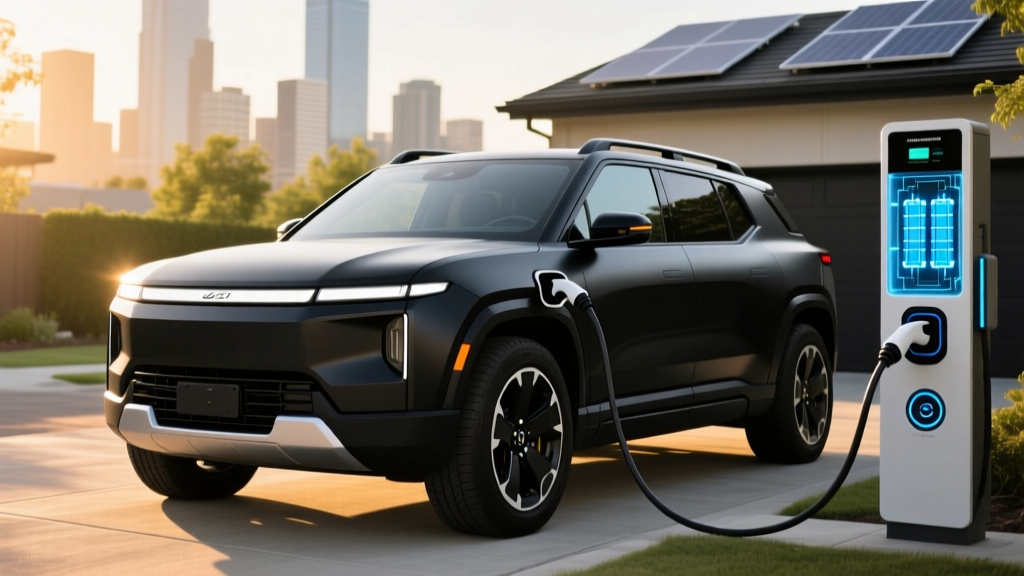
At home, the R1S's onboard charger supports up to 11.5 kW (48 amps) on a Level 2 circuit. With a properly installed 60-amp dedicated circuit and a hardwired Wall Connector or Rivian Wall Charger, you'll add roughly 30 miles of range per hour — meaning a full overnight charge from 20% to 100% takes about 8–9 hours. Most owners will plug in each evening and wake up fully charged, which is the ideal EV ownership pattern.
Rivian has also integrated its vehicles with the Tesla Supercharger network via the native NACS port, giving R1S owners access to over 20,000 Supercharger stalls nationwide without an adapter. This is a significant practical advantage for road trips compared to CCS-only vehicles still transitioning to NACS access.
Performance: 533 HP Dual-Motor AWD
The "Dual" in Dual Standard refers to Rivian's dual-motor all-wheel-drive powertrain — one electric motor on each axle. Combined output is 533 horsepower and 610 lb-ft of torque in the standard Dual Motor configuration. That's enough to propel this 6,800-pound SUV from 0 to 60 mph in approximately 4.5 seconds, according to Rivian's published figures.
That acceleration is genuinely quick for a three-row family hauler. For comparison, the Kia EV9 GT-Line AWD hits 60 mph in about 5.0 seconds with 379 hp, and the Tesla Model X Long Range does it in 3.8 seconds with 670 hp but starts at over $98,000. The R1S Dual Standard threads the needle: it's fast enough to feel effortless in highway merging and passing, without the price premium of Rivian's Performance Dual Motor or Tri/Quad motor setups.
The AWD system also supports Rivian's suite of off-road drive modes, including All-Purpose, Sport, Conserve, Snow, and Off-Road modes with adjustable air suspension ride height. The R1S can wade through up to 36 inches of water and offers up to 14.9 inches of ground clearance in its highest suspension setting — genuine off-road capability that most electric SUVs can't match. Towing capacity is rated at 7,700 pounds when properly equipped, making it viable for boat, camper, or utility trailers.
Interior, Cargo, and Technology
The R1S seats up to seven passengers across three rows. Second-row captain's chairs are standard (a bench is not available), meaning the configuration is 2-2-3. Front-row legroom measures 41.4 inches, second-row legroom is 38.2 inches, and the third row offers 30.4 inches — adequate for children and smaller adults on shorter trips, but tight for full-size adults on long journeys.
Cargo volume breaks down as follows:
- Behind third row: 10.6 cu ft (enough for a few grocery bags or small luggage)
- Behind second row (third row folded): 46.7 cu ft
- Behind first row (all rear seats folded): 79.6 cu ft
- Front trunk (frunk): 11.0 cu ft — a genuinely useful, weather-sealed compartment
The 11-cubic-foot frunk is one of the R1S's standout practical features. It's large enough to hold charging cables, a medium cooler, or a couple of carry-on bags, and because it's sealed and drainable, it doubles as a gear locker for muddy or wet outdoor equipment.
On the technology front, the 2025 R1S runs Rivian's latest software on a 15.6-inch center touchscreen with a clean, responsive interface. Wireless Apple CarPlay and Android Auto are not supported — Rivian uses its own native navigation and media apps, which are well-designed but may frustrate users who prefer phone projection. The digital driver display is a 12.3-inch cluster, and a 6.8-inch rear touchscreen allows second-row passengers to control climate and media.
Driver assistance comes via Rivian's Driver+ system, a Level 2 SAE automation suite that includes adaptive cruise control, lane centering, automatic emergency braking, blind-spot monitoring, and highway assist on compatible roads. It's competent and smooth, but it is not a hands-free system like GM's Super Cruise or Ford's BlueCruise — your hands must remain on the wheel. Rivian has indicated future over-the-air updates will expand capabilities, but as of the 2025 model year, this is a supervised driver-assist system.
Pricing, Trim Levels, and Federal Tax Credit
| Trim / Configuration | Base MSRP | Est. After §30D Credit* |
|---|---|---|
| R1S Dual Standard (Adventure) | $84,950 | $77,450 |
| R1S Dual Large | $91,950 | $84,450 |
| R1S Dual Max | $99,950 | $92,450 |
| R1S Performance Dual Standard | $89,950 | $82,450 |
The 2025 Rivian R1S Dual Standard starts at an MSRP of $84,950, including destination. That's before any options, and Rivian's packages (such as the $2,500 Off-Road Upgrade or premium paint colors at $1,800–$2,800) can push the as-tested price into the $90,000–$93,000 range.
Federal tax credit eligibility: Under current IRS §30D rules, the R1S qualifies for up to $7,500 in federal clean vehicle credits, but eligibility depends on several factors:
- MSRP cap: SUVs must have an MSRP at or below $80,000. The R1S Dual Standard at $84,950 exceeds this cap and does NOT qualify for the new-vehicle §30D credit at its base price.
- Buyer income limits: Modified adjusted gross income must not exceed $300,000 (joint filers), $225,000 (head of household), or $150,000 (individual).
- Battery sourcing: Critical minerals and battery components must meet phased-in domestic sourcing requirements.
- Point-of-sale transfer: If eligible, the credit can be transferred to the dealer at purchase, reducing the cash price directly.
Critical note: The R1S Dual Standard's $84,950 MSRP puts it above the $80,000 SUV cap for the new-vehicle §30D credit. This means most buyers purchasing new will not receive the $7,500 federal credit. However, if you purchase the R1S as a used qualified plug-in EV (under the separate §25E used clean vehicle credit), you may be eligible for up to $4,000 or 30% of the sale price (whichever is less), subject to a $25,000 maximum sale price — which typically excludes the R1S on the used market as well given current resale values.
Some buyers have structured lease deals where the leasing entity claims the commercial clean vehicle credit (§45W) and passes savings through as a reduced monthly payment. Consult a tax professional for your specific situation, and always verify current rules at irs.gov before purchasing.
Warranty and Battery Longevity
Rivian backs the 2025 R1S with the following warranty coverage:
- Battery pack: 8 years or 175,000 miles (whichever comes first), with a capacity retention threshold of 70% minimum state of health
- Powertrain (motors, reducers): 8 years or 175,000 miles
- Vehicle (bumper-to-bumper): 5 years or 60,000 miles
- Corrosion perforation: 8 years, unlimited miles
The 175,000-mile battery warranty is generous and above the industry standard of 100,000 miles (though some competitors like Hyundai offer 10 years/100,000 miles). The 70% capacity retention threshold is standard — if your battery degrades below 70% of original capacity within the warranty period, Rivian will repair or replace it.
Based on data from first-generation R1S owners and industry-wide NMC battery degradation curves, expect approximately 8–12% capacity loss over the first 100,000 miles under normal use patterns. Avoiding frequent DC fast charging above 90%, not letting the battery sit at 0% for extended periods, and using preconditioning before fast charging will help maximize longevity.
How It Compares: R1S Dual Standard vs. the Competition
| Spec | 2025 Rivian R1S Dual Std | 2025 Tesla Model X LR | 2025 Kia EV9 GT-Line AWD |
|---|---|---|---|
| EPA Range | 270 mi | 335 mi | 270 mi |
| Battery (usable) | ~92 kWh NMC | ~95 kWh | 99.8 kWh NMC |
| DC Fast Charge Peak | 220 kW | 250 kW | 236 kW |
| 10–80% DCFC Time | ~26 min | ~22 min | ~24 min |
| 0–60 mph | 4.5 sec | 3.8 sec | 5.0 sec |
| Horsepower | 533 hp | 670 hp | 379 hp |
| Base MSRP | $84,950 | $98,490 | $73,900 |
| Seating | 7 | 5–7 | 6–7 |
| Towing Capacity | 7,700 lbs | 5,000 lbs | 5,000 lbs |
| Federal Credit Eligible (New) | No (MSRP > $80K) | Partial* | Yes (up to $7,500) |
*Tesla Model X credit eligibility varies by battery sourcing and buyer income. Verify at fueleconomy.gov.
Choose the Tesla Model X if: Maximum range (335 mi) and Supercharger network maturity are your top priorities, and you can absorb the $98K+ price tag.
Choose the Kia EV9 if: You want the best value in a three-row electric SUV, qualify for the $7,500 federal credit (bringing effective price to ~$66K), and don't need off-road capability or heavy towing.
Pros and Cons
- 533 hp dual-motor AWD with 4.5-second 0–60
- Class-leading 7,700-lb towing capacity
- Genuine off-road capability with air suspension
- 11 cu-ft front trunk (frunk) — sealed and drainable
- Native NACS port with Tesla Supercharger access
- 175,000-mile battery warranty
- Premium interior materials and build quality
- 270-mile EPA range is modest for the price
- MSRP exceeds $80K cap — no federal §30D credit
- No wireless Apple CarPlay or Android Auto
- Third-row space tight for adults on long trips
- Driver+ is competent but not hands-free
- 220 kW peak charge rate trails some competitors
- Limited service center network vs. legacy brands
Who Should Buy the 2025 Rivian R1S Dual Standard?
This SUV is built for a specific buyer: an active family or outdoor enthusiast who needs three rows, wants genuine off-road and towing capability, and values design and build quality over maximizing range-per-dollar. If your weekends involve mountain trails, boat ramps, or camping gear, the R1S's combination of 7,700-lb towing, 14.9 inches of adjustable ground clearance, and a weather-sealed frunk is difficult to match in any electric vehicle at any price.
It's less ideal for buyers whose primary concern is maximum range or lowest total cost. The 270-mile EPA range means road trips will require more frequent charging stops than a Tesla Model X or even the Kia EV9 with its available 300+ mile configurations. And the ineligibility for the federal tax credit at this MSRP means you're paying full sticker — a reality that pushes the value proposition closer to competitors that do qualify.
For daily commuting and suburban family duty with occasional adventure use, the R1S Dual Standard is a rewarding, well-built, and genuinely capable electric SUV. Just go in with eyes open about range, charging logistics, and the tax credit situation.
Frequently Asked Questions
What is the real-world range of the 2025 Rivian R1S Dual Standard?
The EPA rates it at 270 miles, but real-world highway driving at 70–80 mph yields approximately 220–245 miles. In freezing weather, expect 195–215 miles. City driving with regenerative braking can approach the EPA number at 250–270 miles.
How fast does the R1S Dual Standard charge?
On a DC fast charger, it peaks at 220 kW and charges from 10–80% in approximately 25–28 minutes. At home on a Level 2 charger (11.5 kW / 48A), it adds about 30 miles of range per hour, fully charging overnight in 8–9 hours.
Does the 2025 Rivian R1S qualify for the $7,500 federal EV tax credit?
No — the R1S Dual Standard's $84,950 MSRP exceeds the IRS §30D cap of $80,000 for SUVs. Buyers will not receive the new-vehicle federal credit. Some lease structures may pass through savings via the commercial credit (§45W), but consult a tax professional.
Is the R1S Dual Standard worth it vs. the Kia EV9 or Tesla Model X?
It depends on your priorities. The R1S wins on off-road capability, towing (7,700 lbs), and build quality. The Kia EV9 wins on value (starting ~$73,900, eligible for $7,500 credit). The Tesla Model X wins on range (335 mi EPA) but costs $98K+. If you need adventure capability, the R1S is unmatched; if you want value and range, look at the EV9.
What battery chemistry does the R1S Dual Standard use?
The 2025 R1S Dual Standard uses NMC (nickel manganese cobalt) lithium-ion cells with approximately 92 kWh of usable capacity. NMC offers higher energy density than LFP, which is important for maximizing range in a heavy, large SUV.
Can the R1S use Tesla Superchargers?
Yes. The 2025 R1S comes with a native NACS (North American Charging Standard) port, giving it direct access to Tesla's Supercharger network without an adapter — over 20,000 stalls across the U.S.
What is the warranty on the R1S battery?
Rivian covers the battery pack for 8 years or 175,000 miles with a minimum 70% capacity retention guarantee. The powertrain is also covered for 8 years/175,000 miles, and the bumper-to-bumper warranty runs 5 years/60,000 miles.