Quick Verdict: The Benchmark Electric Sports Sedan, Priced Like One
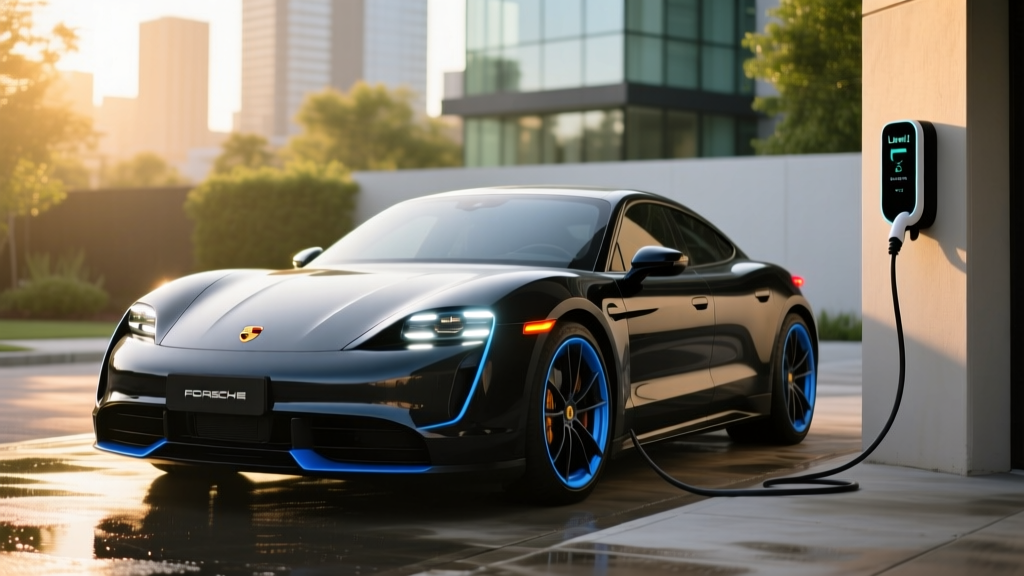
The 2025 Porsche Taycan Turbo S is the quickest, most technologically advanced sedan Porsche has ever built. A comprehensive mid-cycle refresh brought a larger 105 kWh battery, a revised rear-axle motor pushing system output to 939 horsepower in launch-control mode, and DC fast-charging capability up to 320 kW — figures that reset the bar for the luxury performance EV segment. The trade-off is a starting MSRP north of $230,000 and an EPA range that, while dramatically improved over the pre-2025 car, still trails more efficiency-focused rivals. For buyers who prioritize driving dynamics, charge speed, and build quality above all else, nothing else in the EV market delivers quite like the Turbo S.
2025 Taycan Turbo S Core Specifications
| Spec | 2025 Porsche Taycan Turbo S |
|---|---|
| EPA Range | 283 miles (Performance Battery Plus) |
| Battery (usable / gross) | ~97 kWh usable / 105 kWh gross, NMC lithium-ion |
| Drivetrain | Dual-motor AWD, 2-speed rear transmission |
| Peak Output (Launch Control) | 939 hp / 738 lb-ft torque |
| 0–60 mph | 2.4 seconds (manufacturer, with rollout) |
| Top Speed | 162 mph (electronically limited) |
| Max DC Fast Charge Rate | 320 kW peak (800V architecture) |
| 10–80% DC Charge Time | ~18 minutes (optimal conditions) |
| Level 2 Home Charge Rate | 11 kW (onboard AC charger) |
| Efficiency | 79 MPGe combined / 43 kWh/100 mi |
| Cargo Volume | 14.3 cu ft (rear trunk) + 2.9 cu ft (frunk) |
| Curb Weight | ~5,170 lbs |
| Base MSRP (2025 Turbo S) | $230,700 + $1,650 destination |
| Battery Warranty | 8 years / 100,000 miles (70% capacity retention) |
Range and Real-World Efficiency
The 2025 refresh replaced the old 93.4 kWh Performance Battery Plus with a new 105 kWh unit (gross capacity; approximately 97 kWh usable). Porsche adopted a more energy-dense NMC cell chemistry and revised the thermal-management system, yielding an EPA-estimated 283 miles for the Turbo S sedan — a substantial jump from the 2024 Turbo S, which was rated at just 222 miles.
EPA sticker: 283 miles. In real-world highway driving at 70–75 mph, expect 240–260 miles on a full charge. In cold weather (below 32°F), range can drop to 200–220 miles due to cabin heating loads and reduced battery efficiency. City driving with regenerative braking can push closer to or slightly above the EPA figure. The Turbo S's wide, sticky tires and heavy curb weight work against efficiency at sustained high speeds.
The efficiency rating of 79 MPGe combined (43 kWh per 100 miles) places the Taycan Turbo S behind the Tesla Model S Plaid (roughly 120 MPGe) and the Lucid Air Grand Touring (131 MPGe). Porsche prioritized performance and charge speed over maximum miles per kilowatt-hour, and that engineering choice is reflected at the plug.
According to fueleconomy.gov, the combined annual electricity cost for the Taycan Turbo S (15,000 miles driven) is approximately $1,150 at the national average electricity rate — roughly equivalent to a gas vehicle getting about 27 MPG at current fuel prices.
Charging: Class-Leading DC Speed, Adequate Home Rate
Porsche's 800-volt electrical architecture remains a defining advantage of the Taycan platform. The 2025 Turbo S supports DC fast charging at up to 320 kW peak — up from 270 kW in the pre-refresh model. On a compatible 350 kW charger (such as Electrify America's latest stalls or IONITY stations in Europe), the car can add approximately 10–80% in about 18 minutes under ideal battery-temperature conditions.
The 320 kW peak is not sustained across the entire charge session. The Taycan Turbo S holds above 250 kW from roughly 10–40% State of Charge, then gradually tapers. From 60–80%, expect charge rates closer to 150–180 kW. Above 80%, charging slows significantly to protect the battery — a full 80–100% top-off can add another 25–30 minutes. Always use the navigation preconditioning feature when routing to a DC fast charger; the car will warm the battery to optimal temperature for maximum charge acceptance.
For home charging, the onboard AC charger handles up to 11 kW on a Level 2 (240V) connection. On a 48-amp hardwired home charger (such as a Porsche Mobile Charger Connect or ChargePoint Home Flex), you can expect roughly 30–33 miles of range added per hour of charging. A full 10–100% home charge takes approximately 10–11 hours.
| Charging Level | Power | Approximate Rate | Use Case |
|---|---|---|---|
| Level 1 (120V) | ~1.4 kW | ~4 miles/hour | Emergency/trickle only |
| Level 2 (240V, 48A) | 11 kW | ~31 miles/hour | Daily home charging |
| DC Fast Charge | Up to 320 kW peak | 10–80% in ~18 min | Road trips, rapid top-ups |
The Taycan uses the CCS1 connector in North America. Porsche has confirmed that future models will adopt NACS, but the 2025 Taycan retains CCS. A CCS-to-NACS adapter (for Tesla Supercharger access) is available from Porsche and third-party manufacturers, though Supercharger speeds will be limited by the adapter's current rating.
Performance: 939 HP and a 2.4-Second 0–60
The 2025 Turbo S pairs a newly developed rear-axle permanent-magnet synchronous motor (producing up to 536 hp on its own — more than many standalone EVs) with a carryover front-axle motor. Combined with launch control, system output reaches 939 horsepower and 738 lb-ft of torque. Porsche claims a 0–60 mph time of 2.4 seconds with rollout subtracted, making it one of the quickest production cars on the planet.
Unlike most EV competitors that use a single-speed reduction gear, the Taycan retains a two-speed transmission on the rear axle. First gear provides explosive acceleration off the line, while second gear optimizes high-speed efficiency and top-speed runs (electronically limited to 162 mph). This engineering choice gives the Taycan a distinctive character: brutal initial thrust that doesn't fall off as dramatically at highway speeds as single-speed rivals.
Regenerative braking capacity reaches up to 290 kW — meaning the Taycan can recapture energy at an extraordinary rate during deceleration, reducing brake wear in daily driving. Porsche's blended braking system seamlessly transitions between regen and the mechanical brakes (10-piston front calipers clamping 420 mm ceramic composite rotors on the Turbo S).
Pricing, Tax Credits, and the $230K+ Reality
The 2025 Porsche Taycan Turbo S starts at $230,700, plus a $1,650 destination charge, for a total of $232,350 before options. Commonly selected packages — such as the Sport Chrono package, rear-axle steering, Burmester audio, and adaptive cruise control — can push a well-equipped Turbo S to $250,000–$265,000 as-tested.
No. The IRS §30D clean vehicle credit has a manufacturer's suggested retail price (MSRP) cap: $55,000 for sedans and $80,000 for SUVs/trucks. At $230,700+, the Taycan Turbo S exceeds this cap by a wide margin and is ineligible for the $7,500 federal credit regardless of buyer income or battery sourcing. Additionally, the credit has modified adjusted gross income (MAGI) caps of $300,000 for joint filers and $150,000 for single filers. Consult the IRS §30D guidelines and a tax professional for your specific situation. Some state-level incentives may apply — check your state's energy or DMV website for details.
| 2025 Taycan Trim | Base MSRP | EPA Range | §30D Eligible? |
|---|---|---|---|
| Taycan (RWD) | $99,400 | 318 mi | No (exceeds $55K sedan cap) |
| Taycan 4S | $125,200 | 292 mi | No |
| Taycan Turbo | $175,200 | 292 mi | No |
| Taycan Turbo S | $230,700 | 283 mi | No |
| Taycan Turbo GT (w/ Weissach) | $240,000+ | 269 mi | No |
Interior, Tech, and Practicality
The Turbo S cabin is trimmed in premium leather (or optional Race-Tex microfiber), with a 16.8-inch curved digital instrument cluster, a 10.9-inch central touchscreen, and an available 10.9-inch front-passenger display. Porsche Communication Management (PCM) handles navigation, media, and vehicle settings. Wireless Apple CarPlay is standard; Android Auto is wired.
Driver-assistance features include adaptive cruise control with stop-and-go, lane-keeping assist, night vision with pedestrian detection, and surround-view cameras. These are SAE Level 1–2 systems — the driver must remain fully engaged and hands on the wheel at all times. Porsche's system is competent but does not offer hands-free highway driving like GM's Super Cruise or Ford's BlueCruise.
Practicality is where the Taycan reveals its sports-sedan compromises. Rear legroom is 32.7 inches — adequate for adults on short trips but tight compared to a Mercedes EQS (41.8 inches). The rear trunk offers 14.3 cubic feet of cargo space, supplemented by a 2.9-cubic-foot frunk. Total storage is sufficient for two carry-on suitcases and a couple of soft bags, but the Taycan is not a road-trip hauler. The Taycan Cross Turismo wagon variant offers more cargo volume if utility matters.
Ownership: Warranty, Maintenance, and Depreciation
Porsche covers the Taycan's high-voltage battery for 8 years or 100,000 miles, guaranteeing a minimum of 70% capacity retention over that period. The limited vehicle warranty is 4 years / 50,000 miles. Scheduled maintenance is minimal compared to a combustion Porsche — no oil changes, spark plugs, or transmission fluid to worry about — but brake fluid service, cabin air filters, and tire rotations still apply.
Insurance costs are substantial. Expect annual premiums of $5,000–$8,000+ depending on your driving record, location, and coverage level, reflecting the Turbo S's replacement cost and repair complexity. Depreciation on high-end EVs has historically been steep, though the 2025 refresh's improved range and charging may help the Taycan hold value better than the 2020–2024 models, which saw significant used-price declines.
Competitor Comparison: Taycan Turbo S vs. Model S Plaid vs. Lucid Air Sapphire
| Metric | 2025 Taycan Turbo S | 2025 Tesla Model S Plaid | 2025 Lucid Air Sapphire |
|---|---|---|---|
| Base MSRP | $230,700 | $108,490 | $250,500 |
| EPA Range | 283 mi | 359 mi | 427 mi |
| 0–60 mph | 2.4 sec | 1.99 sec | 3.3 sec (est.) |
| Horsepower | 939 hp | 1,020 hp | 1,234 hp |
| Max DC Charge | 320 kW | 250 kW | 300+ kW |
| 10–80% DC Time | ~18 min | ~25 min | ~20 min |
| Build Quality | Exceptional | Good (improving) | Very Good |
| Charging Network | CCS (adapter for NACS) | NACS (native Supercharger) | NACS (adapter included) |
The Model S Plaid is the clear value proposition — more power, more range, and a lower price by over $120,000. But the Taycan Turbo S delivers a driving experience the Plaid cannot match: a stiffer, more communicative chassis, a more luxurious interior, and the two-speed rear transmission that makes the Taycan feel alive at every speed. The Lucid Air Sapphire offers the most range and the highest horsepower, but at a similar price point and with a less proven service network.
Pros and Cons
- 320 kW DC fast charging — among the fastest of any production EV
- 939 hp and 2.4s 0–60 with repeatable, heat-managed performance
- Two-speed rear axle gives unique character vs. single-speed rivals
- Exceptional build quality, materials, and fit-and-finish
- 800V architecture enables superior charge acceptance
- 290 kW regen capacity reduces brake wear significantly
- $230K+ starting price; $250K+ realistic as-tested
- 283-mile EPA range trails Model S Plaid and Lucid Air
- CCS connector requires adapter for Tesla Supercharger access
- No federal §30D tax credit eligibility (MSRP cap)
- Tight rear legroom (32.7 in) for a sedan at this price
- Level 2 ADAS lacks hands-free highway capability
- High insurance and depreciation costs
Who Should Buy the 2025 Taycan Turbo S?
The Taycan Turbo S is built for a specific buyer: someone who values Porsche's driving dynamics, build quality, and brand cachet, and who has reliable access to home charging plus DC fast-charging infrastructure for road trips. It excels as a daily-driver sports sedan for enthusiasts who want EV instant torque wrapped in a chassis that communicates through every corner.
It is not the right choice if maximum range is your priority (choose the Lucid Air Grand Touring), if you want the best value-per-horsepower (the Model S Plaid wins decisively), or if you need generous rear-seat and cargo space for family duty (consider the BMW i7 or Mercedes EQS).
Frequently Asked Questions
What is the real-world range of the 2025 Porsche Taycan Turbo S?
The EPA rates it at 283 miles. In real-world highway driving at 70+ mph, expect 240–260 miles. In cold weather below freezing, range can drop to 200–220 miles. City driving with regen braking may approach or slightly exceed the EPA number.
How fast does the Taycan Turbo S charge?
On a 350 kW DC fast charger, it peaks at 320 kW and charges from 10–80% in approximately 18 minutes. At home on a Level 2 (240V, 48A) charger, it adds about 31 miles of range per hour, with a full charge taking 10–11 hours.
Does the 2025 Taycan Turbo S qualify for the federal EV tax credit?
No. The IRS §30D credit caps eligible sedans at an MSRP of $55,000. At $230,700, the Turbo S is ineligible regardless of buyer income or battery sourcing. Check your state's incentive programs for potential local credits.
Is the Taycan Turbo S worth it vs. the Tesla Model S Plaid?
It depends on your priorities. The Plaid is quicker (1.99s 0–60), has more range (359 mi EPA), native Supercharger access, and costs $122,000 less. The Taycan wins on build quality, chassis dynamics, charging speed (320 vs. 250 kW), and the prestige factor. If driving engagement and luxury matter more than outright value, the Taycan earns its premium.
What battery does the 2025 Taycan Turbo S use?
A 105 kWh gross (~97 kWh usable) NMC (nickel-manganese-cobalt) lithium-ion battery pack operating on an 800-volt architecture. It is covered by an 8-year / 100,000-mile warranty with a 70% capacity-retention guarantee.
Can I charge a Taycan at a Tesla Supercharger?
Not natively — the 2025 Taycan uses the CCS1 connector. However, Porsche and third-party CCS-to-NACS adapters are available, enabling Supercharger access at reduced charge rates (typically limited to 150–250 kW depending on the adapter).