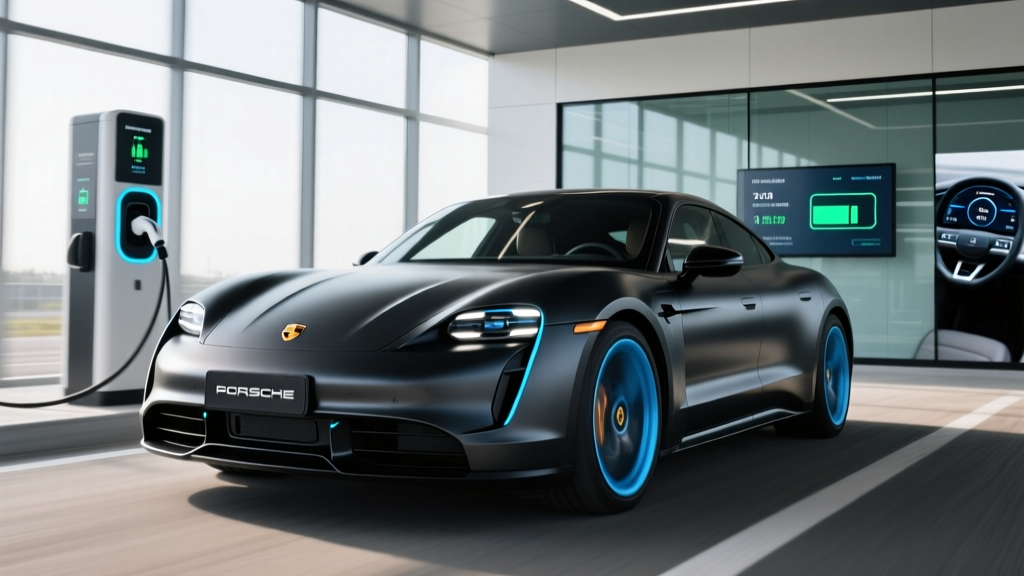
The 2025 Porsche Taycan represents the most significant mid-cycle refresh since the nameplate debuted. Porsche overhauled the battery chemistry, pushed DC fast-charging speeds to a segment-leading 320 kW, and quietly addressed the biggest criticism leveled at the previous generation: EPA range figures that trailed rivals by 50 to 80 miles. The result is a luxury performance sedan that now competes on efficiency metrics, not just Nürburgring lap times.
But spec sheets don't tell the whole story. After analyzing EPA data, Porsche's technical documentation, and real-world driving logs from owners in varied climates, here's what actually matters if you're considering a 2025 Taycan.
Quick Verdict: Who Should Buy the 2025 Taycan?
The 2025 Taycan is the right choice if you prioritize driving dynamics and charging speed above all else, and you're willing to accept tighter rear-seat packaging than a Tesla Model S or Lucid Air delivers. It's a driver's EV first, luxury cruiser second. The updated powertrain and battery make it genuinely viable for road trips—a claim the pre-refresh model struggled to back up.
- You value handling precision and steering feel over interior volume
- You want the fastest DC charging in the luxury EV sedan segment
- You're a daily driver who occasionally road-trips 300+ miles
- You need usable rear seats for adults on a regular basis
- You want 400+ miles of EPA range without stepping to a Lucid Air
- Federal tax credit eligibility is a dealbreaker (the Taycan does not qualify)
Range and Efficiency: EPA vs. Reality
Porsche's biggest engineering win for 2025 is the battery and thermal management overhaul. The updated Taycan lineup uses a new NMC (nickel manganese cobalt) cell chemistry with higher energy density, paired with an 800-volt architecture that Porsche pioneered in this segment.
| Trim | Battery (usable kWh) | EPA Range (mi) | MPGe (combined) | kWh/100 mi |
|---|---|---|---|---|
| Taycan (RWD) | 89.0 | 318 | 92 | 36 |
| Taycan 4S | 89.0 | 293 | 87 | 39 |
| Taycan GTS | 89.0 | 282 | 84 | 40 |
| Taycan Turbo | 89.0 | 278 | 82 | 41 |
| Taycan Turbo S | 89.0 | 270 | 79 | 43 |
| Taycan Turbo GT | 89.0 | 269 | 78 | 43 |
The EPA-rated 318 miles on the RWD Taycan is a meaningful improvement over the outgoing model's 225-mile base figure. However, real-world results depend heavily on conditions:
- Highway (70-75 mph, moderate climate): Expect 265–285 miles on the RWD; 240–260 on AWD trims.
- Cold weather (below 32°F, cabin heat active): Budget a 20–30% reduction. The RWD may deliver 220–255 miles; AWD trims can dip to 190–220 miles.
- Mixed suburban commuting: This is where the Taycan shines—regenerative braking recovers energy effectively, and you'll approach or occasionally exceed EPA estimates.
The Taycan's heat pump (standard on all 2025 trims) mitigates cold-weather losses compared to resistive heating, but physics still applies. Preconditioning the battery while plugged in before departure is essential to preserving range in winter.
Compared to the Tesla Model S Long Range (402 mi EPA) or the Lucid Air Grand Touring (516 mi EPA), the Taycan trails on raw range. But Porsche's bet is that charging speed compensates—more on that below.
Charging Speed: 320 kW Peak and the Curve That Matters
The 2025 Taycan's 800-volt architecture enables DC fast-charging speeds that currently lead the luxury EV sedan class. Porsche quotes a peak rate of 320 kW on the Performance Battery Plus (the 89 kWh usable pack standard on all US trims for 2025). But peak kW is not sustained kW, and understanding the charge curve is critical for trip planning.
| Charging Level | Power / Rate | Time or Miles Added |
|---|---|---|
| Level 1 (120V household) | ~1.4 kW | ~4 miles per hour |
| Level 2 (240V, 48A home charger) | 11.5 kW | ~33 miles per hour; 0–100% in ~9 hours |
| DC Fast Charge (peak) | 320 kW | 10–80% in approximately 18 minutes |
| DC Fast Charge (sustained avg, 10–80%) | ~230–250 kW | 5–80% in ~20 minutes on a 350 kW charger |
Here's what those numbers mean in practice. At a 350 kW-capable charger (Electrify America, Ionity, or Porsche's own dealer network), the Taycan will ramp quickly to its 320 kW peak—but only between roughly 10% and 30% state of charge. From 30% to 60%, the rate tapers to around 270 kW. Above 80%, charging slows dramatically to protect battery longevity, dropping below 50 kW past 90%.
This is the charge-curve taper that every EV buyer should understand. A "320 kW peak" headline is impressive, but the sustained average of ~240 kW from 10–80% is what actually determines your road-trip stop duration. Even so, 18 minutes from 10–80% is among the fastest in any production EV and meaningfully beats the Tesla Model S on CCS-based networks (~26 minutes, 10–80% at 250 kW peak).
Connector note: The 2025 Taycan uses the CCS1 connector in North America. With the industry's shift to NACS (Tesla's standard), Porsche has confirmed that a NACS adapter will be available, and future model years will adopt the native NACS port. For now, CCS access covers Electrify America, EVgo, and most non-Tesla networks. Tesla Supercharger access via adapter is expanding but verify compatibility before relying on it for trip planning.
Performance: 0-60, Horsepower, and Drivetrain
Porsche doesn't build slow cars, and the 2025 Taycan lineup is its most potent yet. The refresh brought a new rear-axle motor across the range, improving both power output and efficiency. Launch control enables the quoted 0-60 times, which Porsche historically underestimates— independent testing by outlets like Car and Driver routinely beats these figures by a tenth or two.
| Trim | Drivetrain | Horsepower (Launch Control) | 0–60 mph (sec) | Top Speed (mph) |
|---|---|---|---|---|
| Taycan (RWD) | Rear-wheel drive | 402 | 4.5 | 143 |
| Taycan 4S | All-wheel drive (dual motor) | 590 | 3.4 | 155 |
| Taycan GTS | All-wheel drive (dual motor) | 690 | 3.0 | 155 |
| Taycan Turbo | All-wheel drive (dual motor) | 870 | 2.5 | 161 |
| Taycan Turbo S | All-wheel drive (dual motor) | 939 | 2.3 | 162 |
| Taycan Turbo GT | All-wheel drive (dual motor) | 1,019 | 2.1 | 190 |
The Turbo GT with the Weissach Package is Porsche's halo—1,019 horsepower in overboost, making it the most powerful road-legal Porsche ever produced. But for most buyers, the 4S (590 hp, 3.4 seconds) or GTS (690 hp, 3.0 seconds) occupies the sweet spot: devastating acceleration without the Turbo's $100K+ price premium.
Regenerative braking on the 2025 Taycan recovers up to 400 kW—class-leading—and enables genuine one-pedal driving in most scenarios. The brake pedal feel remains one of the best in any EV, avoiding the vague, blended-braking mush that plagues some competitors.
Pricing, Trims, and Federal Tax Credit Eligibility
The 2025 Taycan lineup spans a wide price range. Porsche positions this car against the Tesla Model S, Lucid Air, BMW i5 M60, and Mercedes-AMG EQE. Here's where each trim lands before options, destination, or incentives:
| Trim | Base MSRP | Typical As-Tested | Federal Tax Credit (§30D) |
|---|---|---|---|
| Taycan (RWD) | $101,000 | $108,000–$115,000 | Not eligible (MSRP exceeds $55,000 sedan cap) |
| Taycan 4S | $117,400 | $130,000–$145,000 | Not eligible |
| Taycan GTS | $131,400 | $145,000–$160,000 | Not eligible |
| Taycan Turbo | $163,400 | $180,000–$200,000 | Not eligible |
| Taycan Turbo S | $199,400 | $215,000–$240,000 | Not eligible |
| Taycan Turbo GT | $240,000 | $250,000+ | Not eligible |
Under current IRS §30D rules, new clean vehicle credits have strict limitations:
- MSRP cap for sedans: $55,000 (the Taycan starts at $101,000)
- Buyer income cap: $150,000 single / $300,000 joint MAGI
- Battery critical minerals and component sourcing: Must meet phased-in thresholds
Even the base Taycan at $101,000 far exceeds the $55,000 sedan MSRP cap. No trim in the 2025 Taycan lineup qualifies for the federal $7,500 new EV tax credit. Buyers should not factor this incentive into their purchase math. Some states may offer separate luxury EV incentives or utility rebates for home charger installation—check your local jurisdiction and utility provider.
Porsche options add up fast. A modestly equipped 4S can climb $15,000–$25,000 above base with packages like Premium Plus, Sport Chrono, rear-axle steering, and the passenger display screen. Budget accordingly.
Interior, Cargo, and Daily Livability
The Taycan is a Porsche sports car first, and the interior reflects that priority. The cabin is driver-focused, beautifully assembled, and loaded with screens—but space is at a premium compared to rivals.
| Dimension | Measurement |
|---|---|
| Front legroom | 41.3 inches |
| Rear legroom | 32.7 inches |
| Trunk (rear cargo) | 14.3 cu ft (sedan) / 15.7 cu ft (Sport Turismo/Cross Turismo) |
| Frunk (front trunk) | 2.9 cu ft |
| Total cargo (rear seats folded, Cross Turismo) | 44.6 cu ft |
That 32.7 inches of rear legroom is the Taycan's most significant practicality compromise. Adults over 5'10" will find their knees pressed into the front seatbacks on longer journeys. The Tesla Model S offers 41.7 inches rear, and the Lucid Air provides limousine-level space. If you regularly carry rear-seat passengers, test-fit them before ordering.
The sedan's 14.3 cu ft trunk is adequate for two carry-ons and a week's groceries but won't swallow golf bags easily. The Cross Turismo and Sport Turismo wagon variants improve cargo versatility significantly and are worth considering if utility matters.
On the tech front, the Taycan features a 12.6-inch curved instrument cluster, a 10.9-inch central touchscreen running Porsche Communication Management (PCM), and an available 10.9-inch passenger display. Wireless Apple CarPlay and Android Auto are standard. The optional head-up display with augmented-reality navigation is one of the best implementations in any luxury vehicle.
Driver Assistance and Safety
Porsche bundles its ADAS suite under the "Porsche InnoDrive" and "Active Safe" branding. Standard features include adaptive cruise control with stop-and-go, lane-keeping assist, forward collision warning with automatic emergency braking, and surround-view cameras.
The Taycan's driver-assistance systems are SAE Level 2. This means the car can manage steering, acceleration, and braking simultaneously under certain conditions—but the driver must remain fully engaged, hands on or near the wheel, and eyes on the road at all times. This is not autonomous or self-driving capability. Porsche does not currently offer a Level 3 or Level 4 system on any production vehicle.
Porsche InnoDrive with active lane guidance is the most sophisticated cruise system available on the Taycan. It uses predictive map data and radar to adjust speed for curves, roundabouts, and speed limits up to 1.5 miles ahead. It's smooth and confidence-inspiring on highways—but it still requires driver supervision and will not handle complex urban intersections or construction zones autonomously.
Safety ratings: The Taycan earned a 5-star overall rating from NHTSA and top marks from IIHS in crashworthiness testing.
Warranty, Battery Longevity, and Ownership Costs
| Coverage | Term |
|---|---|
| New vehicle limited warranty | 4 years / 50,000 miles |
| Battery and powertrain warranty | 8 years / 100,000 miles |
| Battery capacity retention guarantee | ≥70% of original capacity over 8 yr / 100,000 mi |
| Corrosion perforation warranty | 12 years / unlimited miles |
| Roadside assistance | 4 years / 50,000 miles |
The 8-year / 100,000-mile battery warranty with a 70% capacity retention floor is standard for the luxury EV segment and matches BMW, Mercedes, and Audi. Tesla offers the same duration but with a slightly lower 70% threshold at the same mileage.
Porsche's NMC battery chemistry is proven and benefits from the Taycan's sophisticated liquid thermal management system, which keeps cells in their optimal temperature window during both charging and driving. Early data from 2020–2023 Taycan owners shows degradation in the 5–8% range after 50,000 miles—well within warranty parameters. The 2025's updated cell chemistry should maintain or improve on this trajectory, though long-term data isn't yet available.
A full battery replacement out of warranty is estimated at $20,000–$30,000 based on current Porsche parts pricing and labor, though this figure is expected to decline as cell costs continue their long-term downward trend.
- Fastest DC charging in the luxury EV sedan class (320 kW peak, ~18 min 10–80%)
- Best-in-class driving dynamics: steering feel, chassis balance, brake modulation
- Significant range improvement over pre-2025 models (up to 318 mi EPA)
- 800V architecture enables sustained high-rate charging, not just peak bursts
- Build quality and material finish exceed Tesla and most German rivals
- Regenerative braking up to 400 kW — true one-pedal driving
- Rear-seat legroom (32.7 in) is cramped for adults on longer trips
- No federal tax credit eligibility (MSRP exceeds $55K sedan cap)
- EPA range trails Lucid Air and Tesla Model S by 80–200 miles
- CCS1 connector requires adapter for Tesla Supercharger access
- Options inflate price quickly — a well-equipped 4S easily exceeds $140,000
- Cargo space (14.3 cu ft sedan) is modest for the price point
Frequently Asked Questions
What is the real-world range of the 2025 Taycan?
The EPA rates the RWD Taycan at 318 miles, but real-world highway driving at 70–75 mph typically yields 265–285 miles. In cold weather (below freezing), expect 220–255 miles on the RWD and potentially as low as 190 miles on AWD trims. City and suburban driving with regenerative braking can approach or slightly exceed the EPA figure.
How fast does the 2025 Taycan charge at home and on the road?
On a 350 kW DC fast charger, the Taycan peaks at 320 kW and charges from 10–80% in approximately 18 minutes. At home on a Level 2 charger (240V, 48 amps, 11.5 kW), expect about 33 miles of range added per hour, with a full 0–100% charge taking roughly 9 hours. Level 1 (120V) trickle charging adds about 4 miles per hour—suitable only for emergencies or very low daily mileage.
Does the 2025 Taycan qualify for the federal EV tax credit?
No. Under current IRS §30D rules, the federal new clean vehicle credit has a $55,000 MSRP cap for sedans. The least expensive 2025 Taycan starts at $101,000, making no trim eligible. Buyer income limits and battery sourcing requirements are additional hurdles, but the MSRP cap alone disqualifies the entire lineup.
Is the 2025 Taycan worth buying over the Tesla Model S or Lucid Air?
It depends on your priorities. The Model S offers 402 miles of range, more rear-seat space, and Supercharger network access at a lower starting price (~$75,000). The Lucid Air delivers 516 miles and limousine-like interior room. But neither matches the Taycan's steering feel, chassis tuning, brake pedal response, or build quality. If driving engagement is your top criterion and you can accept the range and space trade-offs, the Taycan is the segment benchmark.
What are the biggest drawbacks of the 2025 Taycan?
The three most cited complaints are: (1) tight rear-seat legroom that's unsuitable for adults on long trips, (2) no federal tax credit eligibility, which adds $7,500 to the effective cost versus credit-eligible competitors, and (3) cargo capacity that's modest for a six-figure luxury sedan. The CCS connector also requires an adapter for Tesla Supercharger access until Porsche transitions to NACS in future model years.
How does the Taycan's battery hold up over time?
Porsche guarantees at least 70% battery capacity retention over 8 years or 100,000 miles. Early data from 2020–2023 models shows 5–8% degradation at 50,000 miles, well within warranty limits. The 2025's updated NMC cells and robust liquid thermal management are expected to maintain or improve on this. Out-of-warranty replacement is estimated at $20,000–$30,000 but should decline as battery costs fall.