Quick Verdict: The Driver's EV With a Charging Trick Up Its Sleeve
The 2025 Porsche Taycan GTS sits in the sweet spot of the Taycan lineup — more power and engagement than the 4S, without stepping into the Turbo's six-figure-plus territory. For the 2025 model year, Porsche gave the Taycan a substantial mid-cycle refresh: a larger battery, dramatically faster DC charging, more standard equipment, and a modest range bump. The GTS variant, available as both a sedan and a Sport Turismo (wagon), delivers 590 horsepower on overboost, all-wheel drive, and a chassis tuned for back-road enjoyment. It remains one of the most dynamically accomplished electric sedans on the market — but at a price where compromises in rear-seat space and tax-credit eligibility need honest examination.
| Spec | GTS Sedan | GTS Sport Turismo |
|---|---|---|
| EPA Range | 268 miles | 261 miles |
| Usable Battery Capacity | 89.0 kWh (105 kWh gross, NMC) | 89.0 kWh (105 kWh gross, NMC) |
| Peak DC Fast-Charge Rate | 320 kW | 320 kW |
| 10–80% DC Charge Time | ~18 minutes (optimal conditions) | ~18 minutes |
| Level 2 Home Charge Rate | 11 kW (onboard charger) | 11 kW |
| 0–60 mph (with Launch Control) | 3.3 seconds | 3.5 seconds |
| Peak Horsepower (Overboost) | 590 hp | 590 hp |
| Drivetrain | Dual-motor AWD | Dual-motor AWD |
| Combined MPGe | 83 MPGe | 80 MPGe |
| Efficiency | 41 kWh/100 mi | 42 kWh/100 mi |
| Cargo Volume | 14.3 cu ft (rear trunk) + 2.9 cu ft (frunk) | 15.7 cu ft (rear) + 2.9 cu ft (frunk) |
| Rear Legroom | 32.7 inches | 32.7 inches |
| Base MSRP | $108,150 | $111,950 |
| Battery/Powertrain Warranty | 8 years / 100,000 miles | 8 years / 100,000 miles |
Range and Efficiency: EPA vs. the Real World
Real-World Expectation: ~220–245 miles on highway road trips at 70–80 mph; ~180–200 miles in sub-30°F cold weather. City driving with regenerative braking can approach or slightly exceed EPA figures.
The 2025 Taycan's new 105 kWh gross battery pack (89.0 kWh net usable) uses NMC (nickel manganese cobalt) chemistry, prioritizing energy density and charge-rate performance over the cycle-life longevity of LFP cells. Porsche maintains a relatively large buffer — about 16 kWh — to protect long-term battery health and sustain repeated high-power launches, which is consistent with the brand's performance-first philosophy.
The EPA-estimated 83 MPGe combined (sedan) is respectable for a 5,000+ lb performance sedan, though it trails the efficiency of lighter rivals like the Tesla Model S or Lucid Air. On a 300-mile highway loop at 75 mph in 65°F weather, expect to consume roughly 42–45 kWh/100 mi, translating to around 220–235 miles before you'd want to stop. In winter conditions (20°F or below), cabin heating and battery thermal management can push consumption above 50 kWh/100 mi, reducing effective range to under 200 miles. The GTS's standard heat pump helps mitigate cold-weather losses compared to older Taycan models, but physics still applies.
For context, the EPA's fueleconomy.gov listing confirms the 268-mile sedan figure and 83 MPGe combined. These numbers represent a meaningful improvement over the pre-refresh Taycan GTS (227 miles EPA on the older 93.4 kWh pack).
Charging: 320 kW Peak, But Mind the Curve
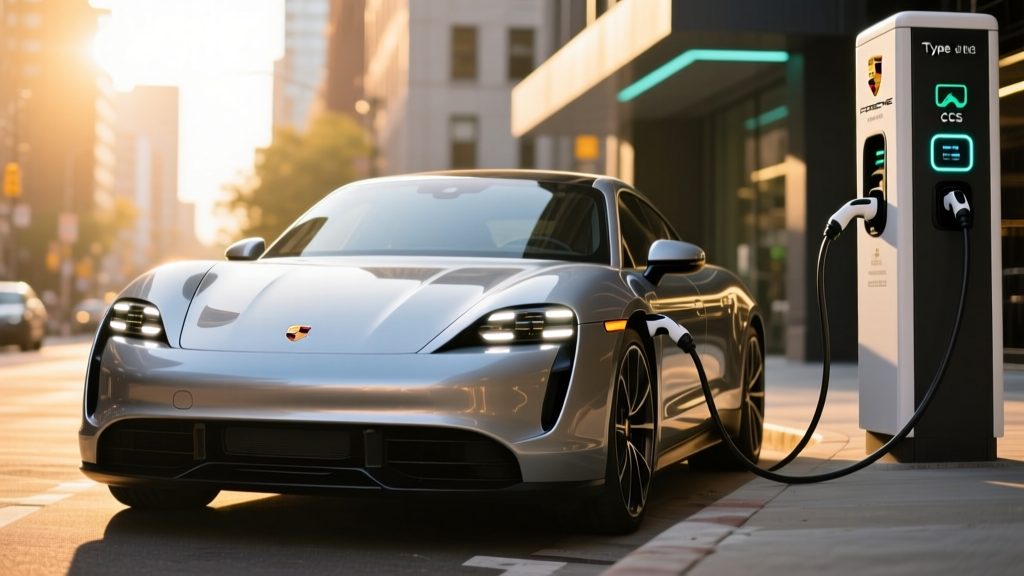
The headline upgrade for 2025 is the Taycan's new 320 kW peak DC fast-charging capability, up from 270 kW on the previous generation. Porsche achieves this through a revised thermal management system and an upgraded battery architecture that can sustain high charge rates longer into the session. On a compatible 350 kW charger (such as Electrify America's latest stalls or Ionity units in Europe), the Taycan GTS can add roughly 190 miles of range in 10 minutes under ideal conditions — specifically, when arriving at a low state of charge (5–10%) and with battery preconditioning active.
| Charging Level | Power | Time / Rate | Notes |
|---|---|---|---|
| Level 1 (120V) | ~1.4 kW | ~3–4 miles per hour | Emergency/trickle only; a full charge takes days |
| Level 2 (240V, 48A) | 11 kW (onboard max) | ~28–30 miles per hour; ~9 hrs for full charge | Requires a 60A circuit; Porsche Mobile Charger Connect or wall unit |
| DC Fast Charge (peak) | 320 kW | 10–80% in ~18 min | Requires 350 kW-capable CCS/NACS station; battery preconditioned; curve tapers significantly above 80% |
| DC Fast Charge (50 kW) | 50 kW | 10–80% in ~80 min | Typical older public charger; usable but slow for this battery size |
The critical nuance: 320 kW is a peak, not a sustained rate. The Taycan's charge curve is impressive through 55% SoC, where it can hold above 250 kW, but it tapers progressively from 60% onward. By 80%, you're typically seeing 100–120 kW. This is normal behavior for NMC cells protecting longevity, but it means charging from 80–100% on DC is painfully slow — plan to stop at 80% on road trips and move on. Porsche's navigation system will automatically precondition the battery when a DC fast charger is set as your destination, which is essential for achieving advertised charge speeds. Without preconditioning (e.g., pulling into a charger with a cold battery), expect peak rates closer to 150–200 kW.
For home Level 2 charging, the Taycan's 11 kW onboard charger is adequate for overnight replenishment. A full charge from 10% takes roughly 9 hours on a 48-amp Level 2 unit connected to a 240V/60A circuit. Most owners will plug in nightly and rarely need a full 0–100% charge, so daily top-ups take 2–4 hours depending on driving.
Connector note: Porsche has transitioned to NACS (Tesla-style) for the North American market on new 2025 models, with CCS1 adapter support for legacy networks. Confirm your specific vehicle's port configuration at delivery, as early-build 2025 models may still carry CCS1.
Performance: What the GTS Badge Actually Delivers
The GTS occupies the performance sweet spot: 590 horsepower on overboost (via Launch Control) and 524 hp in continuous driving, with 590 lb-ft of torque available instantly from the dual-motor all-wheel-drive system. The 3.3-second 0–60 mph time (sedan) puts it in supercar territory from a decade ago, yet the Taycan GTS deploys that performance with a composure that few EVs match.
What separates the Taycan from a Tesla Model S Plaid or Lucid Air Sapphire isn't straight-line speed — it's chassis communication. The GTS's standard adaptive air suspension with Porsche Active Suspension Management (PASM), rear-axle steering, and Porsche Torque Vectoring Plus give it a level of steering feel, body control, and corner-exit traction that makes it genuinely engaging on canyon roads. The two-speed transmission on the rear motor (a Taycan hallmark) provides strong initial acceleration while keeping the motor in an efficient RPM band at highway speed.
Drive mode selection (Normal, Sport, Sport Plus, Range, Individual) meaningfully alters throttle mapping, suspension damping, and steering weight. Sport Plus firms everything up and pre-conditions the battery for maximum power delivery. The regenerative braking system can recover up to 290 kW — among the highest regen rates in production — though Porsche deliberately does not offer true one-pedal driving to a complete stop, requiring a brake-pedal blend that some EV converts find unintuitive but most driving enthusiasts prefer for modulation.
Interior, Tech, and Daily Livability
The Taycan's cabin blends Porsche's traditional build quality with a screen-heavy dashboard that has drawn polarized reactions. The 12.6-inch curved digital instrument cluster, a 10.9-inch central infotainment touchscreen, and an optional 10.9-inch front-passenger display dominate the dash. Physical buttons are scarce — climate controls live on a lower 8.4-inch haptic touchscreen that can be finicky to operate while driving. The 2025 refresh updated PCM (Porsche Communication Management) with faster response times, improved voice recognition, and wireless Apple CarPlay and Android Auto.
Driver assistance includes standard adaptive cruise control, lane-keeping assist, automatic emergency braking with pedestrian detection, and surround-view cameras. Porsche's InnoDrive (predictive adaptive cruise that adjusts to curves and speed limits via navigation data) is available as part of the Premium Plus package. This is an SAE Level 2 system — the driver must remain fully engaged with hands on the wheel and eyes on the road at all times. It is not autonomous driving.
Space is the Taycan's most honest compromise. Rear legroom at 32.7 inches is tight for a $100K+ sedan; taller passengers (over 6 feet) will find the sloping roofline limiting headroom. The 14.3 cu ft trunk (sedan) and 2.9 cu ft frunk are adequate for a weekend trip for two but won't swallow a family's luggage for a week. The Sport Turismo's hatchback design and 15.7 cu ft rear cargo area (expandable with seats folded) make it meaningfully more practical, which is why many GTS buyers choose the wagon.
Pricing, Trims, and Federal Tax Credit Reality
The 2025 Taycan GTS sedan starts at $108,150 (including destination), and the GTS Sport Turismo at $111,950. Porsche's options structure can add $15,000–$25,000 quickly. A typical well-equipped GTS with the Premium Plus package, 21-inch wheels, rear-axle steering, and Porsche Electric Sport Sound lands in the $120,000–$130,000 range before any incentives.
| Item | Amount / Status |
|---|---|
| GTS Sedan Base MSRP | $108,150 |
| GTS Sport Turismo Base MSRP | $111,950 |
| Typical As-Tested Price | $120,000–$130,000 |
| §30D Federal Tax Credit | NOT eligible — MSRP exceeds $55,000 sedan cap |
| Used §30D Credit (if bought pre-owned) | Up to $4,000 or 30% of sale price (whichever is lower), subject to income caps |
| State/Local Incentives | Varies by jurisdiction; check your state's EV rebate program |
Federal tax credit reality: Under current IRS §30D rules, new clean vehicle credits are capped at sedans with an MSRP of $55,000 or less (and $80,000 for SUVs/pickups/vans). The Taycan GTS, as a sedan well above $55,000, does not qualify for the new-vehicle federal tax credit. Buyer income caps ($300,000 joint / $225,000 head of household / $150,000 individual) also apply to any vehicle that does qualify. If you purchase a qualifying pre-owned Taycan through a licensed dealer, you may be eligible for the used-EV credit of up to $4,000 — but the vehicle must have an MSRP (original) under $80,000 when new, which disqualifies most Taycan trims. Consult a tax professional for your specific situation.
Warranty and Long-Term Ownership
Porsche provides a 4-year / 50,000-mile limited vehicle warranty and an 8-year / 100,000-mile battery warranty that guarantees the high-voltage pack will retain at least 70% of its original capacity during the coverage period. This battery warranty is competitive with BMW and Audi but trails Hyundai/Kia's 10-year/100,000-mile coverage and falls short of Tesla's 8-year/120,000–150,000-mile terms depending on model.
Long-term battery degradation data on the refreshed 105 kWh pack is not yet available (the pack debuted for the 2025 model year). The previous-generation Taycan's 93.4 kWh pack showed modest degradation — typically 5–8% over 60,000 miles in owner-reported data — thanks in part to Porsche's large buffer and conservative charge management. The larger buffer on the new pack should maintain this trend. A full battery replacement out of warranty is estimated at $20,000–$30,000 based on current Porsche parts pricing, though this figure is expected to decline as cell costs fall.
Porsche includes 2 years of complimentary scheduled maintenance and 3 years of Electrify America charging (30-minute sessions, unlimited) with new Taycan purchases — a meaningful perk for road-trip-heavy owners.
Who the Taycan GTS Is For — and Who Should Look Elsewhere
Pros
- Class-leading driving dynamics: steering feel, body control, and chassis communication exceed every EV sedan rival
- 320 kW peak DC charging with strong sustained curve through 55% SoC
- 590 hp and 3.3s 0–60 with repeatable launch performance (no power fade on repeated hard pulls)
- Build quality, material selection, and cabin quietness at highway speed
- Sport Turismo wagon variant adds real cargo practicality
- Strong regenerative braking (up to 290 kW recovery) reduces brake wear
Cons
- 268-mile EPA range trails Tesla Model S (402 mi), Lucid Air (420+ mi), and even the Porsche Macan EV
- No federal tax credit eligibility due to MSRP cap
- Rear-seat space is cramped for the price class; 32.7" legroom is tight
- Lower touchscreen climate controls are distracting while driving
- No one-pedal driving to a full stop — a dealbreaker for some EV adopters
- Options quickly push price above $125K; even basic features like passenger display cost extra
Buy the Taycan GTS if: You prioritize driving engagement above all else in an EV, you want a sedan (or wagon) that communicates through the steering wheel, and your typical daily driving stays under 200 miles with reliable home charging. It's ideal for the enthusiast who takes back roads on weekends and wants a daily driver that doesn't feel like an appliance.
Look elsewhere if: Maximum range is your top priority (Lucid Air Pure or Tesla Model S), you need genuine four-adult comfort (Mercedes EQS), you want autonomous-capable highway driving tech (Tesla FSD Supervised or GM Super Cruise in the Cadillac Celestiq), or you're counting on the federal tax credit to make the numbers work.
Frequently Asked Questions
What is the real-world range of the 2025 Porsche Taycan GTS?
Expect roughly 220–245 miles on highway road trips at 70–80 mph in moderate temperatures, and 180–200 miles in sub-30°F winter conditions. City driving with frequent regenerative braking can approach or slightly exceed the 268-mile EPA estimate. The Taycan's range estimator in the instrument cluster is notably accurate — trust it over the EPA sticker for trip planning.
How fast does the Taycan GTS charge at home and on the road?
On a 350 kW-capable DC fast charger with battery preconditioning, the Taycan GTS peaks at 320 kW and reaches 10–80% in approximately 18 minutes. On a 50 kW public charger, expect 10–80% in roughly 80 minutes. At home on a Level 2 (240V, 48A) setup, the 11 kW onboard charger delivers about 28–30 miles of range per hour, fully replenishing the battery overnight in about 9 hours.
Does the 2025 Taycan GTS qualify for the federal EV tax credit?
No. Under current IRS §30D rules, new sedans must have an MSRP of $55,000 or less to qualify for the new clean vehicle credit. The Taycan GTS starts at $108,150, well above that cap. State and local incentives may still apply depending on your jurisdiction. Always verify current rules on irs.gov and consult a tax professional.
Is the Taycan GTS worth buying over the Tesla Model S or Lucid Air?
It depends on your priorities. The Taycan GTS offers the best driving dynamics and chassis engagement in the segment, with superior build quality and 320 kW charging. The Tesla Model S provides nearly double the range (402 mi EPA), access to the Supercharger network natively, and a lower starting price. The Lucid Air offers 420+ miles of range and a more spacious rear seat. If driving feel matters most, the GTS wins; if range and value lead your decision, the Model S or Air are stronger choices.
What battery chemistry does the Taycan GTS use?
The 2025 Taycan GTS uses an NMC (nickel manganese cobalt) lithium-ion battery with a 105 kWh gross / 89.0 kWh usable capacity. NMC chemistry prioritizes energy density and high charge-rate capability over the longer cycle life of LFP (lithium iron phosphate) cells. Porsche's large ~16 kWh buffer helps protect long-term battery health by avoiding extreme states of charge in daily use.
How much cargo space does the Taycan GTS have?
The GTS sedan offers 14.3 cubic feet in the rear trunk and 2.9 cubic feet in the front trunk (frunk). The GTS Sport Turismo wagon provides 15.7 cubic feet behind the rear seats (expandable with seats folded) plus the same 2.9 cu ft frunk. Neither matches a midsize SUV, but the Sport Turismo's hatchback opening makes loading bulkier items far more practical.