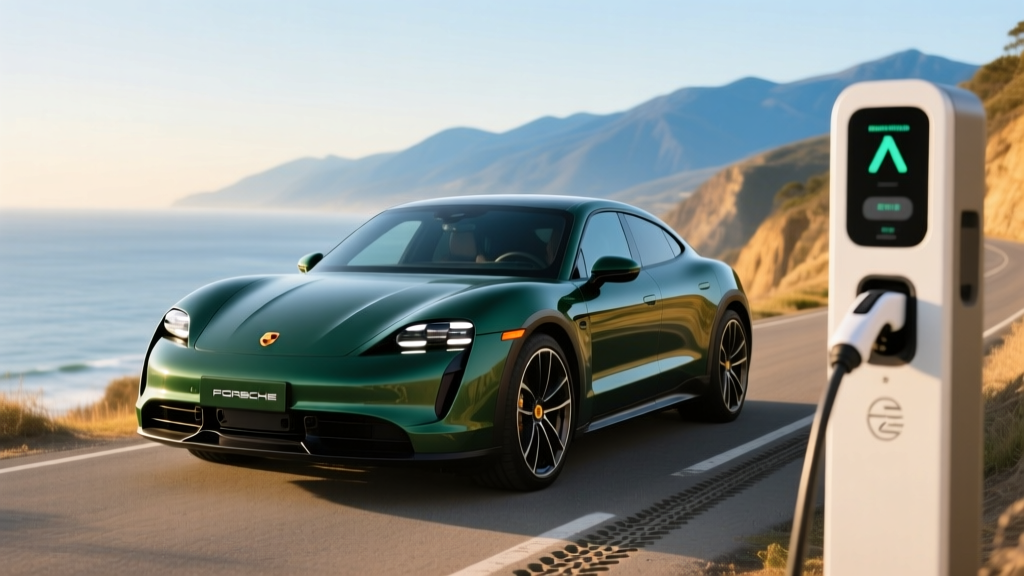
The 2025 Porsche Taycan Cross Turismo enters its first major refresh with a larger battery, faster charging, and more power across the lineup. As one of the few electric wagons on the market, it targets buyers who want sports-sedan dynamics with the cargo versatility of a raised hatchback. But with a starting price above $103,000 and a luxury EV tax credit landscape that excludes it entirely, the Cross Turismo demands a clear-eyed look at what you actually get for the money.
We've examined the EPA data, Porsche's published specs, and real-world driving variables to give you the numbers that matter — from sustained DC fast-charging rates to cold-weather range loss — so you can decide whether this electric wagon earns a spot in your garage.
Quick Verdict: Who the Taycan Cross Turismo Is For
The 2025 Taycan Cross Turismo is best suited for driving enthusiasts who need more cargo space than a sedan but refuse to step into an SUV. It excels as a two-person-plus-gear road-trip machine, a premium daily commuter with all-weather AWD confidence, and a weekend adventure hauler for skis, bikes, or dogs. It is not the right choice if you need three rows of seating, maximum cargo volume, or a sub-$70,000 price tag.
Range, Efficiency & Real-World Expectations
For 2025, Porsche equips all Taycan Cross Turismo variants with an upgraded Performance Battery Plus — a 105 kWh gross (97 kWh usable) lithium-ion pack using NMC (nickel manganese cobalt) chemistry. The larger pack translates directly to more EPA-rated range across the board.
| Trim | EPA Range | MPGe (Combined) | kWh/100 mi | Drivetrain |
|---|---|---|---|---|
| Taycan 4 Cross Turismo | 281 mi | 84 MPGe | 40 | AWD |
| Taycan 4S Cross Turismo | 272 mi | 81 MPGe | 42 | AWD |
| Taycan Turbo Cross Turismo | 265 mi | 78 MPGe | 43 | AWD |
| Taycan Turbo GT Cross Turismo | 243 mi | 71 MPGe | 47 | AWD |
Source: EPA / fueleconomy.gov
Charging Speed: 800-Volt Architecture in Practice
The Taycan Cross Turismo's standout technical advantage remains its 800-volt electrical architecture. While most competitors run 400V systems, the Taycan's higher voltage allows it to accept DC fast-charging power at rates that dramatically cut road-trip downtime.
| Charge Level | Max Power (kW) | 10–80% Time | Miles Added/Hr | Connector |
|---|---|---|---|---|
| Level 1 (120V household) | 1.3 kW | ~72 hours | ~3 mi/hr | J1772 / NACS |
| Level 2 (240V home/public) | 19.2 kW | ~5 hours | ~47 mi/hr | J1772 / NACS |
| DC Fast Charge (peak) | 320 kW | ~18 minutes | — | CCS / NACS adapter |
Understanding the Charge Curve
The 320 kW peak rate is available only when the battery is preconditioned (via the Porsche Charging Planner route navigation) and the State of Charge (SoC) is low — typically between 10% and 30%. As the battery fills, charge power tapers: expect roughly 200 kW sustained from 30–50%, dropping to around 120 kW by 70%, and falling below 50 kW past 85%. This is normal for NMC chemistry — the taper protects the cells from heat damage and lithium plating.
On a 300-mile road trip, the practical workflow is: arrive at a 350 kW charger at ~15% SoC, charge to 80% in about 18 minutes (adding roughly 200 miles), and continue. Two short stops beat one long one.
For home charging, the Taycan's onboard charger accepts up to 19.2 kW on Level 2 — that requires a hardwired wall connector on a 100-amp circuit. Most residential installations use a 60-amp circuit delivering 11.5 kW (about 28 miles of range per hour), which still replenishes a depleted battery overnight in roughly 8.5 hours. Budget $800–$2,000 for a professional Level 2 installation depending on your panel capacity and run distance — consult a licensed electrician for a site-specific quote.
Performance: Power, Acceleration & Drivetrain
Every 2025 Taycan Cross Turismo comes with dual-motor all-wheel drive as standard. The upgraded battery and revised electric motors deliver more power than the pre-refresh model, and Porsche's two-speed rear transmission (unique in the EV world) provides both explosive launch acceleration and relaxed high-speed cruising.
| Trim | Horsepower (Launch Control) | 0–60 mph | Top Speed |
|---|---|---|---|
| Taycan 4 Cross Turismo | 469 hp | 4.5 sec | 143 mph |
| Taycan 4S Cross Turismo | 590 hp | 3.7 sec | 155 mph |
| Taycan Turbo Cross Turismo | 871 hp | 2.6 sec | 162 mph |
| Taycan Turbo GT Cross Turismo | 1,019 hp | 2.3 sec | 180 mph |
The Turbo GT's 1,019 hp figure (with Launch Control engaged) places it among the most powerful production vehicles ever sold. But even the base Taycan 4's 4.5-second 0–60 time is quick enough for any real-world merge or passing scenario. Where the Taycan Cross Turismo separates itself from rivals is handling: adaptive air suspension, rear-axle steering (optional on 4S, standard on Turbo trims), and a low center of gravity give it cornering composure that no electric SUV can match.
The Cross Turismo also has a slightly raised ride height compared to the Taycan sedan — about 0.8 inches more ground clearance — and includes a Gravel drive mode for unpaved roads. It's not an off-roader, but it handles forest service roads and snowy driveways without drama.
Interior, Cargo & Technology
Cargo & Passenger Space
The Cross Turismo's wagon body style pays dividends in cargo capacity. Behind the rear seats, you get 15.7 cubic feet of storage — roughly double the Taycan sedan's trunk. Fold the rear seats flat and capacity expands to 42.8 cubic feet, enough for a full set of golf bags, two large suitcases, or a week's worth of camping gear for two.
The front trunk (frunk) adds 2.9 cubic feet — useful for charging cables and a small duffel. Rear-seat legroom measures 32.7 inches, which is adequate for adults on shorter trips but tight for anyone over six feet on long hauls. Headroom benefits from the Cross Turismo's raised roofline versus the sedan.
Infotainment & Driver Assists
The 2025 Taycan runs Porsche Communication Management (PCM) on a 10.9-inch central touchscreen, supplemented by an 8.4-inch haptic lower panel for climate and handwriting input. A curved 12.6-inch digital instrument cluster faces the driver, and an optional 10.9-inch passenger display prevents distraction for the person behind the wheel.
Wireless Apple CarPlay and Android Auto are standard. Navigation includes the Porsche Charging Planner, which automatically precondition the battery when a DC fast charger is set as your destination — critical for achieving those peak 320 kW charge rates.
Driver-assistance technology includes:
- Adaptive cruise control with stop-and-go
- Lane-keeping assist with active steering
- Surround-view camera with 3D rendering
- Night vision assist with pedestrian detection (optional)
- Porsche InnoDrive — predictive cruise that uses navigation data and traffic-sign recognition to adjust speed proactively (optional)
Notable Drawbacks
The Taycan Cross Turismo's dual-screen climate control setup draws criticism: the lower haptic panel lacks physical buttons, making temperature adjustments less intuitive while driving. Rear visibility is compromised by the sloping roofline and thick C-pillars — the surround-view camera is nearly essential for parking. And while the infotainment system is responsive, Porsche's menu nesting requires more taps than rival systems for common functions like seat heating or drive-mode changes.
Pricing, Trims & Federal Tax Credit Eligibility
| Trim | Base MSRP | Typical As-Tested | §30D Federal Credit |
|---|---|---|---|
| Taycan 4 Cross Turismo | $103,300 | $115,000–$125,000 | Not eligible |
| Taycan 4S Cross Turismo | $127,100 | $140,000–$155,000 | Not eligible |
| Taycan Turbo Cross Turismo | $177,900 | $190,000–$210,000 | Not eligible |
| Taycan Turbo GT Cross Turismo | $232,400 | $245,000+ | Not eligible |
MSRP includes destination charge. As-tested prices reflect common option packages (Premium, Sport Chrono, rear-axle steering). Source: Porsche USA.
Why the Taycan Cross Turismo Does Not Qualify for the Federal EV Tax Credit
Under IRS §30D Clean Vehicle Credit rules, the Taycan Cross Turismo fails the MSRP cap: the federal credit is limited to new vans, SUVs, and pickup trucks priced at or below $80,000, and to sedans and "other" vehicles (including wagons) priced at or below $55,000. Since the Taycan Cross Turismo starts at $103,300 — and is classified as a wagon/other vehicle — it exceeds the cap on every trim.
Additionally, the Taycan is manufactured in Leipzig, Germany. The §30D credit requires final assembly in North America, which the Taycan does not satisfy. Even if pricing were within limits, the assembly-location requirement alone would disqualify it.
- MSRP cap (wagons/other): $55,000 — Taycan 4 CT starts at $103,300 ❌
- Final assembly: Must be North America — Taycan built in Germany ❌
- Buyer income cap: $150K single / $300K joint — varies by buyer
- Battery sourcing & critical minerals: Moot — fails on MSRP and assembly
If you're counting on a federal incentive to offset the purchase price, the Taycan Cross Turismo will not provide one. Some states offer their own rebates or tax credits that are not bound by federal sourcing rules — check your state's energy or DMV website for current programs, and consult a tax professional for eligibility specifics.
Warranty & Long-Term Ownership
Porsche backs the 2025 Taycan Cross Turismo with the following warranty coverage:
- New-vehicle limited warranty: 4 years / 50,000 miles
- Battery & powertrain warranty: 8 years / 100,000 miles (whichever comes first)
- Battery capacity guarantee: Porsche warrants that the high-voltage battery will retain at least 70% of its original usable capacity for 8 years or 100,000 miles
- Corrosion protection: 12 years, unlimited miles
- Roadside assistance: 4 years / 50,000 miles
The 70% capacity retention threshold is standard among European automakers and slightly below the 8-year/100,000-mile federal minimum mandated by the EPA for emissions-related components on PHEVs, though BEV battery warranties are not federally mandated at a specific retention level. In practice, NMC batteries in the Taycan's thermal management system (liquid-cooled with active heating) have shown modest degradation in early fleet data — expect roughly 5–8% capacity loss over the first 100,000 miles under normal use.
For long-term ownership cost context: a Taycan battery replacement is not a consumer-serviceable item, and out-of-warranty replacement costs are estimated at $25,000–$35,000 based on current Porsche parts pricing. However, individual module replacement (if only a subset of cells degrades) may be available at lower cost through authorized Porsche service centers.
Taycan Cross Turismo vs. the Competition
The Cross Turismo occupies a niche with almost no direct rivals. Here's how it stacks up against the closest alternatives:
| Spec | Porsche Taycan 4 CT | Audi A6 Avant e-tron | Tesla Model S |
|---|---|---|---|
| EPA Range | 281 mi | ~300 mi (est.) | 402 mi |
| Peak DC Charge | 320 kW | 270 kW | 250 kW |
| 0–60 mph | 4.5 sec | ~5.0 sec | 3.1 sec |
| Cargo (rear seats up) | 15.7 cu ft | ~18 cu ft (est.) | 28 cu ft (hatchback) |
| Starting MSRP | $103,300 | ~$75,000 (est.) | $79,990 |
| Federal Tax Credit | No | TBD (not on sale) | No (exceeds MSRP cap) |
The Audi A6 Avant e-tron is the closest conceptual rival — a premium electric wagon on the same VW Group PPE platform. It promises more cargo space and a lower starting price, but U.S. availability remains limited as of early 2026, and it lacks the Taycan's proven 800V charging speed and driving dynamics.
The Tesla Model S offers vastly more range and a lower price, but it's a liftback sedan rather than a wagon, with a notably sparser interior and no pretense of luxury craftsmanship. It's a technology benchmark, not a driver's car.
Choose the Taycan Cross Turismo if: You prioritize handling, build quality, and ultra-fast charging over maximum range, and you can absorb the six-figure price without a federal credit.
Choose the Model S if: Range is your top priority, you want over-the-air software updates and Supercharger network access, and you don't need wagon cargo height.
Wait for the A6 Avant e-tron if: You want a premium electric wagon at a lower price point and can tolerate first-year availability uncertainty.
Pros & Cons at a Glance
✓ Pros
- Class-leading 320 kW DC fast-charging — 10–80% in ~18 min
- Exceptional handling and ride quality; adaptive air suspension standard
- 800V architecture with consistent charge-curve performance
- Wagon cargo versatility (15.7 / 42.8 cu ft) with premium build
- Up to 1,019 hp in Turbo GT trim — supercar acceleration
- Standard AWD with Gravel mode for light unpaved use
- Heat pump standard for improved cold-weather efficiency
✗ Cons
- No federal §30D tax credit (MSRP cap + non-NA assembly)
- Moderate EPA range (281 mi max) vs. Tesla Model S (402 mi)
- Starting price above $103K; options push well past $130K
- Touchscreen-only climate controls — no physical buttons
- Rear-seat legroom tight for tall passengers (32.7 in)
- No hands-free Level 2+ highway driving system
- Insurance premiums significantly above segment average
Frequently Asked Questions
What is the real-world range of the 2025 Taycan Cross Turismo?
The EPA rates the Taycan 4 Cross Turismo at 281 miles. In real-world highway driving at 70–75 mph, expect 240–255 miles. In freezing temperatures, that drops to roughly 190–220 miles. The Taycan's exceptional charging speed partially compensates — you'll spend less time at DC fast chargers than most rivals with larger batteries but slower charge rates.
How fast does the Taycan Cross Turismo charge at home and on the road?
On DC fast chargers, it peaks at 320 kW and charges from 10–80% in approximately 18 minutes (with battery preconditioning). At home on a Level 2 charger, the onboard charger accepts up to 19.2 kW, adding roughly 47 miles of range per hour. A typical 60-amp home installation delivers 11.5 kW (~28 mi/hr), fully recharging the battery in about 8.5 hours.
Does the 2025 Taycan Cross Turismo qualify for the federal EV tax credit?
No. The Taycan Cross Turismo does not qualify for the IRS §30D Clean Vehicle Credit for two reasons: (1) it exceeds the $55,000 MSRP cap for wagons/other vehicles on every trim, and (2) it is assembled in Leipzig, Germany, not in North America. Some state-level incentives may still apply — check your local program rules.
Is the Taycan Cross Turismo worth buying over the Taycan sedan?
If cargo versatility matters to you, yes. The Cross Turismo offers nearly double the rear cargo volume (15.7 vs. ~8.5 cu ft), a slightly raised ride height for rough roads, and the Gravel drive mode. You sacrifice roughly 10–15 miles of EPA range versus the equivalent sedan trim due to the larger body and increased weight. If you never need the extra space, the sedan is the more efficient choice.
What's the biggest competitor to the Taycan Cross Turismo?
The closest rival is the Audi A6 Avant e-tron, which shares the same PPE platform but targets a lower price point and more cargo room. The Tesla Model S offers far more range at a lower price but lacks the Porsche's build quality and driving dynamics. For buyers cross-shopping luxury electric SUVs, the BMW iX and Mercedes EQE SUV offer more interior space but sacrifice the wagon's lower center of gravity and handling advantage.
How long will the Taycan's battery last?
Porsche warrants the high-voltage battery for 8 years or 100,000 miles, guaranteeing at least 70% of original capacity retention. Real-world data from early Taycan owners suggests NMC degradation of roughly 5–8% over the first 100,000 miles when using a mix of Level 2 and occasional DC fast charging. Avoid routinely charging to 100% or leaving the car at very low SoC for extended periods to maximize longevity. Out-of-warranty battery replacement is estimated at $25,000–$35,000.