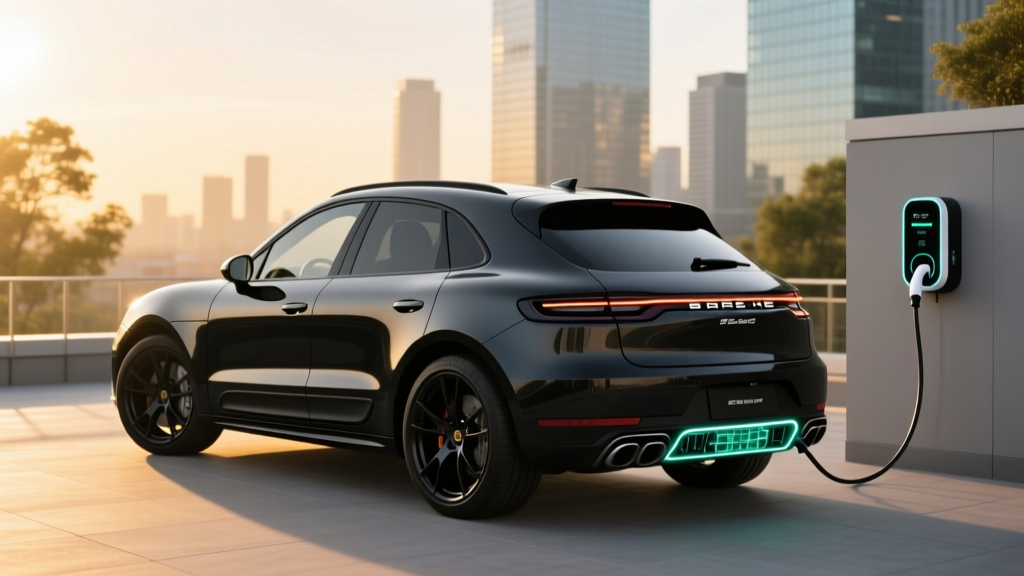
The Porsche Macan was already a benchmark compact luxury SUV. For 2025, Porsche has fully electrified it on the Premium Platform Electric (PPE) architecture co-developed with Audi. The result is a vehicle that preserves the brand's dynamic DNA while entering the premium EV SUV segment head-on. But does the 2025 Porsche Macan Electric justify its premium pricing against rivals like the Tesla Model Y Performance, BMW iX, and Genesis Electrified GV70? This review breaks down every number that matters — from real-world range to charging-curve behavior — so you can decide with data, not marketing.
Quick Verdict: The Driver's EV SUV
The Macan Electric is the best-handling vehicle in its class, bar none. Its 800-volt architecture delivers class-leading DC fast-charging speeds, and the dual-motor all-wheel-drive powertrain offers up to 630 horsepower in the Turbo trim. The trade-offs are a premium price that pushes well past $80,000, a smaller cargo area than some competitors, and federal tax credit eligibility that remains uncertain due to battery-sourcing rules. If driving dynamics and charging speed are your top priorities in a luxury electric SUV, the Macan Electric has no equal. If value and interior space rank higher, alternatives deserve a close look.
Range, Battery, and Efficiency
The 2025 Macan Electric uses a lithium-ion NMC (nickel-manganese-cobalt) battery pack with a gross capacity of 100 kWh and approximately 95 kWh usable. Porsche's 800V architecture enables not only fast charging but also efficient energy delivery to the motors.
| Specification | Macan 4 Electric | Macan Turbo Electric |
|---|---|---|
| Battery (gross / usable) | 100 kWh / ~95 kWh | 100 kWh / ~95 kWh |
| Chemistry | NMC | NMC |
| EPA Est. Range | 308 miles | 288 miles |
| MPGe (combined) | ~95 MPGe | ~87 MPGe |
| Efficiency (kWh/100 mi) | ~35 kWh/100 mi | ~39 kWh/100 mi |
| Drivetrain | Dual-motor AWD | Dual-motor AWD |
| Horsepower (Launch Control) | 402 hp | 630 hp |
| 0–60 mph | 4.9 seconds | 3.1 seconds |
| Top Speed | 136 mph | 161 mph |
The EPA rates the Macan 4 Electric at 308 miles and the Turbo at 288 miles. In real-world highway driving at 70–75 mph, expect approximately 250–270 miles from the Macan 4 and 230–250 miles from the Turbo. In cold weather (below 32°F), range can drop an additional 15–25%, bringing the Turbo down to roughly 200–220 miles on a full charge. The Macan 4's efficiency advantage comes from its less aggressive power delivery and standard wheel/tire package. Porsche's heat pump, standard on all trims, mitigates some cold-weather losses by efficiently warming the cabin without drawing heavily from the traction battery.
Charging: 800V Architecture in Practice
The Macan Electric's 800-volt electrical architecture is its most practical advantage for road-trip charging. This system enables peak DC fast-charge rates up to 270 kW at compatible chargers — among the fastest in any production SUV sold in the U.S.
| Charging Level | Power / Rate | Time / Miles Added |
|---|---|---|
| Level 1 (120V household) | ~1.4 kW | ~4–5 miles per hour |
| Level 2 (240V home, 11.5 kW onboard) | Up to 11.5 kW | ~33–37 miles per hour; full charge in ~9 hours |
| DC Fast Charge (peak) | Up to 270 kW | 10–80% in approximately 21 minutes |
| DC Fast Charge (50 kW station) | 50 kW | ~140 miles per hour; 10–80% in ~80 minutes |
Charging-curve reality: The 270 kW peak is not sustained across the entire session. Like all EVs, the Macan's charge rate tapers as the battery fills. You'll see peak rates between roughly 10–40% state of charge. From 40–60%, expect sustained rates around 175–200 kW. Above 80%, charging slows significantly to protect battery health — a 80–100% top-off can add another 25–30 minutes. For road trips, the 10–80% sprint is the number that matters, and 21 minutes is genuinely competitive. At home on a Level 2 charger, plan for an overnight charge: 9 hours from empty is practical for most owners who plug in nightly and rarely deplete the pack fully.
The Macan Electric ships with a NACS (North American Charging Standard) port, giving native access to Tesla Superchargers via adapter-free compatibility as the industry converges on the NACS standard. A CCS adapter is available for legacy Electrify America and other CCS-equipped stations during the transition period.
Performance and Driving Dynamics
This is where Porsche earns its premium. The Macan Electric uses a dual-motor setup with a permanently excited synchronous motor on the rear axle and an asynchronous motor on the front. The rear-biased torque distribution and available rear-axle steering (optional on Macan 4, standard on Turbo) give it a agility that defies its ~5,300-pound curb weight.
The Macan 4's 402 hp and 4.9-second 0–60 time are brisk but not exotic. The Turbo's 630 hp and 3.1-second sprint are supercar territory. Both trims feature Porsche's adaptive air suspension with Porsche Active Suspension Management (PASM), which adjusts damping in real time. The result: compliant ride quality in Normal mode, flat cornering in Sport. The steering is communicative by EV standards, and regenerative braking offers up to 290 kW of recuperation — enough for true one-pedal driving in most scenarios, though Porsche stops short of a full stop-hold without touching the brake pedal.
Towing capacity is rated at 4,409 pounds (braked), adequate for a small trailer or a pair of personal watercraft but below what a full-size electric truck or SUV can handle.
Interior, Tech, and Cargo
Porsche's new PCM (Porsche Communication Management) infotainment system runs on a 12.6-inch curved digital instrument cluster and a 10.9-inch central touchscreen. An optional 10.9-inch passenger display lets the front-seat rider control media and navigation without distracting the driver. The system supports wireless Apple CarPlay and Android Auto, over-the-air updates, and a new voice assistant with natural-language recognition.
The available head-up display with augmented-reality navigation overlays directional arrows onto the road view — genuinely useful at highway interchanges.
Driver assistance includes adaptive cruise control with stop-and-go, lane-keeping assist, intersection assist, and Porsche's InnoDrive predictive cruise, which uses navigation and traffic-sign data to adjust speed proactively. This is a SAE Level 2 system — the driver must remain attentive with hands on or near the wheel at all times. It is not a self-driving system.
| Dimension | Measurement |
|---|---|
| Cargo (behind rear seats) | 18.0 cu ft |
| Cargo (rear seats folded) | 46.5 cu ft |
| Front trunk (frunk) | 2.9 cu ft |
| Front headroom | 40.1 in |
| Rear headroom | 38.7 in |
| Front legroom | 41.3 in |
| Rear legroom | 35.0 in |
The cargo area is the Macan Electric's most obvious compromise. At 18.0 cubic feet behind the rear seats, it trails the Tesla Model Y (30.2 cu ft) and the BMW iX (35.5 cu ft) substantially. The frunk is modest at 2.9 cu ft — enough for a charging cable bag, not a suitcase. Rear legroom is adequate for adults but tighter than the iX or Model Y. If you regularly haul four adults with luggage, the Macan Electric demands compromise.
Pricing, Trims, and Federal Tax Credit Eligibility
The 2025 Macan Electric is offered in two trims. Pricing reflects Porsche's positioning as a premium performance brand:
| Trim | Base MSRP | Typical As-Tested | Federal Tax Credit (§30D) |
|---|---|---|---|
| Macan 4 Electric | $78,800 | $85,000–$95,000 | See eligibility notes below |
| Macan Turbo Electric | $106,900 | $115,000–$130,000 | Ineligible (MSRP cap) |
Federal tax credit eligibility is limited. Under IRS §30D rules, the Macan Turbo Electric exceeds the $80,000 MSRP cap for SUVs and is categorically ineligible for the up-to-$7,500 federal credit regardless of buyer income or battery sourcing. The Macan 4 Electric, with a base MSRP of $78,800, falls under the cap — but eligibility still depends on:
- Battery component sourcing: A percentage of battery components must be manufactured or assembled in North America. Porsche's PPE battery supply chain is primarily European, and as of the current model year, the Macan 4 Electric does not appear to meet the full $7,500 threshold. It may qualify for the $3,750 partial credit if critical-mineral requirements are met but battery-component requirements are not — verify on the IRS qualified vehicles list before purchasing.
- Buyer income caps: Adjusted gross income must not exceed $300,000 (married filing jointly), $225,000 (head of household), or $150,000 (single).
- Point-of-sale transfer: If eligible, the credit can be transferred to the dealer at purchase, reducing your out-of-pocket cost immediately rather than waiting for a tax return.
State and local incentives vary. California's CVRP, Colorado's innovative motor vehicle credit, and other state programs may stack with or substitute for the federal credit. Check your state's energy office for current programs.
Warranty and Ownership Costs
Porsche provides a competitive warranty package for the Macan Electric:
- New vehicle limited warranty: 4 years / 50,000 miles
- Battery and electric powertrain: 8 years / 100,000 miles (with a capacity-retention threshold of 70%)
- Corrosion perforation: 12 years, unlimited miles
- Roadside assistance: 4 years / 50,000 miles
The 70% capacity-retention threshold is industry-standard — if the battery drops below 70% of original capacity within 8 years or 100,000 miles, Porsche will repair or replace it under warranty. NMC chemistry in an 800V system with active thermal management should deliver strong longevity; most modern NMC packs lose 10–15% capacity over 150,000 miles of normal use.
Insurance costs are a factor: expect premiums 15–25% higher than a comparably priced gas Macan, driven by higher repair costs for EV-specific components and the vehicle's performance profile. Get quotes before committing.
Pros, Cons, and Who Should Buy
- Best-in-class handling and steering feel
- 270 kW peak DC fast-charging (10–80% in ~21 min)
- 800V architecture for sustained charging efficiency
- Macan Turbo's 3.1-second 0–60 is supercar-quick
- High-quality interior with excellent fit and finish
- Standard heat pump for cold-climate efficiency
- NACS charging port for broad network access
- High price — Macan 4 starts near $79K, Turbo over $106K
- Turbo trim ineligible for federal tax credit (MSRP cap)
- Cargo space (18 cu ft) trails Model Y, iX, and GV70
- Rear legroom tight for taller passengers
- Limited federal tax credit even on Macan 4 due to battery sourcing
- Small frunk (2.9 cu ft) limits front storage
- Insurance premiums higher than gas equivalents
Who this EV suits best: The Macan Electric is ideal for the enthusiast driver who wants an EV daily-driver that rewards on back roads and charges quickly on road trips. It fits a couple or small family (1–2 children) who don't need maximum cargo space. It's less suited for buyers who prioritize interior volume, budget-friendliness, or guaranteed tax-credit eligibility.
Key competitors: The Tesla Model Y Performance ($52,490) offers more range, more cargo room, and full Supercharger access at roughly $30K less — but can't match Porsche's build quality or ride refinement. The BMW iX xDrive50 ($87,250) offers a more spacious cabin and similar luxury, though its charging speed tops out around 195 kW. The Genesis Electrified GV70 ($66,450) is a value play with strong luxury credentials but slower charging and less range.
Frequently Asked Questions
What is the real-world range of the 2025 Porsche Macan Electric?
The EPA rates the Macan 4 at 308 miles and the Turbo at 288 miles. Expect 250–270 real-world highway miles for the Macan 4 and 230–250 for the Turbo in moderate temperatures. Cold weather (below freezing) can reduce range by 15–25%, and sustained high-speed driving above 75 mph will push consumption higher than the EPA cycle suggests.
How fast does the Macan Electric charge at home and on the road?
On a Level 2 home charger (240V, 48A), the Macan charges at up to 11.5 kW, adding roughly 33–37 miles per hour and reaching a full charge in about 9 hours. On a DC fast charger capable of 270 kW, the 10–80% charge takes approximately 21 minutes. At older 50 kW stations, plan for about 80 minutes for the same 10–80% session.
Does the 2025 Macan Electric qualify for the $7,500 federal EV tax credit?
The Macan Turbo Electric is ineligible due to its MSRP exceeding the $80,000 SUV cap. The Macan 4 Electric's base MSRP of $78,800 clears the cap, but full $7,500 credit eligibility depends on battery-component and critical-mineral sourcing requirements under IRS §30D rules. As of the current model year, Porsche's European battery supply chain likely limits the credit to a partial $3,750 or eliminates it entirely. Verify on the IRS qualified vehicles list before purchasing, and consult a tax professional for your specific situation.
Is the Porsche Macan Electric worth buying over a Tesla Model Y or BMW iX?
If driving dynamics, build quality, and charging speed are your top priorities and budget allows, the Macan Electric is worth the premium. If interior space, value, and maximum range matter more, the Model Y or iX are more practical choices. The Macan Electric doesn't compete on price — it competes on the quality of the driving experience, which is difficult to quantify in a spec sheet.
What charging connector does the Macan Electric use?
The 2025 Macan Electric is equipped with a NACS (North American Charging Standard) port, providing native access to Tesla Superchargers. A CCS1 adapter is available for use with Electrify America and other CCS networks during the industry-wide transition to NACS.
How long will the Macan Electric battery last?
Porsche warranties the battery for 8 years or 100,000 miles against capacity loss below 70%. NMC chemistry with the Macan's active liquid thermal management system should deliver 10–15% degradation over 150,000 miles under normal use. Avoiding frequent DC fast-charging to 100% and routine charging to 80% for daily use will help maximize long-term battery health.