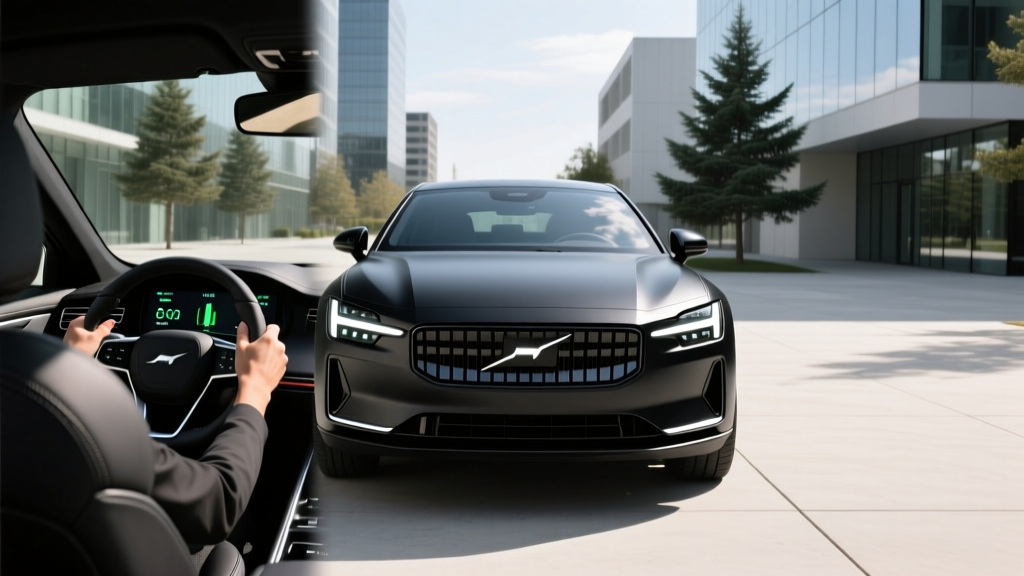
If you've been searching for 2025 Polestar 3 images, you've likely noticed Volvo's electrified offshoot has crafted something visually arresting. But beyond the Scandinavian surfacing and pixel-perfect press photos lies a serious luxury electric SUV that competes directly with the BMW iX, Audi Q8 e-tron, and Tesla Model X. We've compiled the full technical profile — from EPA range to real-world charging behavior — so you can look past the gallery and understand exactly what this EV delivers on the road.
The Polestar 3 launches in the U.S. as a premium dual-motor, all-wheel-drive crossover built on the same SPA2 platform as the Volvo EX90. It targets buyers who want design-forward luxury, credible long-distance range, and fast DC charging without the ubiquity of a Tesla badge. Here's every number that matters.
2025 Polestar 3 at a Glance: Key Specifications
| Specification | Long Range Dual Motor | Long Range Dual Motor w/ Performance Pack |
|---|---|---|
| EPA Estimated Range | ~315 miles | ~279 miles (est. w/ 22" wheels) |
| Battery (Usable) | 107 kWh (NMC) | 107 kWh (NMC) |
| Horsepower | 489 hp / 620 lb-ft | 517 hp / 671 lb-ft |
| 0–60 mph | 4.8 seconds | 4.5 seconds |
| Drivetrain | Dual-Motor AWD | Dual-Motor AWD |
| Max DC Fast Charge | 200 kW (peak) | 200 kW (peak) |
| 10–80% DC Time | ~30 minutes | ~30 minutes |
| Level 2 Home Charging | 11 kW (~37 mi/hr) | 11 kW (~37 mi/hr) |
| Efficiency (Combined) | ~80 MPGe | ~72 MPGe (est.) |
| Cargo Volume (rear seats up) | ~17.1 cu ft | ~17.1 cu ft |
| Cargo Volume (rear seats folded) | ~50 cu ft | ~50 cu ft |
| Base MSRP | $79,900 | $84,900 |
| Battery/Powertrain Warranty | 8 years / 100,000 miles | 8 years / 100,000 miles |
Real-World Range: Beyond the EPA Sticker
EPA Estimate: ~315 miles (Long Range Dual Motor, standard 21" wheels)
Real-World Highway (70 mph, mild weather): Expect ~255–275 miles
Real-World Cold Weather (below 30°F): Expect ~220–250 miles
Combined Mixed Driving: ~270–290 miles typical
The Polestar 3's 107 kWh usable battery pack (111 kWh gross) is one of the largest in the luxury SUV segment. That NMC (nickel manganese cobalt) chemistry prioritizes energy density over the LFP approach used in some lower-cost EVs, giving the Polestar 3 its strong EPA figure.
However, as with any large, heavy AWD crossover, real-world highway efficiency takes a hit. Aerodynamic drag at sustained 70–80 mph speeds pushes consumption to roughly 38–42 kWh/100 mi, translating to a practical highway range closer to 255–275 miles in mild conditions. In freezing temperatures, the battery's thermal management system draws additional energy for cabin and pack heating — even with a heat pump equipped — reducing effective range by 15–25%. If your daily routine is primarily city and suburban driving with frequent regenerative braking opportunities, you'll see numbers much closer to the EPA sticker.
According to fueleconomy.gov, the combined MPGe rating places the Polestar 3 in the middle of the luxury EV SUV pack — behind the more efficiency-focused BMW iX xDrive50 but ahead of the heavier, more powerful Audi SQ8 e-tron.
Charging Speed: DC Fast Charging and Home Setup
Charging infrastructure compatibility is where the Polestar 3 makes a smart long-term play. It ships with a native NACS (North American Charging Standard) port in the U.S. market, meaning direct access to Tesla's Supercharger network — currently the most reliable and expansive DC fast-charging system in North America. No adapter required.
| Charging Level | Power | Speed (Miles Added per Hour) | Notes |
|---|---|---|---|
| Level 1 (120V household) | ~1.4 kW | ~4–5 mi/hr | Emergency/trickle only |
| Level 2 (240V home) | 11 kW | ~37 mi/hr | Full charge in ~10 hours |
| DC Fast Charge (peak) | 200 kW | ~550+ mi/hr (at peak) | 10–80% in ~30 min |
| DC Fast Charge (avg 10–80%) | ~140 kW sustained | — | Charge curve tapers above 60% |
The 200 kW peak DC rate is competitive but not class-leading — the Hyundai Ioniq 5 and Kia EV9 can peak at 236–240 kW, and the Lucid Gravity exceeds 300 kW. In practice, the Polestar 3's charge curve holds strong through the 20–50% state of charge window before progressively tapering. Expect the 10–80% session to take roughly 30 minutes at a capable 250+ kW Supercharger or Electrify America station.
Preconditioning tip: The Polestar 3's navigation-based battery preconditioning warms the pack when a DC fast charger is set as your destination. Always use this feature in cold weather — skipping it can add 10–15 minutes to your charging session by limiting the initial charge rate to under 80 kW until the pack warms organically.
For home charging, the 11 kW onboard charger means you'll need a 48-amp (hardwired) or 40-amp (NEMA 14-50) Level 2 circuit to maximize speed. At 11 kW, a depleted 107 kWh pack reaches full in roughly 10 hours — ideal for overnight replenishment. Most owners will rarely arrive home below 30% SoC, making a typical overnight session 6–7 hours.
Performance, Drivetrain, and Driving Dynamics
Both Polestar 3 trims use a dual-motor AWD layout with a permanent magnet synchronous motor on each axle. The standard Long Range Dual Motor produces 489 hp and 620 lb-ft of torque, launching to 60 mph in 4.8 seconds. The optional Performance Pack bumps output to 517 hp and 671 lb-ft, dropping the 0–60 time to 4.5 seconds.
Neither figure is exotic by performance-SUV standards — the Tesla Model X Plaid demolishes that benchmark in under 2.5 seconds — but Polestar's engineering priority is clearly refinement over raw acceleration. The torque-vectoring rear motor can disconnect via a clutch for highway efficiency, effectively operating as a front-wheel-drive vehicle during steady-state cruising to conserve energy.
The standard air suspension (with adaptive dampers) delivers a composed ride quality that absorbs road imperfections effectively. Steering feel is precise if slightly light, and the low center of gravity from the floor-mounted battery pack keeps body roll well-controlled through corners. This is a grand-touring SUV, not a track weapon, and that calibration suits the luxury-EV buyer well.
Regen braking offers adjustable levels through the infotainment system but doesn't quite achieve true one-pedal driving at its strongest setting — you'll still need the friction brakes for final stops, which some competitors (like the BMW iX) manage more seamlessly.
Interior, Technology, and Cargo Space
The Polestar 3 cabin leans heavily into Scandinavian minimalism. A 14.5-inch center touchscreen running a Google Automotive-based infotainment system anchors the dashboard, with Google Maps navigation, Google Assistant voice control, and Play Store app access built natively into the vehicle. A 9-inch driver display sits behind the steering wheel, and an available head-up display projects speed and navigation prompts onto the windshield.
Standout tech features:
- Google Automotive OS with native Google Maps and EV-aware route planning
- LiDAR sensor (from Luminar) integrated into the roofline — enables future over-the-air ADAS upgrades
- Pilot Assist (SAE Level 2) adaptive cruise + lane centering
- 360-degree camera system with see-through hood view
- Over-the-air (OTA) software updates for powertrain, infotainment, and safety systems
- Bowers & Wilkins premium audio (available)
- Phone-as-key via Bluetooth Low Energy
The Polestar 3's Pilot Assist is an SAE Level 2 driver-assistance system. It provides combined steering and speed control on highways, but the driver must remain fully engaged, hands on or near the wheel, and eyes on the road at all times. It is not a self-driving system. Only Level 4 robotaxi services (e.g., Waymo) operate without a human driver.
Cargo and passenger space: With rear seats upright, the Polestar 3 offers approximately 17.1 cu ft of cargo space — adequate for weekly groceries or a couple of large suitcases but notably less than the BMW iX (~35.5 cu ft) or Tesla Model X (~37.1 cu ft). Folding the rear seats opens up roughly 50 cu ft. A small front trunk (frunk) adds about 1.1 cu ft for charging cables or a small bag. Rear legroom is generous at approximately 41 inches, comfortably accommodating adults on longer trips.
Notable drawbacks: The cargo area is the Polestar 3's most obvious competitive weakness. The sloping roofline prioritizes aesthetics over utility, and the smaller frunk limits cable storage. Additionally, the Google Automotive system, while feature-rich, requires a data connection for full functionality, and some owners report occasional lag when cold-booting. Touch-sensitive climate controls on the screen may frustrate drivers who prefer physical buttons.
Pricing, Trims, and Federal Tax Credit Eligibility
The 2025 Polestar 3 starts at $79,900 for the Long Range Dual Motor, with the Performance Pack variant at $84,900. With options (premium paint, 22-inch wheels, Bowers & Wilkins audio, Pilot Pack with enhanced ADAS), a well-equipped example can push past $90,000 before destination fees.
- MSRP Cap: SUVs must be priced at or below $80,000 to qualify. The base Polestar 3 LRDM ($79,900) meets this threshold; the Performance Pack ($84,900) does NOT.
- Buyer Income Cap: AGI must not exceed $150,000 (single), $225,000 (head of household), or $300,000 (married filing jointly).
- Battery Sourcing: The credit is split into two $3,750 halves — one for critical minerals sourcing and one for battery component manufacturing. Polestar's supply chain is evolving; verify current-year sourcing compliance on IRS.gov's qualified vehicle list.
- Point-of-Sale Transfer: Eligible buyers can transfer the credit to the dealer at purchase for an immediate price reduction rather than waiting for a tax refund.
- Lease Loophole: If the vehicle is leased (commercial entity ownership), the $7,500 commercial credit (§45W) may apply regardless of MSRP caps or buyer income — consult your tax professional.
Based on current rules, a qualifying buyer purchasing the base Long Range Dual Motor at $79,900 could potentially reduce the effective price to approximately $72,400 with the full $7,500 credit — assuming both battery-sourcing requirements are met and income limits are satisfied. The Performance Pack trim exceeds the MSRP cap for purchase credit eligibility, though leasing may preserve access to incentives through the commercial credit pathway.
Always verify eligibility before purchase. The IRS qualified vehicle list updates periodically, and battery sourcing compliance can shift model year to model year. A direct check on IRS.gov is essential.
How the Polestar 3 Stacks Up Against Key Competitors
| Spec | Polestar 3 LRDM | BMW iX xDrive50 | Audi Q8 e-tron | Tesla Model X LR |
|---|---|---|---|---|
| EPA Range | ~315 mi | ~324 mi | ~285 mi | ~335 mi |
| Battery (kWh usable) | 107 (NMC) | 105.2 (NMC) | 106 (NMC) | ~100 (NMC) |
| Peak DC Charge | 200 kW | 195 kW | 170 kW | 250 kW |
| 0–60 mph | 4.8 sec | 4.4 sec | 5.1 sec | 3.8 sec |
| Cargo (seats up) | 17.1 cu ft | 35.5 cu ft | 28.5 cu ft | 37.1 cu ft |
| Base MSRP | $79,900 | $87,250 | $74,400 | $79,990 |
| NACS Native? | Yes | No (adapter) | No (adapter) | Yes |
The Polestar 3 occupies an interesting niche. It undercuts the BMW iX on price while offering comparable range and a native NACS port. It matches the Tesla Model X on price but trades cargo capacity and Supercharger charging speed for a more refined interior and distinctive design. The Audi Q8 e-tron undercuts it on price but lags in range and charging speed. The Polestar 3's strongest differentiator is its design language and the integrated LiDAR hardware for future ADAS potential — a forward-looking bet that no competitor in this price range currently matches.
Warranty Coverage and Long-Term Ownership
Polestar backs the Polestar 3 with a competitive warranty package:
- Limited Vehicle Warranty: 4 years / 50,000 miles
- Battery & Powertrain Warranty: 8 years / 100,000 miles (covers battery capacity retention below 70% of original capacity)
- Corrosion Warranty: 12 years (unlimited miles)
- Roadside Assistance: 4 years / 50,000 miles
The 70% capacity retention threshold over 8 years / 100,000 miles is industry-standard, matching what BMW, Audi, and Tesla offer. For a 107 kWh pack, that means Polestar warrants the battery will retain at least ~75 kWh of usable capacity through the warranty period. Real-world degradation data from similar NMC packs suggests most owners will see 8–12% degradation over 100,000 miles, well within the warranty threshold.
Maintenance costs are minimal compared to ICE equivalents — no oil changes, no transmission fluid, no spark plugs. Expect to budget for cabin air filter replacement (~$150–200 annually), brake fluid checks, and tire rotation. The heavy vehicle weight and instant torque do accelerate tire wear; budget for a replacement set of 21-inch tires ($1,200–1,800) every 25,000–35,000 miles depending on driving style.
Pros and Cons: The Honest Verdict
- Striking Scandinavian design — stands out in a sea of similar-looking luxury SUVs
- Native NACS port — direct Supercharger access without adapters
- Integrated LiDAR hardware for future ADAS upgrades
- Strong 315-mile EPA range with a large 107 kWh battery
- Refined ride quality with standard air suspension
- Google Automotive OS with native EV route planning
- Base trim qualifies for potential $7,500 federal tax credit
- Cargo space (17.1 cu ft) trails every major competitor
- 200 kW peak charge rate is average, not class-leading
- Performance Pack trim exceeds $80K MSRP cap for tax credit
- Small frunk limits practical storage
- Touch-heavy interior controls can distract while driving
- Relatively new brand — long-term service network is thinner than BMW/Audi/Tesla
- No third-row seating option
Who Should Buy the 2025 Polestar 3?
Choose the Polestar 3 if:
- You prioritize design exclusivity and want an EV that turns heads without shouting
- You commute 40–80 miles daily and want multi-day range between charges
- You value Supercharger access but don't want a Tesla
- You're interested in future ADAS capability via the built-in LiDAR sensor
- You primarily carry 1–2 passengers and don't need maximum cargo volume
- You regularly haul large cargo or need family-friendly utility (consider BMW iX or Tesla Model X)
- You want the fastest possible DC charging (Hyundai Ioniq 5, Kia EV9, or Lucid Gravity are faster)
- You need a third row for children (Volvo EX90 or Kia EV9)
- Budget is a primary concern (the Audi Q8 e-tron starts ~$5,500 lower)
Frequently Asked Questions
What is the real-world range of the 2025 Polestar 3?
The EPA estimates ~315 miles for the Long Range Dual Motor on standard 21-inch wheels. In real-world highway driving at 70+ mph, expect 255–275 miles. In cold weather (below 30°F), plan for 220–250 miles. Mixed city/suburban driving with regenerative braking yields results closest to the EPA figure, typically 270–290 miles.
How fast does the Polestar 3 charge at home and on the road?
At home on a Level 2 (240V, 48A) charger, the Polestar 3 charges at 11 kW, adding roughly 37 miles of range per hour — a full charge from empty takes about 10 hours. On a DC fast charger, it peaks at 200 kW, achieving a 10–80% charge in approximately 30 minutes. The native NACS port provides seamless Tesla Supercharger access.
How much does the Polestar 3 cost after tax credits?
The base Long Range Dual Motor starts at $79,900. If you qualify for the full $7,500 federal tax credit (meeting income limits, MSRP cap, and battery sourcing requirements), the effective price drops to approximately $72,400. The Performance Pack at $84,900 exceeds the SUV MSRP cap for the purchase credit but may qualify through a lease arrangement. Always verify current eligibility on IRS.gov.
Does the Polestar 3 qualify for the federal EV tax credit?
The base Long Range Dual Motor ($79,900) sits just under the $80,000 MSRP cap for SUVs, making it potentially eligible. The Performance Pack ($84,900) exceeds the cap and is not eligible for the §30D purchase credit. Eligibility also depends on buyer income limits ($150K single / $300K married filing jointly), battery critical-mineral sourcing, and battery component manufacturing requirements. Leasing may bypass MSRP and income caps through the commercial credit pathway.
Is the Polestar 3 worth buying over the BMW iX or Tesla Model X?
It depends on your priorities. The Polestar 3 wins on design exclusivity, native Supercharger access, and future-ready LiDAR hardware. The BMW iX offers nearly double the cargo space (35.5 vs 17.1 cu ft) and a slightly longer EPA range. The Tesla Model X leads in charging speed (250 kW), cargo volume (37.1 cu ft), and available third-row seating. If design and tech-forwardness matter most, the Polestar 3 is compelling. If utility and proven service infrastructure are paramount, the BMW or Tesla may be the better call.
What are the biggest pros and cons of the 2025 Polestar 3?
The top pros are its distinctive Scandinavian design, native NACS Supercharger access, integrated LiDAR for future ADAS, strong 315-mile EPA range, and refined air-suspension ride. The main cons are its limited cargo space (17.1 cu ft), average 200 kW peak charging speed, Performance Pack pricing above the tax credit MSRP cap, and Polestar's still-developing U.S. service network compared to established luxury brands.