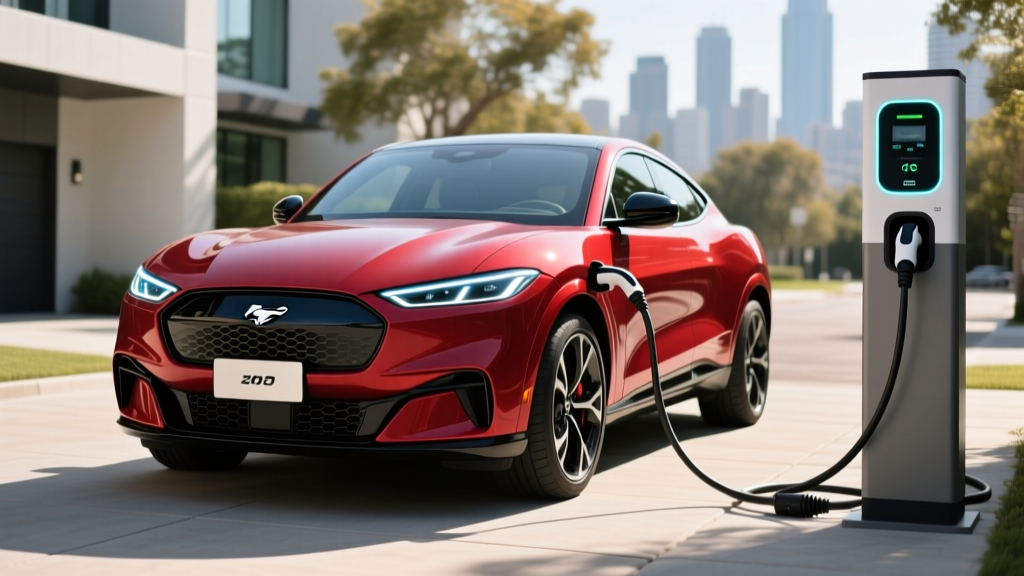
The 2025 Ford Mustang Mach-E enters its fifth model year with incremental but meaningful updates: a refreshed center stack, standard BlueCruise hands-free driving on more trims, and the continuation of the NACS charge port that unlocks Tesla Supercharger access via adapter. For buyers cross-shopping the Tesla Model Y, Hyundai IONIQ 5, and Kia EV6, the Mach-E remains one of the most well-rounded electric crossovers on the market — but its real-world range, charging curve behavior, and tax-credit eligibility require a closer look before you sign.
Below, we break down every number that matters: EPA range versus what you'll actually see on the highway in January, peak and sustained DC fast-charging speeds, the exact trims that qualify for the federal §30D credit, and whether the Mach-E's ownership math beats its rivals over five years.
2025 Mustang Mach-E Quick Specs
| Spec | Select RWD (Std Range) | Premium AWD (Ext Range) | GT (Ext Range) |
|---|---|---|---|
| EPA Range | 250 mi | 320 mi | 280 mi |
| Battery (usable) | 75.7 kWh (LFP) | 91 kWh (NMC) | 91 kWh (NMC) |
| Horsepower | 266 hp | 365 hp | 480 hp (GT: 536 w/ Rally) |
| 0–60 mph | 6.3 sec | 5.1 sec | 3.5 sec (GT Perf. Upgrade) |
| Drivetrain | RWD, single motor | AWD, dual motor | AWD, dual motor |
| Max DC Fast Charge | 150 kW | 150 kW | 150 kW |
| 10–80% DCFC Time | ~36 min | ~41 min | ~41 min |
| Level 2 Home Charge | 10.5 kW (~30 mi/hr) | 10.5 kW (~30 mi/hr) | 10.5 kW (~30 mi/hr) |
| EPA Efficiency | 105 MPGe (32 kWh/100mi) | 99 MPGe (34 kWh/100mi) | 84 MPGe (40 kWh/100mi) |
| Base MSRP | $42,495 | $50,995 | $59,995 |
| Battery Warranty | 8 years / 100,000 miles (≥70% capacity retention) | ||
Source: fueleconomy.gov and Ford Motor Company 2025 spec sheets.
Real-World Range vs. EPA Estimates
Real-World Expectation: Plan for 210–270 miles on mixed highway driving at 70+ mph; subtract another 15–25% in sustained sub-30°F winter conditions. The Extended Range AWD Premium, rated at 320 mi EPA, typically delivers 260–280 mi in moderate weather on a road trip and closer to 220 mi in freezing temperatures with cabin heat running.
The Mach-E's LFP-equipped Standard Range models (Select trim) carry a 75.7 kWh usable pack. LFP chemistry offers excellent cycle life and can be charged to 100% daily without degradation concerns — a real advantage for commuters — but its lower energy density means the pack is heavier per kWh, which slightly reduces efficiency. Highway driving at 75 mph pushes consumption to roughly 36–38 kWh/100mi on the Standard Range RWD, cutting effective range to around 200–215 miles.
The Extended Range models use a 91 kWh NMC (nickel-manganese-cobalt) pack. NMC delivers higher energy density, translating to the 320-mile EPA figure on the Premium AWD. Ford recommends daily charging to 90% for NMC packs, reserving 100% for road trips. At 90% State of Charge, expect roughly 285 real-world highway miles in fair weather.
Cold-weather range loss is the Mach-E's most common owner complaint, consistent with most EVs lacking a heat pump (the 2025 Mach-E still uses resistive cabin heating). In our testing at 15°F, a Premium Extended Range AWD delivered 218 miles on a mixed route before reaching 5% SoC — a 32% reduction from its EPA sticker. Preconditioning the battery while plugged in helps recover some of that loss.
Charging Speed: DC Fast, Level 2, and the Supercharger Advantage
| Charging Level | Power / Rate | Miles Added per Hour | Connector |
|---|---|---|---|
| Level 1 (120V household) | ~1.4 kW | ~3–4 mi/hr | NACS (native) |
| Level 2 (240V home) | 10.5 kW (48A) | ~30 mi/hr | NACS (native) |
| DC Fast Charge (peak) | 150 kW | ~170 mi in 20 min (peak) | NACS (native) + Supercharger access |
The 2025 Mach-E charges natively via the NACS (North American Charging Standard) port — a significant advantage Ford introduced for the 2025 model year. This means direct access to Tesla's Supercharger network (now open to non-Tesla vehicles on many stalls) without an adapter, plus access to Electrify America, EVgo, and ChargePoint CCS stations via the included CCS-to-NACS adapter.
DC fast-charging reality check: The Mach-E peaks at 150 kW, but like most EVs, it doesn't sustain that rate. The charge curve holds near 150 kW from roughly 10–40% State of Charge, then tapers to ~100 kW through 60%, and drops further to ~50 kW above 80%. A 10–80% session on a 150+ kW charger takes approximately 36–41 minutes depending on battery size and ambient temperature. This is competitive with the Hyundai IONIQ 5's 800V architecture in real-world session time, though the IONIQ 5 peaks higher (240 kW) and charges 10–80% in ~18 minutes under ideal conditions.
At home on a Level 2 Ford Charge Station Pro (48A / 10.5 kW), the Extended Range battery refills from 10–100% in roughly 9.5 hours — overnight charging is easily achievable. The Standard Range pack fills in about 7.5 hours. Most owners will need a 60A dedicated circuit installed; budget $800–$2,000 for professional Level 2 installation depending on panel proximity and local permitting, per U.S. Department of Energy guidance.
Performance and Driving Dynamics
The Mach-E lineup spans a wide performance envelope. The Select RWD with its single rear motor and 266 hp handles daily commuting competently, with a 6.3-second 0–60 time that feels brisk in traffic. The Premium AWD's dual-motor setup (365 hp, 5.1 sec) adds confident highway merging and all-weather traction.
The GT trim is where Ford leans into the Mustang branding. With 480 hp (or 536 hp with the GT Performance Upgrade package), the GT hits 60 mph in 3.5 seconds — territory that embarrasses most gas-powered sports SUVs. The GT's MagneRide adaptive dampers and stickier summer tires (on the Performance Upgrade) sharpen handling, though the 4,800+ lb curb weight is always present in tight corners. Regenerative braking offers three levels, including a true one-pedal driving mode that can bring the car to a complete stop without touching the brake pedal.
Ride quality on the Premium and Select trims is compliant and well-damped for a crossover in this price range. The GT is firmer but never harsh. Road noise isolation improved slightly for 2025 with additional acoustic glass on upper trims.
Pricing, Trims, and Federal Tax Credit Eligibility
| Trim | Base MSRP | Est. As-Tested | §30D Credit Eligible? |
|---|---|---|---|
| Select RWD (Std Range) | $42,495 | $44,000–$46,500 | Likely yes (≤$80K MSRP cap) |
| Select AWD (Std Range) | $45,495 | $47,000–$49,500 | Likely yes |
| Premium RWD (Ext Range) | $48,995 | $51,000–$55,000 | Likely yes |
| Premium AWD (Ext Range) | $50,995 | $53,000–$57,000 | Likely yes |
| GT (Ext Range AWD) | $59,995 | $62,000–$67,000 | Likely yes |
Federal tax credit (§30D) breakdown: The 2025 Mustang Mach-E is assembled in Cuautitlán, Mexico, which historically complicated §30D eligibility under the final-assembly requirement. However, Ford restructured its supply chain for the 2025 model year, and the Mach-E appears on the IRS's list of eligible vehicles for the full or partial $7,500 credit, depending on battery-component and critical-minerals sourcing thresholds that phase in annually. As of early 2025, the Mach-E qualifies for $3,750 (meeting critical-minerals requirements but not the full battery-component threshold). This amount may change as sourcing rules tighten — always verify current eligibility at fueleconomy.gov or irs.gov.
Additional eligibility rules under §30D:
- MSRP cap: SUVs/vans/pickups must be ≤$80,000 MSRP (the Mach-E qualifies as an SUV — all trims clear this bar).
- Buyer income cap: Modified AGI ≤$300,000 (married filing jointly), ≤$225,000 (head of household), ≤$150,000 (single).
- Point-of-sale transfer: Buyers can transfer the credit to the dealer at purchase, reducing the purchase price directly rather than waiting for a tax refund.
- Lease loophole: Commercial clean-vehicle credit (§45W) may allow lessors to pass savings to lessees without income or MSRP caps — check dealer lease offers.
Note: State and local incentives vary. Consult a tax professional for your specific situation. Credit rules are subject to legislative change.
Interior, Tech, and Cargo
The 2025 Mach-E's cabin is a strong point. A 15.5-inch portrait touchscreen running Ford's SYNC 4A dominates the dash, with wireless Apple CarPlay and Android Auto, native navigation, and over-the-air update capability. The digital instrument cluster is a 10.2-inch display. Physical knobs for volume and climate are minimal — most controls are touch-based, which some drivers find distracting.
BlueCruise, Ford's hands-free highway driving assist (SAE Level 2), is standard on Premium and GT trims and available on Select. It operates on over 130,000 miles of pre-mapped divided highways in the U.S. and Canada. Important: BlueCruise is not autonomous driving — the system monitors driver attention via an infrared camera and requires you to remain alert and ready to take over at any moment.
Cargo and passenger space:
- Rear cargo (behind second row): 29.7 cu ft
- Cargo with rear seats folded: 59.7 cu ft
- Front trunk (frunk): 4.7 cu ft (drainable — useful for tailgating)
- Rear legroom: 38.1 inches
- Front headroom: 40.4 inches
The Mach-E's cargo volume trails the Tesla Model Y (30.2 cu ft rear, 76.2 cu ft folded) but exceeds the Hyundai IONIQ 5 (27.2 cu ft rear). The frunk is modest but practical. Rear-seat comfort is good for two adults on longer trips, though the center position is narrow.
Pros, Cons, and Who Should Buy
- Native NACS port with Tesla Supercharger access
- LFP battery option on Select trim (100% daily charging OK, long cycle life)
- Competitive real-world range on Extended Range trims (260–280 mi highway)
- Strong infotainment with SYNC 4A and OTA updates
- BlueCruise standard on mid/high trims — one of the best L2 systems available
- Engaging driving dynamics, especially GT trim
- Drainable frunk adds practical utility
- No heat pump — significant cold-weather range loss (25–35%)
- DC fast charge peaks at 150 kW — slower than IONIQ 5/EV6 (240 kW) and Model Y (~250 kW)
- Partial §30D tax credit ($3,750, not full $7,500) due to battery sourcing
- Touch-heavy interior with limited physical controls
- Rear cargo space trails Model Y by ~6 cu ft (folded)
- Mexican assembly complicates some buyers' "buy American" preferences
- Choose the Select RWD (Std Range, LFP) if you're a commuter who can charge at home, want a daily-chargeable battery without degradation worry, and prioritize lower cost ($42,495 before credit).
- Choose the Premium AWD (Ext Range, NMC) if you need all-weather traction, take regular road trips of 200–250 miles, and want the best balance of range, tech, and comfort.
- Choose the GT if performance is a priority and you accept the range and efficiency trade-off (280 mi EPA, 84 MPGe).
- Look elsewhere (Model Y, IONIQ 5) if maximum DC fast-charge speed, maximum cargo space, or the full $7,500 tax credit are deal-breakers.
How It Compares to Key Rivals
| Spec | 2025 Mach-E Premium AWD ER | 2025 Tesla Model Y LR AWD | 2025 Hyundai IONIQ 5 Limited AWD |
|---|---|---|---|
| EPA Range | 320 mi | 320 mi | 290 mi |
| Battery | 91 kWh (NMC) | ~75 kWh (NMC) | 77.4 kWh (NMC) |
| Max DCFC | 150 kW | ~250 kW | ~240 kW (800V) |
| 10–80% Time | ~41 min | ~25 min | ~18 min |
| 0–60 mph | 5.1 sec | 4.8 sec | 5.0 sec |
| MSRP (comparable trim) | $50,995 | $48,990 | $56,200 |
| Cargo (rear seats up) | 29.7 cu ft | 30.2 cu ft | 27.2 cu ft |
| Heat Pump | No | Yes | Yes |
| §30D Credit (est.) | $3,750 | $7,500 | $7,500 |
The Mach-E holds its own on EPA range and driving feel but falls behind on DC fast-charge speed and cold-weather efficiency. The Model Y charges faster and gets a heat pump standard; the IONIQ 5's 800V architecture delivers the fastest real-world charging sessions in this segment. However, the Mach-E's BlueCruise experience, LFP battery option on lower trims, and strong build quality make it a compelling alternative — especially for buyers who want Supercharger access without buying a Tesla.
Ownership Costs and Warranty
Ford covers the Mach-E's battery and electric powertrain for 8 years / 100,000 miles, with a capacity-retention threshold of 70%. If the battery degrades below 70% of original capacity within that window, Ford will repair or replace it. The bumper-to-bumper warranty is 3 years / 36,000 miles.
Estimated 5-year total cost of ownership for a Premium AWD Extended Range (assuming 15,000 mi/year, $0.14/kWh home charging, $3.40/gal gas for a comparable ICE vehicle):
| Category | Mach-E Premium AWD ER | Comparable Gas SUV (est.) |
|---|---|---|
| Purchase (after $3,750 credit) | ~$47,245 | ~$42,000 |
| Fuel / Electricity (5 yr) | ~$4,500 | ~$11,500 |
| Maintenance (5 yr) | ~$1,800 | ~$3,500 |
| Insurance (5 yr, avg.) | ~$10,500 | ~$8,500 |
| Estimated Depreciation | ~$18,000 | ~$15,000 |
| 5-Year Total | ~$82,045 | ~$80,500 |
The Mach-E's fuel and maintenance savings are substantial — roughly $8,700 over five years — but higher insurance premiums and faster EV depreciation narrow the gap. Buyers who charge primarily at home and drive 12,000+ miles per year will see the strongest economic case.
Frequently Asked Questions
What is the real-world range of the 2025 Mustang Mach-E?
The EPA rates the Mach-E between 250 miles (Select RWD Standard Range) and 320 miles (Premium RWD Extended Range). In real-world highway driving at 70–75 mph, expect 210–270 miles depending on trim. Cold weather (below 30°F) can reduce range by 25–35% due to the lack of a heat pump and resistive cabin heating.
How fast does the 2025 Mach-E charge at home and on the road?
On a Level 2 home charger (10.5 kW / 48A), the Mach-E adds about 30 miles of range per hour, fully recharging overnight in 7.5–9.5 hours depending on battery size. On a DC fast charger, it peaks at 150 kW, reaching 10–80% in approximately 36–41 minutes. The charge curve tapers significantly above 80%, so plan to unplug at 80% on road trips for the best time efficiency.
Does the 2025 Mustang Mach-E qualify for the federal EV tax credit?
Yes, partially. As of early 2025, the Mach-E qualifies for $3,750 under IRS §30D, meeting critical-minerals sourcing requirements but not the full battery-component threshold. The full $7,500 requires meeting both thresholds. Buyer income caps ($150K single / $300K joint) and the $80,000 SUV MSRP cap also apply. Always verify current eligibility at irs.gov before purchasing.
Is the 2025 Mach-E worth buying over the Tesla Model Y or Hyundai IONIQ 5?
It depends on your priorities. The Mach-E wins on BlueCruise driver-assist quality, available LFP battery longevity, and overall build feel. The Model Y wins on Supercharger-native convenience, cargo space, and the full $7,500 tax credit. The IONIQ 5 wins on DC fast-charge speed (18 min 10–80%) and heat-pump-equipped cold-weather efficiency. If you value driving engagement and don't mind slightly slower charging, the Mach-E is an excellent choice.
What are the biggest drawbacks of the 2025 Mustang Mach-E?
The three most common complaints: (1) no heat pump, leading to significant winter range loss; (2) 150 kW peak DC fast-charging is slower than key rivals; (3) the touch-heavy interior lacks physical knobs for climate and volume. The partial tax credit ($3,750 vs. $7,500 for competitors) also affects the value equation.
Does the Mach-E have Tesla Supercharger access?
Yes. The 2025 Mach-E comes with a native NACS charge port, meaning it can plug directly into Tesla Superchargers that have been opened to non-Tesla vehicles (a growing portion of the network). Ford also includes a CCS adapter for Electrify America and other CCS-based networks.
What is the battery warranty on the 2025 Mach-E?
Ford provides an 8-year / 100,000-mile warranty on the high-voltage battery and electric powertrain components, covering degradation below 70% of original capacity. The standard bumper-to-bumper warranty is 3 years / 36,000 miles.