The 2025 Ford Mustang Mach-E arrives with its most significant mid-cycle refresh since launch, and while the exterior tweaks are subtle, the 2025 Ford Mustang Mach-E interior has been comprehensively reworked. Ford listened to owner feedback: physical controls return for climate and volume, material quality climbs a tier, and the massive 15.5-inch portrait screen now runs a faster, more intuitive SYNC 4A interface. But a cabin refresh only matters if the fundamentals—range, charging speed, and value—hold up against an increasingly fierce crop of electric SUVs.
We spent time evaluating the 2025 Mach-E across Select, Premium, California Route 1, and GT trims to answer the questions that matter: What's the real-world range when you leave the city? How fast does it actually charge on a road trip? Does it still qualify for the federal tax credit? And critically, is the new interior enough to make it the best choice in a segment that now includes the Tesla Model Y, Hyundai IONIQ 5, and Kia EV6?
Quick Specs: 2025 Ford Mustang Mach-E at a Glance
| Spec | Select RWD (Std Range) | Premium RWD (Ext Range) | GT AWD |
|---|---|---|---|
| EPA Range | 250 mi | 320 mi | 290 mi |
| Battery (usable) | 70 kWh (LFP) | 91 kWh (NMC) | 91 kWh (NMC) |
| Horsepower | 266 hp | 290 hp | 480 hp (536 w/ GT Perf Upgrade) |
| 0-60 mph | 6.2 sec | 5.8 sec | 3.3 sec (GT Perf Upgrade) |
| Drivetrain | RWD single motor | RWD single motor | AWD dual motor |
| DC Fast Charge Peak | 115 kW | 150 kW | 150 kW |
| 10-80% DCFC Time | ~38 min | ~32 min | ~32 min |
| Level 2 Home Rate | 10.5 kW (~30 mi/hr) | 10.5 kW (~30 mi/hr) | 10.5 kW (~30 mi/hr) |
| MPGe (Combined) | 103 MPGe | 101 MPGe | 84 MPGe |
| Base MSRP | $39,995 | $44,995 | $57,995 |
| Battery Warranty | 8 years / 100,000 miles | ||
The 2025 Ford Mustang Mach-E Interior: What Changed and Why It Matters
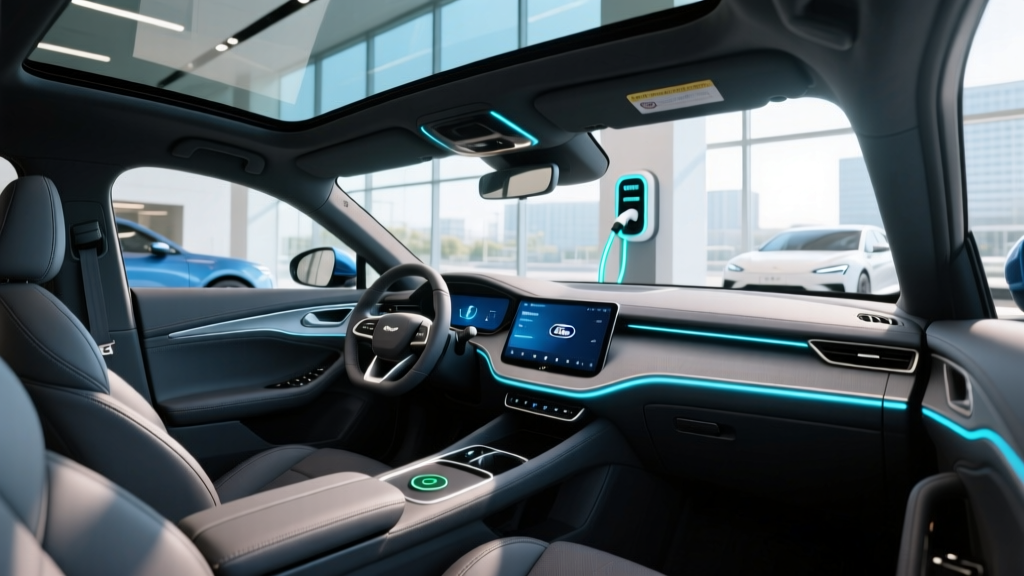
The headline of the 2025 refresh is the cabin. Ford's design team addressed the most common complaint from 2021-2024 owners: the touchscreen-only control philosophy. The 2025 Ford Mustang Mach-E interior reintroduces a physical volume knob and a row of capacitive-touch-but-tactile climate controls below the central screen. This sounds minor until you're trying to adjust the fan speed on a bumpy highway—it's a meaningful usability win.
The 15.5-inch portrait-oriented SYNC 4A display remains, but the underlying processor is upgraded, cutting boot times and making wireless Apple CarPlay and Android Auto feel genuinely responsive. Ford has also added customizable home screen widgets, so you can pin navigation, media, and charge status simultaneously without digging through menus.
Material quality sees a bump across all trims. The Select trim now gets a soft-touch dashboard upper (previously hard plastic), while Premium and GT trims feature available ActiveX synthetic leather with contrast stitching that holds up well against competitors' vegan-leather offerings. The flat-bottom steering wheel on GT trims feels grippy and purposeful.
Cargo and Passenger Space
Dimensionally, the 2025 Mach-E hasn't changed, which means the practical numbers remain competitive:
- Cargo behind rear seats: 29.7 cu ft
- Cargo with rear seats folded: 59.7 cu ft
- Front trunk (frunk): 4.7 cu ft (drainable, useful for wet gear or groceries)
- Rear legroom: 38.9 inches
- Front headroom: 40.4 inches (panoramic glass roof on Premium/GT reduces this slightly)
The frunk is a genuine differentiator versus the Tesla Model Y (whose frunk is smaller and not drainable) and the Hyundai IONIQ 5 (no frunk at all on most trims). For families hauling strollers or road-trippers packing a cooler, that drainable 4.7 cu ft space is surprisingly useful.
Range and Efficiency: EPA Sticker vs. Real-World Miles
The Extended Range RWD (Premium trim) carries an EPA-estimated 320 miles. In real-world highway driving at 70-75 mph in moderate temperatures (60-75°F), expect approximately 260-280 miles before needing to charge. In cold weather (below 30°F), that figure drops to roughly 220-250 miles due to battery resistance and cabin heating demands. The GT AWD, rated at 290 mi EPA, typically delivers 230-250 miles on highway road trips in fair conditions.
Ford's decision to offer LFP (lithium iron phosphate) chemistry on the Standard Range Select trim is noteworthy. LFP batteries sacrifice some energy density—hence the 250-mile EPA rating from a 70 kWh pack—but they gain longevity, tolerate frequent 100% charging without degradation concerns, and reduce reliance on cobalt and nickel. For a daily commuter who charges at home nightly, the LFP pack is arguably the smarter long-term choice. The Extended Range trims use NMC (nickel manganese cobalt) chemistry for higher energy density and longer per-charge range.
Efficiency-wise, the RWD Extended Range model achieves 101 MPGe combined (roughly 33 kWh/100 mi), which is respectable but trails the Hyundai IONIQ 5 RWD (114 MPGe) and Tesla Model Y RWD (122 MPGe). The GT AWD's 84 MPGe reflects its performance-oriented tuning and dual-motor drag.
Charging Speed: DC Fast Charging and Home Level 2
Charging remains an area where the Mach-E is adequate but not class-leading. Here's the full breakdown:
| Charging Level | Power / Rate | Miles Added Per Hour | Notes |
|---|---|---|---|
| Level 1 (120V household) | ~1.4 kW | ~3-4 mi/hr | Emergency/top-up only; adds ~30 mi overnight |
| Level 2 (240V home, Ford Mobile Power Cord) | ~7.7 kW | ~22 mi/hr | Standard 30A outlet; full charge in ~10-12 hrs |
| Level 2 (240V, Ford Connected Charge Station) | 10.5 kW | ~30 mi/hr | Requires 48A circuit; full charge in ~8-9 hrs |
| DC Fast Charge (Standard Range) | Peak 115 kW | ~150 mi in 30 min | 10-80% in ~38 min; tapers significantly above 80% |
| DC Fast Charge (Extended Range / GT) | Peak 150 kW | ~185 mi in 30 min | 10-80% in ~32 min; tapers above 80% |
The Mach-E uses the CCS1 connector on all non-Tesla chargers. Ford has also secured Tesla Supercharger access for Mach-E owners via an included adapter (NACS-compatible), which dramatically expands the available fast-charging network—particularly in rural corridors where Electrify America and EVgo coverage thins out. This adapter access is a genuine competitive advantage and mirrors what Hyundai/Kia and Rivian have done.
One honest caveat: the 150 kW peak charge rate on Extended Range models is exactly that—a peak. The charging curve tapers noticeably after 60% state of charge (SoC), and above 80%, speeds drop to roughly 50-60 kW. This is standard behavior for NMC packs with active thermal management, but it means a 10-90% stop takes closer to 45-50 minutes, not the 32-minute figure often quoted for 10-80%. Plan road-trip charging stops accordingly: charge to 80% and move on rather than waiting for the last 20%.
For home charging, the Ford Connected Charge Station (10.5 kW) requires a dedicated 60A circuit installed by a licensed electrician. Expect installation costs of $600-$1,500 depending on your panel's capacity and the run distance from your breaker box to the garage. Older homes with 100A service panels may need a panel upgrade ($1,500-$3,000) before adding a 48A EV charger circuit.
Performance and Driving Dynamics
The base Select RWD with 266 hp and a 6.2-second 0-60 time is perfectly adequate for commuting and merging—it never feels slow, but it also never feels like a Mustang. The Premium RWD bumps output to 290 hp and drops 0-60 to 5.8 seconds, which is where the car starts to feel appropriately brisk.
The GT trim is the performance outlier: 480 hp standard (536 hp with the GT Performance Upgrade package) and a 3.3-second 0-60 with the upgrade. That puts it in Porsche Taycan territory for acceleration, though the Mach-E GT is a heavier, softer-handling vehicle. The MagneRide adaptive dampers (included on GT) do excellent work managing body roll, and the GT's low center of gravity makes it feel planted in corners despite its 4,800-lb curb weight.
All trims feature one-pedal driving with strong regenerative braking. Ford's regen tuning is progressive and predictable—not as aggressive as Nissan Leaf's e-Pedal but more natural than early Chevy Bolt programming. You can also select from three drive modes (Whisper, Engage, Unbridled) that adjust throttle response, steering weight, and regen intensity.
Pricing, Trims, and Federal Tax Credit Eligibility
| Trim | MSRP (incl. destination) | Est. After §30D Credit* | Key Features |
|---|---|---|---|
| Select RWD Std Range | $39,995 | ~$32,495 | 15.5" screen, wireless CarPlay/AA, LFP battery, Ford Co-Pilot360 2.0 |
| Premium RWD Ext Range | $44,995 | ~$37,495 | Panoramic roof, ActiveX seats, 320-mi range, B&O audio |
| Premium AWD Ext Range | $47,995 | ~$40,495 | Dual-motor AWD, 300-mi range, all-weather capability |
| GT AWD | $57,995 | ~$50,495 | 480 hp, MagneRide, GT-specific interior, 290-mi range |
| GT Perf Upgrade AWD | $64,995 | ~$57,495 | 536 hp, 3.3s 0-60, Brembo brakes, track-tuned suspension |
*Federal tax credit estimates assume full §30D eligibility. Actual credit depends on battery sourcing, buyer income, and MSRP caps. See details below.
Does the 2025 Mach-E Qualify for the Federal EV Tax Credit?
The 2025 Ford Mustang Mach-E may qualify for up to $3,750 or $7,500 under IRS §30D, but eligibility is not automatic and depends on several factors that change periodically:
- MSRP Cap: The Mach-E qualifies as an SUV under IRS rules, so the MSRP cap is $80,000. All current trims fall under this threshold.
- Buyer Income Cap: Modified adjusted gross income (MAGI) must not exceed $150,000 (single), $225,000 (head of household), or $300,000 (joint filing).
- Battery Component & Critical Mineral Sourcing: As of 2025, the Mach-E's battery must meet escalating domestic-content and critical-mineral thresholds to qualify for the full $7,500. Vehicles meeting only one of the two requirements receive $3,750. Ford has been transparent that some Mach-E configurations meet the full threshold while others qualify for $3,750. Check the current status at IRS.gov's clean vehicle credit page or ask your dealer for the latest battery-sourcing compliance letter before purchasing.
- Point-of-Sale Transfer: Under current rules, you can transfer the credit to the dealer at the point of sale, reducing your purchase price immediately rather than waiting to claim it on your tax return. This effectively functions as a down-payment reduction.
Because sourcing rules tighten annually and Ford's supply chain evolves, we strongly recommend verifying credit eligibility with your dealer and a tax professional before finalizing a purchase. The fueleconomy.gov tax credit lookup is also a reliable reference for current qualifying configurations.
Tech, Safety, and Driver Assistance
The 2025 Mach-E comes standard with Ford Co-Pilot360 2.0, which includes automatic emergency braking with pedestrian detection, blind-spot monitoring with rear cross-traffic alert, lane-keeping assist, and evasive steering assist. These are well-calibrated systems that intervene smoothly without being intrusive.
Available BlueCruise (Ford's hands-free highway driving system) is offered on Premium and GT trims with a 90-day free trial, after which it requires a subscription (~$75/month or $800/year). BlueCruise operates on pre-mapped divided highways and is classified as SAE Level 2—meaning the driver must remain attentive and keep eyes on the road. An in-cabin camera monitors driver gaze. It's a competent system for long highway stretches, but it is not autonomous driving and will disengage in construction zones, on unmapped roads, or if the driver looks away for too long.
BlueCruise is an SAE Level 2 driver-assistance system. The driver must remain fully engaged, monitor the road, and be prepared to take over at any moment. It does not navigate unmapped roads, handle complex intersections, or replace driver judgment. True driverless operation (SAE Level 4) is currently limited to geofenced robotaxi services like Waymo in select cities.
The 2025 Mach-E earned an IIHS Top Safety Pick rating in prior model years, and Ford has carried forward the same structural safety architecture. NHTSA 5-star ratings from prior years are expected to carry over; check NHTSA.gov for the latest crash-test results as they're published.
Pros, Cons, and How It Compares
Pros
- Refreshed interior with physical controls is a genuine improvement
- LFP battery option on Select trim offers excellent long-term durability
- Tesla Supercharger access via included NACS adapter
- Competitive cargo space (29.7 cu ft) plus drainable frunk
- GT Performance Upgrade delivers 3.3s 0-60 for under $65K
- Ford dealer network for service is vastly larger than most EV startups
Cons
- DC fast charge peak of 150 kW trails Hyundai IONIQ 5 (240 kW) and Tesla Model Y (250 kW)
- Efficiency (101 MPGe RWD) lags segment leaders by 10-20%
- BlueCruise subscription model adds recurring cost after trial
- No third-row seating option (unlike Model Y available 7-seat)
- GT range (290 mi EPA) is modest for the price point
2025 Mach-E vs. Key Competitors
Vs. Tesla Model Y (Long Range RWD): The Model Y wins on efficiency (122 MPGe), DC fast charging (250 kW peak), and access to the native Supercharger network without an adapter. The Mach-E counters with a more traditional interior layout, physical controls, a drainable frunk, and a less polarizing brand experience for first-time EV buyers.
Vs. Hyundai IONIQ 5 (RWD SEL): The IONIQ 5 dominates on charging speed (240 kW peak, 10-80% in ~18 min) and efficiency (114 MPGe). Its interior design is more avant-garde, though it lacks a frunk. The Mach-E offers more conventional styling, slightly more rear cargo volume, and broader dealer service availability in rural markets.
Vs. Kia EV6 (Wind RWD): Mechanically similar to the IONIQ 5 with the same 800V architecture and ultra-fast charging. The EV6's sportback roofline sacrifices some cargo height versus the Mach-E's more upright SUV profile. Choose the Mach-E if cargo practicality and traditional SUV ergonomics matter more than charging speed.
Who Should Buy the 2025 Ford Mustang Mach-E?
Decision Framework
Choose the Mach-E Select RWD (LFP) if: You're a daily commuter with home charging, drive under 80 miles round-trip, and want a durable battery you can charge to 100% nightly without degradation worry. At ~$32,500 after tax credit, it's a compelling value.
Choose the Mach-E Premium RWD Extended Range if: You take regular road trips of 200-300 miles and need the 320-mile EPA range buffer. The panoramic roof and upgraded audio make it the best daily-driver trim for most buyers.
Choose the Mach-E GT if: You want sports-sedan acceleration (3.3s 0-60) in a practical SUV package and accept the range/efficiency trade-off. It's a performance bargain versus a Porsche Taycan or BMW i4 M50.
Look elsewhere if: Ultra-fast DC charging is your top priority (consider IONIQ 5/EV6), you need a third row (Model Y), or you want maximum efficiency per kWh (Model Y RWD or IONIQ 5).
Frequently Asked Questions
What is the real-world range of the 2025 Mustang Mach-E?
The Extended Range RWD is EPA-rated at 320 miles. In real-world highway driving at 70-75 mph, expect 260-280 miles. In cold weather (below 30°F), plan for 220-250 miles. The GT AWD delivers roughly 230-250 miles on highway trips in moderate conditions.
How fast does the 2025 Mach-E charge at home and on the road?
At home on a Level 2 Ford Connected Charge Station (10.5 kW), it adds roughly 30 miles per hour and fully charges in 8-9 hours. On DC fast chargers, the Extended Range models peak at 150 kW, achieving a 10-80% charge in approximately 32 minutes, with significant taper above 80% SoC.
Does the 2025 Mustang Mach-E qualify for the $7,500 federal tax credit?
It may qualify for $3,750 or $7,500 depending on battery component and critical-mineral sourcing compliance, which varies by configuration and changes periodically. Buyer income must be under $150K/$225K/$300K (single/HOH/joint), and the MSRP must be under $80,000 (SUV cap)—all Mach-E trims meet this. Verify current eligibility at IRS.gov or with your dealer before purchasing.
Is the 2025 Mach-E worth buying versus the Tesla Model Y or IONIQ 5?
It depends on priorities. The Mach-E wins on interior usability (physical controls, traditional layout), frunk practicality, and Ford's extensive dealer network for service. The Model Y wins on efficiency and native Supercharger access. The IONIQ 5 wins on DC charging speed. If you value a conventional SUV experience and don't road-trip weekly, the Mach-E is an excellent choice.
What is the battery warranty on the 2025 Mach-E?
Ford covers the high-voltage battery for 8 years or 100,000 miles (whichever comes first), with a capacity retention threshold of 70%. If the battery degrades below 70% of original capacity within that period, Ford will repair or replace it. The basic vehicle warranty is 3 years/36,000 miles, and the powertrain (motors, reducers) is covered for 5 years/60,000 miles.
Can I use Tesla Superchargers with the 2025 Mach-E?
Yes. Ford provides a NACS adapter that allows Mach-E owners to access Tesla's Supercharger network. The adapter works with V3 Superchargers (up to 150 kW, which matches the Mach-E's peak acceptance rate). You activate sessions through the FordPass app. This significantly expands charging options, especially in rural areas where other networks have limited coverage.