The 2025 Mustang Mach-E Interior: What Buyers Actually Need to Know
Ford's electric crossover enters the 2025 model year with a refreshed interior that addresses some of the first-generation Mach-E's biggest complaints. The centerpiece remains the 15.5-inch vertical touchscreen running SYNC 4A, but Ford has added physical volume and climate controls, upgraded soft-touch materials across the dash and door panels, and reworked the center console for more usable storage. If you're searching for a detailed look at the 2025 Mustang Mach-E interior — and whether it holds up against the Tesla Model Y and Hyundai IONIQ 5 — this review covers the cabin alongside the powertrain specs, charging realities, and ownership economics that matter just as much as stitching quality.
We'll walk through every metric a data-driven EV buyer needs: EPA range versus what you'll actually see on a highway, battery chemistry options, DC fast-charge curves, home charging speeds, and the federal §30D tax credit rules that determine your out-of-pocket cost.
2025 Mustang Mach-E Specifications at a Glance
| Spec | Select RWD (Std Range) | Premium AWD (Ext Range) | GT (Ext Range) |
|---|---|---|---|
| EPA Range | 250 mi | 320 mi | 280 mi |
| Battery (Usable) | 72 kWh (LFP) | 91 kWh (NMC) | 91 kWh (NMC) |
| Horsepower / Torque | 266 hp / 317 lb-ft | 346 hp / 428 lb-ft | 480 hp / 634 lb-ft |
| 0-60 mph | 6.3 sec | 5.1 sec | 3.5 sec |
| Drivetrain | RWD, single motor | AWD, dual motor | AWD, dual motor |
| Max DC Fast Charge | 150 kW | 150 kW | 150 kW |
| 10-80% DC Time | ~36 min | ~45 min | ~45 min |
| Level 2 Home Rate | 10.5 kW (32 mi/hr) | 10.5 kW (32 mi/hr) | 10.5 kW (32 mi/hr) |
| Efficiency (MPGe) | 105 MPGe | 98 MPGe | 84 MPGe |
| Base MSRP | $39,995 | $48,995 | $57,995 |
Source: fueleconomy.gov and Ford Motor Company 2025 specifications.
Real-World Range: What the EPA Number Doesn't Tell You
The 2025 Mach-E's 91 kWh usable battery (NMC lithium-ion chemistry) in the Extended Range models gives it one of the larger packs in the mid-size electric crossover segment. That capacity is what delivers the 320-mile EPA figure on the Premium AWD — but the EPA test cycle blends low-speed city driving with moderate highway speeds and mild temperatures. Real-world consumption tells a different story.
At a steady 75 mph on flat interstate, the AWD Extended Range typically consumes around 34-36 kWh per 100 miles, translating to roughly 250-265 miles before the battery buffer engages. The RWD Select with its 72 kWh LFP (lithium iron phosphate) pack is rated at 250 miles EPA, and real-world highway testing yields approximately 210-225 miles. LFP chemistry trades energy density for longevity — you'll get more charge cycles over the battery's lifetime, but you're carrying fewer kilowatt-hours in the same physical space.
The GT trim, despite sharing the 91 kWh NMC pack, sacrifices range for performance. Its 280-mile EPA rating drops to around 230-245 miles in real-world mixed driving and closer to 190-210 miles at sustained highway speeds, especially with the GT's stickier summer tires increasing rolling resistance.
Charging Speed: DC Fast Charge and Home Level 2
Charging speed is where the 2025 Mach-E shows its age relative to 800-volt competitors like the Hyundai IONIQ 5 and Kia EV6. The Mach-E operates on a 400-volt architecture and peaks at 150 kW on a DC fast charger. Here's what that means in practice:
| Charging Level | Power (kW) | Speed (miles added/hr) | Notes |
|---|---|---|---|
| Level 1 (120V household) | ~1.4 kW | ~3-4 mi/hr | Emergency/trickle only; ~80+ hrs for full charge |
| Level 2 (240V, 48A) | 10.5 kW | ~32 mi/hr | Full overnight charge in 8-10 hrs |
| DC Fast Charge (peak) | 150 kW | ~150 mi in 20 min (peak) | Tapers significantly above 80% SoC |
The 150 kW peak rate applies primarily between 10-50% state of charge (SoC). Above 60%, the charge curve tapers noticeably — by 80% SoC, you're pulling roughly 50-60 kW. That's why a 10-80% session on the Extended Range takes approximately 45 minutes, not the 20 minutes you might expect from a simple kW calculation. The Standard Range LFP pack charges slightly faster in absolute time (around 36 minutes, 10-80%) because the smaller battery requires less total energy, even at the same peak rate.
For home charging, Ford includes the Mobile Power Cord with every Mach-E, which delivers up to 10.5 kW on a 240V, 48-amp NEMA 14-50 outlet. That translates to roughly 32 miles of range per hour of charging — enough to replenish a full day's driving overnight. A hardwired Level 2 wall connector from Ford's Connected Charge Station delivers the same 10.5 kW rate but with added reliability and smart scheduling features via the FordPass app.
The Mach-E uses the NACS (North American Charging Standard) connector for 2025, giving it native access to the Tesla Supercharger network — a major practical advantage over CCS-only vehicles that still require adapters. This is one of the strongest charging-infrastructure arguments in the Mach-E's favor.
Interior Quality, Space, and Technology
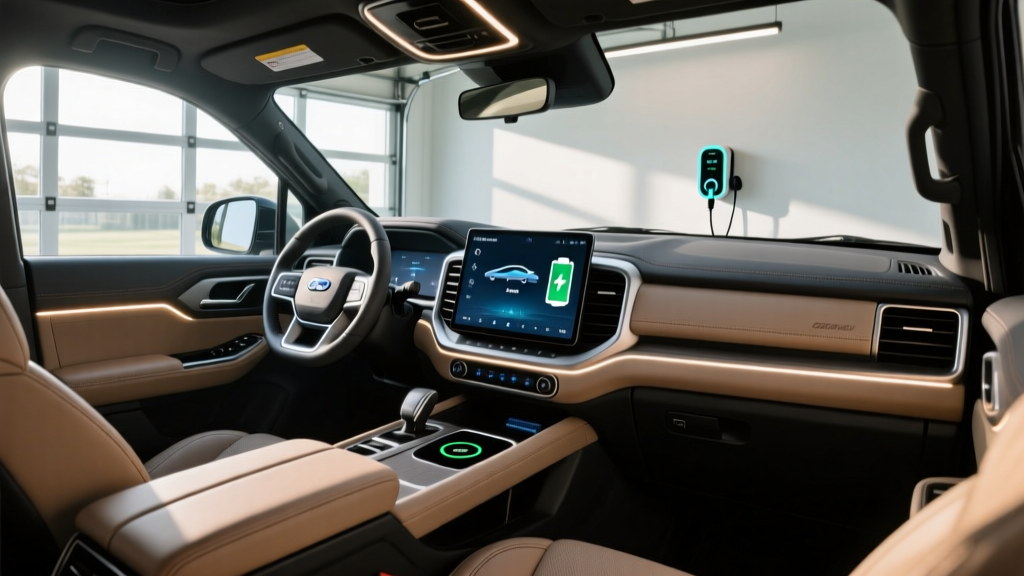
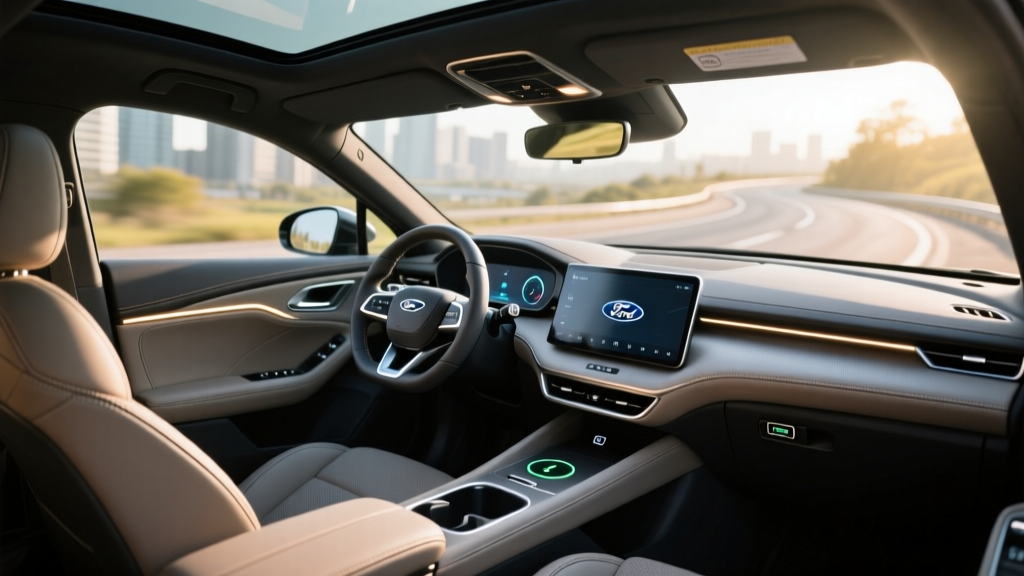
The 2025 Mustang Mach-E interior represents Ford's most significant mid-cycle cabin update since the vehicle's 2021 launch. The dashboard now features stitched synthetic leather across the upper surface, replacing the hard plastics that drew criticism in earlier model years. The door armrests and center console bin have been reworked with softer materials, and Ford has finally added a physical volume knob and dedicated climate control buttons below the main touchscreen — a direct response to owner feedback about the touchscreen-only interface.
Infotainment and Driver Assistance
The 15.5-inch portrait-oriented SYNC 4A touchscreen remains the cabin's focal point. It runs a responsive interface with wireless Apple CarPlay and Android Auto, over-the-air (OTA) update capability, and integrated navigation with real-time charger routing. The digital instrument cluster is a 10.2-inch display behind the steering wheel, showing speed, range, and driver-assist status without the clutter of older Ford interfaces.
Ford's BlueCruise hands-free driving system is available on Premium and GT trims (and optional on Select). BlueCruise is an SAE Level 2 driver-assistance system — it controls steering, acceleration, and braking on pre-mapped divided highways, but you must remain attentive. An infrared driver-monitoring camera tracks your eye position and will issue warnings (and eventually slow the vehicle) if you look away for too long. This is not autonomous driving; it's a supervised highway assist that reduces fatigue on long trips. BlueCruise covers over 130,000 miles of divided highways in North America as of the 2025 model year.
Passenger and Cargo Dimensions
The Mach-E is a mid-size crossover built on Ford's dedicated EV platform, and its packaging reflects that. Interior volume and cargo space are competitive with the segment, though the sloping roofline does cut into rear cargo height compared to boxier rivals.
- Front headroom: 40.4 inches
- Front legroom: 43.3 inches
- Rear headroom: 38.2 inches (reduced by panoramic roof on Premium/GT)
- Rear legroom: 38.9 inches
- Cargo behind rear seats: 29.7 cu ft
- Cargo with rear seats folded: 59.7 cu ft
- Front trunk (frunk): 4.7 cu ft (drainable, useful for wet gear or groceries)
The 38.9 inches of rear legroom is generous for the segment — adults over six feet will fit comfortably behind a similarly sized driver. The frunk, while small, includes a drain plug, making it practical for tailgating or storing muddy hiking boots.
Pricing, Tax Credit Eligibility, and Ownership Costs
The 2025 Mustang Mach-E lineup starts at $39,995 for the Select RWD Standard Range and tops out at $57,995 for the GT Extended Range AWD (before destination charges and options). A well-equipped Premium AWD Extended Range — the trim most buyers target for its blend of range and features — lands around $48,995 base, climbing to $52,000-$55,000 with packages like the BlueCruise subscription and panoramic roof.
Federal Tax Credit: §30D Eligibility
- MSRP cap: SUVs/vans/pickups must be ≤ $80,000 — all Mach-E trims qualify.
- Buyer income cap: MAGI ≤ $150,000 (single) / $225,000 (head of household) / $300,000 (joint).
- Battery sourcing: Critical minerals and battery components must meet escalating domestic-content thresholds. As of 2025, the Mach-E's battery sourcing has been updated to meet partial credit requirements — check the IRS qualified vehicles list for your specific build date and VIN.
- Point-of-sale transfer: You can transfer the credit to the dealer at purchase, reducing your out-of-pocket cost immediately (rather than waiting to claim it on your tax return).
- Final assembly: Must be in North America — the Mach-E is built in Cuautitlán, Mexico, which qualifies.
Credit amounts range from $0 to $7,500 depending on sourcing compliance. Always verify with a tax professional and the latest IRS guidance before purchasing.
With the maximum $7,500 credit, a Select RWD drops from $39,995 to an effective $32,495 — a compelling entry point for an electric crossover with a usable fast-charge network. The Premium AWD Extended Range at $48,995 falls to approximately $41,495 with the full credit, though sourcing requirements may reduce the actual credit to $3,750 for some build dates.
Five-Year Ownership Cost Snapshot
Compared to a similarly priced gas crossover (e.g., Ford Edge, Honda Passport), the Mach-E's savings come primarily from fuel and maintenance. At $0.13/kWh (national average residential electricity rate) and 3.0 mi/kWh efficiency, the Premium AWD costs roughly $0.043 per mile to fuel. A comparable gas vehicle at 24 MPG and $3.50/gallon costs $0.146 per mile. Over 15,000 annual miles, that's approximately $1,545 in annual fuel savings. Add reduced maintenance (no oil changes, fewer brake replacements due to regenerative braking) and the five-year total cost of ownership narrows significantly despite the Mach-E's higher sticker price.
Warranty Coverage and Battery Longevity
Ford provides the following warranty coverage for the 2025 Mach-E:
- Bumper-to-bumper: 3 years / 36,000 miles
- Powertrain: 5 years / 60,000 miles
- High-voltage battery: 8 years / 100,000 miles (retains ≥ 70% of original capacity)
- BlueCruise: Complimentary for the first 2 years; then ~$75/month or $800/year subscription
The 70% capacity retention threshold over 8 years is industry-standard and matches what Tesla, Hyundai, and Kia offer. In practice, NMC batteries in liquid-cooled packs like the Mach-E's typically degrade 10-15% over the first 100,000 miles based on fleet data from earlier model years. The LFP pack in the Standard Range models is expected to show even less degradation — LFP chemistry tolerates regular 100% charging and deeper cycles better than NMC, making it well-suited for daily commuters who charge nightly at home.
How the 2025 Mach-E Stacks Up Against Competitors
The mid-size electric crossover segment is crowded in 2025. Here's how the Mach-E Premium AWD Extended Range compares on the metrics that matter most:
| Spec | 2025 Mach-E Premium AWD ER | 2025 Tesla Model Y LR AWD | 2025 Hyundai IONIQ 5 SEL AWD |
|---|---|---|---|
| EPA Range | 320 mi | 308 mi | 290 mi |
| Battery | 91 kWh NMC | ~78 kWh NMC | 77.4 kWh NMC |
| Peak DC Charge | 150 kW | 250 kW | 240 kW (800V) |
| 10-80% Time | ~45 min | ~27 min | ~18 min |
| 0-60 mph | 5.1 sec | 4.8 sec | 5.2 sec |
| Cargo (rear seats up) | 29.7 cu ft | 30.2 cu ft | 27.2 cu ft |
| Base MSRP | $48,995 | $49,990 | $50,100 |
The Mach-E wins on EPA range and offers the most generous rear legroom in the group, but it falls decisively on DC fast-charge speed. The IONIQ 5's 800-volt architecture delivers a 10-80% charge in roughly 18 minutes — less than half the Mach-E's time. If you road-trip frequently and rely on public fast chargers, that 27-minute gap per stop adds up over a 600-mile drive.
Where the Mach-E claws back ground is the NACS connector and Supercharger access. Tesla's network remains the most reliable and widely deployed DC fast-charging infrastructure in the US, and having native access (no adapter required) is a genuine day-one convenience advantage for 2025 Mach-E owners.
Pros, Cons, and Who Should Buy the 2025 Mach-E
- 320-mile EPA range (Premium ER) is among the best in segment
- Native NACS connector = direct Tesla Supercharger access
- Spacious rear seat (38.9" legroom) and drainable frunk
- Improved 2025 interior materials and added physical controls
- BlueCruise hands-free highway assist on 130,000+ mi of roads
- LFP option (Std Range) for buyers prioritizing battery longevity
- 150 kW peak DC charge rate lags 800V competitors badly
- 10-80% in ~45 min means longer road-trip stops
- BlueCruise requires paid subscription after 2 years
- Sloping roofline reduces rear cargo height vs boxier rivals
- No front trunk power outlet or V2L capability
- GT range penalty (280 EPA) is steep for the performance gain
Best Use Cases
Commuter with home charging: The Select RWD Standard Range at $39,995 (potentially $32,495 after credit) is an excellent daily driver. The LFP battery handles nightly 100% charges without accelerated degradation, and 250 miles of EPA range covers virtually any commute with margin.
Family crossover buyer: The Premium AWD Extended Range offers the best blend of range, space, and features. The 320-mile EPA rating, 38.9 inches of rear legroom for child seats, and Supercharger access make it a practical one-car solution for families who road-trip a few times a year.
Performance enthusiast: The GT's 3.5-second 0-60 time and 480 hp are genuinely thrilling, but the 280-mile range and 45-minute fast-charge stops are real compromises. Choose the GT if you prioritize acceleration over road-trip convenience.
Frequently Asked Questions
What is the real-world range of the 2025 Mustang Mach-E?
The Premium AWD Extended Range is EPA-rated at 320 miles, but real-world mixed driving typically yields 270-290 miles. Sustained highway driving at 75 mph drops that to roughly 250-265 miles, and cold-weather operation below 30°F can reduce range to 200-230 miles due to battery heating demands and cabin climate use.
How fast does the 2025 Mach-E charge?
On a DC fast charger, the Mach-E peaks at 150 kW and charges from 10-80% in approximately 45 minutes (Extended Range) or 36 minutes (Standard Range). At home on a 240V Level 2 charger, it pulls 10.5 kW, adding about 32 miles of range per hour — a full overnight charge takes 8-10 hours.
Does the 2025 Mustang Mach-E qualify for the federal EV tax credit?
Yes, with caveats. All Mach-E trims fall under the $80,000 MSRP cap for SUVs, and final assembly in Mexico qualifies under USMCA rules. However, the credit amount ($3,750 or $7,500) depends on battery component and critical-mineral sourcing thresholds that change annually. Buyer income must not exceed $150,000 (single) or $300,000 (joint filers). Verify your specific VIN on the IRS qualified vehicles list before purchase.
Is the 2025 Mach-E worth buying versus the Tesla Model Y or Hyundai IONIQ 5?
It depends on your priorities. The Mach-E offers the longest EPA range in the segment (320 mi for Premium ER) and native Supercharger access, making it strong for range-focused buyers who want reliable public charging. The IONIQ 5 charges nearly three times faster on DC (18 min vs 45 min, 10-80%), which matters if you road-trip frequently. The Model Y offers the most cargo space and the lowest operating costs but has a sparser interior and no physical controls. Test-drive all three and weight your decision by how often you fast-charge versus charge at home.
What is the battery warranty on the 2025 Mach-E?
Ford covers the high-voltage battery for 8 years or 100,000 miles, whichever comes first, guaranteeing it will retain at least 70% of its original capacity. This matches the industry standard set by Tesla, Hyundai, and Kia.
Does BlueCruise make the Mach-E self-driving?
No. BlueCruise is an SAE Level 2 driver-assistance system. It handles steering, acceleration, and braking on approved divided highways, but you must remain alert and ready to take over at any time. A driver-monitoring camera enforces attention. Level 4 autonomous driving (no driver required) is currently only available through commercial robotaxi services like Waymo in limited geographic areas.