Quick Verdict: The Benchmark Hot SUV Still Has Teeth
The 2025 Tesla Model Y Performance remains the default answer for buyers who want sports-sedan acceleration in a practical electric crossover. With a 3.5-second 0-60 mph time, 285 miles of EPA-rated range, and access to the most reliable DC fast-charging network in North America, it is still the vehicle that every rival measures itself against. But after years of incremental updates and the arrival of serious competitors like the Hyundai Ioniq 5 N and Porsche Macan EV, the question in 2026 is no longer whether the Model Y Performance is fast — it is whether its compromises are still worth accepting.
This review covers the Long Range AWD Performance variant (sometimes badged simply as the Model Y Performance) as sold for the 2025 model year. We break down its real-world range, charging curve behavior, tax credit eligibility under current IRS §30D rules, and the ownership realities that spec sheets do not show.
Range, Efficiency, and the Real-World Caveat
Real-World Expectation: 230–255 miles at sustained highway speeds (70–80 mph); 190–220 miles in freezing temperatures with cabin heat; 260–280 miles in mixed city/suburban driving with moderate regen use.
The 2025 Model Y Performance uses a 78.1 kWh usable battery pack (approximately 82 kWh gross) with NMC (nickel-manganese-cobalt) chemistry. Unlike the Standard Range RWD variant, which has shifted to LFP (lithium iron phosphate) cells in recent model years, the Performance trim retains NMC for its higher energy density and better cold-weather discharge characteristics.
The 285-mile EPA figure is achieved on the standard 21" Überturbine wheels. If you option down to the 19" Gemini wheels — available on the Long Range AWD but not typically on the Performance trim — the EPA rating climbs to approximately 310 miles. That 25-mile gap illustrates how much wheel and tire choice affects efficiency in a vehicle with this much power and frontal area.
Efficiency on the EPA combined cycle rates at 111 MPGe, which translates to roughly 30 kWh per 100 miles. In our experience, expect 28–31 kWh/100mi in temperate conditions and 34–38 kWh/100mi in winter or aggressive highway driving. That is competitive with the Ford Mustang Mach-E GT but slightly behind the more aerodynamically optimized Hyundai Ioniq 5 N at similar power levels.
| Specification | Value |
|---|---|
| EPA Range | 285 miles |
| Battery (usable / gross) | 78.1 kWh / ~82 kWh, NMC |
| Drivetrain | Dual-motor AWD |
| Horsepower | ~456 hp (combined) |
| Torque | ~497 lb-ft |
| 0–60 mph | 3.5 seconds |
| Top Speed | 155 mph |
| Efficiency (combined) | 111 MPGe / ~30 kWh/100mi |
| Max DC Fast Charge | 250 kW (V3 Supercharger) |
| 10–80% DC Charge Time | ~27 minutes |
| Level 2 Home Charge Rate | 11.5 kW (~44 mi/hr) |
| Cargo Volume (rear seats up / down) | 30.2 cu ft / 72.1 cu ft |
| Front Trunk (Frunk) | 4.1 cu ft |
| Rear Legroom | 37.6 inches |
| Battery Warranty | 8 years / 120,000 miles |
| Base MSRP (Performance) | $52,490 (before incentives) |
Charging Speed: DC Fast, Level 2, and the Curve Reality
The Model Y Performance supports a peak DC fast-charge rate of 250 kW on Tesla V3 Superchargers. On a properly preconditioned battery (the car does this automatically when you navigate to a Supercharger), the charge curve is aggressive in the low state-of-charge range: you will see 240–250 kW from roughly 5% to 30% SoC, tapering to 150–170 kW by 50%, and dropping further to 80–100 kW above 70%. The 10–80% charge takes approximately 27 minutes under ideal conditions.
Above 80%, the curve flattens significantly. Charging from 80% to 100% can take nearly as long as 10% to 80%. This is standard behavior for NMC lithium-ion cells managed conservatively to preserve long-term health, but it means road-trip strategy should target 10–80% stops rather than full fills.
| Level | Power | Miles Added per Hour | Typical Use Case |
|---|---|---|---|
| Level 1 (120V) | ~1.4 kW | ~4–5 mi/hr | Emergency / trickle top-off |
| Level 2 (240V, 48A) | 11.5 kW | ~44 mi/hr | Home overnight, workplace |
| DC Fast (V3 Supercharger) | Peak 250 kW | ~1,000 mi/hr (peak) | Road trips, rapid top-ups |
| DC Fast (CCS adapter, non-Tesla) | Peak ~170 kW | ~700 mi/hr (peak) | Electrify America, EVgo, etc. |
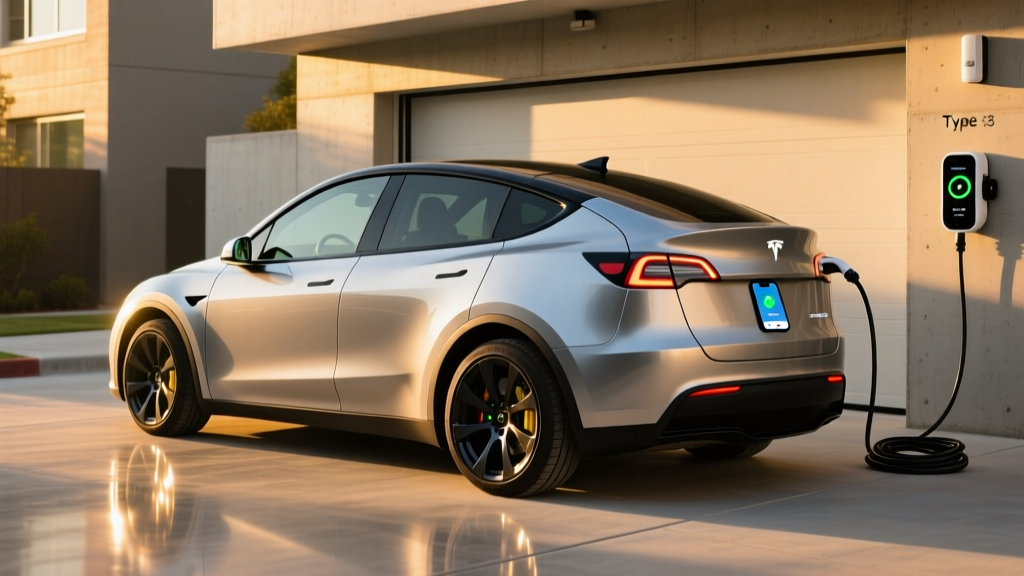
Home charging on a 240V/48A Level 2 circuit (such as the Tesla Wall Connector) delivers 11.5 kW, adding roughly 44 miles of range per hour. A full overnight session from 20% to 90% takes about 8–9 hours, which is comfortable for daily use. Note that installation of a 60A circuit (required for 48A continuous draw) typically costs $800–$2,500 depending on panel proximity and local permitting, according to Tesla's home charging guidance.
With the included CCS adapter (now standard for North American models), the Model Y can also use Electrify America, EVgo, and other CCS1 networks. However, peak charge rates on non-Tesla chargers tend to be lower — typically 150–170 kW — because the vehicle's charge profile is optimized for V3 Supercharger communication. Tesla's NACS connector is now being adopted industry-wide, and by 2026 most new EVs from other manufacturers can access Superchargers with adapters, but the Model Y still enjoys the most seamless plug-and-charge experience on the network.
Performance, Ride, and Daily Drivability
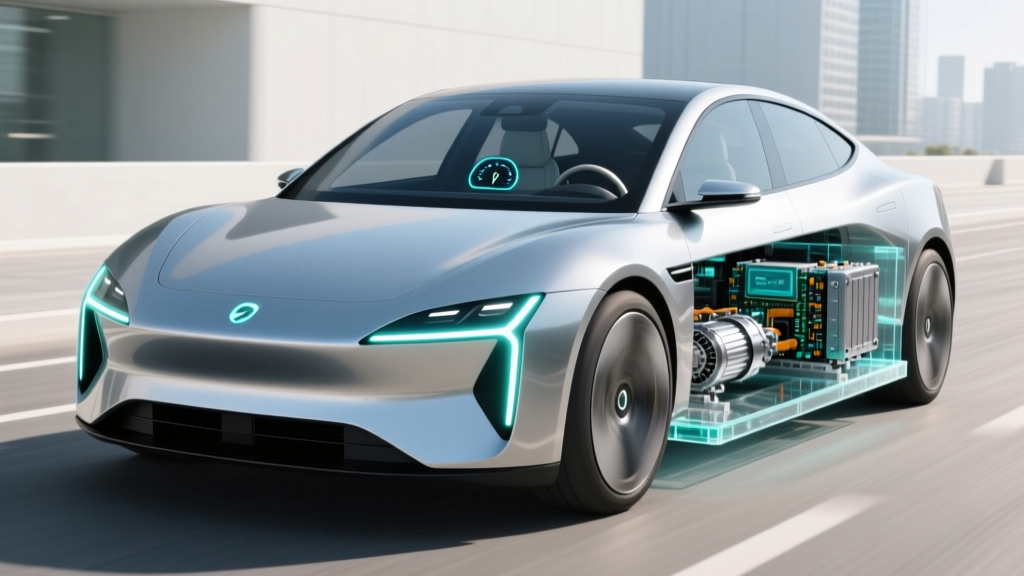
The dual-motor all-wheel-drive powertrain produces approximately 456 horsepower and 497 lb-ft of torque. The 3.5-second 0–60 mph time is not just a benchmark number — it is repeatable, consistent, and available without the warm-up or boost lag that turbocharged ICE vehicles require. In Track Mode, the car adjusts torque distribution, regen intensity, and cooling profiles for sustained high-speed driving, though this is a performance feature, not a daily commuting necessity.
Ride quality is the Performance trim's most debated characteristic. The lowered sport suspension (approximately 0.6 inches lower than the Long Range) and the 21" Überturbine wheels with low-profile tires produce a firm ride. On well-maintained highways, it feels planted and composed. On broken urban pavement or expansion joints, you feel every imperfection more than you would in a Mach-E GT or Ioniq 5 N, both of which have slightly more compliant tuning. If ride comfort is a priority, the Long Range AWD on 19" wheels is the better choice — but you sacrifice the 3.5-second acceleration claim and the Performance brake package.
The 2025 Model Y continues with Tesla's minimalist interior: a 15-inch center touchscreen controls virtually all vehicle functions, including climate, mirrors, and glovebox. There is no instrument cluster — speed and navigation appear on the left third of the main screen. Rear passengers get a small 8-inch screen for climate and entertainment. Build quality has improved meaningfully since the 2022 Fremont-to-Austin production shift, with tighter panel gaps and updated interior materials, though it still does not match the tactile richness of a Porsche Macan EV or even a well-optioned Genesis GV60.
Pricing, Trims, and Federal Tax Credit Eligibility
The 2025 Model Y Performance carries a base MSRP of approximately $52,490, including destination. Adding FSD (Supervised) capability adds $8,000 (or $99/month), though this remains a SAE Level 2 driver-assist system — not autonomous driving. Premium interior colors, 21" wheels (standard on Performance), and other options can push the as-tested price to $58,000–$62,000.
| Item | Amount |
|---|---|
| Base MSRP (Performance) | $52,490 |
| Typical As-Tested (with FSD, paint) | $60,490 |
| Federal §30D Credit (if eligible) | Up to $7,500 |
| Estimated Net Price (with full credit) | ~$44,990–$52,990 |
Federal tax credit eligibility is not automatic. Under IRS §30D rules, the buyer must meet all of the following:
- MSRP cap: The vehicle's base MSRP must not exceed $80,000 for SUVs — the Model Y Performance qualifies.
- Buyer income cap: Modified adjusted gross income must not exceed $150,000 (single), $225,000 (head of household), or $300,000 (joint). Income is checked against the year of delivery or the prior year, whichever is lower.
- Battery sourcing requirements: A percentage of critical minerals and battery components must be sourced from the US or free-trade-agreement countries. These thresholds increase annually. As of 2025, Tesla has structured its supply chain to qualify most US-built Model Y variants, but eligibility can change with IRS guidance updates. Always verify on fueleconomy.gov before purchasing.
- Point-of-sale transfer: Since 2024, buyers can transfer the credit to the dealer at purchase, reducing the out-of-pocket price directly rather than waiting for a tax refund. This requires the dealer to be registered with the IRS Energy Credits Online portal.
State and local incentives vary by jurisdiction and are not covered here — check your state's energy office or DMV for current programs.
Tech, Safety, and Driver Assistance
The Model Y's technology stack centers on its 15-inch touchscreen running Tesla's proprietary operating system. Navigation, over-the-air updates, Sentry Mode dashcam recording, and the Tesla app integration remain class-leading in responsiveness. The 2025 model includes Hardware 4.0 (AI4) for Autopilot and FSD (Supervised), with higher-resolution cameras and improved neural-net processing.
On safety, the Model Y earned a 5-star overall rating from NHTSA and Top Safety Pick+ recognition from IIHS in prior model years (2025 results pending at publication). Standard active safety features include automatic emergency braking, blind-spot monitoring, lane departure warning, and rear cross-traffic alert — all included without subscription.
Notable tech drawbacks: the lack of Apple CarPlay and Android Auto continues to frustrate buyers who prefer phone-mirrored interfaces. Tesla's native navigation and media apps are capable, but they do not replicate the familiarity of CarPlay for many users. There is also no head-up display, and the reliance on touchscreen controls for basic functions (glovebox, mirror adjustment, wiper settings) remains a polarizing design choice.
Who Should Buy the Model Y Performance?
The 2025 Model Y Performance is best suited for:
- Performance-oriented commuters who want sports-car acceleration with daily practicality and low running costs.
- Tech-forward families who value OTA updates, the Supercharger network, and the frunk+rear cargo flexibility (30.2 cu ft rear, 72.1 cu ft with seats folded).
- Road-trip drivers who prioritize charging infrastructure reliability — the Supercharger network's uptime and plug-and-charge simplicity still outperform third-party CCS networks in most US corridors.
It is less ideal for:
- Ride-comfort seekers who prioritize suspension suppleness over handling sharpness (consider the Long Range AWD or a Genesis GV60).
- Buyers who need Apple CarPlay/Android Auto — Tesla will not offer this, and it is a dealbreaker for a meaningful segment of shoppers.
- Buyers in areas without reliable home charging access — the Model Y's ownership experience is heavily dependent on overnight Level 2 charging. Without it, you will rely on public infrastructure, which adds time and cost.
Pros
- 3.5s 0–60 mph is supercar territory in a 4,400-lb SUV
- Supercharger network remains the gold standard for reliability
- Class-leading cargo volume (72.1 cu ft max) with a usable frunk
- OTA updates continuously add features and refinements
- Strong resale value relative to most EV competitors
- 11.5 kW Level 2 acceptance rate charges overnight easily
Cons
- Firm ride on 21" wheels — harsh on broken pavement
- No Apple CarPlay or Android Auto
- Touchscreen-only controls for basic functions (mirrors, glovebox)
- 285-mile EPA range is modest for the segment in 2025
- FSD (Supervised) costs $8,000 extra and is still Level 2
- Interior materials lag behind luxury rivals at this price point
Is It Worth Buying vs. Key Competitors?
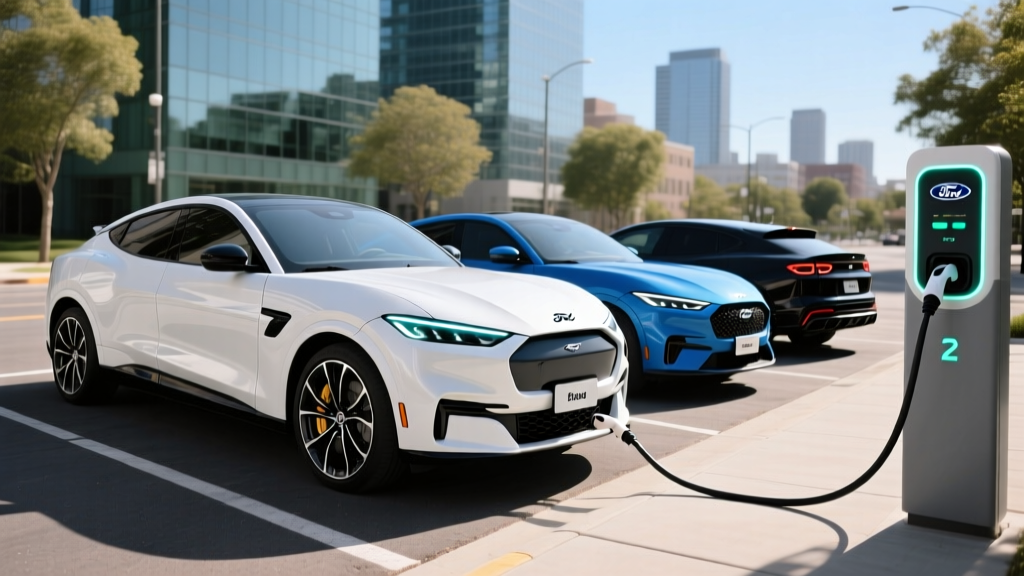
The Model Y Performance competes against the Hyundai Ioniq 5 N ($66,000+ MSRP, 601 hp, 28-mile EPA range penalty vs. standard Ioniq 5), the Ford Mustang Mach-E GT ($59,995, 3.5s 0-60, 280-mile range), and the Porsche Macan 4 EV ($84,900+, 4.9s 0-60, 308-mile range). Among these, the Model Y Performance offers the lowest entry price, the best charging infrastructure, and the strongest cargo practicality. The Ioniq 5 N is the more engaging driver's car with its simulated gear shifts and N-tuned chassis, but it costs $14,000 more and has less range. The Mach-E GT is a credible alternative with a more conventional interior layout and CarPlay support, but Ford's charging network access is less seamless. The Macan EV is a luxury tier above in price and refinement but cannot match the Tesla's acceleration or price.
Choose the Ioniq 5 N if: You are a driving enthusiast who values chassis feedback, simulated gear shifts, and track-day capability over daily range and price.
Choose the Mach-E GT if: You want comparable performance with CarPlay, a more traditional control layout, and do not mind a slightly smaller Supercharger-adjacent network (via Ford's BlueOval Charge Network).
Frequently Asked Questions
What is the real-world range of the 2025 Model Y Performance?
The EPA rates it at 285 miles, but real-world highway driving at 70–80 mph typically yields 230–255 miles. In freezing temperatures with cabin heating, expect 190–220 miles. City and suburban driving with regenerative braking can approach the EPA sticker at 260–280 miles.
How fast does it charge at home and on the road?
On a 240V/48A Level 2 home charger, it accepts 11.5 kW, adding about 44 miles per hour — a full overnight charge is comfortable. On a Tesla V3 Supercharger, it peaks at 250 kW and charges from 10% to 80% in roughly 27 minutes. Above 80%, the charge rate tapers significantly.
Does the 2025 Model Y Performance qualify for the $7,500 federal tax credit?
It can, but eligibility depends on your income (under $150K single / $300K joint), the vehicle's MSRP (under $80K — it qualifies), and current battery-sourcing rules. Tesla has structured US-built Model Y variants to meet critical-mineral and component thresholds, but rules change. Verify on fueleconomy.gov and consult a tax professional before relying on the credit.
How much does it cost after tax credits?
With the base MSRP of $52,490 and a full $7,500 federal credit (if eligible), the net price drops to approximately $44,990. A fully loaded example with FSD and premium paint at ~$60,490 would net to ~$52,990 after the credit. State incentives may reduce this further.
Is the Model Y Performance worth buying over the Long Range AWD?
If you want the 3.5-second 0–60 time, Track Mode, Performance brakes, and the sport suspension, yes. If ride comfort, maximum range (310 miles on 19" wheels), and a lower price are more important, the Long Range AWD is the more practical daily driver. The performance delta is meaningful but comes with a ride-quality trade-off.
What is the battery warranty?
Tesla covers the Model Y Performance battery and drive unit for 8 years or 120,000 miles, whichever comes first, with a minimum 70% capacity retention threshold over that period. This is competitive with the segment standard, though some rivals (Hyundai/Kia) offer 10-year/100,000-mile powertrain coverage on their EVs.