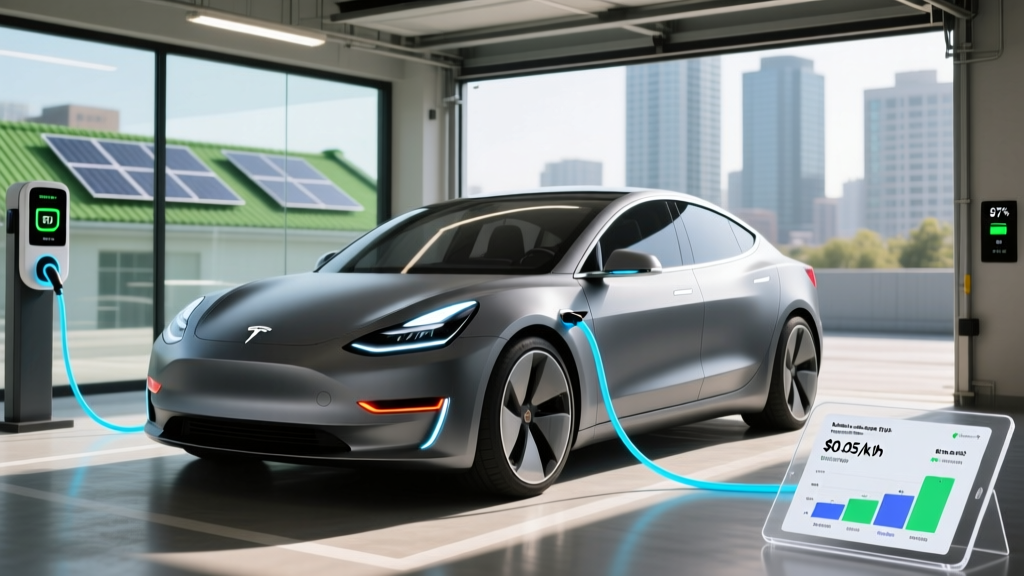
The Tesla Model Y has been the world's best-selling EV for two consecutive years, but by late 2024 it was showing its age against fresher rivals like the Hyundai IONIQ 5 and Ford Mustang Mach-E. Enter Project Juniper — Tesla's comprehensive mid-cycle refresh that transforms the Model Y inside and out for the 2025 model year. Borrowing design cues from the Cybertruck and the refreshed Model 3 Highland, the Juniper update brings a full-width light bar, ventilated seats, rear touchscreen, ambient lighting, and critically, a revised battery and thermal management system that nudges range and charging speed upward.
But does the Juniper refresh go far enough to maintain Tesla's dominance in the most competitive EV segment? After examining EPA data, real-world driving impressions, and ownership economics, here's what buyers need to know before signing an order agreement.
Quick Verdict: Is the Juniper Model Y Worth the Wait?
The 2025 Model Y Juniper is an evolutionary, not revolutionary, update — and that's largely a compliment. Tesla addressed the most common complaints (ride harshness, cabin noise, stale interior) without breaking what works: class-leading efficiency, Supercharger network access, and over-the-air improvement capability. If you were already considering a Model Y, Juniper makes the decision easier. If you were cross-shopping rivals, the refreshed interior and improved ride quality close the gap substantially.
Range, Battery & Efficiency: Real-World Numbers
The 2025 Model Y Long Range AWD — the volume seller — carries an EPA-estimated 320 miles of range, a modest 10-mile bump over the pre-refresh Long Range. The Rear-Wheel-Drive base model is rated at 300 miles EPA. Tesla achieves this through a combination of slightly higher usable battery capacity and improved drivetrain efficiency rather than a wholesale battery swap.
| Spec | Long Range AWD | Rear-Wheel Drive | Performance |
|---|---|---|---|
| EPA Range | 320 mi | 300 mi | 295 mi |
| Battery (Usable) | ~78 kWh (NMC) | ~60 kWh (LFP) | ~78 kWh (NMC) |
| Efficiency | 122 MPGe / 27 kWh/100mi | 128 MPGe / 26 kWh/100mi | 117 MPGe / 29 kWh/100mi |
| Drivetrain | Dual-Motor AWD | Single-Motor RWD | Dual-Motor AWD |
The EPA sticker says 320 miles for the Long Range AWD, but plan for approximately 260–280 miles on sustained highway driving at 70–75 mph, and 220–250 miles in freezing temperatures (below 32°F). The RWD LFP model holds range slightly better in cold weather due to LFP chemistry characteristics but starts from a lower baseline of 300 miles EPA. For road-trip planning, budgeting 250 miles between Supercharger stops in moderate weather is a safe, stress-free approach.
The chemistry split matters for long-term ownership. The Long Range and Performance trims use NMC (nickel manganese cobalt) cells, which offer higher energy density but Tesla recommends daily charging to 80% for longevity. The RWD trim uses LFP (lithium iron phosphate) chemistry, which Tesla explicitly allows charging to 100% regularly — effectively giving the smaller battery more daily usable capacity and better calendar-life durability. For high-mileage commuters, the LFP RWD model is arguably the smarter long-horizon buy.
Charging Speed: DC Fast, Level 2 & Supercharger Access
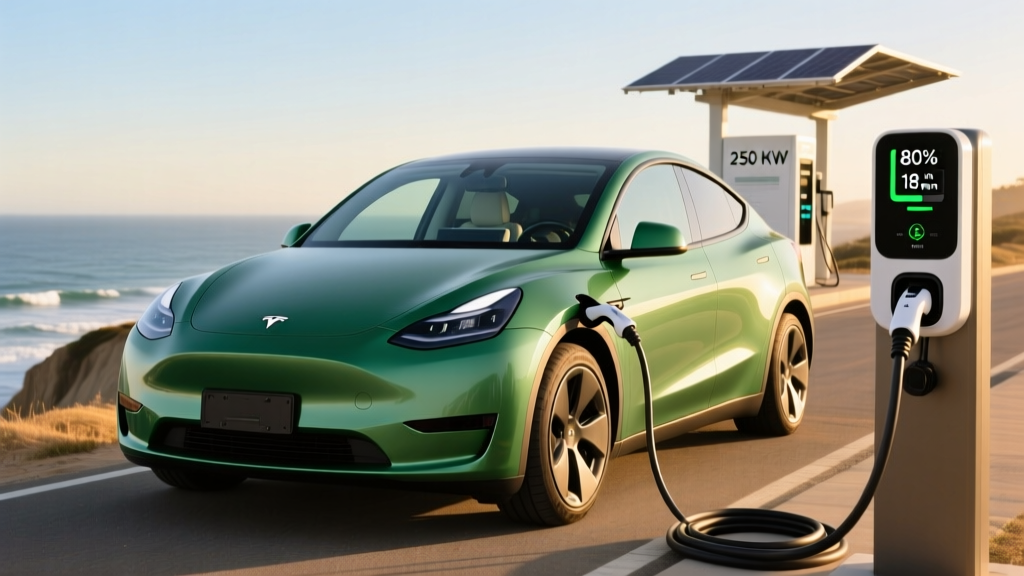
Charging remains one of Tesla's strongest competitive advantages, and the Juniper refresh modestly improves DC fast-charge capability. The Long Range and Performance models now peak at approximately 250 kW on V3 Superchargers (and compatible third-party CCS/NACS stations), achieving a 10–80% charge in roughly 25 minutes. The RWD LFP model peaks closer to 170 kW due to LFP's charge-rate limitations, taking approximately 30–32 minutes from 10–80%.
| Charging Method | Power / Rate | Speed (Miles Added) | Notes |
|---|---|---|---|
| DC Fast Charge (V3 Supercharger) | Peak 250 kW (LR/Perf) Peak 170 kW (RWD) |
~1,000 mi/hr at peak ~680 mi/hr at peak |
10–80% in ~25 min (LR), ~30 min (RWD). Curve tapers sharply above 80%. |
| Level 2 Home (48A / 11.5 kW) | 11.5 kW | ~37 mi/hr | Full charge in ~7–8 hours. Requires NEMA 14-50 or hardwired 60A circuit. |
| Level 2 Home (32A / 7.7 kW) | 7.7 kW | ~25 mi/hr | Full charge in ~10–11 hours. Adequate for most daily commutes. |
| Level 1 (120V / 12A) | 1.4 kW | ~4 mi/hr | Emergency/trickle only. Not viable for daily use. |
A critical note on charging curves: The 250 kW peak is sustained only between roughly 10–35% state of charge. Above 50%, the rate drops to approximately 120 kW, and above 80% it falls below 50 kW. This is normal lithium-ion behavior, but it means a 10–90% charge takes closer to 40 minutes, not the 25 minutes Tesla's marketing implies. Plan road-trip stops around 10–80% windows for the best time efficiency.
The Juniper Model Y ships with the NACS (North American Charging Standard) connector natively. Tesla's Supercharger network — now exceeding 6,000 V3 and V4 stalls across North America — remains the most reliable public DC charging infrastructure available, according to fueleconomy.gov and independent reliability surveys. Non-Tesla CCS vehicles can access Superchargers via adapter, but Tesla owners benefit from seamless plug-and-charge integration with no app or RFID card required.
Performance & Driving Dynamics
The Juniper refresh carries over the Model Y's proven powertrains with minor software and thermal tweaks:
- Long Range AWD: 384 hp, 0–60 mph in 4.8 seconds. Dual-motor all-wheel drive with excellent traction in rain and light snow.
- Rear-Wheel Drive: 295 hp, 0–60 mph in 6.2 seconds. Adequate for merging and highway passing, but noticeably less urgent than AWD trims.
- Performance: 456 hp, 0–60 mph in 3.5 seconds. Track Mode, lowered suspension, 21" wheels. Thrilling but at the cost of ~25 miles of range and a firmer ride.
The most significant driving-dynamics improvement in the Juniper update is the retuned suspension and additional acoustic insulation. Tesla has softened the low-speed ride (addressing a common complaint about the pre-refresh car's harshness over potholes and expansion joints) while adding laminated glass and sound-deadening material that noticeably reduces wind and road noise at highway speeds. It's still not Lexus-quiet, but the gap to premium competitors has narrowed considerably.
One-pedal driving via regenerative braking remains excellent, with Tesla's regen calibration among the smoothest in the industry. The Juniper Model Y also retains a 3,500-pound towing capacity (AWD trims) when equipped with the factory tow hitch — competitive with the Ford Mach-E and slightly ahead of the Hyundai IONIQ 5.
Interior, Tech & Driver Assistance
This is where the Juniper refresh is most visible. Tesla has adopted the minimalist design language from the Model 3 Highland:
- Front: 15.4-inch center touchscreen (same as before, but with faster processor and improved responsiveness). No instrument cluster — speed and navigation data appear in the upper-left corner of the main display. Ventilated front seats (a first for Model Y), ambient lighting strip across the dash and doors, and a redesigned center console with wireless charging pads and improved cupholder geometry.
- Rear: An 8-inch rear touchscreen for climate control and entertainment (streaming, navigation), heated rear seats, and slightly improved legroom from revised seat packaging. Rear legroom measures 41.6 inches, which remains best-in-class for the segment.
- Cargo: 30.2 cubic feet behind the second row, expanding to 72.1 cubic feet with the 60/40 split rear seats folded. The front trunk (frunk) adds an additional 4.1 cubic feet — useful for charging cables or a small bag.
On the driver-assistance front, the Juniper Model Y ships with Tesla's Enhanced Autopilot hardware (HW4 cameras and processor). Standard features include Traffic-Aware Cruise Control, Autosteer (lane centering), and automatic emergency braking. The optional Full Self-Driving (Supervised) package ($8,000 or $99/month) adds Navigate on Autopilot, Auto Lane Change, Autopark, and Smart Summon.
Tesla Autopilot and FSD (Supervised) are SAE Level 2 driver-assistance systems. The driver must remain fully engaged, eyes on the road, and hands available to take over at any moment. These are NOT autonomous or self-driving systems. Tesla's naming conventions ("Full Self-Driving") have drawn criticism from NHTSA and safety advocates. Only Level 4 services like Waymo operate without a human driver — and those are limited to specific geofenced areas.
Pricing, Trims & Federal Tax Credit Eligibility
| Trim | Base MSRP | As-Tested (Typical) | §30D Credit Eligible? |
|---|---|---|---|
| Rear-Wheel Drive | $44,990 | $46,490 (w/ paint + wheels) | Yes — up to $7,500 |
| Long Range AWD | $48,990 | $51,490 (w/ FSD + paint) | Yes — up to $7,500 |
| Performance | $52,490 | $55,990 (w/ FSD + red paint) | Yes — up to $7,500 |
Federal tax credit details (§30D): As of current IRS guidelines, the Model Y qualifies for up to $7,500 in federal tax credits, which can now be transferred to the dealer at the point of sale as an immediate price reduction. However, eligibility depends on several factors:
- Income caps: Modified adjusted gross income must not exceed $150,000 (single), $225,000 (head of household), or $300,000 (joint filing).
- MSRP cap: The vehicle MSRP (including options but excluding destination) must not exceed $80,000 for SUVs — all Model Y trims clear this comfortably.
- Battery sourcing: A percentage of critical minerals and battery components must be sourced from the US or free-trade-agreement countries. Tesla's supply chain has largely met these thresholds, but the exact credit amount ($3,750 vs. $7,500) can shift as sourcing rules tighten annually. Confirm current eligibility on the IRS clean vehicle credit page before purchasing.
With the full $7,500 credit applied, the effective price of the Long Range AWD drops to approximately $41,490 — making it competitive with the Hyundai IONIQ 5 SEL ($45,500 before incentives) and significantly undercutting the Ford Mach-E Premium AWD ($49,995).
Warranty & Long-Term Ownership
Tesla's warranty coverage remains in line with the EV industry standard:
- Basic Vehicle: 4 years / 50,000 miles
- Battery & Drive Unit: 8 years / 120,000 miles (Long Range, Performance) with a minimum 70% capacity retention guarantee. The RWD LFP model carries an 8-year / 100,000-mile battery warranty.
Based on aggregated fleet data from Tesla's own impact reports and third-party sources like Recurrent Auto, Model Y batteries typically show approximately 10–12% degradation at 100,000 miles, well within the warranty threshold. LFP batteries in the RWD model are expected to degrade even more slowly, though long-term fleet data is still maturing. A full battery replacement out of warranty currently costs approximately $12,000–$16,000 at Tesla Service Centers, though this is rarely needed within the vehicle's typical 15-year lifespan.
Insurance costs remain a consideration: the Model Y carries above-average insurance premiums compared to non-electric compact SUVs, typically $1,800–$2,400 annually depending on driver profile and location. This partially offsets fuel savings in total-cost-of-ownership calculations.
Pros, Cons & Who Should Buy
✓ Pros
- Class-leading efficiency (26–29 kWh/100mi)
- Supercharger network — most reliable public DC charging
- Over-the-air updates continuously add features
- Spacious rear seat and cargo area (72.1 cu ft max)
- LFP RWD option for 100% daily charging and longevity
- Improved ride comfort and cabin quietness over pre-refresh
- 3,500-lb towing capacity (AWD trims)
✗ Cons
- No physical turn-signal stalk (steering-wheel buttons)
- No Apple CarPlay or Android Auto
- Higher insurance costs than segment average
- Performance trim ride remains firm on rough roads
- FSD package ($8,000) is not worth the cost for most buyers
- Rear visibility is limited; relies heavily on camera
- Build quality still inconsistent panel-gap-wise vs. legacy OEMs
- Daily commuters (30–80 miles round-trip): Home Level 2 charging makes this effortless; LFP RWD is the value pick.
- Young families: Rear seat space, cargo volume, and Supercharger road-trip capability check every box.
- Tech-forward buyers: OTA updates, app integration, and the Tesla ecosystem are unmatched.
- NOT ideal for: Buyers who prioritize traditional luxury interior materials, physical controls, or who lack access to home charging (public-only charging erodes the cost advantage).
Frequently Asked Questions
What is the real-world range of the 2025 Model Y Juniper?
The EPA rates the Long Range AWD at 320 miles, but expect approximately 260–280 miles on highway trips at 70–75 mph and 220–250 miles in sub-freezing temperatures. The RWD LFP model starts at 300 miles EPA with slightly better cold-weather retention.
How fast does the Juniper Model Y charge?
The Long Range and Performance trims peak at 250 kW on DC fast chargers, achieving 10–80% in about 25 minutes. The RWD LFP model peaks at 170 kW with a 10–80% time of roughly 30 minutes. At home on a 48-amp Level 2 charger, expect about 37 miles of range per hour of charging.
How much does the 2025 Model Y cost after tax credits?
The Long Range AWD starts at $48,990 MSRP. With the full $7,500 federal tax credit (transferred at point of sale), the effective price drops to approximately $41,490. Eligibility depends on income caps ($150K single / $300K joint), and battery-sourcing requirements that may shift — verify on IRS.gov before purchasing.
Is the Juniper Model Y worth buying vs. the Hyundai IONIQ 5 or Ford Mach-E?
The Juniper Model Y wins on charging infrastructure (Supercharger access), efficiency, and cargo space. The IONIQ 5 offers faster peak charging (350 kW on 800V architecture), a more distinctive design, and a slightly more comfortable highway ride. The Mach-E provides a more traditional driving feel and better dealership service network. For most buyers prioritizing total ownership ease, the Model Y remains the default choice — but the gap has narrowed meaningfully.
Does the 2025 Model Y qualify for the federal EV tax credit?
Yes — all Model Y trims currently qualify for up to $7,500 under IRS §30D, subject to buyer income limits and battery-sourcing requirements. The credit can be transferred to the dealer at point of sale for an instant price reduction. Always confirm current eligibility at irs.gov, as critical-mineral sourcing rules tighten annually.
Is Tesla Autopilot self-driving?
No. Autopilot and Full Self-Driving (Supervised) are SAE Level 2 driver-assistance systems. You must remain fully attentive, with hands available and eyes on the road, at all times. Tesla's marketing language has been criticized by safety regulators — treat these as advanced cruise control and lane-keeping aids, not autonomous systems.