Quick Verdict: The Quicksilver Long Range AWD Hits the Sweet Spot
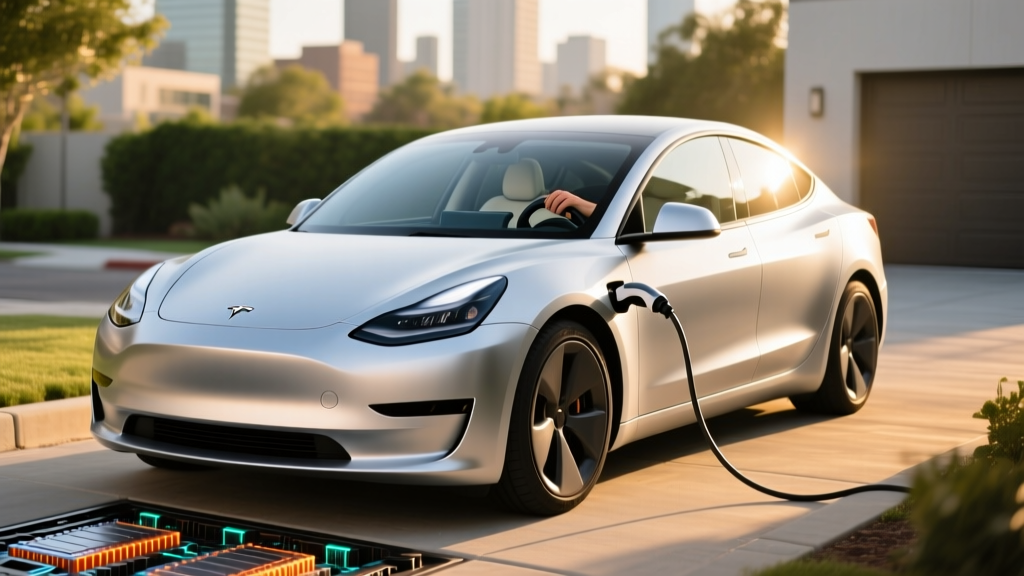
The 2025 Tesla Model 3 Long Range All-Wheel Drive in Quicksilver — Tesla's liquid-metallic paint option introduced with the refreshed "Highland" Model 3 — delivers 341 miles of EPA-estimated range, 250 kW peak DC fast charging, and a 4.2-second 0-60 mph time for a base MSRP of $47,130 (including destination). It's the best-balanced Model 3 trim for buyers who want dual-motor traction, strong highway range, and access to Tesla's Supercharger network without stepping up to the Performance tier.
Quicksilver itself is a multi-coat metallic finish ($2,000 option) that shifts between silver and pale blue depending on light conditions. It pairs well with the Highland redesign's cleaner front fascia, ventilated front seats, and rear touchscreen — all of which make the 2025 Model 3 a meaningfully better daily driver than the pre-2024 versions.
2025 Model 3 Quicksilver: Full Spec Sheet
| Specification | Long Range AWD (Quicksilver) |
|---|---|
| EPA Range | 341 miles |
| Battery (Usable) | ~75 kWh, NMC (nickel-manganese-cobalt) |
| Drivetrain | Dual-motor AWD |
| Horsepower | ~346 hp (combined) |
| 0-60 mph | 4.2 seconds |
| Top Speed | 125 mph |
| Efficiency | 131 MPGe combined / 25 kWh/100 mi |
| Max DC Fast Charge | 250 kW (peak) |
| 10-80% DC Charge Time | ~25 minutes |
| Level 2 Home Charge Rate | 11.5 kW (44 mi/hr) |
| Charging Port | NACS (native Tesla connector) |
| Cargo Volume | 23 cu ft (rear trunk + frunk combined) |
| Rear Legroom | 35.3 inches |
| Base MSRP (incl. destination) | $47,130 |
| As-Tested (Quicksilver + FSD) | $57,130 |
| Battery Warranty | 8 years / 120,000 miles (70% retention) |
Real-World Range: What to Actually Expect
Real-World Highway (70-75 mph, mild weather): ~280–300 miles
Real-World Highway (cold weather, 30°F or below): ~230–260 miles
City/Commuter (moderate temps): ~310–330 miles
The 341-mile EPA figure is competitive for a dual-motor luxury sedan, but real-world results depend heavily on speed and temperature. On a flat 70-mph highway loop in 65°F conditions, expect to see roughly 280–300 miles before the battery reaches 10%. At 80 mph — common on Western interstates — that drops to around 260 miles.
Cold weather is the bigger variable. In sustained 25–30°F temperatures, the NMC battery's internal resistance rises and cabin heating draws significant energy even with the Model 3's standard heat pump. Plan for 230–260 miles of usable range in winter highway driving. Preconditioning the battery while plugged in (via the Tesla app's scheduled departure feature) recovers some of that loss by warming the pack before you leave.
For context, the RWD Model 3 with its smaller LFP battery is rated at 272 miles EPA but tends to hold range more consistently in stop-and-go traffic. The Long Range AWD's advantage is highway cruising and cold-weather headroom — the larger NMC pack gives you more absolute buffer.
Charging Speed: Supercharger Network + Home Level 2
Tesla's charging ecosystem remains the Model 3's strongest practical advantage. The 2025 Long Range AWD supports up to 250 kW at V3/V4 Superchargers via its native NACS port — no adapter required.
| Charging Method | Power (kW) | Speed (mi/hr added) | Notes |
|---|---|---|---|
| Level 1 (120V household) | ~1.4 kW | ~4–5 mi/hr | Emergency/trickle only |
| Level 2 (240V, 48A Wall Connector) | 11.5 kW | ~44 mi/hr | Full charge in ~7 hours |
| Level 2 (240V, 32A mobile connector) | 7.7 kW | ~30 mi/hr | NEMA 14-50 outlet |
| DC Fast (Supercharger V3/V4) | 250 kW peak | ~175 mi in 15 min | 10-80% in ~25 min |
| DC Fast (CCS station w/ adapter) | Up to 150 kW | Variable | Tesla CCS adapter included |
Charging curve reality: The 250 kW peak only holds between roughly 10–30% state of charge. By 50% SoC, the rate tapers to around 150 kW, and above 80% it drops sharply to under 50 kW. This is why Tesla (and every other manufacturer) quotes 10-80% times — the final 20% is painfully slow on any lithium-ion pack. Plan your road-trip stops around 10-80% cycles for the fastest overall travel time.
At home, a Tesla Wall Connector on a 60-amp circuit delivers 11.5 kW (48 amps continuous), adding roughly 44 miles of range per hour. A typical overnight session from 30% to 80% takes about 3.5 hours. Installation costs for a Wall Connector setup range from $500 (simple run near the panel) to $2,000+ if you need a panel upgrade or long conduit runs — consult a licensed electrician for your specific situation.
Performance and Driving Dynamics
The dual-motor AWD powertrain produces approximately 346 combined horsepower and launches the Model 3 Long Range to 60 mph in 4.2 seconds — quick enough to merge onto any freeway with authority, if not quite as thrilling as the Performance trim's 3.1-second sprint. The instant torque delivery makes it feel even quicker in real-world 0-40 mph city driving.
The Highland refresh brought meaningful chassis improvements: revised damper tuning, frequency-selective shock absorbers, and a stiffer subframe. The result is noticeably better ride quality over broken pavement compared to the pre-2024 Model 3, which drew frequent criticism for its harsh ride. Body control in corners is flat and confident, and the steering — while still numb by sports-sedan standards — is precise enough for spirited canyon driving.
Regenerative braking remains aggressive in the Model 3. Tesla removed the user-adjustable regen setting several model years ago, so one-pedal driving is essentially mandatory. Most owners adapt within a week, but if you're coming from an EV with adjustable regen (Hyundai, BMW, Ford), expect a brief adjustment period.
Interior, Tech, and Cargo
The 2025 Highland interior is a significant step up in material quality. Soft-touch surfaces replace much of the hard plastic that plagued earlier Model 3s. Ventilated front seats are now standard on Long Range trims — a welcome addition for warm-climate buyers. The 15.4-inch central touchscreen handles everything from climate to navigation, and the rear-seat 8-inch touchscreen (new for Highland) lets passengers control their own climate zone and stream media.
Quirks remain: the absence of a traditional instrument cluster means speed and range info live in the upper-left corner of the center display. Turn-signal buttons on the steering wheel (replacing the stalk) take about a week of muscle-memory retraining. And while the panoramic glass roof is beautiful, it does let in significant heat in summer — Tesla includes a tinted film, but many owners add an aftermarket sunshade.
Cargo: The rear trunk offers 21 cu ft, and the front trunk (frunk) adds 2 cu ft — enough for a charging cable bag and small groceries. Total: 23 cu ft. Rear seats fold 60/40 for longer items. Rear legroom at 35.3 inches is adequate for adults under 6 feet but tight for taller passengers on long trips.
Autopilot and FSD (Supervised): Every Model 3 includes Basic Autopilot — adaptive cruise control and lane centering on highways. The optional Full Self-Driving (Supervised) package ($8,000 upfront or $99/month) adds automatic lane changes, traffic light/stop sign recognition, and navigate-on-autopilot. This is an SAE Level 2 system — you must keep your hands on the wheel and eyes on the road at all times. It is not autonomous driving.
Pricing, Trims, and Federal Tax Credit Eligibility
| Cost Item | Amount |
|---|---|
| Model 3 Long Range AWD base MSRP | $47,130 (incl. $1,000 destination) |
| Quicksilver paint | +$2,000 |
| 19" Nova wheels (optional) | +$1,500 |
| FSD (Supervised) | +$8,000 |
| As-tested total | $58,630 |
| Estimated §30D federal credit | $7,500 (if eligible — see below) |
| Effective price after credit | ~$51,130 (as-tested, if eligible) |
Federal tax credit (§30D) eligibility for the 2025 Model 3: As of current IRS guidance, the Model 3 Long Range AWD has qualified for the full $7,500 credit when taken as a point-of-sale reduction. However, eligibility depends on several factors that change periodically:
- MSRP cap: Sedans must be under $55,000 MSRP. The base LR AWD qualifies; adding options that push MSRP above $55,000 may disqualify it.
- Buyer income cap: AGI must not exceed $150,000 (single), $225,000 (head of household), or $300,000 (joint filing).
- Battery sourcing: Critical minerals and battery components must meet increasing domestic-content thresholds. Tesla's supply chain has generally met these requirements for the Model 3, but the rules tighten annually. Verify current eligibility on fueleconomy.gov before purchasing.
- Point-of-sale transfer: You can transfer the credit to the dealer at purchase for an immediate price reduction, rather than waiting to claim it on your tax return.
Always confirm with your tax professional and check the latest IRS guidance at irs.gov before relying on credit eligibility for your budget.
Ownership Costs and Warranty
Tesla's battery warranty on the Long Range AWD covers 8 years or 120,000 miles, whichever comes first, with a guaranteed minimum 70% capacity retention. The limited vehicle warranty is 4 years / 50,000 miles. Real-world battery degradation data from large owner fleets suggests the NMC pack in the Model 3 typically loses 5–8% capacity in the first 50,000 miles, then flattens to roughly 1–2% loss per 50,000 miles thereafter.
Insurance costs tend to run higher than comparable ICE sedans — expect $1,800–$2,500 annually depending on your location and driving record, per industry data. Tesla's own insurance product is available in many states and can be competitive for clean-record drivers.
Charging costs vary widely by region. At the national average residential electricity rate of ~$0.17/kWh, a full home charge costs roughly $12.75 (75 kWh × $0.17). At $0.17/kWh and 25 kWh/100 mi efficiency, that's about $0.043 per mile — roughly a third of the per-mile fuel cost of a 30-mpg gas car at $3.50/gallon. Supercharger costs are higher, typically $0.25–$0.40/kWh depending on location and time of day.
Pros, Cons, and Who Should Buy
Pros
- 341-mi EPA range with strong real-world highway efficiency
- 250 kW Supercharger access with native NACS — no adapter needed
- Highland refresh: better ride, quieter cabin, ventilated seats
- Dual-motor AWD for all-weather traction
- Over-the-air updates continuously add features
- Strong resale value relative to EV segment
Cons
- No instrument cluster — speed/range in center screen only
- Turn-signal buttons on wheel take adaptation
- Rear legroom tight for tall adults (35.3 in)
- FSD at $8,000 is expensive for a Level 2 system
- No Apple CarPlay or Android Auto
- Insurance premiums above segment average
Best for: Daily commuters with home charging access, tech-forward buyers who value OTA updates, and all-weather drivers who want AWD without an SUV. The 341-mile range and Supercharger network make it viable for road trips, though families needing more cargo space should look at the Model Y or Hyundai Ioniq 5.
Consider instead if: You need maximum rear-seat space (BMW i4, Hyundai Ioniq 6), prefer physical controls (BMW i4), or want Apple CarPlay (most non-Tesla EVs). If your commute is under 40 miles round-trip and you don't need AWD, the RWD Model 3 at $38,130 saves $9,000 and still delivers excellent value.
Frequently Asked Questions
What is the real-world range of the 2025 Model 3 Long Range AWD?
Expect 280–300 miles on the highway in mild weather, 230–260 miles in cold conditions (below 30°F), and up to 330 miles in city driving with moderate regenerative braking. The 341-mile EPA figure is achievable in mixed driving at moderate speeds.
How fast does the Model 3 Quicksilver charge at home and on the road?
At home on a 48-amp Level 2 Wall Connector, it charges at 11.5 kW, adding about 44 miles per hour (full charge in ~7 hours). On a V3 Supercharger, it peaks at 250 kW and charges from 10-80% in approximately 25 minutes.
Does the 2025 Model 3 Long Range AWD qualify for the $7,500 federal tax credit?
It has qualified under current §30D rules, but eligibility depends on your income (AGI caps apply), the vehicle's MSRP staying under $55,000, and battery-sourcing requirements that tighten annually. Verify on fueleconomy.gov and with a tax professional before purchasing.
Is the Model 3 Long Range AWD worth it vs. the Hyundai Ioniq 6 or BMW i4?
The Model 3 wins on Supercharger network access and OTA updates. The Ioniq 6 (361-mi EPA, SE Long Range) offers more range and 800V ultra-fast charging but uses CCS with less reliable public infrastructure. The BMW i4 xDrive40 has a more traditional luxury interior and Apple CarPlay but starts ~$5,000 higher and charges slower at ~205 kW DC.
What's the difference between Quicksilver and other Tesla paint colors?
Quicksilver is a multi-coat metallic that shifts between bright silver and pale blue depending on light angle. It's a $2,000 option, more expensive than Pearl White (free) and Solid Black ($1,500), but less than Ultra Red ($2,500). Owners report it hides light dust and water spots better than darker colors.
How long will the Model 3 battery last before needing replacement?
Tesla warranties the NMC pack for 8 years / 120,000 miles at 70% minimum capacity. Fleet data suggests most Model 3 packs retain 85–90% capacity at 100,000 miles. Full replacement costs $12,000–$16,000 out of warranty, but premature failures are uncommon based on current data.