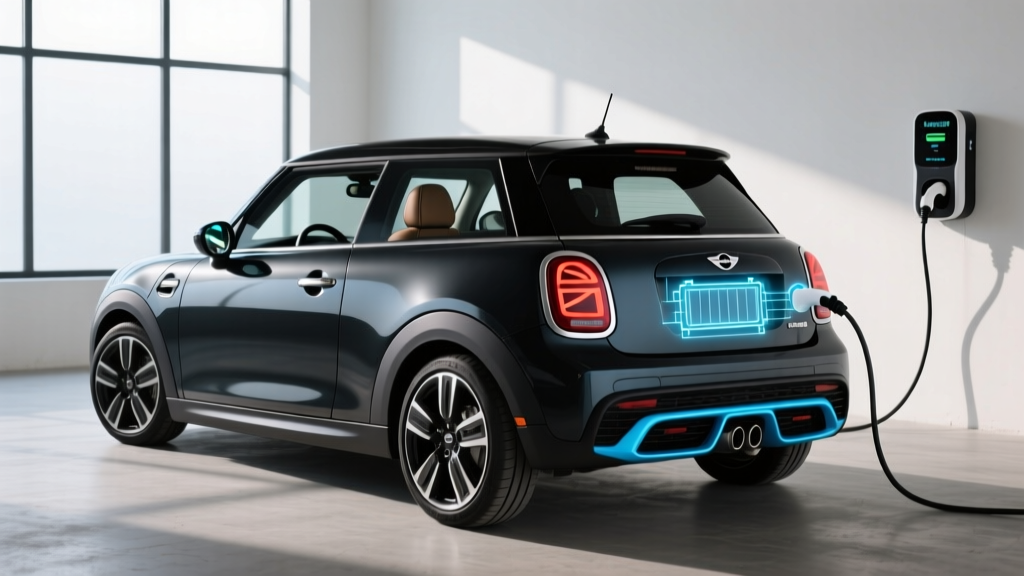
Quick Verdict: The 2025 Mini Cooper SE at a Glance
The 2025 Mini Cooper SE returns with a generational leap in battery capacity, jumping from the previous model's modest 32.6 kWh pack to a 54.2 kWh (usable) battery that pushes EPA-estimated range past the 100-mile barrier. For urban EV shoppers who prioritize driving dynamics, premium interior quality, and compact parking-footprint dimensions, the new Cooper SE is a compelling city companion — provided your daily commute and charging access align with its range profile.
But how does this EV stack up on paper and in practice? Below, we break down every spec that matters: the 2025 Mini Cooper SE length in inches, real-world range expectations, DC fast-charge speeds, pricing after federal tax credits, and the practical trade-offs of owning an electric Mini in 2026.
| Spec | Value |
|---|---|
| EPA Range | 114 miles (est.) |
| Battery (usable) | 54.2 kWh, NMC chemistry |
| Motor / Drivetrain | Single front motor / FWD |
| Horsepower / Torque | 218 hp / 243 lb-ft |
| 0–60 mph | 6.5 seconds |
| Max DC Fast Charge | 95 kW (peak) |
| 10–80% DC Time | ~30 minutes |
| Level 2 Charge Rate | 11 kW (AC) |
| Efficiency | ~110 MPGe / ~30 kWh/100 mi |
| Overall Length | 153.2 inches |
| Cargo Volume (rear seats up) | ~7.1 cu ft |
| Base MSRP (Signature) | ~$30,900 (before destination) |
| Battery Warranty | 8 years / 100,000 miles |
Dimensions & Packaging: 2025 Mini Cooper SE Length in Inches and More
The search for the 2025 Mini Cooper SE length in inches leads directly to one of this car's defining traits: it remains one of the smallest EVs sold in the U.S. market. At approximately 153.2 inches long, the new-generation Cooper SE is only marginally longer than its predecessor, preserving the go-kart proportions that make Minis legendary in tight urban environments.
Here is a full dimensional breakdown:
- Length: 153.2 in
- Width (excl. mirrors): 68.5 in
- Height: 58.4 in
- Wheelbase: 99.8 in
- Curb weight: ~3,600 lbs
For context, that length is roughly 18 inches shorter than a Chevrolet Bolt EV and over 30 inches shorter than a Tesla Model 3. The payoff is effortless parallel parking and nimble lane changes. The trade-off is interior space — particularly cargo room and rear-seat legroom, which we detail below.
Interior and Cargo Space
Front-seat occupants enjoy generous headroom and adequate legroom, with supportive sport-style seats standard on most trims. The rear seats, however, are best suited for children or short trips — adult legroom is tight at approximately 30 inches. Cargo volume behind the rear seats sits around 7.1 cubic feet, expanding to roughly 22 cu ft with the rear seatbacks folded. There is no front trunk (frunk); the compact motor compartment leaves no room for one.
Range, Efficiency, and Real-World Expectations
Real-world expectation: Plan for approximately 90–105 miles during sustained highway driving at 70+ mph, and potentially 75–90 miles in cold weather (below 35°F) with cabin heating active. City driving with regenerative braking can approach or slightly exceed the EPA sticker.
The jump from the previous Cooper SE's 114-mile EPA rating (with only 32.6 kWh) to the 2025 model's improved efficiency is a function of both the larger 54.2 kWh battery and refinements in the powertrain and thermal management system. The new model uses a J1 platform engineered from the ground up for electrification, reducing parasitic losses compared to the adapted-ICE architecture of the prior generation.
Efficiency lands around 110 MPGe combined, or roughly 30 kWh per 100 miles — competitive with other small EVs but not class-leading. The Honda Prologue and Hyundai Kona Electric achieve higher MPGe figures, though neither matches the Mini's driving character.
Cold-Weather Range Loss
Like all EVs, the Cooper SE suffers range reduction in freezing temperatures. The NMC battery chemistry, combined with the relatively small pack, means cold-weather losses can be proportionally more impactful. Expect a 20–30% reduction in sub-freezing conditions. The heat pump — standard on the 2025 model — helps mitigate this compared to resistive heating, but physics is physics: a smaller battery has less buffer to absorb the hit. Preconditioning the battery while plugged in is essential for preserving range and enabling peak DC charge rates in winter.
Charging Speeds: DC Fast, Level 2, and Level 1
Charging is where the 2025 Cooper SE makes practical strides, though it does not lead the segment in peak charge rate. Here is the full charging profile:
| Level | Power | Speed (approx.) | Notes |
|---|---|---|---|
| Level 1 (120V) | ~1.4 kW | ~4–5 mi/hr | Emergency/trickle only; full charge in ~40+ hours |
| Level 2 (240V) | 11 kW | ~33–37 mi/hr | Full charge in ~5–6 hours; ideal for home/work |
| DC Fast Charge | 95 kW peak | 10–80% in ~30 min | Tapers significantly above 80%; CCS connector |
The 95 kW peak DC charge rate is modest by 2025 standards — rivals like the Hyundai Kona Electric and Volvo EX30 accept higher peak rates. In practice, the Cooper SE's charge curve holds near peak only briefly before tapering. A 10–80% session takes roughly 30 minutes at a capable charger (150 kW or higher). Charging from 80–100% adds considerable time due to the taper, so road-trippers should plan to hop between chargers rather than waiting for a full top-up.
For daily ownership, Level 2 home charging at 11 kW is the sweet spot. A full overnight charge takes about 5–6 hours, meaning you'll wake up to a full battery every morning. Installation of a 240V/48A home charger typically costs $500–$2,000 depending on panel capacity and run length — consult a licensed electrician for a site-specific quote.
The Cooper SE uses a CCS1 connector for DC fast charging. It is not natively equipped with the Tesla NACS connector, though adapters are available for accessing Tesla Supercharger stalls (check Mini's official guidance for compatibility updates).
Performance and Driving Dynamics
Mini has always prioritized driving engagement over raw power, and the 2025 Cooper SE continues that tradition. The front-mounted electric motor produces 218 horsepower and 243 lb-ft of torque, delivering a 0–60 mph time of approximately 6.5 seconds. That's quick enough for confident highway merging and genuinely fun in urban canyon carving.
The single-speed transmission and instant electric torque give the Cooper SE the responsive, darting character that defines the Mini brand. Steering is direct and well-weighted, and the low center of gravity (battery pack mounted under the floor) keeps body roll in check through corners. The FWD layout means you'll experience some torque steer under hard acceleration, but it's manageable and part of the Mini personality.
Regenerative braking is adjustable via paddle-style controls or the driving mode selector. In its strongest setting, one-pedal driving is achievable around town, though the system doesn't always bring the car to a complete stop — you'll still need the brake pedal at times.
Pricing, Trims, and Federal Tax Credit Eligibility
The 2025 Mini Cooper SE is offered in multiple trims, with pricing structured to give buyers meaningful customization options:
| Trim | Base MSRP | Est. After §30D Credit* |
|---|---|---|
| Signature | ~$30,900 | ~$27,150 (if eligible for $3,750) |
| Iconic | ~$34,900 | ~$31,150 (if eligible for $3,750) |
| Favorable (JCW Sport Package) | ~$37,000+ | Varies by package |
*Destination charges (~$995) not included. Tax credit amounts depend on battery sourcing, buyer income, and MSRP cap compliance. See IRS details below.
Does the 2025 Mini Cooper SE Qualify for the Federal EV Tax Credit?
This is where things get nuanced. Under IRS §30D rules, the Cooper SE faces several eligibility hurdles:
- MSRP Cap: The Cooper SE falls under the $55,000 cap for sedans/hatchbacks — this requirement is met.
- Buyer Income Cap: Modified adjusted gross income must not exceed $150,000 (single), $225,000 (head of household), or $300,000 (joint).
- Battery Sourcing: This is the critical variable. The Cooper SE's battery cells are sourced from supply chains that may not fully meet the critical-minerals and battery-component requirements under current §30D rules. As of the 2025 model year, the Cooper SE is unlikely to qualify for the full $7,500 credit; partial credit ($3,750) may apply depending on the specific battery batch and IRS guidance updates.
- Point-of-Sale Transfer: If eligible, the credit can be transferred to the dealer at purchase, reducing your out-of-pocket cost immediately rather than waiting for tax filing.
Always verify current eligibility on the fueleconomy.gov tax credit page and consult a tax professional before relying on credit amounts for purchase decisions. Rules change, and sourcing compliance is updated periodically by the IRS.
Technology, Safety, and Driver Assists
The 2025 Cooper SE features Mini's latest infotainment system built around a 9.4-inch circular OLED display — a distinctive design element that replaces the traditional instrument cluster. The interface runs Mini Operating System 9, supporting wireless Apple CarPlay and Android Auto, over-the-air updates, and voice assistant integration.
Standard driver-assistance features include:
- Forward collision warning with automatic emergency braking
- Lane departure warning
- Rear cross-traffic alert
- Parking sensors (front and rear)
- Adaptive cruise control (available on higher trims)
Notably absent from the standard package: a 360-degree camera system and hands-free driving assist. The adaptive cruise control is a conventional SAE Level 2 system — it requires continuous driver attention and hands-on-wheel input. It is not autonomous or "self-driving" in any capacity.
The circular OLED display is visually striking but polarizing. Some drivers find the lack of a traditional gauge cluster disorienting, and the screen's round shape means navigation maps and media info compete for space. It's a design-forward choice that prioritizes aesthetics over pure information density.
Pros and Cons: The Honest Assessment
Pros
- Class-leading driving dynamics — genuinely fun to drive
- Compact 153.2-inch length ideal for urban parking
- Premium interior materials and distinctive circular OLED display
- Improved range over previous generation (114 mi EPA)
- Strong 11 kW Level 2 AC charging for overnight home use
- Heat pump standard (improves cold-weather efficiency)
Cons
- Range still trails competitors (Kona Electric: 261 mi, Bolt: 259 mi)
- Modest 95 kW DC fast-charge rate — 30-min 10–80% time
- Very limited cargo space (7.1 cu ft) and tight rear seats
- Federal tax credit eligibility uncertain due to battery sourcing
- No frunk for additional storage
- Circular display may not suit all drivers' preferences
Who Should Buy the 2025 Mini Cooper SE?
Choose the Cooper SE if: You live in a city or dense suburb, have reliable home Level 2 charging, drive fewer than 80 miles per day, value driving engagement over utility, and want a premium compact EV with distinctive styling.
Look elsewhere if: You need road-trip range (200+ miles), regularly carry rear-seat passengers or cargo, lack home charging access, or want to maximize federal tax credit savings. The Hyundai Kona Electric, Chevrolet Equinox EV, or Volvo EX30 may better serve those needs.
The Cooper SE is, fundamentally, a city commuter and lifestyle vehicle. It excels as a second car in a two-vehicle household, a solo commuter runabout, or an urban dweller's daily driver where parking space is at a premium. It is not a family hauler, a road-trip machine, or a budget-maximizing EV purchase. Buy it because you love how it drives and how it looks — not because it wins on a spec-sheet comparison.
Frequently Asked Questions
What is the 2025 Mini Cooper SE length in inches?
The 2025 Mini Cooper SE measures approximately 153.2 inches in overall length, making it one of the shortest EVs available in the U.S. market. This compact footprint is ideal for tight city parking and narrow streets.
What is the real-world range of the 2025 Mini Cooper SE?
The EPA estimates 114 miles of range. In real-world driving, expect roughly 90–105 miles on the highway and 75–90 miles in cold weather (below 35°F). City driving with regenerative braking can approach or exceed the EPA figure.
How fast does the 2025 Mini Cooper SE charge?
DC fast charging peaks at 95 kW, achieving a 10–80% charge in approximately 30 minutes. Level 2 home charging at 11 kW adds about 33–37 miles of range per hour, with a full charge taking 5–6 hours.
Does the 2025 Mini Cooper SE qualify for the $7,500 federal tax credit?
Full $7,500 credit eligibility is unlikely due to battery-sourcing requirements under IRS §30D. Partial credit ($3,750) may apply. Verify current eligibility on fueleconomy.gov and consult a tax professional.
Is the 2025 Mini Cooper SE worth buying vs. competitors?
If driving fun, compact dimensions, and premium interior quality are your top priorities, yes. If range, cargo space, or tax-credit savings matter more, consider the Hyundai Kona Electric (261-mi range), Chevrolet Equinox EV (~300-mi range), or Volvo EX30 (similar size, higher charge rate).
What is the battery warranty on the 2025 Mini Cooper SE?
Mini provides an 8-year / 100,000-mile warranty on the high-voltage battery pack, covering defects and capacity loss below a specified threshold (typically 70% state of health). The basic vehicle warranty is 4 years / 50,000 miles.
What battery chemistry does the 2025 Mini Cooper SE use?
The 2025 Cooper SE uses an NMC (nickel manganese cobalt) lithium-ion battery with approximately 54.2 kWh of usable capacity. NMC offers higher energy density than LFP chemistry, which is important in the Mini's compact platform where physical space for cells is limited.