Quick Answer: Should You Buy the 2025 Mercedes-Benz G-Class EV?
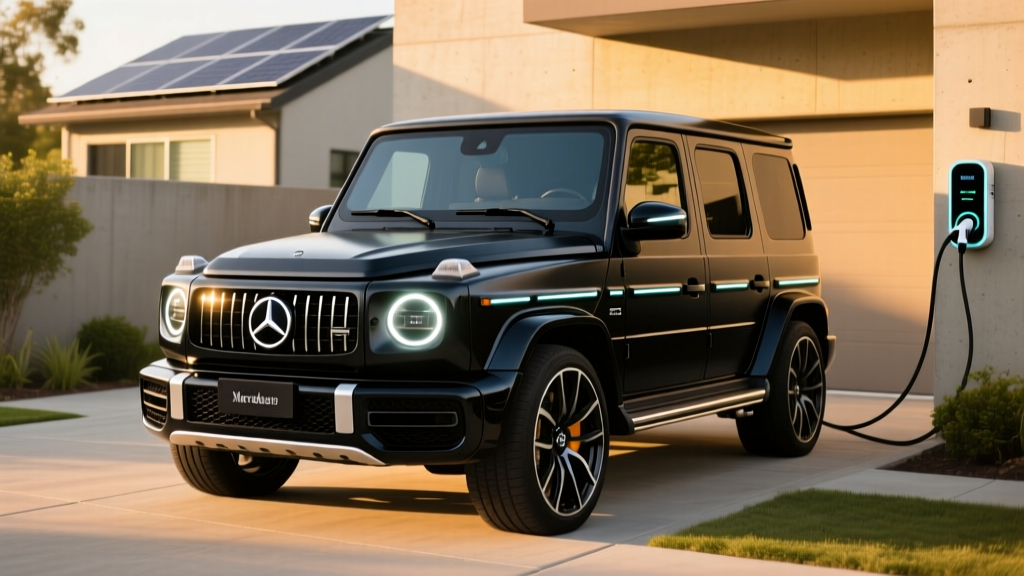
The 2025 Mercedes-Benz G 580 with EQ Technology (the electric G-Class) starts at $161,500 including destination, delivers 239 miles EPA range from a 116 kWh usable battery, and produces 576 horsepower with a 0–60 mph time of 4.1 seconds. It charges at up to 200 kW DC, reaching 10–80% in approximately 32 minutes. Federal §30D tax credit eligibility is unlikely for most buyers due to the MSRP cap ($80,000 for SUVs) — this vehicle exceeds that ceiling. It makes sense if you want the G-Wagen presence and off-road capability with silent, instant-torque electric propulsion, and you can charge at home. It does not make sense as a cost-saving EV — it is a luxury statement vehicle first.
Range, Battery, and What to Expect in the Real World
The G 580 uses a 116 kWh usable lithium-ion battery (NMC chemistry) housed in a double-layer arrangement within the ladder frame. Mercedes-Benz quotes the following EPA figure:
| Metric | Value |
|---|---|
| EPA Range (combined) | 239 miles |
| Battery (usable) | 116 kWh (NMC) |
| Efficiency | 48 kWh/100 mi (approx.) |
| MPGe (combined) | ~70 MPGe |
Real-World Range Reality
The 239-mile EPA sticker is a combined cycle. Expect ~190–210 miles on sustained highway driving at 70+ mph due to the G-Wagen's boxy aerodynamics (Cd of roughly 0.44). In cold weather (below 32°F), plan for 170–195 miles of usable range before needing to charge. The heat pump helps mitigate cabin-draw losses, but the slab-sided body is the dominant efficiency penalty at speed. For city and suburban driving with regenerative braking, 230+ miles is achievable.
The four-motor layout (one per wheel) enables torque vectoring, 360-degree "G-Turns," and a crawl function that replicates low-range gearing. This is a genuine off-road vehicle — not a lifted crossover — with 12.4 inches of ground clearance and the ability to ford 33.5 inches of water. However, that capability comes at a steep efficiency cost compared to aerodynamically optimized EVs like the Lucid Air or Tesla Model Y.
Charging Speed and Infrastructure
The G 580 supports 200 kW peak DC fast charging via a CCS1 connector (NACS adapter available for Tesla Supercharger access in the US). Here is what that looks like in practice:
| Charging Level | Power | Speed / Time | Use Case |
|---|---|---|---|
| Level 1 (120V) | ~1.4 kW | ~3 mi/hr | Emergency only |
| Level 2 (240V, 48A) | 11.5 kW | ~23 mi/hr; 0–100% in ~10 hrs | Overnight home charging |
| DC Fast Charge | 200 kW peak | 10–80% in ~32 min | Road trips |
The 200 kW peak rate is competitive but not class-leading — the Hyundai Ioniq 5 and Kia EV9 hit 250+ kW, and Tesla's architecture supports 250 kW. More importantly, the charge curve matters: the G 580 sustains strong charging rates between 10–60% SoC, then tapers progressively. Plan for 32 minutes at a 200+ kW station for a 10–80% session, but a full 10–100% session will take closer to 55 minutes due to taper above 80%.
For home charging, the 116 kWh battery is large. On a standard 11.5 kW Level 2 home charger (the most common residential setup on a 60A circuit), a full depletion-to-full charge takes roughly 10 hours. This is manageable overnight but means you should charge more frequently rather than running the pack to near-empty. A certified Level 2 home charger with a NEMA 14-50 outlet or hardwired connection is strongly recommended — Level 1 charging at ~3 miles per hour is impractical for daily use with this battery size.
Cost Breakdown: Purchase, Fueling, and Ownership
The G 580 is not an EV purchase motivated by savings. Here is the full financial picture:
| Cost Factor | G 580 EV | G 550 (Gas, 2025) |
|---|---|---|
| Base MSRP | $161,500 | $148,250 |
| Federal §30D Tax Credit | $0 (exceeds $80K SUV cap) | $0 |
| Fuel/Energy Cost per Year* | ~$1,050 (at $0.15/kWh) | ~$3,600 (at $3.50/gal, 14 MPG) |
| Annual Maintenance (est.) | ~$400 | ~$1,200 |
| Insurance (annual est.) | ~$4,800–$6,000 | ~$4,200–$5,500 |
| 5-Year Energy/Fuel Cost | ~$5,250 | ~$18,000 |
*Based on 12,000 miles/year. Electricity costs vary significantly by region — California averages ~$0.30/kWh (doubling the EV energy cost), while Midwest states may be closer to $0.12/kWh. Source: fueleconomy.gov.
The EV saves roughly $2,500–$2,800 per year in fuel and maintenance compared to the gas G 550. Over five years, that is approximately $12,500–$14,000 in operational savings. However, the G 580's higher MSRP ($13,250 more than the G 550) and potentially higher insurance premiums mean the total cost of ownership (TCO) advantage is modest. You are paying a premium for the electric powertrain's refinement, instant torque, and novelty — not for economic rationality.
5-Year Total Cost Estimate
| Category | G 580 EV | G 550 Gas |
|---|---|---|
| Purchase Price | $161,500 | $148,250 |
| Fuel/Energy (5 yrs) | $5,250 | $18,000 |
| Maintenance (5 yrs) | $2,000 | $6,000 |
| Insurance (5 yrs est.) | $27,000 | $24,000 |
| Total (before depreciation) | $195,750 | $196,250 |
Depreciation on both models is significant — luxury SUVs in this price range typically lose 45–55% of value over five years. The G-Class historically holds value better than most luxury vehicles due to limited supply and strong demand, but the EV variant's long-term residual value is unproven as of 2026.
Tax Credit and Incentive Reality
The IRS §30D federal tax credit has an $80,000 MSRP cap for SUVs, vans, and pickup trucks (source: IRS.gov). The G 580's starting MSRP of $161,500 far exceeds this limit, making it ineligible for the $7,500 federal credit regardless of your income or the vehicle's battery sourcing.
Some states offer additional incentives that are not MSRP-capped — for example, certain utility company rebates for EV purchases or home charger installations. Check with your local utility and state energy office. However, do not factor any federal credit into your purchase calculation for this vehicle.
EV vs. Gas G-Class: Performance and Driving Comparison
| Attribute | G 580 EV | G 550 (Gas) | AMG G 63 (Gas) |
|---|---|---|---|
| Horsepower | 576 HP | 416 HP | 577 HP |
| Torque | 852 lb-ft | 443 lb-ft | 627 lb-ft |
| 0–60 mph | 4.1 sec | 5.5 sec | 4.3 sec |
| Range / Tank | 239 mi (EPA) | ~350 mi (~14 MPG, 26 gal) | ~280 mi (~12 MPG) |
| Curb Weight | ~6,800 lbs | ~5,500 lbs | ~5,800 lbs |
| Towing Capacity | TBD (est. 7,000+ lbs) | 7,700 lbs | 7,700 lbs |
| Off-Road Capability | Full (4 motors, G-Turn) | Full (3 locking diffs) | Full (3 locking diffs) |
The EV G-Class matches the AMG G 63 on power and beats it to 60 mph, while being nearly silent. The four independent motors provide torque vectoring that no mechanical differential can replicate — the "G-Turn" feature spins the vehicle 360 degrees on loose surfaces by counter-rotating the left and right wheels. The trade-off is 1,300+ pounds of additional weight, which affects tire wear, braking distances, and efficiency at highway speeds.
For off-road use, the EV has an advantage in low-speed precision (electric motors deliver torque from 0 RPM) and water fording (no air intake to submerge). The gas G 550 retains an advantage in remote-range scenarios — if you are driving in areas without charging infrastructure, the 350-mile gas range and 5-minute refueling are irreplaceable.
Common Misconceptions About the G 580 EV
| Myth | Fact |
|---|---|
| "It gets the $7,500 federal tax credit" | It does not — the MSRP far exceeds the §30D $80,000 SUV cap. |
| "Electric means it can't off-road" | The four-motor setup, simulated diff locks, and 33.5" water fording make it one of the most capable off-road EVs built. It has completed the Schöckl mountain test course in Austria, as every G-Class must. |
| "239 miles is enough for road trips" | On highways, expect ~190–210 miles real-world. Plan charging stops every 180 miles on long trips to maintain a comfort buffer. |
| "It charges as fast as a Tesla" | At 200 kW peak, it is ~20% slower than Tesla's 250 kW V3 Superchargers and significantly slower than 350 kW-capable vehicles like the Porsche Taycan or Hyundai Ioniq 5 on compatible chargers. |
| "No maintenance means it's cheap to own" | Tires (heavy EV + off-road rubber), insurance, and cabin air filters still add up. Budget ~$400–$600/year in basic maintenance. |
First-Time EV Buyer Considerations for the G 580
If this is your first EV, the G 580 is an unusual but not unreasonable entry point — provided you address these fundamentals:
- Home charging is essential. A 116 kWh battery on Level 1 (standard 120V outlet) gains roughly 3 miles per hour — requiring nearly 80 hours for a full charge. You need a Level 2 (240V) home charger. Installation on a 60-amp circuit typically costs $800–$2,000 including the charger unit, but may require a panel upgrade ($1,500–$3,000) if your home has a 100-amp or older electrical service. Consult a licensed electrician for an assessment.
- Understand kW vs. kWh. The battery holds 116 kWh of energy (like a 26-gallon gas tank). The charger delivers power measured in kW — a 200 kW DC fast charger can theoretically deliver 200 kWh in one hour, though no vehicle charges at peak rate for a full session.
- Cold weather reduces range. In sustained sub-freezing temperatures, expect 15–25% range reduction. The G 580's heat pump mitigates cabin-heating energy draw, but the battery itself is less efficient when cold. Preconditioning the battery while plugged in (using the Mercedes me app) before driving restores some range.
- Public charging is improving but inconsistent. With CCS1 native and NACS access via adapter, you can use Electrify America, EVgo, ChargePoint, and Tesla Superchargers (with adapter). Reliability on non-Tesla networks has improved but still lags behind Tesla's network uptime.
Decision Framework: Is the G 580 EV Right for You?
Choose the G 580 EV If:
- You want G-Wagen presence and genuine off-road capability with electric silence and instant torque.
- You can install a Level 2 home charger and primarily drive within 180 miles of home between charges.
- You value the novelty of G-Turns, four-motor torque vectoring, and zero-emission local driving.
- You are not purchasing primarily for cost savings — this is a luxury/enthusiast vehicle.
- You tow occasionally within ~150 miles of home and can charge at destination.
Choose the Gas G 550 or AMG G 63 If:
- You regularly drive in remote areas or take road trips exceeding 300 miles between stops.
- You need maximum range without planning charging stops (350+ miles on a tank).
- You tow heavy loads over long distances frequently.
- You do not have reliable access to Level 2 home charging.
- You prefer proven long-term residual values and established service infrastructure.
Consider a Different Luxury EV If:
- Efficiency and range are priorities — the Rivian R1S (321 mi EPA, ~$80K) or BMW iX (324 mi EPA, ~$87K) deliver far more range per dollar.
- You want three rows — the G 580 seats only five; the Rivian R1S seats seven.
- You need a functional frunk — the G 580 does not have a front trunk (the space houses electrical components).
Battery Warranty and Longevity
Mercedes-Benz provides an 8-year / 100,000-mile high-voltage battery warranty with a capacity retention threshold of 70%. This is standard for the luxury EV segment and matches BMW, Audi, and Porsche coverage. NMC chemistry in the G 580 is expected to degrade roughly 10–15% over the first 100,000 miles based on industry averages for liquid-cooled packs — meaning your 239-mile range may become ~205–215 miles after several years of typical use.
To maximize battery longevity, Mercedes recommends charging to 80% for daily use and reserving 100% charges for trips. The vehicle's battery management system includes a buffer (the total pack capacity exceeds the 116 kWh usable figure), which protects against deep-discharge degradation.
Frequently Asked Questions
Does the 2025 Mercedes-Benz G-Class EV qualify for any tax credits?
No federal §30D credit — the $161,500 MSRP exceeds the $80,000 SUV cap. Some state utility rebates may apply; check local programs. The IRS outlines all eligibility rules at irs.gov.
What is the real-world highway range of the G 580?
Expect approximately 190–210 miles at sustained highway speeds (70–80 mph). The boxy aerodynamics are the primary range penalty. In cold weather, reduce that estimate by another 15–20%.
Can the G 580 EV really go off-road?
Yes. It has completed the mandatory Schöckl mountain proving ground test. The four-motor system provides simulated differential locks, a low-range crawl mode, and 12.4 inches of ground clearance. The 33.5-inch water fording depth exceeds many gas SUVs.
How long does it take to charge at home?
On an 11.5 kW Level 2 charger (240V, 48A), a full charge from empty takes roughly 10 hours. Most owners charge from 20–80% overnight, which takes about 6 hours and provides ~140 miles of range.
Is the G 580 heavier than the gas G-Class?
Significantly. At approximately 6,800 pounds, it is roughly 1,300 pounds heavier than the G 550. This affects tire wear (budget for more frequent replacements), braking distance, and efficiency. The low center of gravity from the floor-mounted battery helps on-road dynamics, but mass is mass in corners and emergency stops.
Does it have a frunk?
No. The space under the hood houses power electronics and the onboard charger. Cargo volume is in the rear only, at approximately 35.3 cubic feet behind the second row — comparable to the gas G-Class.
What connector does it use for charging?
The G 580 uses a CCS1 connector natively for DC fast charging and a J1772 inlet for Level 2 AC. Mercedes-Benz provides or offers a NACS adapter for Tesla Supercharger access. Confirm adapter availability with your dealer at purchase.