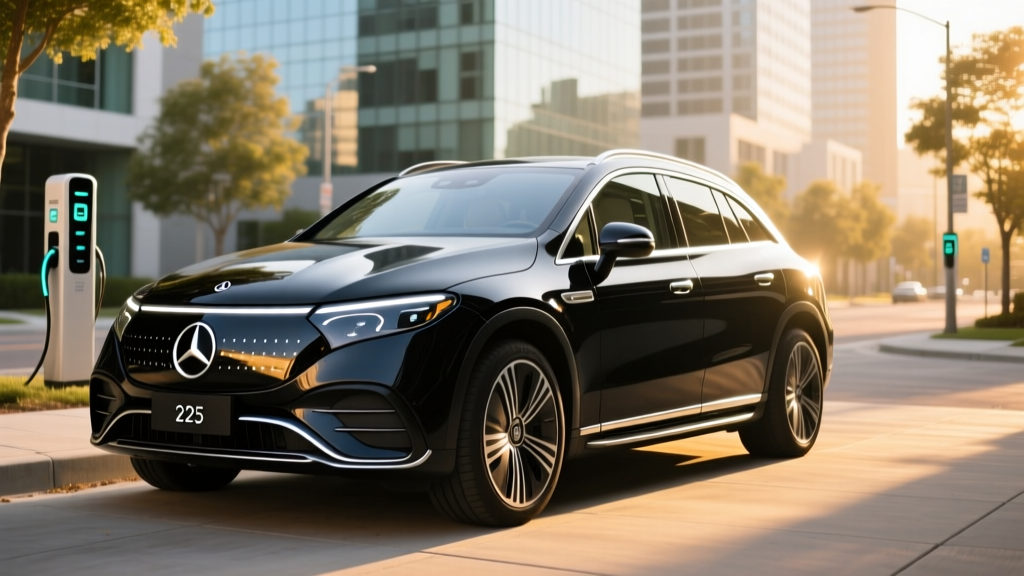
The 2025 Mercedes-Benz EQS SUV occupies a rare position in the electric-vehicle market: a full-size, three-row luxury crossover that pairs a massive battery with genuine long-distance capability. With an EPA-estimated range reaching 305 miles in its most efficient configuration and a 108.4 kWh usable battery pack, it's engineered for buyers who need premium comfort without range compromise. But at a base price above $104,000, the EQS SUV demands scrutiny beyond the spec sheet. This review breaks down real-world range expectations, charging behavior, ownership economics, and how it stacks up against rivals like the BMW iX, Tesla Model X, and Rivian R1S.
Quick Verdict: Who the EQS SUV Is For
The 2025 EQS SUV is best suited for affluent families and executives who prioritize cabin serenity, ride quality, and brand prestige over outright performance or value. It excels as a daily commuter and cross-country cruiser but isn't a performance SUV in the mold of a Model X Plaid or Rivian R1S Quad-Motor. If you need three rows, want over 300 miles of EPA range, and can charge at home, the EQS SUV delivers. If you're chasing driving dynamics or bargain pricing, look elsewhere.
Range and Efficiency: EPA Numbers vs. Real-World Reality
The 2025 EQS SUV lineup offers three main trims, each with distinct range profiles:
| Trim | Drivetrain | EPA Range | MPGe (City/Hwy/Combined) | kWh/100 mi |
|---|---|---|---|---|
| EQS 450+ SUV | RWD (single motor) | 305 mi | 97 / 92 / 95 | 35 |
| EQS 450 4MATIC SUV | AWD (dual motor) | 285 mi | 91 / 86 / 89 | 38 |
| EQS 580 4MATIC SUV | AWD (dual motor) | 285 mi | 89 / 84 / 87 | 39 |
Source: fueleconomy.gov
EPA sticker: Up to 305 miles (450+ RWD)
Highway driving (70-75 mph): Expect 250–275 miles in moderate temperatures. The EQS SUV's large frontal area and ~5,800-lb curb weight hurt efficiency at sustained speed.
Cold weather (below 32°F): Range drops 20–30%, meaning a 305-mile rated SUV may deliver 215–245 miles in freezing conditions, even with its standard heat pump.
Mixed city/highway (55–65°F): 280–300 miles is achievable with moderate regen use and conservative acceleration.
The EQS SUV's efficiency is respectable for its size but not class-leading. The BMW iX xDrive50 achieves a similar 307-mile EPA rating with a smaller battery, while the Tesla Model X Long Range posts 348 miles thanks to superior aerodynamics and a lighter platform. The EQS SUV's 0.26 drag coefficient is good for a three-row SUV, but its weight works against it on the highway.
Battery: 108.4 kWh NMC Pack and Degradation Outlook
All 2025 EQS SUV trims share a single battery configuration: a 108.4 kWh usable (120 kWh gross) lithium-ion pack using NMC (nickel-manganese-cobalt) chemistry. This is a high-energy-density choice optimized for range, not the cycle-life longevity of LFP (lithium iron phosphate) packs found in some competitors' base trims.
Mercedes-Benz warrants the high-voltage battery for 10 years or 155,000 miles (whichever comes first) against capacity loss below 70% of original capacity. This is more generous than the industry-standard 8-year/100,000-mile warranty required by federal mandate, and it matches or exceeds coverage from BMW and Audi. In practice, NMC packs in liquid-cooled systems like the EQS SUV's typically retain 85–90% capacity after 100,000 miles based on fleet data from similar architectures.
One ownership note: Mercedes recommends keeping the state of charge (SoC) between 20% and 80% for daily use and limiting DC fast charging frequency to extend long-term battery health. The vehicle's configurable charge limit (settable in the MBUX infotainment system) makes this easy to enforce.
Charging Speed: DC Fast, Level 2, and the Taper Curve
The EQS SUV supports a peak DC fast-charge rate of 200 kW via its CCS1 connector. Here's what that translates to in practice:
| Charging Level | Max Power | Speed | Notes |
|---|---|---|---|
| Level 1 (120V household) | ~1.4 kW | ~3–4 mi/hr | Emergency/trickle only; ~30+ hours for full charge |
| Level 2 (240V home/public) | 9.6 kW (40A) / 11.5 kW (48A) | ~25–32 mi/hr | Full charge in ~11–13 hours; ideal overnight |
| DC Fast Charge | 200 kW peak | 10–80% in ~31 min | Peak rate sustained to ~40% SoC; tapers significantly above 80% |
The 200 kW peak rate is competitive but not best-in-class. The Hyundai Ioniq 5 and Kia EV6 both hit 350 kW peaks (10–80% in ~18 minutes), and the Tesla Model X accesses 250 kW at V3 Superchargers. The EQS SUV's charge curve is the real story: it sustains roughly 170–200 kW from 10% to about 40% SoC, then tapers progressively. By 80%, you're looking at roughly 50–70 kW. This means the published 31-minute 10–80% time is realistic on a capable 350 kW charger (like Electrify America or EVgo stations), but charging to 90% or 100% adds significant time.
Mercedes includes a battery preconditioning feature that activates when you navigate to a DC fast charger in the MBUX system. This warms the pack to optimal temperature for faster charging — essential in cold weather, where unplugged DC charging can be 30–40% slower.
For home Level 2 charging, the EQS SUV's onboard charger accepts up to 11.5 kW (48 amps), which requires a hardwired wallbox or a NEMA 14-50 outlet on a 60-amp circuit. A full home charge from 10% to 100% takes roughly 11 hours at 11.5 kW — plan your overnight charging accordingly.
Performance: 0–60 Times, Power, and Drivetrain
| Trim | Horsepower | Torque (lb-ft) | 0–60 mph | Drivetrain | Top Speed |
|---|---|---|---|---|---|
| EQS 450+ | 355 hp | 419 | 6.5 sec | RWD | 130 mph |
| EQS 450 4MATIC | 355 hp | 590 | 5.3 sec | AWD (dual motor) | 130 mph |
| EQS 580 4MATIC | 536 hp | 633 | 4.3 sec | AWD (dual motor) | 130 mph |
Even the base RWD 450+ moves a 5,800-pound SUV to 60 mph in 6.5 seconds — brisk for daily driving. The 580 4MATIC's 4.3-second run puts it in sports-sedan territory, though the Rivian R1S Quad-Motor (3.0 sec) and Tesla Model X Plaid (2.5 sec) are in a different performance league entirely.
The EQS SUV's air suspension (standard on all trims) delivers a magic-carpet ride quality that neither the Model X nor the iX can match. It absorbs highway imperfections with composure and offers adjustable ride height for light off-road use or easier cargo loading. The available rear-axle steering (up to 10 degrees) shrinks the turning circle to a manageable 36 feet — remarkable for a 201-inch-long SUV.
Interior, Cargo, and Passenger Space
The EQS SUV offers three rows of seating (standard on most trims, optional on some configurations) and a cabin that sets the benchmark for luxury EV interiors.
| Measurement | Specification |
|---|---|
| Cargo (behind 3rd row) | 14.4 cu ft |
| Cargo (3rd row folded) | 42.0 cu ft |
| Cargo (all rear rows folded) | 74.2 cu ft |
| Front legroom | 41.0 in |
| 2nd-row legroom | 40.4 in |
| 3rd-row legroom | 30.1 in |
| Frunk | None (no front trunk) |
The third row is best suited for children or occasional use — the 30.1-inch legroom is tight for adults on longer trips. The 14.4 cu ft behind the third row is modest; a week's groceries for a family of five will fill it. Fold the third row and the 42 cu ft space becomes genuinely practical for luggage and gear.
The available MBUX Hyperscreen — a 56-inch curved glass panel spanning the entire dashboard — is the cabin's centerpiece. It integrates a 17.7-inch central OLED touchscreen, a 12.3-inch driver cluster, and a 12.3-inch passenger display. The system supports wireless Apple CarPlay and Android Auto, over-the-air updates, and Mercedes' "Hey Mercedes" voice assistant. Build quality, material selection, and cabin noise isolation are exemplary — at 70 mph, the EQS SUV is whisper-quiet.
Pricing, Trims, and Federal Tax Credit Eligibility
| Trim | Base MSRP | Typical As-Tested | Federal §30D Credit Eligible? |
|---|---|---|---|
| EQS 450+ SUV | $104,400 | $112,000–$125,000 | No — exceeds MSRP cap |
| EQS 450 4MATIC SUV | $107,400 | $115,000–$130,000 | No — exceeds MSRP cap |
| EQS 580 4MATIC SUV | $120,400 | $130,000–$148,000 | No — exceeds MSRP cap |
The 2025 EQS SUV does not qualify for the IRS §30D federal EV tax credit of up to $7,500. Under current rules, SUVs must have an MSRP at or below $80,000 to qualify. Every EQS SUV trim exceeds this cap by at least $24,000. Additionally, buyers must meet modified adjusted gross income limits ($300,000 joint / $150,000 single) and the vehicle must satisfy critical-mineral and battery-component sourcing requirements.
Some state and local incentives may still apply — check your state's EV rebate program and consult a tax professional for personalized guidance.
Driver Assistance and Safety Technology
The EQS SUV comes standard with Mercedes' Driver Assistance Package, which includes:
- Active Distance Assist DISTRONIC: Adaptive cruise control with stop-and-go
- Active Steering Assist: Lane-centering on highways
- Active Lane Change Assist: Semi-automated lane changes when turn signal is engaged
- Active Emergency Stop Assist: Brings vehicle to a stop if driver is unresponsive
- Pre-Safe Plus: Prepares cabin for imminent rear collision
Despite its sophistication, the EQS SUV's driver-assistance suite is classified as SAE Level 2 — meaning the driver must remain attentive, keep hands on or near the wheel, and be prepared to take over at any moment. This is not autonomous or "self-driving" capability. Mercedes' Level 3 system (Drive Pilot), which allows hands-off driving under specific conditions, is available only on the EQS sedan in select markets and is not offered on the EQS SUV as of the 2025 model year.
Safety ratings from NHTSA and IIHS should be verified at time of purchase, as testing for the EQS SUV was ongoing at time of writing. The vehicle's size, weight, and comprehensive airbag system provide strong passive safety fundamentals.
Competitive Comparison: EQS SUV vs. Key Rivals
| Spec | Mercedes EQS 450+ | BMW iX xDrive50 | Tesla Model X LR | Rivian R1S Dual-Motor |
|---|---|---|---|---|
| EPA Range | 305 mi | 307 mi | 348 mi | 316 mi |
| Battery (usable kWh) | 108.4 | 105.2 | ~100 | 128.9 (Max Pack) |
| DC Fast Charge (peak kW) | 200 | 150 | 250 | 200 |
| 10–80% DC Time | ~31 min | ~34 min | ~25 min | ~30 min |
| 0–60 mph | 6.5 sec | 4.4 sec | 3.8 sec | 5.0 sec |
| Third Row | Standard | No | Optional | Standard |
| Base MSRP | $104,400 | $87,250 | $79,990 | $79,900 |
| Federal Credit Eligible | No | No | Yes (if under $80k MSRP cap) | Yes (if under $80k MSRP cap) |
The EQS SUV's advantages are ride quality, cabin luxury, and three-row standard seating. Its disadvantages are price, charging speed relative to Tesla, and lack of tax-credit eligibility. The BMW iX is more engaging to drive and starts $17,000 lower but has no third row. The Tesla Model X offers the best range and Supercharger access but trails in interior refinement. The Rivian R1S provides genuine off-road capability and adventure versatility at a lower price point.
- You want the quietest, most comfortable ride in the luxury EV SUV segment
- Three-row seating is non-negotiable and you don't want a Rivian's truck-like character
- You value Mercedes brand prestige, dealer service network, and build quality
- Home charging is available and most trips are under 250 miles
- You want tax-credit eligibility (consider Model X or R1S in qualifying trims)
- Performance and handling are priorities (BMW iX or Model X Plaid)
- You need maximum range for frequent 300+ mile road trips (Model X LR at 348 mi)
- Budget is a primary concern — the iX and R1S deliver 80% of the experience at 70% of the price
Warranty and Ownership Costs
Mercedes-Benz provides the following coverage for the 2025 EQS SUV:
- New Vehicle Limited Warranty: 4 years / 50,000 miles
- High-Voltage Battery Warranty: 10 years / 155,000 miles (capacity retention above 70%)
- Powertrain Warranty: 4 years / 50,000 miles
- Roadside Assistance: 4 years / 50,000 miles
- Complimentary Maintenance: None (Mercedes does not include free scheduled maintenance unlike BMW)
Insurance costs for the EQS SUV run higher than average for the segment. Expect annual premiums of $3,500–$5,200 depending on your profile, location, and coverage level — roughly 15–25% more than a BMW iX due to higher repair costs and MSRP.
Tire replacement is another ownership reality: the EQS SUV's weight (5,800–6,000 lbs) accelerates tire wear. Budget $1,800–$2,800 for a set of premium all-season or EV-specific tires every 25,000–35,000 miles.
- Class-leading ride comfort and cabin quietness
- 305-mile EPA range (450+) is excellent for a three-row luxury SUV
- 10-year/155,000-mile battery warranty exceeds industry standard
- Rear-axle steering makes this large SUV surprisingly maneuverable
- MBUX Hyperscreen is visually stunning and feature-rich
- Standard three-row seating in a segment where it's often optional
- Base price above $104,000 — no federal tax credit eligibility
- 200 kW peak DC charge rate trails Tesla and Hyundai/Kia platforms
- Third-row legroom (30.1 in) is cramped for adults
- No front trunk (frunk) — lost cargo opportunity
- Heavy weight impacts tire wear and cold-weather range
- Driver-assist is Level 2 only; no Level 3 Drive Pilot availability
- Infotainment learning curve is steep; some functions buried in menus
Frequently Asked Questions
What is the real-world range of the 2025 Mercedes-Benz EQS SUV?
The EPA rates the EQS 450+ SUV at 305 miles and the dual-motor 4MATIC trims at 285 miles. In real-world highway driving at 70–75 mph in moderate temperatures, expect 250–275 miles from the 450+ and 240–260 from the 4MATIC models. In freezing weather, subtract 20–30%, bringing realistic winter range to roughly 215–245 miles for the 450+.
How fast does the EQS SUV charge at home and on the road?
On a DC fast charger, the EQS SUV peaks at 200 kW and charges from 10% to 80% in approximately 31 minutes on a capable 350 kW station. At home on a Level 2 charger (240V, 48A/11.5 kW), a full charge takes about 11 hours. The onboard charger maxes out at 11.5 kW — faster than some competitors but slower than the 19.2 kW option available on the Ford F-150 Lightning.
Does the 2025 EQS SUV qualify for the federal EV tax credit?
No. Under IRS §30D rules, new electric SUVs must have an MSRP at or below $80,000 to qualify for the up-to-$7,500 credit. The cheapest EQS SUV trim starts at $104,400, well above the cap. Additionally, buyers must meet income limits and the vehicle must satisfy battery-sourcing requirements. Consult a tax professional for your specific situation.
Is the EQS SUV worth buying over the Tesla Model X or BMW iX?
It depends on your priorities. If ride comfort, cabin luxury, and three-row seating are paramount, the EQS SUV has no equal in the segment. If you want the longest range (348 mi EPA), Supercharger network access, and potential tax-credit eligibility, the Model X Long Range wins. If you prefer a sportier drive and a lower price, the BMW iX xDrive50 is the better pick — though it lacks a third row.
How long will the EQS SUV battery last?
Mercedes warrants the 108.4 kWh NMC battery for 10 years or 155,000 miles against degradation below 70% of original capacity. Based on data from similar liquid-cooled NMC packs, owners can reasonably expect 85–90% capacity retention at 100,000 miles with proper care (avoiding frequent 100% charges and excessive DC fast charging). Full battery replacement, if ever needed outside warranty, is estimated at $20,000–$30,000 based on current Mercedes pricing.
Does the EQS SUV have a frunk?
No. Unlike the Tesla Model X, Rivian R1S, and Ford F-150 Lightning, the EQS SUV has no front trunk. The space under the hood houses power electronics and HVAC components. All cargo must go in the rear compartment.
Can the EQS SUV tow?
Yes. The EQS 450 4MATIC and 580 4MATIC are rated to tow up to 3,500 pounds when properly equipped with the factory tow package. The RWD 450+ is not rated for towing. Note that towing significantly reduces range — expect a 30–50% reduction depending on trailer weight and aerodynamics.