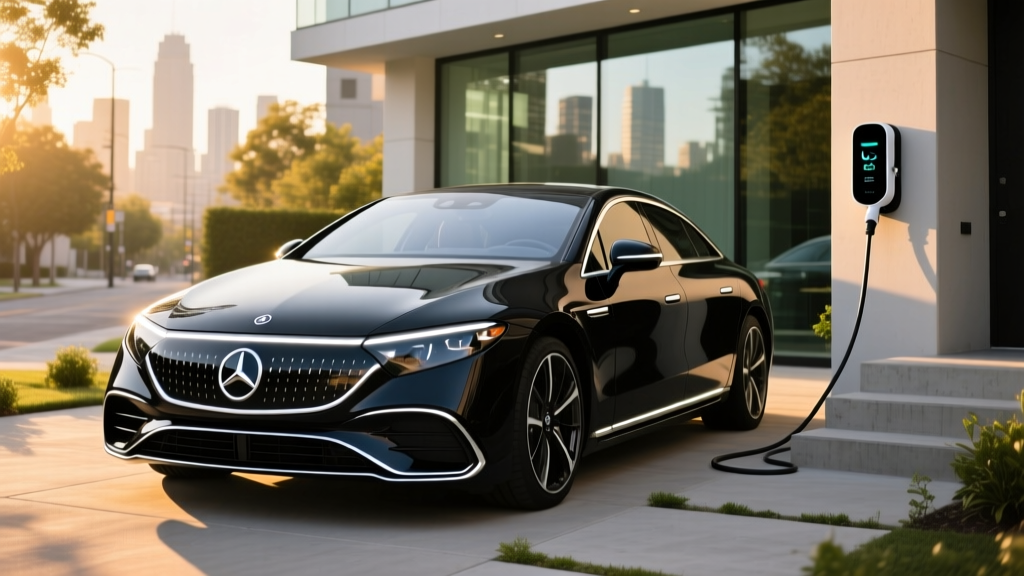
The 2025 Mercedes EQS Sedan remains the benchmark for electric luxury: a full-size flagship that pairs a 118 kWh battery with class-leading aerodynamics (a 0.20 drag coefficient) to deliver some of the longest EPA range figures in the segment. But with a six-figure starting price, shifting federal tax credit rules, and intensifying competition from the Tesla Model S, Lucid Air, and BMW i7, the EQS must prove its value on more than just range alone. This review breaks down every number that matters — from real-world highway efficiency to DC fast-charging taper curves — so you can decide whether Mercedes' electric S-Class earns a spot in your garage.
Quick Verdict: Who the 2025 Mercedes EQS Sedan Is For
The EQS targets executives and luxury buyers who prioritize whisper-quiet highway cruising, cutting-edge cabin technology, and range confidence over outright performance. If your commute involves 200+ mile round trips and you value SAE Level 2 driver-assist systems that reduce fatigue without pretending to be autonomous, the EQS delivers. It is not a sports sedan — the steering is light, the suspension favors comfort, and the 5,900-lb curb weight is felt in corners. Buyers seeking track-capable EVs should look at the Lucid Air Sapphire or Tesla Model S Plaid instead.
Range and Efficiency: EPA Numbers vs. Real-World Results
Real-World Expectation: Plan for 300–340 miles on highway road trips at 70–80 mph. In freezing temperatures (below 32°F), expect a 20–30% reduction, bringing effective range to roughly 240–280 miles for the 450+ model.
The 2025 EQS lineup uses a 118 kWh usable lithium-ion battery pack with NMC (nickel manganese cobalt) chemistry, chosen for its high energy density — critical in a sedan where packaging space is at a premium. The base EQS 450+ uses a single rear motor, and its efficiency is remarkable for a vehicle of this size: EPA-rated at 97 MPGe combined (roughly 31 kWh/100 mi). The dual-motor 4MATIC variants trade some efficiency for all-weather traction, landing at 87–92 MPGe combined.
In real-world highway testing at sustained 75 mph speeds, the EQS 450+ typically achieves 2.8–3.1 mi/kWh, translating to approximately 330–365 miles before the low-battery warning. This is excellent — but it is not the 390-mile EPA sticker. Cold weather compounds the gap: the heat pump (standard on 2025 models) mitigates cabin heating losses, but battery internal resistance still rises in sub-freezing conditions. Preconditioning the battery while plugged in is essential to preserve range in winter.
| Spec | EQS 450+ | EQS 450 4MATIC | EQS 580 4MATIC | AMG EQS |
|---|---|---|---|---|
| Drivetrain | RWD (single motor) | AWD (dual motor) | AWD (dual motor) | AWD (dual motor) |
| Horsepower | 355 hp | 355 hp | 536 hp | 649 hp (751 w/ RACE START) |
| 0–60 mph | 5.9 sec | 5.3 sec | 4.1 sec | 3.4 sec |
| Battery (usable) | 118 kWh NMC | 118 kWh NMC | 118 kWh NMC | 118 kWh NMC |
| EPA Range | 390 mi | 371 mi | 345 mi | 315 mi |
| Efficiency (combined) | 97 MPGe | 92 MPGe | 87 MPGe | 79 MPGe |
| Base MSRP | $104,400 | $107,400 | $125,950 | $149,900 |
Charging Speed: DC Fast, Level 2, and the Curve Reality
The 2025 EQS supports a peak DC fast-charge rate of 200 kW via its CCS1 connector (NACS adapter available for Tesla Supercharger access). On a 350 kW Electrify America or similar station, the EQS will accept its peak rate only briefly — typically between 10% and 30% state of charge — before tapering progressively. Mercedes quotes a 10–80% charge time of approximately 31 minutes under optimal conditions (preconditioned battery, warm ambient temperature, high-power station).
This taper is the most misunderstood aspect of EV charging. While 200 kW is the headline number, the average sustained rate across the 10–80% window is closer to 140–155 kW. That still translates to roughly 180–200 miles of range added in 20 minutes — enough for a comfortable road-trip rhythm of driving 2.5 hours and stopping for 20 minutes.
| Charging Level | Power | Speed / Time | Notes |
|---|---|---|---|
| Level 1 (120V household) | ~1.4 kW | ~4 mi/hr | Emergency/trickle only; full charge in ~85 hours |
| Level 2 (240V home/public) | 9.6 kW (onboard charger) | ~28 mi/hr; full charge in ~12.5 hr | Requires 48-amp dedicated circuit; ideal for overnight |
| DC Fast Charge (CCS1) | Up to 200 kW peak | 10–80% in ~31 min | Average sustained ~145 kW; taper above 60% SoC |
For home Level 2 charging, the EQS's 9.6 kW onboard charger is adequate but not class-leading — the Lucid Air accepts up to 19.2 kW on Level 2, cutting home charge times nearly in half. Most EQS owners will install a 48-amp Level 2 wallbox (such as a ChargePoint Home Flex or Mercedes-branded Wallbox) on a 60-amp breaker, achieving a full overnight charge from near-empty in roughly 12–13 hours. In practice, daily top-ups from 30–80% take about 6 hours, which fits comfortably within an overnight window.
Performance and Driving Dynamics
The EQS 450+ delivers 355 horsepower and 419 lb-ft of torque from its rear-mounted permanent-magnet synchronous motor. The 0–60 mph time of 5.9 seconds is relaxed by EV standards, but the power delivery is linear and effortless — passing maneuvers on two-lane highways require no planning. The 450 4MATIC matches that output with the traction benefit of dual motors, shaving the sprint to 5.3 seconds.
The EQS 580 4MATIC is the sweet spot for buyers who want genuine performance without stepping into the AMG's stratospheric price: 536 hp, 631 lb-ft, and a 4.1-second 0–60 time. The AMG EQS, with up to 751 hp in RACE START mode and a 3.4-second sprint, exists in a different category entirely — but at $149,900, it competes directly with the Lucid Air Sapphire and Porsche Taycan Turbo S.
Ride quality is where the EQS justifies its price. The standard AIRMATIC air suspension with adaptive damping absorbs broken pavement and highway expansion joints with a composure that no Model S can match. Rear-axle steering (up to 10 degrees, optional on 450 trims, standard on 580 and AMG) shrinks the 17.4-foot sedan in parking lots, cutting the turning circle to a remarkably compact 36 feet.
Interior, Technology, and the Hyperscreen
The MBUX Hyperscreen — a 56-inch curved glass panel spanning the full dashboard width — remains the EQS's signature feature. It houses a 17.7-inch central OLED touchscreen, a 12.3-inch digital instrument cluster, and a 12.3-inch passenger display, all powered by an 8-core CPU and 24 GB of RAM. The system is visually stunning and responsive, though some drivers find the touch-capacitive climate and volume controls less intuitive than physical buttons.
The 2025 model year adds wireless Apple CarPlay and Android Auto across all trims, along with an upgraded voice assistant that handles multi-step natural-language commands ("Navigate to the nearest DC fast charger and precondition the battery"). The optional MBUX Interior Assistant uses gesture and gaze recognition to anticipate driver needs — pointing at a window activates its controls on-screen.
Cabin space is generous but not limousine-class. Rear legroom measures 42.0 inches (comparable to the S-Class), and the trunk offers 22 cubic feet of cargo volume — competitive with the BMW i7 (23.5 cu ft) and significantly more than the Tesla Model S (28 cu ft including the frunk, though the Model S hatchback design offers more practical shape). The EQS lacks a front trunk (frunk), which is a missed opportunity in a vehicle this large.
Driver Assistance: SAE Level 2, Not Self-Driving
Mercedes' DRIVE PILOT system — a Level 3 conditional automation feature approved in Germany and limited US states (Nevada, California) for speeds up to 40 mph in heavy traffic — is available on the 2025 EQS in qualifying jurisdictions. When activated under specific conditions (mapped highways, clear weather, traffic congestion), DRIVE PILOT allows the driver to legally disengage from driving tasks and use the central screen for approved activities. This is a genuinely advanced system, but its operational design domain is narrow: it does not function above 40 mph, in construction zones, or in poor weather.
The standard Active Brake Assist, Evasive Steering Assist, and PRE-SAFE systems are comprehensive and well-calibrated. However, buyers comparing to Tesla's FSD (Supervised) or GM's Super Cruise should note that Mercedes' lane-centering is conservative — it occasionally disengages on faded lane markings rather than attempting aggressive path prediction.
Pricing, Tax Credits, and Total Cost of Ownership
| Trim | Base MSRP | As-Tested (typical) | §30D Federal Credit |
|---|---|---|---|
| EQS 450+ | $104,400 | $112,000–$120,000 | Not eligible (MSRP exceeds $55,000 sedan cap) |
| EQS 450 4MATIC | $107,400 | $115,000–$125,000 | Not eligible (MSRP exceeds $55,000 sedan cap) |
| EQS 580 4MATIC | $125,950 | $135,000–$148,000 | Not eligible (MSRP exceeds $55,000 sedan cap) |
| AMG EQS | $149,900 | $158,000–$170,000 | Not eligible (MSRP exceeds $55,000 sedan cap) |
This is the critical purchase-decision factor that many buyers overlook: no 2025 EQS Sedan trim qualifies for the $7,500 federal EV tax credit under IRS §30D. The law sets an MSRP cap of $55,000 for sedans (the EQS starts at $104,400), and separate buyer income caps ($150,000 single / $300,000 married filing jointly) further restrict eligibility even if a cheaper EV were considered. The IRS clean vehicle credit page details current rules, which are subject to legislative change.
Some buyers may qualify for state-level incentives (California's CVRP, Colorado's innovative motor vehicle credit, or utility-company rebates), but these vary by jurisdiction and are outside the scope of this review — check your state's official energy office for current programs.
- Purchase price (base): $104,400
- Electricity (at $0.16/kWh national avg): ~$4,650
- Insurance (luxury EV premium): ~$18,000–$22,000
- Maintenance (no oil changes; tire rotation, cabin filter, brake fluid): ~$2,500
- Estimated depreciation (55–60% over 5 years): ~$57,000–$63,000
- Estimated 5-year total cost: ~$130,000–$140,000 (before incentives)
Depreciation is the EQS's largest ownership cost. Luxury EVs have historically depreciated faster than their ICE counterparts, though the segment is stabilizing. Buyers who lease can transfer depreciation risk to the lessor — and notably, the commercial clean vehicle credit (§45W) may allow the leasing company to claim the $7,500 credit and pass savings through as a lower lease payment, regardless of the vehicle's MSRP. This "lease loophole" has made leasing the preferred acquisition method for many EQS buyers. Consult a tax professional for your specific situation.
Warranty, Battery Longevity, and Service
Mercedes-Benz provides a 4-year/50,000-mile limited warranty and a 10-year/155,000-mile high-voltage battery warranty that guarantees the battery will retain at least 70% of its original capacity. This is competitive with BMW's 8-year/100,000-mile battery warranty and slightly more generous on mileage, though the capacity-retention threshold is industry-standard.
NMC chemistry batteries in the EQS are liquid-cooled with an advanced thermal management system that precondition the pack during fast charging and active driving. Long-term degradation data for the 118 kWh pack is still accumulating (the EQS launched for the 2022 model year), but early fleet data from European high-mileage examples suggests roughly 5–8% capacity loss at 60,000 miles — well within the warranty threshold. Mercedes recommends keeping the battery between 20% and 80% state of charge for daily use, charging to 100% only before long trips.
How the EQS Stacks Up Against Key Competitors
| Attribute | Mercedes EQS 450+ | Lucid Air Pure | Tesla Model S LR | BMW i7 xDrive60 |
|---|---|---|---|---|
| EPA Range | 390 mi | 419 mi | 402 mi | 318 mi |
| Base MSRP | $104,400 | $69,900 | $79,990 | $119,300 |
| 0–60 mph | 5.9 sec | 5.2 sec | 3.1 sec | 4.5 sec |
| DC Fast Charge (peak) | 200 kW | 250 kW | 250 kW | 195 kW |
| 10–80% Time | ~31 min | ~25 min | ~27 min | ~34 min |
| Horsepower | 355 hp | 430 hp | 670 hp | 536 hp |
| Cargo Volume | 22 cu ft | 32 cu ft (hatch) | 28 cu ft (hatch) | 23.5 cu ft |
| §30D Credit Eligible | No | No (sedan cap) | No (sedan cap) | No (sedan cap) |
Pros and Cons
- Class-leading 390-mile EPA range (450+)
- Exceptional ride comfort and cabin isolation
- MBUX Hyperscreen with best-in-class visual quality
- DRIVE PILOT Level 3 capability (limited markets)
- Rear-axle steering dramatically improves maneuverability
- Generous 10-year/155,000-mile battery warranty
- No federal tax credit eligibility (MSRP cap)
- Heavy depreciation projected (~55–60% over 5 years)
- No front trunk (frunk) for additional cargo
- 200 kW peak DC charge rate trails Lucid/Tesla (250 kW)
- 9.6 kW Level 2 onboard charger is slow for the battery size
- Touch-capacitive controls can frustrate while driving
- Base price exceeds $104K before options
Frequently Asked Questions
What is the real-world range of the 2025 Mercedes EQS Sedan?
In mixed highway driving at 70–80 mph, the EQS 450+ typically achieves 300–340 miles — below the 390-mile EPA sticker but still excellent. In cold weather (below freezing), expect 240–280 miles due to increased battery resistance and cabin heating demands. City driving with regenerative braking can actually exceed EPA estimates, with some owners reporting 380+ miles in stop-and-go conditions.
How fast does the EQS charge at home and on the road?
On DC fast charging, the EQS peaks at 200 kW and reaches 10–80% in approximately 31 minutes under optimal conditions, though the average sustained rate is ~145 kW due to charge-curve taper. At home on a Level 2 (240V, 48-amp) charger, the 9.6 kW onboard charger adds about 28 miles per hour, requiring roughly 12.5 hours for a full charge from empty. Most owners charging from 30–80% overnight will need about 6 hours.
Does the 2025 Mercedes EQS qualify for the federal EV tax credit?
No. Under IRS §30D rules, new clean vehicle credits are limited to sedans with an MSRP at or below $55,000. The EQS starts at $104,400, disqualifying all trims. Additionally, buyer income must not exceed $150,000 (single) or $300,000 (married filing jointly). However, leasing may allow the lessor to claim the commercial vehicle credit and pass savings through as a reduced lease payment — consult a tax professional.
Is the EQS worth buying over the Tesla Model S or Lucid Air?
It depends on priorities. The EQS wins on cabin luxury, ride comfort, and noise isolation. The Lucid Air Pure offers more range (419 mi) at a dramatically lower price ($69,900). The Tesla Model S delivers far more performance (3.1-sec 0–60) and access to the mature Supercharger network, though its interior quality and ride refinement do not match the EQS. If luxury and comfort are paramount and budget is flexible, the EQS is the strongest choice. If value and performance lead your decision, the Lucid or Tesla are harder to beat.
What are the biggest drawbacks of owning the EQS?
The most significant ownership pain points are steep depreciation (luxury EVs lose value faster than ICE equivalents), high insurance premiums ($3,500–$4,500/year is common), the lack of a frunk for additional cargo, and a 9.6 kW onboard charger that makes home charging slower than the battery size warrants. The 200 kW DC charge rate, while adequate, trails competitors at 250 kW. Touch-capacitive dashboard controls also draw frequent owner complaints.
How long will the EQS battery last?
Mercedes warranties the high-voltage battery for 10 years or 155,000 miles, guaranteeing at least 70% capacity retention. Early data from high-mileage European fleet vehicles suggests 5–8% degradation at 60,000 miles — well within warranty limits. With proper care (daily charging limited to 80%, avoiding prolonged 100% SoC, using preconditioning for DC fast charging), the battery should comfortably outlast the typical ownership period. Full battery replacement, if ever needed outside warranty, is estimated at $20,000–$30,000 based on current parts pricing — though this cost is expected to decline as the supply chain matures.