The Flagship Electric Sedan Under the Microscope
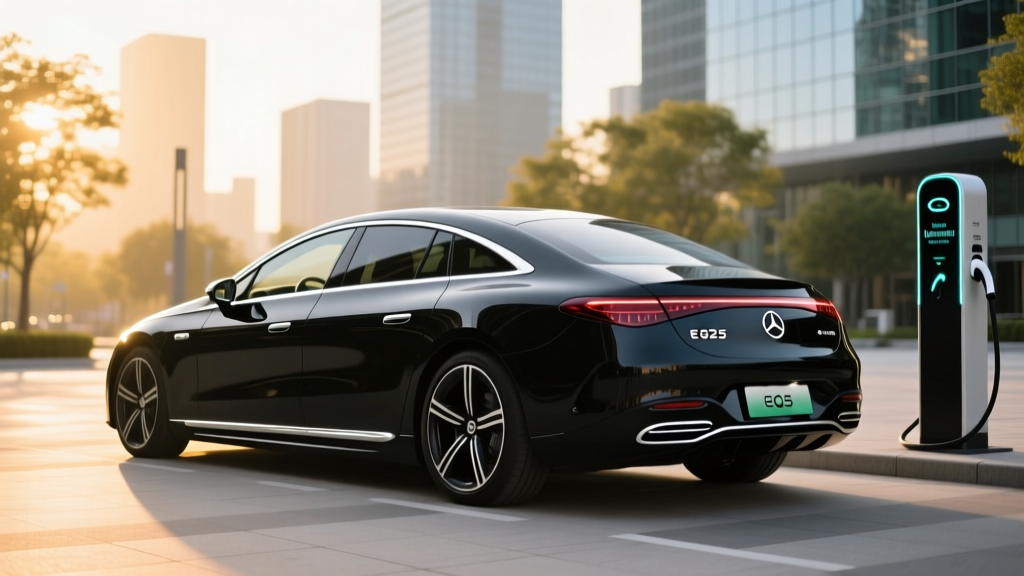
The 2025 Mercedes-Benz EQS remains the automaker's electric flagship — a full-size luxury sedan built on the dedicated EVA2 platform, now updated with a larger battery, a stand-up hood ornament, and revised styling that distances it from the polarizing original design. For buyers cross-shopping the BMW i7, Tesla Model S, and Lucid Air, the EQS poses a specific question: does old-world luxury craftsmanship combined with serious electric range justify a six-figure starting price?
After examining EPA data, charging curves, and ownership economics, the answer depends heavily on your priorities. The EQS excels at ride comfort, cabin isolation, and long-distance cruising efficiency. It stumbles on rear-seat headroom, charging speed relative to 800V competitors, and — critically — federal tax credit eligibility. Here's everything a prospective buyer needs to know, with exact numbers.
Range, Battery, and Efficiency: The Numbers That Matter
The 2025 EQS lineup receives a substantial battery upgrade over the pre-refresh models. The usable battery capacity now sits at 118 kWh (up from 107.8 kWh), using NMC (nickel manganese cobalt) lithium-ion chemistry supplied by CATL and Farasis. Mercedes does not offer an LFP option in the EQS — the energy density requirements for a 390-mile sedan demand NMC's higher specific energy.
| Spec | EQS 450+ | EQS 450 4MATIC | EQS 580 4MATIC |
|---|---|---|---|
| EPA Range | 390 miles | 371 miles | 371 miles |
| Battery (usable) | 118 kWh, NMC chemistry | ||
| Drivetrain | RWD (single motor) | AWD (dual motor) | AWD (dual motor) |
| Horsepower | 355 hp | 355 hp | 536 hp |
| Torque | 406 lb-ft | 564 lb-ft | 633 lb-ft |
| 0-60 mph | 5.9 sec | 5.3 sec | 4.1 sec |
| MPGe (combined) | 97 MPGe | 93 MPGe | 91 MPGe |
| kWh/100 mi | 35 kWh | 36 kWh | 37 kWh |
| Top Speed | 130 mph (electronically limited) | ||
Real-World Range Expectations
EPA Sticker: 390 miles (EQS 450+ RWD)
Highway cruising (70-75 mph, moderate temps): Expect 320-340 miles. The EQS's sedan shape and 0.20 Cd drag coefficient help, but sustained highway speeds consume more energy than the EPA mixed cycle suggests.
City/suburban driving: 370-390 miles is achievable thanks to aggressive regenerative braking (up to 0.25g of regen in D Auto mode) and lower average speeds.
Cold weather (below 32°F): Plan for 260-300 miles. The EQS includes a standard heat pump, which mitigates cabin-heating losses, but battery chemistry slows and internal resistance increases in freezing temperatures. Preconditioning while plugged in recovers roughly 15-20 miles of that deficit.
The efficiency story here is genuinely impressive for a 5,700-pound vehicle. At 97 MPGe combined (35 kWh/100 mi) for the 450+, the EQS extracts more miles per kilowatt-hour than many smaller, lighter EVs. The aerodynamic efficiency — the lowest drag coefficient of any current production car — is the primary reason.
Charging Speed: Where the EQS Shows Its Platform Age
This is the most important section for road-trippers, and it's where the 2025 EQS reveals a limitation of the 400V EVA2 architecture. While competitors like the Hyundai Ioniq 5, Kia EV6, and Porsche Taycan use 800V systems enabling 250-350 kW peak charging, the EQS tops out at 200 kW DC fast charging.
| Charging Level | Power / Rate | Time / Miles Added |
|---|---|---|
| Level 1 (120V household) | ~1.4 kW | ~4 miles per hour of charging |
| Level 2 (240V home, 48A) | 11.5 kW | ~33 miles per hour; full charge in ~11 hours |
| DC Fast Charge (peak) | 200 kW max | 10-80% in approximately 33 minutes |
| DC Fast Charge (sustained avg.) | ~140-155 kW avg. | Expect ~180 miles added in 30 min at a 350 kW station |
The 10-80% DC fast-charge time of approximately 33 minutes is acceptable but not class-leading. On a Electrify America or Tesla Supercharger (via the included NACS adapter for 2025), you'll see the charge curve peak near 200 kW around 20-30% State of Charge, then taper progressively. Above 80%, charging slows dramatically to protect the NMC cells — expect 80-100% to take an additional 25+ minutes.
For home charging, the 11.5 kW onboard AC charger is a bright spot. A full Level 2 session from empty to full takes roughly 11 hours, meaning overnight charging on a 48-amp wall connector easily replenishes any daily driving. Note that kW (kilowatts) measures the rate of power delivery — think of it as how fast water flows through a hose — while kWh (kilowatt-hours) measures total energy stored in the 118 kWh battery, analogous to the total volume of the tank.
Connector note: The 2025 EQS ships with a CCS1 port natively, but Mercedes now includes a NACS adapter in the box, granting access to Tesla's Supercharger network. This is a significant practical improvement for long-distance travel in 2025.
Pricing, Trims, and the Federal Tax Credit Reality
The 2025 EQS lineup carries premium pricing that places it firmly in luxury territory. Here's the current MSRP structure before any incentives or dealer adjustments:
| Trim | Base MSRP | As-Tested (typical options) | §30D Federal Credit |
|---|---|---|---|
| EQS 450+ Sedan | $104,400 | $110,000-$118,000 | Not eligible (MSRP cap) |
| EQS 450 4MATIC Sedan | $107,400 | $114,000-$122,000 | Not eligible (MSRP cap) |
| EQS 580 4MATIC Sedan | $127,350 | $135,000-$148,000 | Not eligible (MSRP cap) |
| EQS 580 SUV | $119,850 | $128,000-$140,000 | Not eligible (MSRP cap) |
Federal tax credit status: The 2025 Mercedes-Benz EQS does not qualify for the $7,500 federal EV tax credit under IRS §30D. The reason is straightforward: the credit imposes an MSRP cap of $55,000 for sedans (and $80,000 for SUVs/vans/pickups). Every EQS sedan trim exceeds $55,000 by a wide margin, and even the EQS SUV at $119,850 surpasses the $80,000 SUV threshold. Additionally, the EQS's battery cells are manufactured outside North America, which would independently disqualify it under the critical-mineral and battery-component sourcing requirements.
Buyers should also be aware of §30D income limits: modified adjusted gross income cannot exceed $300,000 (joint filers), $225,000 (head of household), or $150,000 (single). Even if a future EQS variant fell under the MSRP cap, high-income buyers would still be excluded. Always verify current rules at IRS.gov — Clean Vehicle Credits and consult a tax professional before purchase.
State incentives vary by jurisdiction. Some states (California, Colorado, Massachusetts) offer additional rebates or HOV lane access that may partially offset the lack of federal credit. Check your state's energy office or DMV for current programs.
Interior Space, Technology, and the Hyperscreen Question
The EQS cabin is a showcase of Mercedes' current design language — sweeping surfaces, ambient lighting with 64 colors, and available Nappa leather with heated, ventilated, and massaging front seats. The defining technology feature is the optional MBUX Hyperscreen, a 56-inch curved glass panel spanning the entire dashboard width, integrating three displays (12.3-inch instrument cluster, 17.7-inch central OLED, 12.3-inch passenger screen) behind a single bonded glass surface.
Standard equipment on all 2025 trims includes the 12.8-inch central OLED touchscreen (non-Hyperscreen), wireless Apple CarPlay and Android Auto, a Burmester 3D surround sound system (15 speakers standard, 31 speakers with Hyperscreen), and over-the-air update capability.
Passenger and cargo dimensions:
- Front headroom: 40.4 inches
- Rear headroom: 37.9 inches (the sloping roofline cuts into space for taller passengers)
- Front legroom: 41.7 inches
- Rear legroom: 41.4 inches
- Trunk volume: 22.0 cu ft (sedan); 61.6 cu ft with rear seats folded
- SUV cargo: 31.0 cu ft behind second row; 74.0 cu ft max
The rear headroom is the EQS sedan's most common interior complaint. Passengers over 6'2" will notice the roofline intruding, especially with the available panoramic sunroof. The EQS SUV resolves this entirely, which is one reason it accounts for a growing share of EQS sales.
Driver Assistance and Safety
The 2025 EQS comes equipped with Mercedes' latest Driver Assistance Package, which includes adaptive cruise control with stop-and-go, active lane-keeping, active blind-spot assist, evasive steering assist, and Pre-Safe (predictive collision preparation).
SAE Automation Level: Level 2
The EQS's Active Distance Assist DISTRONIC and Active Steering Assist constitute an SAE Level 2 driver-assistance system. The driver must remain fully engaged, keep hands on the wheel (or demonstrate attentiveness via the cabin camera on newer models), and is legally responsible for vehicle operation at all times. This is not self-driving. Mercedes has a separate Level 3 system (Drive Pilot) approved in Germany and Nevada for low-speed traffic jams under 40 mph, but it is not broadly available across the U.S. and requires specific conditions to activate.
Safety ratings: The EQS earned a Top Safety Pick+ from IIHS and a 5-star overall rating from NHTSA (NHTSA — 2025 EQS). Standard equipment includes 10 airbags, a rearview camera with 360-degree surround view available, and Active Parking Assist.
Driving Dynamics and Who This EV Suits
On the road, the EQS prioritizes isolation over engagement. The standard AIRMATIC air suspension with adaptive damping absorbs road imperfections with genuine authority, and cabin noise levels at 70 mph are among the lowest measured in any production vehicle. The 450+ RWD model's 355 hp and 5.9-second 0-60 time are adequate rather than thrilling; the 580 4MATIC's 536 hp and 4.1-second sprint are properly quick but still trail the Tesla Model S Plaid and Lucid Air Sapphire in straight-line drama.
Rear-axle steering (standard, up to 10 degrees) gives this 17-foot sedan a surprisingly tight 35-foot turning circle — genuinely useful in parking structures and urban maneuvering. The brake pedal feel, a perennial complaint in early EQS models due to the blended regen/friction system, has been improved for 2025 but still lacks the linear progression of BMW's i7.
Who should buy the 2025 EQS:
- Luxury commuters covering 40-80 miles daily who value cabin serenity and can charge at home nightly
- Frequent long-distance travelers who prioritize comfort over charging speed — the 390-mile range means fewer stops, even if each stop takes 33 minutes
- Current S-Class owners transitioning to electric who want brand continuity and familiar MBUX ergonomics
- Executive/fleet buyers for whom the MSRP is less relevant than total ride quality and brand prestige
Who should look elsewhere:
- Buyers who need maximum charging speed for frequent 500+ mile road trips (consider Lucid Air or a Hyundai/Kia 800V platform)
- Families needing maximum rear-seat headroom (the EQS SUV or BMW i7 are better fits)
- Value-oriented buyers — the lack of a federal tax credit and premium pricing make the EQS hard to justify against a loaded Tesla Model S at roughly $40,000 less
Warranty, Ownership Costs, and Long-Term Outlook
Mercedes backs the 2025 EQS with the following warranty coverage:
- New vehicle limited warranty: 4 years / 50,000 miles
- High-voltage battery warranty: 10 years / 155,000 miles, covering defects and capacity loss below 70% of original capacity
- Powertrain (electric motors, reduction gear): Covered under the standard 4/50,000 warranty
- Complimentary maintenance: 1 year / 10,000 miles (limited compared to BMW's 3-year program)
The 70% battery capacity retention threshold over 10 years is industry-standard and aligns with BMW, Audi, and Tesla. Real-world degradation data for the EVA2 platform is still accumulating (the EQS launched for the 2022 model year), but early fleet data from European taxis and high-mileage examples suggests NMC degradation of approximately 5-8% over the first 60,000 miles — well within the warranty buffer.
Estimated annual insurance costs run $3,200-$4,800 depending on state, driving record, and coverage level. Luxury EV insurance remains elevated due to high repair costs for aluminum body panels and the battery pack. Expect roughly 20-30% higher premiums than a comparably priced S-Class.
Pros, Cons, and the Competitive Verdict
Pros
- Class-leading 390-mile EPA range (450+ RWD)
- Exceptional ride comfort and cabin quietness
- Best-in-class aerodynamics (0.20 Cd) yield real efficiency gains
- Generous 118 kWh battery with strong real-world highway capability
- Rear-axle steering for remarkable maneuverability
- NACS adapter included for Supercharger access
- Comprehensive safety suite with strong crash-test ratings
Cons
- 200 kW peak DC charging trails 800V competitors by 30-50%
- No federal tax credit eligibility (MSRP exceeds $55K sedan cap)
- Rear headroom compromises for tall passengers (sedan)
- Brake pedal feel still not fully linear despite improvements
- Hyperscreen adds $8,000+ and can be distracting to operate
- Insurance costs 20-30% above comparable ICE luxury sedans
- 400V architecture limits future-proofing vs. 800V platforms
Is the 2025 EQS worth buying vs. competitors? Against the BMW i7, the EQS wins on range (390 vs. 318 miles) and efficiency but loses on charging speed (200 vs. 195 kW — effectively tied, though the i7's smaller battery charges faster in absolute time), rear headroom, and driving engagement. Against the Tesla Model S, the EQS offers vastly superior build quality and ride comfort but costs $30,000-$50,000 more for similar range. The Lucid Air Grand Touring delivers 516 miles of EPA range and 300 kW charging at a comparable price — a compelling alternative if you can access Lucid's limited service network.
Frequently Asked Questions
What is the real-world range of the 2025 Mercedes-Benz EQS?
The EPA rates the EQS 450+ at 390 miles. In real-world mixed driving at moderate temperatures, expect 340-370 miles. Highway-only driving at 75 mph yields approximately 320-340 miles. In freezing weather (below 32°F), plan for 260-300 miles unless you precondition the battery while plugged in.
How fast does the 2025 EQS charge at home and on the road?
At home on a Level 2 (240V, 48-amp) charger, the EQS charges at 11.5 kW, adding roughly 33 miles of range per hour and filling the 118 kWh battery in about 11 hours. On a DC fast charger, it peaks at 200 kW and charges from 10-80% in approximately 33 minutes. This is slower than 800V competitors like the Hyundai Ioniq 5 (which does 10-80% in ~18 minutes at 240 kW).
Does the 2025 EQS qualify for the $7,500 federal EV tax credit?
No. The EQS sedan's MSRP starts at $104,400, which exceeds the $55,000 sedan cap under IRS §30D. The EQS SUV at $119,850 exceeds the $80,000 SUV/van/pickup cap. Additionally, the battery components and critical minerals do not meet North American sourcing requirements. No trim of the 2025 EQS qualifies for the federal credit. Check fueleconomy.gov for the latest eligible vehicle list.
What is the biggest drawback of the 2025 EQS?
The most impactful limitation is the 200 kW DC fast-charging cap on a 400V architecture. For a vehicle costing over $100,000, buyers increasingly expect 800V-class charging (250-350 kW). The 33-minute 10-80% charge time is functional but noticeably slower than the Porsche Taycan (22 min), Hyundai Ioniq 5 (18 min), or Lucid Air (20 min at 300 kW). For daily commuting with home charging, this is irrelevant. For cross-country road trips, it adds 10-15 minutes per stop.
Should I buy the EQS sedan or the EQS SUV?
Choose the sedan if you prioritize maximum range (390 vs. 330 miles for the SUV), lower pricing, and traditional luxury-sedan proportions. Choose the SUV if you need more rear headroom, easier ingress/egress, greater cargo versatility (31 cu ft vs. 22 cu ft), and a more commanding driving position. The SUV sacrifices roughly 60 miles of range and costs more, but solves the sedan's most common ergonomic complaints.
How long will the EQS battery last?
Mercedes warranties the 118 kWh NMC battery for 10 years / 155,000 miles against capacity loss below 70%. Based on early EVA2 platform data, expect approximately 5-8% degradation over the first 60,000 miles under normal use. With proper care — avoiding frequent 100% charges, using DC fast charging judiciously, and preconditioning in extreme temperatures — the battery should retain 85-90% of original capacity at 100,000 miles. Full battery replacement, if ever needed outside warranty, is estimated at $20,000-$30,000 based on current Mercedes parts pricing.