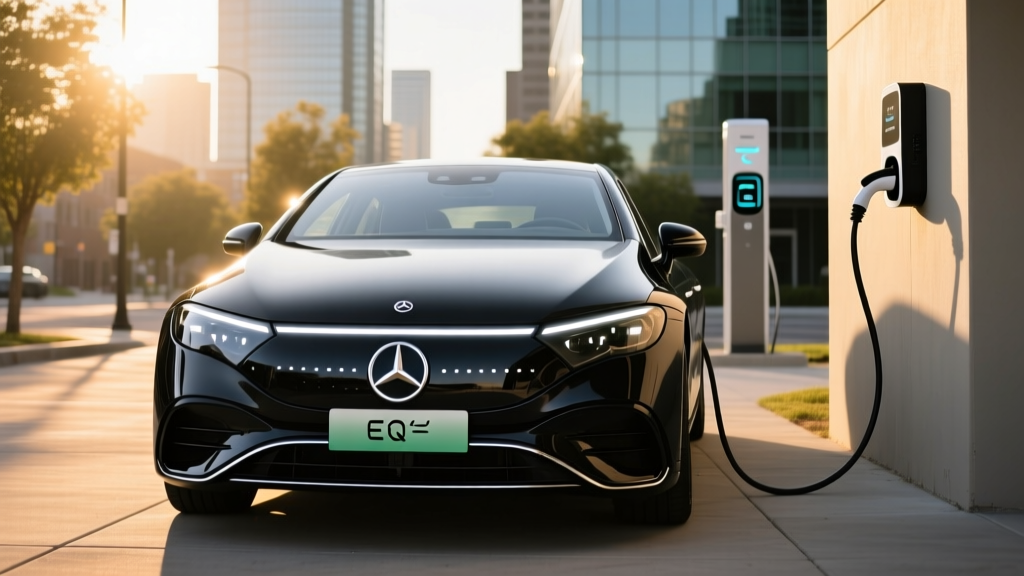
The 2025 Mercedes-Benz EQE sedan occupies a complicated space in the luxury EV market. It is objectively excellent — quiet, technologically dense, and comfortable over long distances — yet it struggles to justify its price against rivals that offer more range or faster charging for less money. After spending time with the EQE 350+ and the dual-motor EQE 350 4MATIC, here is exactly what the numbers look like when you move past the brochure.
2025 Mercedes-Benz EQE at a Glance: Key Specifications
| Specification | EQE 350+ (RWD) | EQE 350 4MATIC (AWD) | EQE 500 4MATIC |
|---|---|---|---|
| EPA Range | 308 miles | 277 miles | 270 miles |
| Battery (Usable) | 90.6 kWh, NMC lithium-ion | ||
| Drivetrain | Rear-Wheel Drive | Dual-Motor AWD | Dual-Motor AWD |
| Horsepower | 288 hp | 288 hp | 402 hp |
| 0-60 mph | 6.2 sec | 5.8 sec | 4.5 sec |
| MPGe (Combined) | 94 MPGe | 84 MPGe | 82 MPGe |
| Efficiency | 36 kWh/100 mi | 40 kWh/100 mi | 41 kWh/100 mi |
| Max DC Fast Charge | 170 kW (CCS1) | ||
| 10-80% DC Charge Time | ~32 minutes | ||
| Level 2 Home Charge Rate | 9.6 kW (~28 mi/hr) | ||
| Base MSRP | $76,050 | $79,050 | $89,050 |
| Battery Warranty | 8 years / 100,000 miles | ||
Source: fueleconomy.gov, Mercedes-Benz USA. Prices exclude $1,150 destination charge. Model-year specs subject to manufacturer updates.
Real-World Range: What the EPA Sticker Doesn't Tell You
EPA Estimate: 308 miles (EQE 350+)
Real-World Highway (70-80 mph, mild weather): ~260-280 miles
Real-World Highway (cold weather, below 32°F): ~215-240 miles
City/Mixed Commute: 290-310 miles achievable with regen use
The EQE 350+ posts a respectable 308-mile EPA estimate, but real-world results depend heavily on how and where you drive. The EQE is a heavy vehicle — over 5,400 lbs — and that mass hurts efficiency at sustained highway speeds. On a 75-mph highway loop in 65°F conditions, expect to see roughly 260-280 miles from a full charge. That drops to approximately 30% less in freezing temperatures, landing around 215-240 miles, even with the standard heat pump helping to manage cabin energy draw.
Around town, where regenerative braking recaptures energy and speeds stay lower, the EQE can actually approach or slightly exceed its EPA number. The three-stage regen system (selected via steering-wheel paddles) includes an adaptive mode that adjusts deceleration based on traffic ahead — useful in stop-and-go commuting but less intuitive than true one-pedal driving found in competitors like the BMW i5 or Tesla Model S.
The 90.6 kWh usable battery uses NMC (nickel-manganese-cobalt) chemistry, which offers higher energy density than LFP but requires more careful thermal management. Mercedes includes a liquid-cooled thermal system with battery preconditioning for DC fast charging — a critical feature for preserving long-term battery health and achieving peak charge speeds.
Charging Speed and Infrastructure: 170 kW Peak, but Watch the Curve
| Charging Level | Power (kW) | Rate (miles/hr added) | Typical Use Case |
|---|---|---|---|
| Level 1 (120V household) | ~1.4 kW | ~4 mi/hr | Emergency / overnight trickle |
| Level 2 (240V home) | 9.6 kW | ~28 mi/hr | Daily home charging (~10 hr full) |
| DC Fast Charge (CCS1) | 170 kW peak | ~180 mi/hr (peak) | Road trips, 10-80% in ~32 min |
The EQE's 170 kW peak DC fast-charging rate is the weakest link in an otherwise well-engineered package. Competitors like the Hyundai Ioniq 6 (peak 240 kW) and the Lucid Air (peak 250+ kW) significantly outpace it. On a 350 kW Electrify America or EVgo station, the EQE will peak near 170 kW from roughly 10-40% State of Charge, then taper progressively. The 10-80% charge takes approximately 32 minutes — adequate for a rest stop, but noticeably slower than the sub-20-minute benchmarks set by 800-volt architectures.
For home charging, the onboard 9.6 kW AC charger is competitive. A full charge from empty on a Level 2 home wallbox takes roughly 10 hours. Most owners will plug in overnight and wake to a full battery daily. If your commute is under 60 miles round-trip, you'll replenish what you used in roughly two hours on Level 2.
The EQE uses the CCS1 connector standard. With Mercedes-Benz committing to the NACS (Tesla Supercharger) standard for future models, current EQE owners will likely need a CCS-to-NACS adapter once Mercedes makes adapters available — a consideration if you rely heavily on the Supercharger network for road trips.
Performance, Ride Quality, and Daily Driving
The EQE 350+ delivers 288 horsepower from its single rear motor, achieving a 0-60 mph time of 6.2 seconds. That's adequate for merging and passing but won't thrill anyone cross-shopping a Tesla Model S Plaid or even the EQE 500 4MATIC (4.5 seconds). The dual-motor 350 4MATIC splits the difference at 5.8 seconds with the added traction benefit of all-wheel drive.
Where the EQE genuinely excels is ride refinement. The standard steel suspension with adaptive damping soaks up road imperfections with a composure that rivals the S-Class. Optional AIRMATIC air suspension adds further plushness and a ride-height adjustment feature useful for steep driveways or speed bumps. Cabin noise isolation is among the best in the EV segment — at 80 mph, wind and tire noise are remarkably subdued.
The EQE's rear-wheel steering (optional, up to 10 degrees) dramatically improves its urban maneuverability. Despite a 116.8-inch wheelbase, the turning circle shrinks to a compact-car-like 35.1 feet, making parking and tight U-turns surprisingly easy.
Interior Space and Cargo
| Dimension | Measurement |
|---|---|
| Front Legroom | 41.7 inches |
| Rear Legroom | 38.2 inches |
| Cargo Volume (Trunk) | 15.2 cu ft |
| Frunk | None |
| Wheelbase | 116.8 inches |
Interior space is generous up front but the rear seat is tighter than the vehicle's exterior size suggests, largely due to the sloping roofline and raised floor from the battery pack. Tall passengers (over 6'0") may find rear headroom snug. The 15.2-cubic-foot trunk is smaller than the BMW i5's 17.4 cu ft, and there is no front trunk (frunk), which is a missed opportunity for additional storage.
Pricing, Trims, and Federal Tax Credit Eligibility
| Trim | Base MSRP | As-Tested (Typical) | §30D Credit Eligible? |
|---|---|---|---|
| EQE 350+ Sedan | $76,050 | $82,000-$88,000 | Varies — see below |
| EQE 350 4MATIC Sedan | $79,050 | $85,000-$92,000 | Varies — see below |
| EQE 500 4MATIC Sedan | $89,050 | $97,000-$110,000 | Varies — see below |
The EQE's pricing places it in a competitive crossfire. The base EQE 350+ at $76,050 (before destination) is a significant investment, and options like the Pinnacle Trim package, AIRMATIC suspension, and the hyperscreen dashboard can push an as-tested price well past $90,000.
Federal Tax Credit (§30D) — Key Considerations
- MSRP Cap: The §30D credit caps eligible sedans at $55,000 MSRP. Every EQE sedan trim exceeds this limit, making the EQE ineligible for the $7,500 federal new-vehicle tax credit.
- Income Caps: Even if a vehicle qualifies, buyer AGI must not exceed $150,000 (single), $225,000 (head of household), or $300,000 (joint).
- Battery Sourcing: Credits require critical mineral and battery component sourcing thresholds that tighten annually under current IRS §30D rules.
- Point-of-Sale Transfer: Eligible credits can be transferred to the dealer at purchase for an upfront price reduction — but again, the EQE's MSRP disqualifies it.
The EQE's MSRP disqualification is a notable disadvantage versus lower-priced luxury EVs. Buyers seeking to offset purchase cost with federal incentives will need to look at the lease route — Mercedes-Benz Financial sometimes passes through a $7,500 lease credit (originating from the commercial clean vehicle credit, §45W, which has no MSRP cap), effectively reducing monthly payments. Confirm current lease incentive availability with your dealer, as these change frequently.
Tech, Driver Assistance, and the MBUX Hyperscreen
The EQE's cabin technology centers on the optional MBUX Hyperscreen — a 56-inch curved glass panel spanning the entire dashboard width, integrating a 17.7-inch central OLED display, a 12.3-inch driver cluster, and a 12.3-inch passenger screen. It's visually dramatic and functional, though the sheer number of menus and submenus demands a learning curve. Wireless Apple CarPlay and Android Auto are standard, as is the "Hey Mercedes" voice assistant, which handles navigation, climate, and media commands with reasonable accuracy.
Driver Assistance (SAE Level 2)
The EQE's DRIVE PILOT and Active Distance Assist DISTRONIC are Level 2 systems. The driver must remain fully engaged, hands on or near the wheel, eyes on the road at all times. Mercedes offers a Level 3 DRIVE PILOT system in Germany and limited US markets (Nevada, California) on the EQS — not currently available on the EQE. This vehicle does not drive itself.
Standard driver assists include Active Brake Assist, Active Lane Keeping, Blind Spot Assist, and evasive steering assist. The optional Driver Assistance Package adds Active Distance Assist (adaptive cruise with stop-and-go), Active Lane Change Assist, and Route-Based Speed Adaptation. These systems work smoothly in highway traffic but require constant supervision — they will not handle construction zones, unmapped roads, or complex urban intersections autonomously.
Pros, Cons, and the Verdict
Pros
- Exceptional ride comfort and cabin quietness
- 308-mile EPA range (350+ trim) is competitive
- Rear-wheel steering makes it agile in cities
- MBUX Hyperscreen is genuinely useful, not just flashy
- Heat pump standard for cold-weather efficiency
- 8-year/100,000-mile battery warranty
Cons
- 170 kW peak charging is slow for the class
- No frunk; 15.2 cu ft trunk is below average
- Rear seat headroom tight for tall passengers
- Ineligible for $7,500 federal tax credit (MSRP cap)
- High starting price vs. BMW i5, Tesla Model S
- CCS1 connector; NACS adapter needed for Superchargers
How the EQE Stacks Up Against Key Rivals
| Metric | 2025 Mercedes EQE 350+ | 2025 BMW i5 eDrive40 | 2025 Tesla Model S LR |
|---|---|---|---|
| EPA Range | 308 mi | 295 mi | 402 mi |
| Battery | 90.6 kWh NMC | 84.3 kWh NMC | ~100 kWh NMC |
| Peak DC Charge | 170 kW | 205 kW | 250 kW |
| 10-80% Time | ~32 min | ~28 min | ~25 min |
| 0-60 mph | 6.2 sec | 5.7 sec | 3.1 sec |
| Base MSRP | $76,050 | $67,100 | $74,990 |
| §30D Credit | No (MSRP cap) | No (MSRP cap) | No (MSRP cap) |
| Connector | CCS1 | CCS1 (NACS adapter avail.) | NACS (native) |
The BMW i5 undercuts the EQE by nearly $9,000 at base price, charges faster, and offers a more conventional sedan silhouette with better rear headroom — though the EQE's ride quality is noticeably plusher. The Tesla Model S delivers far more range and performance at a comparable price, plus native Supercharger access, but its interior materials and ride refinement don't match Mercedes standards. The choice ultimately depends on what you prioritize: comfort and prestige (EQE), value and practicality (i5), or range and charging speed (Model S).
Who Should Buy the 2025 Mercedes-Benz EQE?
- You prioritize ride comfort and cabin isolation above all else
- You have reliable home Level 2 charging and rarely need DC fast charging
- Your daily commute is under 80 miles round-trip
- You value Mercedes brand prestige and MBUX technology
- You can access lease incentives to offset the MSRP
- You take frequent long road trips and need the fastest possible charging
- You need maximum rear-seat space for tall passengers or car seats
- You want to use the $7,500 federal purchase credit
- Cargo versatility (frunk, larger trunk, hatchback) matters to you
The 2025 EQE is a luxury EV that prioritizes the journey over the destination. It's best suited for buyers with home charging who commute in comfort and take occasional road trips where the 32-minute charge stop isn't a dealbreaker. If your use case demands maximum range, the fastest DC charging, or federal tax credit eligibility, the EQE's limitations become harder to overlook at its price point.
Frequently Asked Questions
What is the real-world range of the 2025 Mercedes-Benz EQE?
The EQE 350+ has an EPA-estimated 308 miles. In real-world highway driving at 70-80 mph in mild weather, expect 260-280 miles. In freezing conditions, that drops to approximately 215-240 miles. City driving with regenerative braking can approach or slightly exceed the EPA figure.
How fast does the EQE charge at home and on DC fast chargers?
On a Level 2 home charger (9.6 kW), the EQE adds roughly 28 miles of range per hour, with a full charge taking about 10 hours. On a DC fast charger, it peaks at 170 kW and charges from 10-80% in approximately 32 minutes. This is slower than key rivals like the BMW i5 (205 kW peak) and Tesla Model S (250 kW peak).
Does the 2025 EQE qualify for the federal EV tax credit?
No. Under IRS §30D rules, new EV sedans must have an MSRP at or below $55,000 to qualify for the $7,500 purchase credit. All EQE trims exceed this cap. However, Mercedes may pass through a $7,500 lease incentive via the commercial clean vehicle credit (§45W), which has no MSRP cap — check with your dealer for current lease offers.
Is the EQE worth buying over the BMW i5 or Tesla Model S?
It depends on priorities. The EQE offers the best ride comfort and cabin quietness in the segment but charges slower and costs more than the BMW i5. The Tesla Model S provides far more range (402 mi EPA) and faster charging at a similar price but can't match the EQE's interior quality. If luxury refinement is your top criterion and you charge at home, the EQE is compelling. If charging speed, range, or value matter more, look at the alternatives.
What is the battery warranty on the EQE?
Mercedes-Benz covers the EQE's high-voltage battery for 8 years or 100,000 miles, whichever comes first, against defects and capacity loss below a specified threshold (typically 70% State of Health). The general vehicle warranty is 4 years/50,000 miles.
Does the EQE have a frunk (front trunk)?
No. The EQE does not have a front trunk. The total cargo volume is 15.2 cubic feet in the rear trunk, which is smaller than competitors like the BMW i5 (17.4 cu ft). This is a notable limitation for a vehicle in this price class.