Quick Verdict: Is a 2025 Mach-E Lease Worth It?
The 2025 Ford Mustang Mach-E occupies a rare sweet spot in the midsize electric SUV segment: it delivers credible range, competitive DC fast-charging, and a driving character that genuinely earns its Mustang badge. With Ford aggressively adjusting pricing to remain competitive against the Tesla Model Y, Hyundai Ioniq 5, and Volkswagen ID.4, the 2025 Mach-E is generating some of the most attractive lease offers in the EV space — particularly when factoring in the federal tax credit that dealerships can now apply at the point of sale.
This review breaks down every spec that matters for lease shoppers: real-world range versus the EPA sticker, actual charging speeds at public DC stations, battery chemistry and warranty coverage, and exactly which trims qualify for the $7,500 §30D federal credit. If you're comparing lease numbers right now, this is the data-driven guide you need before signing.
2025 Mach-E Specs at a Glance
| Spec | Select RWD | Premium AWD (Ext. Range) | GT |
|---|---|---|---|
| EPA Range | 250 mi | 320 mi | 280 mi |
| Battery (Usable) | 72 kWh (LFP) | 91 kWh (NMC) | 91 kWh (NMC) |
| Horsepower | 266 hp | 346 hp | 480 hp |
| 0–60 mph | ~6.3 sec | ~5.1 sec | ~3.5 sec |
| Drivetrain | RWD (Single Motor) | AWD (Dual Motor) | AWD (Dual Motor) |
| Max DC Charge Rate | 115 kW | 150 kW | 150 kW |
| 10–80% DC Time | ~42 min | ~36 min | ~36 min |
| MPGe (Combined) | 105 MPGe | 101 MPGe | 84 MPGe |
| Base MSRP | $39,995 | $46,995 | $55,995 |
Source: EPA / fueleconomy.gov and Ford Motor Company. Figures reflect 2025 model year.
Real-World Range vs. EPA Estimates
EPA Sticker: Up to 320 miles (Premium Extended Range RWD)
Real-World Expectation: 265–285 miles on a mixed highway/city loop at 70–75 mph; expect 220–240 miles in freezing weather (below 30°F) with cabin heat running.
The 320-mile EPA figure applies to the Extended Range RWD configuration. If you opt for AWD on the Extended Range battery — the most popular Premium trim — the EPA rating drops to 290 miles. That's a meaningful difference for road-trip planning.
During sustained highway driving at 75 mph in moderate temperatures (60–75°F), owners typically see 265–285 miles from the 91 kWh Extended Range pack. The Mach-E's aerodynamic efficiency is good but not class-leading; the Hyundai Ioniq 5 and Tesla Model Y both edge it out slightly on highway energy consumption. Cold weather hits all EVs hard, and the Mach-E is no exception. Below freezing, expect a 20–30% reduction in range due to battery thermal management demands and resistive cabin heating. The heat pump Ford introduced on updated trims helps, but it doesn't eliminate cold-weather range loss — it mitigates it.
For the Standard Range LFP battery (72 kWh usable), the EPA's 250-mile rating translates to roughly 210–225 real-world highway miles in fair weather. That's adequate for commuting but requires route planning on trips exceeding 180 miles one-way.
Charging Speeds: DC Fast and Level 2 at Home
| Charging Level | Power | Miles Added per Hour | Notes |
|---|---|---|---|
| Level 1 (120V Household) | ~1.4 kW | ~3–4 mi/hr | Emergency/trickle only |
| Level 2 (240V Home, 48A) | 10.5 kW | ~28–32 mi/hr | Full charge in ~9 hrs (Ext. Range) |
| Level 2 (240V Home, 32A) | 7.7 kW | ~21–24 mi/hr | Common portable/mobile connector |
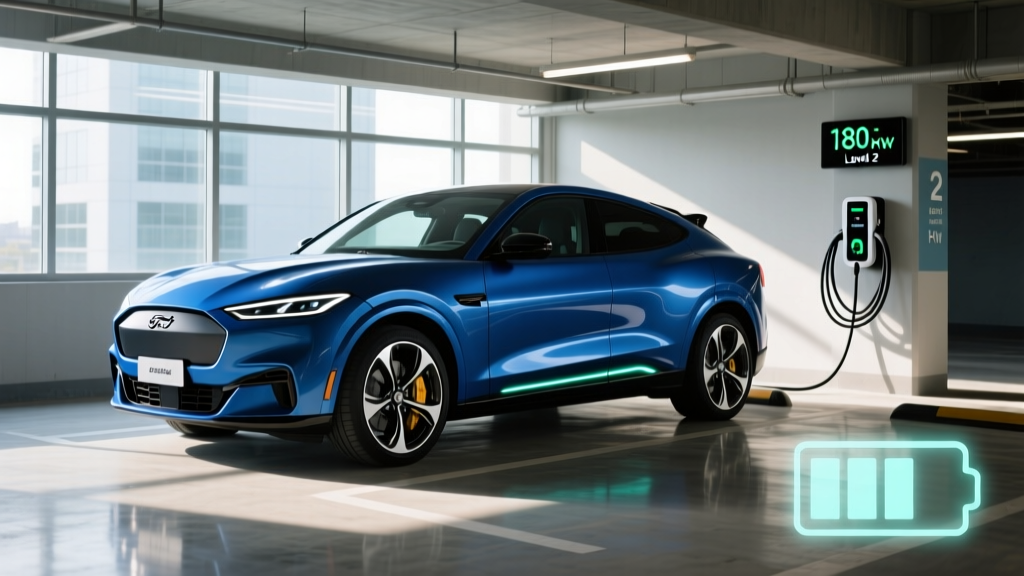
| DC Fast (Peak) | 150 kW (Ext. Range) | ~180 mi in 20 min | 10–80% in ~36 min |
| DC Fast (Standard Range) | 115 kW | ~140 mi in 20 min | 10–80% in ~42 min |
The Mach-E's 150 kW peak DC fast-charging rate is respectable but not segment-leading. The Hyundai Ioniq 5 and Kia EV6, with their 800V architectures, accept up to 235–240 kW and achieve 10–80% charges in roughly 18 minutes. The Mach-E takes about twice as long.
There's an important nuance about the charge curve: the Mach-E sustains near-peak rates up to approximately 50–55% state of charge (SoC), then tapers progressively. Above 80%, charging slows dramatically — this is standard lithium-ion behavior to protect cell longevity, but it means that if you're road-tripping and need to charge past 80%, budget extra time. Most savvy EV road-trippers charge from 10% to 80% and move on.
At home on a 48-amp Level 2 hardwired charger (the recommended setup for Extended Range owners), you'll add roughly 30 miles per hour of charging. A depleted Extended Range battery recovers fully overnight in about 9 hours. For Standard Range models with the smaller 72 kWh pack, expect about 7 hours on the same 48A circuit.
Home installation note: A 48A Level 2 charger requires a 60-amp dedicated circuit. Budget $500–$1,500 for electrician labor plus the charger unit itself ($350–$700 for a quality unit like the ChargePoint Home Flex or Emporia Level 2). If your electrical panel is maxed out or outdated, a panel upgrade can add $1,500–$3,000.
Battery Chemistry, Warranty, and Longevity
Ford uses two distinct battery chemistries in the 2025 Mach-E lineup, and the choice affects more than just range:
Standard Range — LFP (Lithium Iron Phosphate): The 72 kWh pack uses LFP cells, which are known for exceptional cycle life and thermal stability. LFP batteries tolerate frequent 100% charging better than NMC, making them ideal for daily commuters who plug in every night. The trade-off is lower energy density (heavier pack for fewer miles) and somewhat reduced cold-weather performance.
Extended Range — NMC (Nickel Manganese Cobalt): The 91 kWh pack uses NMC chemistry for higher energy density and better cold-weather output. Ford recommends charging to 80–90% for daily use and reserving 100% for road trips to preserve long-term capacity.
Warranty coverage: Ford provides an 8-year / 100,000-mile battery and powertrain warranty, covering defects and capacity loss below 70% of original capacity. This matches the industry standard set by most mainstream EV manufacturers and exceeds the federal minimum. For lease shoppers, this warranty will almost certainly outlast the lease term, so battery degradation risk is essentially irrelevant during your ownership period.
Pricing, Trim Levels, and the Federal Tax Credit
| Trim | Base MSRP | §30D Credit Eligible? | Effective Price (with credit) |
|---|---|---|---|
| Select (Standard Range, RWD) | $39,995 | Yes | $32,495 |
| Select (Standard Range, AWD) | $42,995 | Yes | $35,495 |
| Premium (Extended Range, RWD) | $46,995 | Yes | $39,495 |
| Premium (Extended Range, AWD) | $49,995 | Yes | $42,495 |
| GT (Extended Range, AWD) | $55,995 | Yes | $48,495 |
The 2025 Mach-E qualifies for the full $7,500 federal tax credit under IRS §30D — but eligibility depends on your circumstances, not just the vehicle. Here's what determines whether you actually receive it:
- MSRP Cap: The Mach-E is classified as an SUV, so the cap is $80,000. All current trims fall well below this threshold.
- Buyer Income Limits: Adjusted gross income must not exceed $300,000 (married filing jointly), $225,000 (head of household), or $150,000 (single). These are hard caps.
- Battery Sourcing: The credit splits into two $3,750 halves — one for critical minerals sourcing and one for battery component manufacturing. Ford's supply chain currently satisfies both halves for the 2025 Mach-E, but sourcing rules tighten annually. Always verify current eligibility on IRS.gov before purchase.
- Point-of-Sale Transfer: As of 2024, you can transfer the credit to the dealer at purchase, receiving it as an immediate price reduction rather than waiting to claim it on your tax return. This applies to leases as well — the lessor (Ford Credit) claims the credit and typically passes the savings through as a capitalized cost reduction, lowering your monthly payment.
Lease-specific advantage: When you lease, the $7,500 credit goes to the leasing company (Ford Credit), which then factors it into the lease terms. In practice, Ford has been applying this credit as a cap cost reduction on Mach-E leases, effectively lowering monthly payments by roughly $120–$180/month depending on term and mileage allowance. This is a significant deal sweetener and a key reason the 2025 Mach-E lease deals are competitive right now.
Performance, Efficiency, and Daily Usability
The base Select RWD produces 266 hp and reaches 60 mph in approximately 6.3 seconds — brisk by any standard and more than adequate for highway merging and overtaking. Step up to the Premium AWD and you get 346 hp with a 5.1-second 0–60. The GT, at 480 hp and roughly 3.5 seconds to 60, enters genuine sports-car territory and delivers the kind of instant torque that makes EV performance addictive.
Efficiency varies meaningfully across trims. The Select RWD achieves 105 MPGe combined (roughly 32 kWh/100 mi), while the GT drops to 84 MPGe (40 kWh/100 mi). For cost-conscious lease shoppers prioritizing low running costs, the RWD configurations are clearly the efficiency winners.
Cargo and passenger space: The Mach-E offers 29.7 cubic feet behind the rear seats and 59.7 cubic feet with the rear seats folded. The front trunk (frunk) adds 4.7 cubic feet with a useful drain plug — handy for ice and beverages on tailgate outings. Rear legroom is 38.9 inches, which is generous for the segment and accommodates tall passengers comfortably.
Technology highlights: The 15.5-inch vertical touchscreen running SYNC 4A is the cabin centerpiece. Wireless Apple CarPlay and Android Auto are standard. Ford's BlueCruise hands-free driving system is available on equipped trims, offering genuine hands-off driving on pre-mapped divided highways (over 130,000 miles of compatible roads as of 2025). This is an SAE Level 2 system — you must remain attentive and ready to take over at all times. It is not self-driving.
ADAS Clarification: BlueCruise is an SAE Level 2 driver-assist system. Despite the "hands-free" branding, the driver must remain engaged, eyes on the road (monitored by a driver-facing camera), and prepared to resume manual control instantly. It does not handle construction zones, unmapped roads, or complex urban driving.
Pros, Cons, and How It Compares
Pros
- Up to 320 miles EPA range (Extended Range RWD)
- Full $7,500 federal tax credit eligibility across all trims
- Competitive lease pricing with cap cost reduction
- BlueCruise hands-free highway driving available
- Engaging driving dynamics for an SUV
- Spacious rear seats and practical frunk
- 8-year/100,000-mile battery warranty
- OTA updates continue to improve the platform
Cons
- 150 kW peak DC charging trails 800V rivals (Ioniq 5, EV6)
- 10–80% charge time of ~36 min is mid-pack
- No NACS port standard (CCS1; NACS adapter available)
- GT trim's efficiency (84 MPGe) increases running costs
- Some interior materials feel below the price point
- LFP Standard Range pack loses more range in extreme cold
Versus the Tesla Model Y: The Model Y Long Range AWD offers 310 miles EPA, 250 kW peak charging (via the 4680 cells and NACS network advantage), and a slightly lower starting price. However, the Mach-E counters with more traditional SUV styling, a physical instrument cluster, BlueCruise, and — crucially for many buyers — a non-Tesla dealership experience. If you value Supercharger access and fastest charging, the Model Y wins on infrastructure. If you prefer a Ford dealer network and more conventional ergonomics, the Mach-E is the stronger choice.
Versus the Hyundai Ioniq 5: The Ioniq 5's 800V architecture delivers dramatically faster charging (18-minute 10–80%) and slightly sharper efficiency. The Mach-E offers more rear cargo volume and a larger frunk, plus BlueCruise availability. Both qualify for the $7,500 credit. This is genuinely close — pick the Ioniq 5 for road-trip charging speed, the Mach-E for cargo and ADAS features.
Who Should Lease the 2025 Mach-E?
Choose the Mach-E Select RWD if: You commute 30–60 miles daily, charge at home, and want the lowest lease payment with maximum efficiency (105 MPGe). The 250-mile EPA range is plenty for daily use with weekend errands.
Choose the Mach-E Premium Extended Range AWD if: You need all-weather capability, regularly drive 200+ miles between charges, and want the longest real-world range (265–285 mi highway) with the comfort of dual-motor traction.
Choose the Mach-E GT if: Performance is a priority, you accept higher energy costs (84 MPGe), and you want sports-car acceleration in a practical family SUV. The 3.5-second 0–60 time is genuinely thrilling.
Look elsewhere if: You frequently road-trip 400+ miles and need the fastest possible DC charging — the Ioniq 5 or Model Y serve that use case better. Or if you need three rows of seating — the Kia EV9 or Rivian R1S are the three-row EV options in this price band.
Frequently Asked Questions
What is the real-world range of the 2025 Mach-E?
The Extended Range RWD is EPA-rated at 320 miles, but real-world highway driving at 70–75 mph typically yields 265–285 miles. In freezing weather, expect 220–240 miles. The Standard Range LFP model delivers roughly 210–225 real-world highway miles.
How fast does the 2025 Mach-E charge?
Extended Range models accept up to 150 kW on DC fast chargers, reaching 10–80% in approximately 36 minutes. Standard Range models peak at 115 kW with a 10–80% time of about 42 minutes. At home on a 48A Level 2 charger, expect roughly 30 miles of range per hour of charging.
Does the 2025 Mach-E qualify for the federal EV tax credit?
Yes — all 2025 Mach-E trims currently qualify for the full $7,500 §30D credit, subject to buyer income limits ($150K single / $300K joint) and battery sourcing rules that may tighten. On a lease, the credit typically reduces the capitalized cost, lowering your monthly payment. Verify current eligibility at IRS.gov.
Is the 2025 Mach-E worth leasing vs. buying?
Leasing makes sense if you want lower monthly payments, plan to upgrade in 36 months, and don't want to worry about long-term battery depreciation or resale value. The $7,500 credit flows through the lease as a cap cost reduction. Buying makes sense if you drive high annual mileage (leases penalize excess miles), plan to keep the vehicle 7+ years, or want to build equity.
What charging connector does the Mach-E use?
The 2025 Mach-E uses the CCS1 connector for DC fast charging and J1772 for Level 2 AC. Ford has announced a NACS adapter for Supercharger network access, expanding your public charging options significantly. This adapter is available through Ford dealers.
How does the Mach-E handle cold weather?
Like all EVs, the Mach-E loses 20–30% of its range in sustained sub-freezing temperatures due to battery thermal management and cabin heating demands. The available heat pump reduces this penalty modestly. Preconditioning the battery while plugged in (via the FordPass app) before departure helps preserve range and enables faster DC charging upon arrival at a station.