Quick Verdict: The 2025 Mach-E Cabin Gets Smarter, But Range Is the Real Story
The Ford Mustang Mach-E has been one of the most compelling electric crossovers since its launch, and the 2025 model year brings meaningful refinements to the cabin experience. The headline feature of the 2025 Mach-E interior is the continued dominance of the portrait-oriented 15.5-inch SYNC 4A touchscreen — now with faster response times, a redesigned home screen, and deeper wireless Apple CarPlay and Android Auto integration. Ford also upgraded the BlueCruise hands-free driving system to version 1.5, expanding the hands-free highway map to over 130,000 miles of divided roads across North America.
But the interior upgrades only matter if the underlying EV platform delivers on range, charging, and ownership value. The 2025 Mach-E does, with EPA-estimated range up to 320 miles on the California Route 1 RWD trim and DC fast-charging speeds that peak at 150 kW. Below, we break down everything you need to know — from real-world range expectations to federal tax credit eligibility — so you can decide whether the 2025 Mach-E deserves a spot in your driveway.
2025 Mach-E Interior: Design, Materials, and Technology
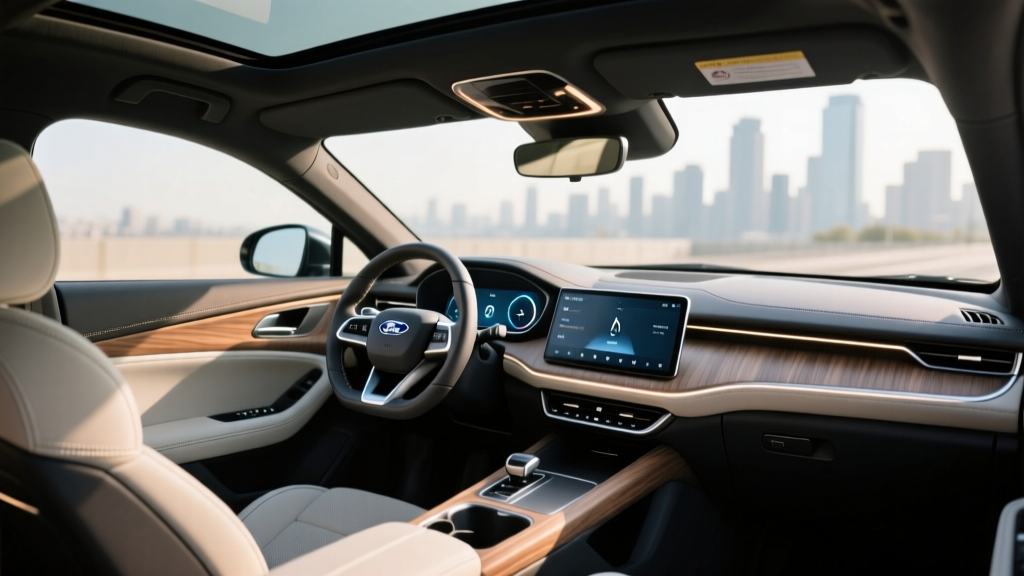
The 2025 Mach-E interior is a study in minimalist, tech-forward design. Ford strips away most physical buttons in favor of the massive 15.5-inch vertically oriented touchscreen that anchors the center stack. The screen runs SYNC 4A with a new card-based interface that groups climate, navigation, and media controls into swipeable tiles — a significant usability improvement over earlier model years where drivers had to dig through submenus for basic adjustments.
Materials and Build Quality
Ford uses a mix of soft-touch materials and hard plastics throughout the cabin. The upper dashboard and door panels feature synthetic leather and stitched vinyl, while lower door bins and the center console use harder, more utilitarian plastics. It's not luxury-grade like a BMW iX or Genesis GV60, but it's competitive with the Tesla Model Y and Hyundai Ioniq 5 at this price point. The ActiveX synthetic leather seats (standard on Premium and GT trims) are durable, easy to clean, and ventilated on higher trims — a practical choice for families.
Digital Cockpit and Displays
Behind the steering wheel, a 10.2-inch digital instrument cluster displays speed, range, navigation prompts, and BlueCruise status. Unlike some competitors that have gone to full augmented-reality head-up displays, Ford keeps the cluster relatively conventional — but it's legible, customizable, and free of the lag that plagued early Mach-E software builds.
Storage and Practicality
The floating center console creates a usable pass-through storage area beneath it — ideal for a purse, tablet, or small bag. The wireless charging pad sits forward of the console and accommodates larger phones. Door pockets are generously sized, and the rear cargo area offers 29.7 cubic feet behind the second row, expanding to 59.7 cubic feet with the 60/40 split rear seats folded. The front trunk (frunk) adds 4.7 cubic feet of drainable storage — useful for wet gear or groceries that might leak.
| Measurement | Dimension |
|---|---|
| Front Headroom | 40.4 in |
| Front Legroom | 43.3 in |
| Rear Headroom | 38.9 in |
| Rear Legroom | 38.1 in |
| Cargo (behind 2nd row) | 29.7 cu ft |
| Cargo (seats folded) | 59.7 cu ft |
| Frunk Volume | 4.7 cu ft |
Range, Battery, and Efficiency: What the EPA Says vs. Reality
The 2025 Mach-E is available with two battery packs across multiple drivetrain configurations. Understanding which combination suits your driving habits is essential for setting accurate range expectations.
The California Route 1 RWD with the Extended Range battery achieves an EPA-estimated 320 miles. In real-world highway driving at 70-75 mph, expect approximately 265–285 miles in moderate temperatures (60–80°F). In cold weather (below 30°F), range can drop to 220–245 miles due to battery chemistry limitations and cabin heating demands. AWD trims with the Extended Range battery are EPA-rated at 290–300 miles depending on wheel size; real-world highway range lands around 245–265 miles in fair weather.
| Trim / Drivetrain | Battery (Usable kWh) | Chemistry | EPA Range | MPGe (Combined) | kWh/100 mi |
|---|---|---|---|---|---|
| Select RWD (Std Range) | 70 kWh | NMC | 250 mi | 101 MPGe | 33 |
| Premium RWD (Ext Range) | 91 kWh | NMC | 310 mi | 103 MPGe | 32 |
| CA Route 1 RWD (Ext Range) | 91 kWh | NMC | 320 mi | 105 MPGe | 32 |
| Premium AWD (Ext Range) | 91 kWh | NMC | 290 mi | 96 MPGe | 35 |
| GT AWD | 91 kWh | NMC | 280 mi | 88 MPGe | 38 |
All 2025 Mach-E models use NMC (nickel manganese cobalt) lithium-ion battery cells supplied by LG Energy Solution. NMC offers higher energy density than LFP (lithium iron phosphate), which is why Ford can pack 91 usable kWh into the Extended Range pack without making the vehicle excessively heavy. The trade-off is that NMC batteries are more sensitive to sustained high states of charge and extreme heat — Ford recommends setting the charge limit to 80% for daily use and only charging to 100% before long trips.
For detailed efficiency data, the EPA's fueleconomy.gov EV database provides official MPGe and kWh/100mi figures for every trim.
Charging Speed: DC Fast Charging and Home Level 2
Charging speed is one of the most practical considerations for EV ownership, and the 2025 Mach-E delivers respectable — if not class-leading — performance.
| Charging Level | Max Power | Speed / Time |
|---|---|---|
| Level 1 (120V household) | ~1.4 kW | ~3–4 miles per hour |
| Level 2 (240V home/public) | 10.5 kW (48A) | ~30–33 miles per hour; full charge in ~9 hrs (Ext Range) |
| DC Fast Charging (CCS) | 150 kW peak | 10–80% in ~45 minutes (Std Range); ~48 minutes (Ext Range) |
Understanding the Charge Curve
The Mach-E's peak 150 kW DC fast-charge rate is achievable only between approximately 10% and 30% state of charge on the Extended Range battery. Beyond 50% SoC, the charge rate tapers progressively — dropping to around 80–90 kW by 60% and further to 40–50 kW above 80%. This is typical of NMC chemistry and the vehicle's thermal management strategy, which prioritizes battery longevity over sustained peak charging.
In practical terms, a 10–80% session at a 150+ kW Electrify America or EVgo station takes roughly 45–48 minutes for the Extended Range pack. If you're road-tripping and need a quick top-up, a 15–20 minute stop can add approximately 80–100 miles of range — enough to reach the next charger comfortably.
Home Charging Setup
The Mach-E comes with a Ford Mobile Charger that supports both 120V (Level 1) and 240V (Level 2 at up to 30A / 7.2 kW) outlets. For optimal home charging, Ford recommends installing a dedicated 48-amp Level 2 wall charger (such as the Ford Charge Station Pro or a third-party unit like the ChargePoint Home Flex) on a 60-amp circuit. At 10.5 kW, you'll add approximately 30–33 miles of range per hour — easily replenishing a day's worth of driving overnight.
Professional installation of a 48A Level 2 charger typically costs between $800 and $2,000 depending on your electrical panel's capacity and the distance from the panel to the garage. If your home has a 100-amp main panel, you may need a panel upgrade ($1,500–$3,000) to support a dedicated 60-amp circuit. Always consult a licensed electrician for a site-specific assessment.
Performance: 0-60, Horsepower, and Drivetrain Options
The 2025 Mach-E offers a range of performance profiles, from the efficiency-focused RWD models to the track-capable GT.
| Trim | Drivetrain | Horsepower | Torque (lb-ft) | 0–60 mph |
|---|---|---|---|---|
| Select / Premium RWD | Rear-Wheel Drive | 266 hp | 317 | 6.3 sec |
| Premium AWD (Ext Range) | Dual-Motor AWD | 346 hp | 428 | 5.1 sec |
| GT | Dual-Motor AWD | 480 hp | 600 | 3.8 sec |
| GT (Performance Upgrade) | Dual-Motor AWD | 480 hp | 634 | 3.5 sec |
The RWD models provide ample acceleration for daily commuting and highway merging, with linear, predictable power delivery. The AWD Extended Range models add meaningful grip in rain and light snow, along with a noticeable performance bump. The GT is genuinely quick — its 3.5-second 0-60 time with the Performance Upgrade puts it in sports-car territory, and the instant electric torque makes it feel even faster in real-world passing situations.
All trims feature regenerative braking with adjustable intensity. The one-pedal driving mode (engaged via the touchscreen or steering wheel button) provides strong enough regen to bring the vehicle to a complete stop in most city driving scenarios, reducing brake wear and improving efficiency in stop-and-go traffic.
Pricing, Trim Levels, and Federal Tax Credit Eligibility
The 2025 Mach-E lineup starts at $39,995 for the Select RWD with the Standard Range battery and climbs to approximately $59,995 for a fully optioned GT with the Performance Upgrade.
| Trim | Base MSRP | As-Tested (Typical Options) |
|---|---|---|
| Select RWD (Std Range) | $39,995 | $41,500–$43,000 |
| Premium RWD (Ext Range) | $48,995 | $50,500–$53,000 |
| CA Route 1 RWD (Ext Range) | $50,995 | $52,000–$54,000 |
| Premium AWD (Ext Range) | $51,995 | $53,500–$56,000 |
| GT AWD | $55,995 | $57,000–$59,995 |
Federal EV Tax Credit (§30D) — 2025 Rules
The 2025 Ford Mustang Mach-E may qualify for up to $3,750 of the federal EV tax credit under IRS §30D, depending on battery component and critical mineral sourcing requirements that are subject to change. Here's what you need to know:
- MSRP Cap: The Mach-E qualifies as an SUV under IRS guidelines, with an MSRP cap of $80,000. All trims fall well under this threshold.
- Income Cap: Buyer adjusted gross income must not exceed $150,000 (single), $225,000 (head of household), or $300,000 (married filing jointly).
- Battery Sourcing: The credit is split into two halves — $3,750 for meeting battery component manufacturing requirements and $3,750 for critical mineral sourcing. As of 2025, the Mach-E's LG Energy Solution cells (manufactured in the U.S.) typically satisfy the component requirement, but critical mineral sourcing may not fully qualify, limiting the credit to $3,750 for many buyers.
- Point-of-Sale Transfer: Eligible buyers can transfer the credit to the dealer at purchase, reducing the out-of-pocket price immediately rather than waiting to claim it on their tax return.
Always verify current eligibility on the IRS clean vehicle credit page and consult a tax professional before making a purchase decision. Credit rules are subject to legislative and regulatory changes.
BlueCruise, Safety, and Driver Assistance
The 2025 Mach-E comes standard with Ford Co-Pilot360 2.0, which includes automatic emergency braking with pedestrian detection, blind-spot monitoring, rear cross-traffic alert, lane-keeping assist, and adaptive cruise control with stop-and-go.
BlueCruise is a Level 2 driver-assistance system, not a self-driving feature. Even when operating hands-free on approved divided highways, the driver must remain attentive, keep their eyes on the road, and be prepared to take over immediately. The system uses a driver-facing camera to monitor eye gaze and will issue warnings — and eventually bring the vehicle to a stop — if the driver appears disengaged.
BlueCruise 1.5 (available on Premium, CA Route 1, and GT trims; included in a $2,100 package on Select) adds lane-change assist — the system can execute highway lane changes automatically when the driver confirms with a turn signal — and improved curve-speed management. In our experience, BlueCruise performs well on well-marked interstates but can be overly cautious in construction zones and may disengage abruptly when lane markings fade.
The Mach-E earned a Top Safety Pick designation from the IIHS and a 5-star overall safety rating from NHTSA, making it one of the safest choices in the electric crossover segment.
Warranty and Long-Term Ownership
Ford backs the 2025 Mach-E with a comprehensive warranty package that provides strong peace of mind for long-term ownership:
- Bumper-to-Bumper: 3 years / 36,000 miles
- Powertrain: 5 years / 60,000 miles
- High-Voltage Battery: 8 years / 100,000 miles (covers capacity loss below 70% of original)
- BlueCruise Hardware: 8 years / 100,000 miles
The 70% capacity retention threshold on the battery warranty is industry-standard, matching what Tesla, Hyundai, and Kia offer. Based on current degradation data from Mach-E owners, NMC packs in this platform are losing approximately 1–2% of total capacity per year under normal use patterns — meaning most owners will retain 85–90% of original capacity at the 8-year mark, well above the warranty threshold.
Out-of-warranty battery replacement for the Extended Range pack is estimated at $15,000–$20,000 including labor, though prices are expected to decline as battery cell costs continue their long-term downward trend.
Pros, Cons, and Who Should Buy the 2025 Mach-E
Pros
- Spacious, tech-forward interior with the excellent 15.5-inch SYNC 4A display
- Up to 320 miles EPA range on the CA Route 1 RWD trim
- BlueCruise hands-free highway driving on 130,000+ miles of roads
- Strong safety ratings (IIHS Top Safety Pick, NHTSA 5-star)
- Practical cargo space (29.7 cu ft + 4.7 cu ft frunk)
- Competitive pricing within the electric crossover segment
- Available AWD for all-weather confidence
Cons
- DC fast charging peaks at 150 kW — slower than Hyundai/Kia's 800V architecture (240+ kW)
- Extended Range battery adds significant weight, affecting handling on AWD trims
- Federal tax credit may be limited to $3,750 (not the full $7,500) due to critical mineral sourcing
- GT trim's range drops to 280 miles EPA — a meaningful trade for the performance
- No LFP battery option for buyers who prefer daily 100% charging
- Rear visibility is compromised by the sloping roofline; rely on the backup camera
Who Is the 2025 Mach-E Best For?
Choose the Mach-E if: You want a tech-rich, spacious electric crossover with strong safety credentials, hands-free highway driving capability, and enough range for daily commuting plus occasional road trips. The Premium or CA Route 1 RWD trims offer the best value-to-range ratio.
Look elsewhere if: You need the fastest possible DC charging for frequent long-distance road trips (consider the Hyundai Ioniq 5 or Kia EV6 with 800V architecture), you want an LFP battery for worry-free daily 100% charging (consider the Tesla Model Y Standard Range), or you need three rows of seating (consider the Kia EV9).
Frequently Asked Questions
What is the real-world range of the 2025 Mach-E?
The EPA rates the California Route 1 RWD at 320 miles, but real-world highway driving at 70-75 mph in moderate temperatures yields approximately 265–285 miles. In cold weather below 30°F, expect 220–245 miles. AWD trims with the Extended Range battery deliver 245–265 real-world highway miles in fair weather.
How fast does the 2025 Mach-E charge at home and on the road?
At home on a 48-amp Level 2 charger, the Mach-E charges at up to 10.5 kW, adding about 30–33 miles of range per hour — a full charge of the Extended Range pack takes roughly 9 hours. On DC fast chargers, it peaks at 150 kW and charges from 10–80% in approximately 45–48 minutes, though the charge rate tapers significantly above 50% state of charge.
Does the 2025 Mach-E qualify for the $7,500 federal EV tax credit?
The Mach-E may qualify for up to $3,750 of the federal tax credit under IRS §30D. The full $7,500 requires meeting both battery component ($3,750) and critical mineral ($3,750) sourcing requirements. As of 2025, the Mach-E typically satisfies the component requirement but may not fully meet the critical mineral threshold. Eligibility also depends on buyer income (capped at $150K single / $300K joint) and the vehicle's MSRP (capped at $80K for SUVs — all trims qualify). Verify current status on IRS.gov.
Is the 2025 Mach-E worth buying vs. the Tesla Model Y or Hyundai Ioniq 5?
It depends on your priorities. The Mach-E offers a more traditional crossover driving experience, an excellent infotainment system, and BlueCruise hands-free driving. The Tesla Model Y has access to the Supercharger network (though Ford is gaining NACS access), slightly more cargo space, and potentially the full $7,500 credit. The Hyundai Ioniq 5 charges significantly faster (800V architecture, 10–80% in ~18 minutes) but has slightly less range and no hands-free driving system as capable as BlueCruise. Test-drive all three before deciding.
What is the warranty on the Mach-E battery?
Ford covers the high-voltage battery for 8 years or 100,000 miles, whichever comes first. The warranty covers capacity loss below 70% of original capacity. Based on current owner data, most Mach-E batteries retain 85–90% capacity at the 8-year mark under normal usage patterns.
Can the 2025 Mach-E use Tesla Superchargers?
Ford has been transitioning to the NACS (North American Charging Standard) connector for future models. For the 2025 Mach-E, which uses the CCS1 connector, Ford provides a NACS adapter that allows access to Tesla Supercharger V3 stalls (up to 150 kW). Verify adapter availability with your dealer at the time of purchase.