The 2025 Lucid Gravity arrives as the second production vehicle from Lucid Motors, and it brings the same engineering obsession with efficiency that made the Air sedan a benchmark. This is a three-row, seven-seat electric SUV built on a 900-volt architecture with a targeted EPA range of up to 440 miles — numbers that, if validated, would make it the longest-range electric SUV on the market. But range stickers don't tell the whole story. After spending time with the specs, the charging data, and Lucid's track record from the Air, here's what real buyers need to know before writing a deposit check.
Range, Battery, and Efficiency Breakdown
Lucid has built its reputation on doing more with less energy. The Gravity uses a battery pack estimated at approximately 118 kWh of usable capacity (Lucid has not published an official figure, but this aligns with the Air Grand Touring's architecture). The chemistry is nickel-manganese-cobalt (NMC), which offers higher energy density than LFP — critical for packaging 440 miles of range into an SUV without excessive weight.
Efficiency is where Lucid separates itself from competitors. The Air Grand Touring achieves roughly 3.5–3.8 miles per kWh in mixed driving, and Lucid has stated the Gravity will target similar efficiency despite its larger footprint. If the Gravity hits approximately 3.6 mi/kWh with a 118 kWh pack, the math checks out for a 440-mile EPA estimate. For comparison, the Rivian R1S (Dual-Motor Max) manages about 2.5 mi/kWh with its 149 kWh pack, and the Tesla Model X Long Range sits around 3.0 mi/kWh.
| Spec | Pure RWD | Grand Touring AWD |
|---|---|---|
| Target EPA Range | 400 mi | 440 mi |
| Battery (est. usable) | ~100 kWh NMC | ~118 kWh NMC |
| Drivetrain | Rear-Wheel Drive | Dual-Motor AWD |
| Horsepower | ~600 hp | ~823 hp |
| 0–60 mph | ~4.5 sec (est.) | 3.5 sec |
| Towing Capacity | 6,000 lb | 6,000 lb |
| Base MSRP | $79,900 | $94,900 |
Charging Speed: 900V Architecture in Practice
The Gravity inherits Lucid's 900-volt electrical architecture — the same system that allows the Air to sustain unusually high charge rates deep into the session. Lucid has stated the Gravity will support peak DC fast charging above 300 kW. On a 350 kW CCS charger (or NACS adapter-equipped Supercharger), the 10–80% session should complete in approximately 20 minutes, though sustained rates will taper as state of charge climbs past 60%.
This is where the 900V system matters: most 400V vehicles (Rivian R1S, earlier Hyundai/Kia models) begin tapering sharply after 50–60% SoC. Lucid's higher voltage allows the battery to accept more power at higher states of charge, meaning the average charge rate across a 10–80% session is closer to the peak rate than competitors. In practical terms, you're spending less time at the charger on a road trip.
| Charging Level | Power / Rate | Time / Range Added |
|---|---|---|
| Level 1 (120V) | ~1.4 kW | ~4–5 mi/hr |
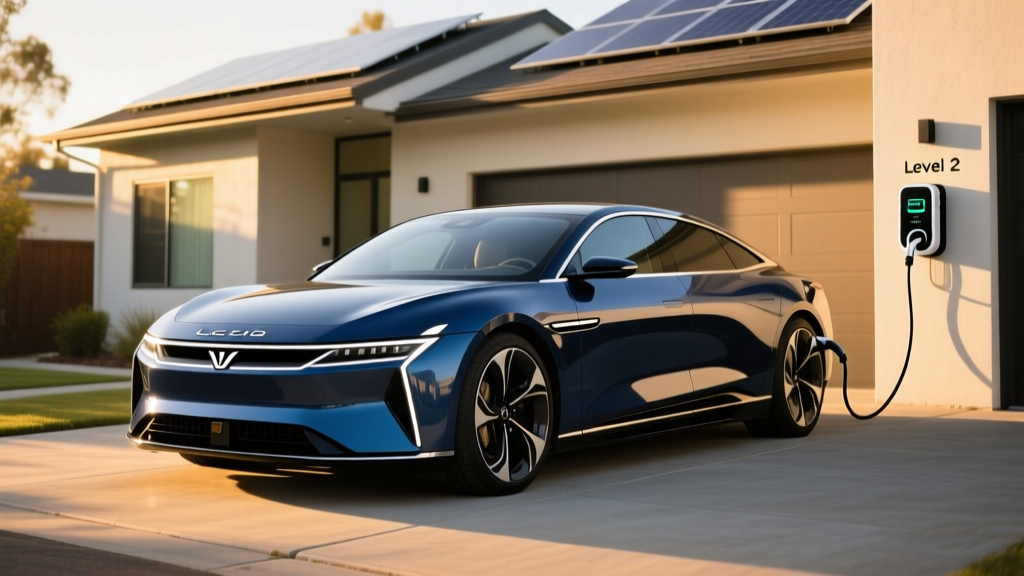
| Level 2 (240V, 48A) | ~11.5 kW | ~38–42 mi/hr; full charge ~10–12 hrs |
| DC Fast Charge (peak) | 300+ kW | 10–80% in ~20 min |
For home charging, the Gravity's onboard charger supports up to 19.2 kW on a hardwired Level 2 circuit (80A), though most residential installations run 48A (11.5 kW), which is sufficient to fully replenish the pack overnight. A NACS adapter is included for access to Tesla Superchargers, which matters because Lucid's native CCS network access (Electrify America, EVgo) still lags behind Supercharger reliability in many corridors.
Performance and Driving Dynamics
The Grand Touring AWD's 823 horsepower and 3.5-second 0–60 time place the Gravity in supercar-SUV territory alongside the Tesla Model X Plaid and Rivian R1S Tri-Motor. But Lucid's tuning philosophy has always leaned toward composed grand touring rather than track aggression. Expect a firm but well-damped ride, with the air suspension offering adjustable ride height for off-road clearance or highway aero efficiency.
The Pure RWD variant, arriving later, will sacrifice some acceleration and all-weather traction for lower pricing and marginally better efficiency. For most buyers who don't need sub-4-second acceleration, the Pure RWD at $79,900 represents the value play — particularly if your climate doesn't demand AWD.
Towing capacity is rated at 6,000 pounds across all trims. Note that towing will slash range by 40–50%, bringing a 440-mile Gravity down to roughly 220–260 miles per charge while pulling a trailer. This is physics, not a Lucid-specific limitation, but it matters for boat or camper owners planning road trips.
Interior, Cargo, and Technology
The Gravity seats seven across three rows. Lucid claims best-in-class third-row space, with a stated goal of accommodating adults — a rarity in the segment. Cargo volume behind the third row is approximately 28 cubic feet, expanding to roughly 60 cu ft with the third row folded and over 100 cu ft with both rear rows down. The front trunk (frunk) adds additional storage with a gullwing-style opening.
The infotainment system centers on a 34-inch curved glass cockpit display that floats above the steering wheel — a continuation of the Air's "glass canopy" concept. There's no traditional instrument cluster; instead, the entire display serves as both gauge cluster and infotainment surface, with a secondary lower touchscreen for climate and vehicle controls.
Driver assistance comes via Lucid's DreamDrive Pro system, which includes adaptive cruise control, lane-centering, automatic emergency braking, and a highway assist feature. This is an SAE Level 2 system — meaning the driver must remain fully engaged with hands on the wheel and eyes on the road at all times. It is not autonomous driving. Lucid has not announced a hands-free system comparable to GM's Super Cruise or Ford's BlueCruise at this time.
Pricing, Tax Credits, and Ownership Cost
The 2025 Lucid Gravity starts at $79,900 for the Pure RWD and $94,900 for the Grand Touring AWD (before destination charges). Fully optioned Grand Touring models will likely push past $110,000.
Federal tax credit eligibility is complicated for the Gravity. Under current IRS §30D rules, new EVs must meet several requirements to qualify for the full $7,500 credit:
- MSRP cap: SUVs/vans/pickups must be under $80,000 MSRP. The Pure RWD at $79,900 squeaks under this limit; the Grand Touring at $94,900 does not qualify.
- Buyer income cap: Modified AGI must not exceed $300,000 (joint), $225,000 (head of household), or $150,000 (single).
- Battery sourcing: Critical minerals and battery components must meet phased-in percentages from US/free-trade-agreement countries. Lucid has not publicly confirmed full compliance for 2025 model-year Gravity packs.
- Point-of-sale transfer: Eligible buyers can transfer the credit to the dealer at purchase, reducing the upfront cost immediately.
| Trim | Base MSRP | MSRP Cap Eligible? | Est. After $7,500 Credit |
|---|---|---|---|
| Pure RWD | $79,900 | Yes (under $80K SUV cap) | ~$72,400* |
| Grand Touring AWD | $94,900 | No (exceeds $80K cap) | $94,900 (no credit) |
*Assumes buyer meets all §30D income and battery-sourcing requirements. Verify current rules at IRS.gov before purchasing.
The battery and powertrain carry Lucid's standard warranty: 8 years / 100,000 miles for the battery (with a capacity retention threshold expected at 70%) and 4 years / 50,000 miles for the basic vehicle warranty.
Gravity vs. Rivian R1S vs. Tesla Model X
The Gravity enters a three-way fight at the premium end of the electric SUV market:
vs. Rivian R1S (Dual-Motor Max): The R1S starts lower (~$75,900), offers genuine off-road capability, and has a more adventurous brand identity. But its 352-mile max range and lower efficiency (149 kWh pack for fewer miles) can't match the Gravity's road-trip economy. The R1S also uses a 400V architecture, meaning slower DC charging sessions.
vs. Tesla Model X Long Range: The Model X offers 348 miles EPA, Supercharger-native access, and a lower starting price (~$77,990). But its interior quality has drawn consistent criticism, its third row is tighter, and its efficiency trails Lucid's. The Model X Plaid matches the Gravity's performance but costs over $94,990 and delivers only 326 miles of range.
Pros
- Class-leading target range (440 mi EPA)
- 900V charging sustains high rates past 60% SoC
- Spacious three-row interior with adult-usable third row
- Exceptional efficiency (mi/kWh) reduces charging costs
- Pure RWD trim under $80K MSRP cap for potential tax credit
Cons
- Grand Touring exceeds MSRP cap — no federal credit
- Late-arriving Pure RWD trim (likely late 2025 or 2026)
- Limited service center network vs. Tesla
- No hands-free driving feature (DreamDrive is Level 2 only)
- Unproven long-term reliability for Lucid as a brand
Who Should Buy the 2025 Lucid Gravity?
Choose the Gravity if:
- You need three rows and prioritize maximum range for frequent road trips
- You value efficiency and want fewer charging stops on long drives
- You have home Level 2 charging and want overnight replenishment
- You're willing to pay a premium for interior quality and space
Look elsewhere if:
- You need serious off-road capability (Rivian R1S is better suited)
- You want hands-free highway driving now (GM Super Cruise or Ford BlueCruise)
- Your budget is strictly under $75,000 and you can't wait for the Pure RWD
- You live far from a Lucid service center and need dealer-network convenience
Frequently Asked Questions
What is the real-world range of the 2025 Lucid Gravity?
The Grand Touring AWD targets 440 miles EPA. In real-world highway driving at 70–75 mph, expect approximately 375–400 miles. Cold weather (below freezing) will reduce this to roughly 310–350 miles. The Pure RWD targets 400 miles EPA; expect ~340–360 real-world highway.
How fast does the Gravity charge at home and on the road?
On a Level 2 home charger (240V, 48A), expect roughly 38–42 miles of range per hour, fully charging overnight in 10–12 hours. On a 350 kW DC fast charger, the 900V architecture enables a 10–80% charge in approximately 20 minutes, with sustained high rates thanks to Lucid's voltage advantage.
Does the 2025 Lucid Gravity qualify for the $7,500 federal tax credit?
The Pure RWD at $79,900 falls under the $80,000 MSRP cap for SUVs and may qualify — provided the buyer meets income limits and the battery meets §30D sourcing requirements. The Grand Touring AWD at $94,900 exceeds the MSRP cap and does not qualify. Always verify current rules at IRS.gov before purchasing.
Is the Gravity worth buying over the Rivian R1S or Tesla Model X?
If range and efficiency are your top priorities, the Gravity's 440-mile target and superior mi/kWh give it a clear road-trip advantage. The R1S wins on off-road capability and starting price; the Model X wins on Supercharger-native access and availability. The Gravity is the best choice for buyers who prioritize maximum distance per charge and a premium three-row interior.
What is the battery warranty on the 2025 Lucid Gravity?
Lucid provides an 8-year / 100,000-mile battery and powertrain warranty, with a capacity retention threshold expected at 70% (consistent with the Air and industry norms). The basic vehicle warranty is 4 years / 50,000 miles.
When will the Gravity Pure RWD be available?
The Grand Touring AWD is the launch variant. The Pure RWD is expected to follow in late 2025 or early 2026. Lucid has not confirmed an exact date. Buyers wanting the lower-priced, tax-credit-eligible trim should reserve early, as initial production slots will go to Grand Touring orders.
Sources: Lucid Motors official specifications, fueleconomy.gov (EPA data upon listing), IRS §30D Clean Vehicle Credit. Specs for the Pure RWD are preliminary pending Lucid's final EPA submission. All pricing and credit eligibility subject to change.