Quick Verdict: The Efficiency King Enters Its Third Year
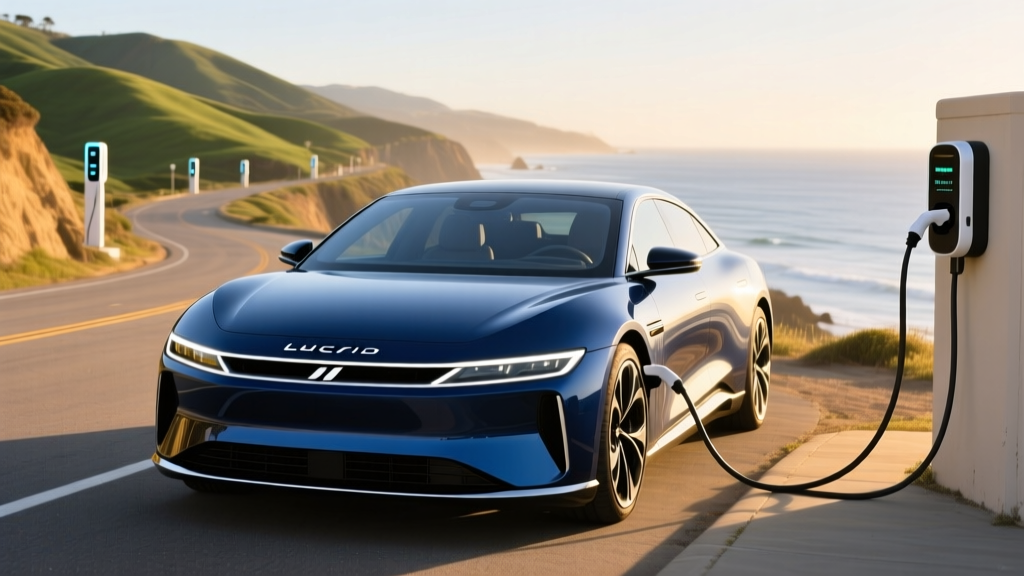
The 2025 Lucid Air Pure remains the most range-efficient full-size luxury sedan on the market. With an EPA-estimated 419 miles on a single charge (RWD) and a class-leading efficiency rating that routinely exceeds 4.5 miles per kWh, this is the EV that proves you don't need a massive, heavy battery pack to go far. Now in its third model year, the Air Pure continues to undercut rivals like the Tesla Model S, Mercedes EQS, and BMW i5 on price while outperforming them on range. But efficiency numbers don't tell the whole story — charging speed, interior execution, and tax credit eligibility are where real ownership decisions get made.
EPA Estimated: 419 miles (RWD, 19" wheels) | 406 miles (AWD)
Real-World Expectation: Expect 340–370 miles on mixed highway driving at 70–80 mph. In cold weather (below 32°F), plan for 270–310 miles. City driving with regenerative braking can match or slightly exceed the EPA sticker. The 19" Aero wheels are critical — stepping to 20" or 21" wheels reduces range by 20–40 miles.
Range, Battery, and Efficiency: The Numbers That Matter
The 2025 Air Pure uses an 88 kWh usable battery pack (gross capacity approximately 92 kWh) built on Lucid's proprietary miniaturized drive unit architecture. Lucid uses NMC (nickel manganese cobalt) chemistry across the Air lineup, which delivers higher energy density than LFP — critical for fitting 400+ miles of range into a sedan footprint without exceeding weight limits that would compromise handling.
| Specification | Air Pure RWD | Air Pure AWD |
|---|---|---|
| EPA Range | 419 miles | 406 miles |
| Battery (usable) | 88 kWh | 88 kWh |
| Chemistry | NMC | NMC |
| Efficiency | 146 MPGe (23 kWh/100mi) | 140 MPGe (24 kWh/100mi) |
| Horsepower | 430 hp | 620 hp (dual motor) |
| 0–60 mph | 5.0 sec | 3.8 sec |
| Drivetrain | Rear-Wheel Drive | All-Wheel Drive |
| Top Speed | 145 mph | 145 mph |
At 146 MPGe combined (source: EPA fueleconomy.gov), the Air Pure RWD is the most efficient vehicle in its class. For context, the Tesla Model S Long Range achieves 120 MPGe, and the Mercedes EQS 450+ lands at 97 MPGe. This efficiency advantage means cheaper charging costs per mile and less frequent stops on road trips.
Charging Speed: DC Fast Charge and Home Level 2
Lucid's 900V+ electrical architecture enables some of the fastest DC charging in the luxury sedan segment. The Air Pure supports a peak charge rate of 300 kW at compatible DC fast chargers.
| Charging Method | Power / Rate | Speed / Time |
|---|---|---|
| DC Fast Charge (peak) | 300 kW | 10–80% in ~25 min (adds ~200 mi in 15 min) |
| DC Fast Charge (sustained avg) | ~180–220 kW | Charge curve tapers above 80% SoC |
| Level 2 (240V, 48A home charger) | 11.5 kW | ~52 miles of range per hour; full charge in ~8.5 hrs |
| Level 2 (240V, 80A / Lucid Connected Home) | 19.2 kW | ~86 miles per hour; full charge in ~5 hrs |
| Level 1 (120V standard outlet) | ~1.4 kW | ~6 miles per hour (emergency/trickle only) |
Real-world charging note: The 300 kW peak is achievable only at V3-class chargers (350 kW stations like Electrify America or EVgo) and requires a preconditioned battery (the Air automatically preconditions when you navigate to a charger). In practice, the sustained average during a 10–80% session hovers around 180–220 kW due to the charge curve taper. That's still excellent — faster than the Model S (~250 kW peak, ~200 kW sustained) and significantly faster than the EQS (~200 kW peak).
The Air Pure ships with a NACS (North American Charging Standard) connector for 2025, giving native access to Tesla Superchargers without an adapter. CCS1 compatibility is maintained via the included adapter for Electrify America and other CCS networks.
Performance and Driving Dynamics
The RWD Air Pure's 430 horsepower and 5.0-second 0–60 time place it firmly in sports-sedan territory — not supercar, but more than adequate for confident highway merging and passing. The AWD variant's 620 hp and 3.8-second sprint make it a genuine performance car that happens to be electric.
Lucid's drive units are remarkably compact (each roughly the size of a carry-on suitcase), which frees up interior space and lowers the vehicle's center of gravity. The result is composed, flat cornering with minimal body roll. The steering is precise if slightly light on feedback — a common EV trait due to the absence of engine vibration through the column.
Regenerative braking offers two modes: standard (mild, coast-friendly) and strong (approaching one-pedal driving but not quite coming to a complete stop). Drivers accustomed to Tesla's one-pedal behavior will need a day or two to adjust.
Interior, Tech, and Cargo
The Air Pure's cabin is a study in minimalist luxury. A 34-inch curved glass cockpit display spans the driver's instrument cluster and infotainment, replacing physical gauges entirely. A lower "pilot panel" touchscreen handles climate, media, and navigation. Physical buttons are limited to steering-wheel controls and a few critical toggles — everything else is screen-based.
Passenger space is generous for a sedan:
- Front legroom: 42.0 inches
- Rear legroom: 38.5 inches
- Rear headroom: 37.2 inches (the glass canopy roof creates an airy feel without sacrificing space)
Cargo capacity: 32.0 cubic feet total (22.0 cu ft trunk + 10.0 cu ft frunk). This is competitive with the Model S (28 cu ft combined) and substantially more than the EQS sedan (22 cu ft). The frunk is deep and practical — it fits a full carry-on bag plus a charging cable kit.
Standout tech features:
- DreamDrive Pro ADAS: Lucid's Level 2 driver-assistance suite includes adaptive cruise, lane centering, automated lane changes, and a 360-degree camera system. It uses 32 sensors including LiDAR — a hardware advantage over Tesla's camera-only Autopilot. However, DreamDrive Pro is competent rather than class-leading; it lacks the hands-free capability of GM's Super Cruise or Ford's BlueCruise on mapped highways.
- Over-the-air updates: Lucid regularly pushes software updates that add features and refine driving dynamics.
- Wunderbox: Lucid's onboard charging module supports bidirectional charging (V2L — vehicle to load), letting you power devices or even small home circuits during outages via an accessory adapter.
Notable drawbacks:
- The all-touchscreen interface has a learning curve — adjusting climate or finding a buried setting takes more taps than physical controls.
- Rear visibility is compromised by the sloping roofline and thick C-pillars; the digital rearview mirror (standard) helps but takes getting used to.
- The Lucid mobile app, while improved, still lags Tesla's in responsiveness and feature completeness.
- No hands-free driving mode on par with Super Cruise — DreamDrive requires hands on the wheel at all times.
Pricing, Trims, and Federal Tax Credit Eligibility
| Trim | Base MSRP | Destination | Total Before Incentives |
|---|---|---|---|
| Air Pure RWD | $69,900 | $1,295 | $71,195 |
| Air Pure AWD | $74,900 | $1,295 | $76,195 |
As-tested pricing with common options (DreamDrive Pro package, premium interior, 20" wheels) typically pushes the RWD to $75,000–$78,000 and the AWD to $80,000–$84,000.
Does the 2025 Lucid Air Pure Qualify for the $7,500 Federal Tax Credit?
This is where buyers need to pay close attention. Under IRS §30D rules, the Air Pure faces several eligibility hurdles:
- MSRP Cap: Sedans must be priced at or below $55,000. The Air Pure starts at $69,900 — it exceeds the sedan MSRP cap and does NOT qualify for the §30D new vehicle credit.
- Buyer Income Cap: Even if it qualified on price, buyers must have AGI at or below $150,000 (single) / $300,000 (joint). (Moot for this model.)
- Battery Sourcing: The credit's critical-minerals and battery-component requirements would also need to be met. (Moot for this model.)
- Point-of-Sale Transfer: Available for qualifying vehicles, but the Air Pure does not qualify.
Bottom line: The 2025 Lucid Air Pure does not qualify for the $7,500 federal new EV tax credit due to its MSRP exceeding the $55,000 sedan cap. Buyers should consult a tax professional regarding state-level incentives, which vary by jurisdiction — states like California, Colorado, and Massachusetts offer additional credits that may apply regardless of the federal MSRP cap.
Warranty and Long-Term Ownership
Lucid backs the Air Pure with a competitive warranty package:
- Basic Vehicle: 4 years / 50,000 miles
- Battery & Drive Unit: 8 years / 100,000 miles (capacity retention guaranteed above 70% of original)
- Roadside Assistance: 4 years / 50,000 miles
The 70% battery capacity retention threshold is industry-standard, matching Tesla and most competitors. NMC chemistry in the Air's pack has shown strong degradation curves in early fleet data — most owners report 93–96% state of health (SoH) after 30,000 miles, consistent with modern thermal management systems.
Long-term cost consideration: Out-of-warranty battery replacement for the Air is estimated at $15,000–$22,000 based on current Lucid service pricing, though this figure should decrease as battery costs continue their long-term decline. Lucid's modular pack design may allow partial module replacement rather than a full pack swap, potentially reducing cost.
Pros and Cons
- Class-leading 419-mile EPA range (RWD)
- Best-in-class efficiency at 146 MPGe — cheapest per-mile charging cost in the luxury sedan segment
- 300 kW peak DC fast charging with 900V architecture
- Spacious interior with 32 cu ft total cargo (trunk + frunk)
- LiDAR-equipped DreamDrive Pro sensor suite (hardware advantage)
- NACS native connector for Tesla Supercharger access
- Competitive pricing vs. Model S and EQS at ~$70K starting
- Does NOT qualify for the $7,500 federal tax credit (exceeds $55K sedan MSRP cap)
- Touchscreen-heavy interface with a steep learning curve
- DreamDrive Pro lacks hands-free highway mode (vs. Super Cruise, BlueCruise)
- Limited service center network compared to Tesla — rural owners may face long tow distances
- Rear visibility is compromised by styling; relies on digital mirror
- Brand is young; long-term reliability data (5+ years) is still limited
Who Should Buy the 2025 Lucid Air Pure?
Choose the Air Pure RWD if: You prioritize maximum range and lowest per-mile charging cost. Ideal for high-mileage commuters (60+ miles/day round trip) and frequent road-trippers who want fewer charging stops. The 419-mile range means most daily drivers charge only once a week at home.
Choose the Air Pure AWD if: You need all-weather traction, live in a snowy climate, or want the 3.8-second 0–60 performance. The 13-mile range penalty is a worthwhile trade for the added capability.
Look elsewhere if: Federal tax credit eligibility is critical to your purchase math (consider the Tesla Model 3, Hyundai Ioniq 6, or BMW i4, which may qualify). Or if hands-free highway driving is a must-have (GM Super Cruise vehicles like the Cadillac CT5 or Chevrolet Silverado EV). Or if you need a large service network with mobile technicians (Tesla remains unmatched here).
Frequently Asked Questions
What is the real-world range of the 2025 Lucid Air Pure?
Expect 340–370 miles in mixed highway driving at legal speeds. In cold weather (below freezing), plan for 270–310 miles depending on cabin heat usage and terrain. City driving with regenerative braking can match or exceed the 419-mile EPA sticker. Wheel choice matters significantly — the 19" Aero wheels deliver the best range; larger 20" or 21" options reduce it by 20–40 miles.
How fast does the Lucid Air Pure charge at home and on the road?
On a DC fast charger, it peaks at 300 kW and averages 180–220 kW during a 10–80% session, completing that charge in approximately 25 minutes. At home on a standard 48-amp Level 2 charger (11.5 kW), you'll add about 52 miles per hour, fully recharging overnight in roughly 8.5 hours. With Lucid's optional 80A Connected Home charger (19.2 kW), a full charge takes about 5 hours.
Does the 2025 Lucid Air Pure qualify for the federal EV tax credit?
No. Under current IRS §30D rules, new electric sedans must have an MSRP at or below $55,000 to qualify for the $7,500 credit. The Air Pure starts at $69,900, which exceeds this cap. State-level incentives may still apply — check your state's energy office or DMV for local programs.
Is the Lucid Air Pure worth buying over the Tesla Model S or Mercedes EQS?
It depends on your priorities. The Air Pure offers more range (419 vs. ~402 miles for the Model S Long Range, ~350 for the EQS 450+) and better efficiency at a lower starting price than the Model S ($69,900 vs. ~$79,990). However, Tesla offers a vastly superior charging and service network, a more mature software ecosystem, and hands-free-capable FSD (Supervised). The EQS offers a more traditional luxury interior and Mercedes dealer support but trails significantly on range and efficiency. If range and efficiency are your top criteria, the Air Pure wins. If network reliability and hands-free driving matter more, the Model S is the stronger pick.
What are the biggest pros and cons of the Air Pure?
The biggest pro is unmatched efficiency — 419 miles of range from an 88 kWh battery means lower electricity costs and fewer charging stops. The biggest con is the lack of federal tax credit eligibility, which adds $7,500 to the effective cost compared to qualifying competitors. Secondary cons include a touchscreen-heavy interface, limited service infrastructure, and an ADAS system that doesn't offer hands-free highway driving.
Does the Air Pure have a frunk and how much cargo space?
Yes. Total cargo volume is 32.0 cubic feet — 22.0 cu ft in the rear trunk and 10.0 cu ft in the front trunk (frunk). The frunk is deep enough for a carry-on bag plus charging cables, and the trunk opening is wide and practical for luggage on road trips.
What is the battery warranty on the Lucid Air Pure?
Lucid provides an 8-year / 100,000-mile warranty on the battery pack and drive units, guaranteeing that the battery will retain at least 70% of its original capacity during that period. This matches industry standards set by Tesla, Hyundai, and most other EV manufacturers.